If you’ve ever watched gold (XAUUSD) move $15 in a few minutes and thought, “How do people trade this without getting stopped out?” you’re in the right place.
Gold is one of the most traded instruments on earth, and it can also be one of the most misunderstood.
Right now, XAUUSD is trading around $2650 (+0.35% on the day), while the DXY sits near 106.80, EUR/USD is around 1.0520, GBP/USD 1.2680, and USD/JPY 149.50.
That mix matters, because gold doesn’t move in isolation.
This XAUUSD trading guide is built to take you from “I know what gold is” to “I have a repeatable plan with risk rules, session timing, and setups I can execute.”
TL;DR: The complete XAUUSD trading guide in 60 seconds
- Gold is a macro-driven asset: real yields, USD strength (DXY), and risk sentiment often drive the bigger moves.
- Trade XAUUSD by session: London sets direction, New York brings volume and reversals; the overlap is often the most tradable window.
- Use levels + confirmation: gold respects key zones, but it loves liquidity sweeps—wait for structure and candle confirmation.
- Risk rules are non-negotiable: typical gold SL is $10–$25; aim for 1:2 to 1:3 R:R with realistic targets.
- Correlations help you filter trades: DXY, USD/JPY, and real-rate expectations can confirm or warn against a gold setup.
- Signals work best with a process: follow entry/SL/TP precisely, track results, and learn the “why” behind each trade.
What is XAUUSD (gold) and why it trades differently than forex
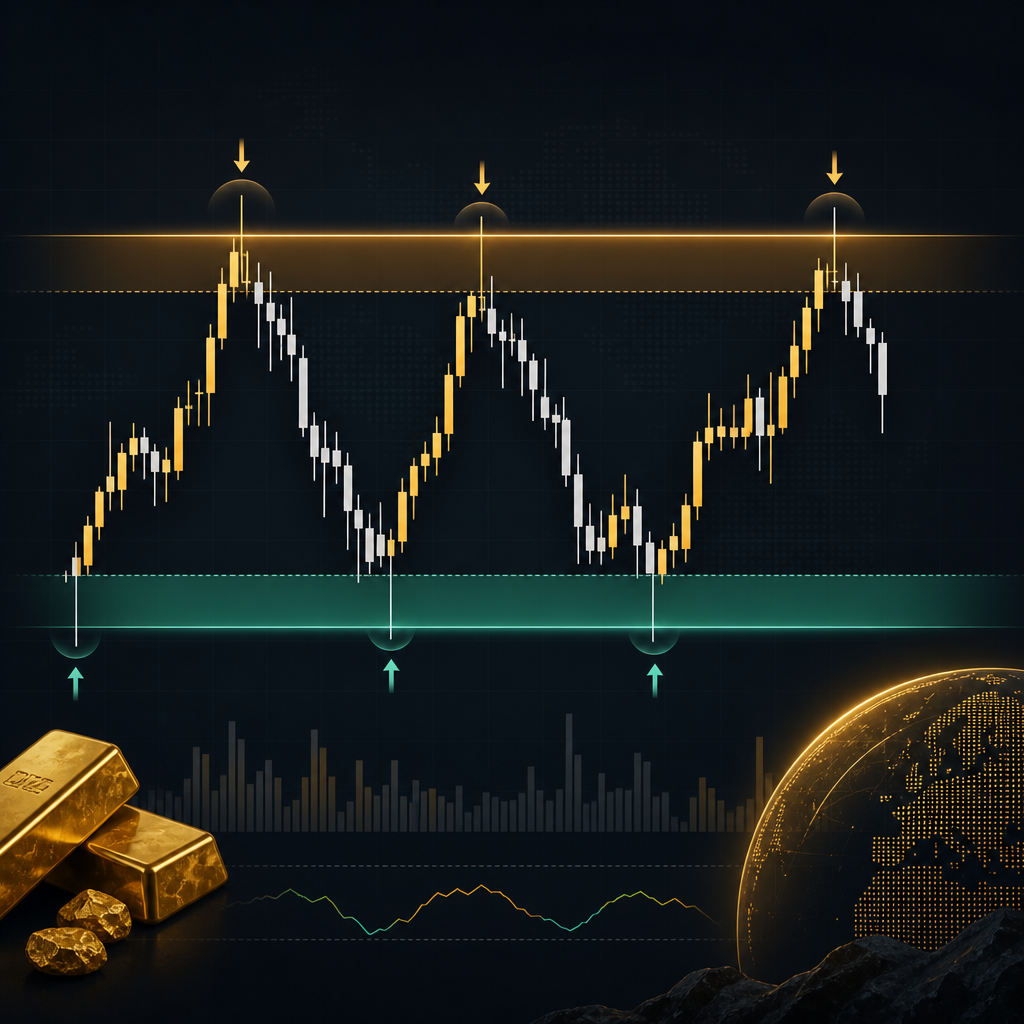
XAUUSD is the price of one troy ounce of gold quoted in US dollars.
When you “buy XAUUSD,” you’re effectively betting that gold will rise relative to the dollar.
But gold is not just another currency pair.
It behaves like a hybrid between a currency, a commodity, and a macro hedge.
That’s why beginners often struggle: they try to trade it like EUR/USD and get chopped up.
Gold’s personality: fast, emotional, and level-driven
Gold is famous for sharp spikes around news, session opens, and liquidity events.
It can move $8–$20 quickly even on “normal” days, especially when price is near a major zone.
At $2650, a $15 move is not rare.
That’s why stop placement and timing matter more than “being right.”
Why gold moves: the three big engines
- USD strength (DXY): gold often moves inversely to the dollar, though not perfectly day-to-day.
- Real yields and rate expectations: when markets price higher real yields, gold can soften; when real yields drop, gold often bids.
- Risk sentiment and geopolitics: gold can act as a safety bid during uncertainty, but it can also sell off when liquidity is needed.
In the current context, with DXY near 106.80 and USD/JPY around 149.50, gold traders should pay attention to USD momentum.
If the dollar is bid across the board, gold longs need stronger technical confirmation.
What “pip value” means on XAUUSD (in plain English)
Gold doesn’t trade in “pips” the same way EUR/USD does.
Most brokers quote XAUUSD to 2 decimals (e.g., 2650.10), and the meaningful unit for most traders is $1.00 moves.
If you’re unsure how your broker calculates value per $1 move based on lot size, read our dedicated guide: XAUUSD pip value calculation resources in our blog.
Your plan should be built around dollars-per-move and your account risk, not guesswork.
Gold market fundamentals: what actually drives XAUUSD day to day
If you want to trade gold profitably, you need a simple mental model for fundamentals.
You don’t need an economics degree.
You need a checklist that tells you whether fundamentals are likely to support your technical setup or fight it.
1) The USD and DXY: the first filter
Start with the dollar.
With DXY around 106.80, the market is signaling relatively firm USD demand.
That doesn’t “ban” gold longs.
It means gold longs should be taken at better prices (discounts) and with clearer confirmation.
When DXY is trending strongly up, gold rallies can be more corrective and prone to sharp pullbacks.
2) Rate expectations: the hidden hand behind gold trends
Gold is sensitive to what traders expect central banks to do next.
Even when rates don’t change today, the expectation can move price now.
When markets price “higher for longer,” gold can struggle to sustain breakouts.
When markets price cuts or slowing growth, gold often finds a bid.
3) Inflation narratives: when gold becomes the headline
Inflation is a tricky driver.
Gold can rise during inflation fears, but if inflation leads to aggressive tightening, gold can also dip.
The key is the market’s interpretation: inflation vs. real yields.
If inflation rises but real yields rise faster, gold can weaken.
4) Geopolitics and risk sentiment: why gold spikes and reverses
Gold headlines can cause sudden $10–$25 bursts.
But many of these moves partially retrace once the first wave of orders clears.
This is where disciplined execution matters.
Chasing a candle on XAUUSD is one of the most expensive habits a trader can build.
Practical fundamental checklist (use this before every session)
- Is DXY trending or ranging near 106.80?
- Is USD/JPY accelerating (risk-on USD strength) or stalling?
- Any major US data today (CPI, NFP, retail sales, ISM)?
- Any scheduled Fed speakers or rate decisions?
- Any geopolitical headline risk that can widen spreads?
If you want a playbook for sudden volatility days, pair this guide with: how gold signals react to unexpected news events.
When to trade gold: London session, New York session, and the overlap

Timing is a strategy on XAUUSD.
Many traders lose money not because their analysis is wrong, but because they trade gold during low-quality hours.
Gold can still move in Asia, but the cleanest liquidity and follow-through often arrive during London and New York.
Session behavior: what to expect
- Asia session: often range-bound; good for marking levels and building a bias, but breakouts can be false.
- London open: frequently sets the day’s direction; liquidity sweeps are common.
- New York open: adds volume; can extend London’s move or reverse it sharply.
- London–NY overlap: typically the best window for execution and follow-through.
United Kings focuses heavily on London and NY session trading because that’s where gold is most “tradable” for most retail traders.
A realistic example using today’s levels
Imagine gold is hovering around $2650 before London.
Asia formed a range between $2642 and $2656.
London opens and sweeps above $2656, prints $2661, then closes back below $2656.
That’s a classic liquidity grab.
A disciplined trader waits for structure to break back down and then sells a retest, instead of buying the spike.
Best times to avoid (especially for beginners)
- Random mid-Asia hours with thin liquidity (unless you’re an experienced range trader).
- Minutes before major US news if you don’t have a plan.
- Late Friday when spreads can widen and moves can get erratic.
Step-by-step: a session-based routine you can repeat daily
- Pre-London (15 minutes): mark Asia high/low and any obvious swing levels (e.g., 2630, 2650, 2675).
- London open (first 60 minutes): watch for sweeps and rejection candles at the range edges.
- Bias confirmation: trade only after you see structure (break + retest) or clear rejection at a zone.
- NY open: manage positions; consider partials if volatility expands.
- Post-trade: journal entry, SL, TP, and what the session did.
If you want guided trade ideas during these windows, our premium gold signals are designed around the most liquid session behavior.
XAUUSD correlations: DXY, USD/JPY, EUR/USD, and risk sentiment
Correlation isn’t a magic button.
But it’s a powerful filter.
When gold and the dollar are sending conflicting messages, you either reduce size, tighten criteria, or stand aside.
Gold vs DXY (Dollar Index)
Gold often has an inverse relationship with DXY.
With DXY around 106.80, if DXY is breaking higher during London, gold longs may struggle to follow through.
If you see gold trying to break above $2665 while DXY is ripping up, that breakout is more likely to fail.
Not guaranteed—just lower probability.
Gold vs USD/JPY
USD/JPY at 149.50 matters because it’s a barometer of USD strength and risk appetite.
A strong USD/JPY push can coincide with gold softness.
But there are days when both rise due to different drivers (e.g., safe-haven USD + safe-haven gold).
Your job is to read the context, not force a rule.
Gold vs EUR/USD and GBP/USD
EUR/USD at 1.0520 and GBP/USD at 1.2680 give you a quick sense of broad USD demand.
If both are falling (USD strength), gold rallies can be choppy.
If both are rising (USD weakness), gold longs often have cleaner continuation.
Risk-on vs risk-off: the “why” behind weird days
Some days, equities rally and gold rallies.
Other days, equities dump and gold dumps too.
That’s usually a liquidity story.
When markets need cash, gold can be sold even if it’s a “safe haven.”
Comparison table: how common drivers typically impact XAUUSD
| Driver | Typical Market Move | Common XAUUSD Reaction | How to Trade It |
|---|---|---|---|
| DXY rising (e.g., 106.80 → 107.20) | USD strength | Gold often softens or fails breakouts | Prefer sells at premium zones; demand stronger confirmation for longs |
| DXY falling (e.g., 106.80 → 106.30) | USD weakness | Gold often trends higher | Look for buy-the-dip setups at support; let winners run |
| Hot US data (CPI/NFP beats) | Higher rate expectations | Gold can drop fast $10–$25 | Wait for first spike, then trade structure (break/retest), not the first candle |
| Soft US data (miss) | Lower yields expectations | Gold often spikes up and may trend | Use pullbacks for entries; avoid chasing above resistance |
| Geopolitical shock | Risk-off + volatility | Gold spikes, spreads widen, whipsaws possible | Reduce size, widen SL logically, or stand aside if execution is poor |
How to read XAUUSD price action: levels, liquidity, and structure
Gold respects technicals.
But it respects liquidity even more.
If you only draw support and resistance, you’ll often be “right” and still lose because gold loves to run stops before moving.
Support and resistance that actually matter on gold
On XAUUSD, the best zones are usually:
- Prior day high/low (PDH/PDL)
- Asia range high/low
- Round numbers (e.g., 2650, 2660, 2675)
- Clean swing highs/lows on H1/H4
In the current $2610–$2690 environment, levels like $2620, $2650, and $2680 are typical magnets.
Market structure: the simplest way to stop guessing
Structure is just the sequence of highs and lows.
When gold is making higher highs and higher lows, you’re in an uptrend.
When it starts breaking prior lows and failing to reclaim them, the trend is weakening.
Many traders enter too early because they “feel” a top.
Structure gives you permission to wait.
Liquidity sweeps: the pattern gold repeats endlessly
A liquidity sweep happens when price pushes beyond an obvious high/low to trigger stops, then reverses.
Gold does this around session opens because that’s when orders hit the market.
Example:
- Gold trades at $2648.
- Asia high is $2656.
- London sweeps to $2660.
- Then it closes back under $2656 and breaks $2648.
That sequence often creates a high-probability short setup.
Confirmation tools that work well on XAUUSD
- Rejection candles: long wicks at key zones, especially on M15/H1.
- Break and retest: let price prove direction before entry.
- Volume/volatility expansion: real moves often come with bigger candles after compression.
Indicators can help, but price action should lead.
The goal is not to predict.
The goal is to react to what gold confirms.
Risk management for XAUUSD: position sizing, SL/TP, and drawdown control
Gold rewards discipline and punishes ego.
Most “good” gold traders are not the best analysts.
They’re the best risk managers.
How far should your stop loss be on gold?
In the $2610–$2690 range, a typical swing or intraday SL is often $10–$25 from entry.
Too tight (like $3–$5) and normal noise will stop you out.
Too wide without reducing lot size and you’ll blow up your risk.
Realistic example: a clean 1:3 setup
Let’s say you buy XAUUSD at $2642 after a break and retest of support.
- Stop loss: $2630 (risk = $12)
- Take profit 1: $2666 (reward = $24, 1:2)
- Take profit 2: $2678 (reward = $36, 1:3)
This is how professionals think: define risk first, then targets.
Position sizing: the one formula that keeps you alive
Pick a fixed % risk per trade.
For beginners, 0.5% to 1% per trade is plenty.
Then calculate lot size based on your stop distance.
If your SL is $20 and you want to risk $50, your size must match that risk.
If you don’t know how to compute it on your broker, use a calculator and confirm with small demo trades first.
Drawdown rules that prevent revenge trading
- Daily loss limit: stop trading after -2R or -3R.
- Weekly loss limit: stop after -6R to -8R and review.
- No doubling size after a loss.
- One “A+ setup” rule: if you miss it, you don’t chase it.
If you trade with signals, risk rules matter even more because execution errors compound quickly.
We’ve written a full framework here: risk management strategies when using trading signals.
Why gold traders blow accounts (and how to avoid it)
The biggest account killers on XAUUSD are:
- Oversizing because “gold always moves.”
- Moving stop losses wider after entry.
- Trading news without a plan.
- Taking 6–10 trades in a session out of boredom.
Profitability is usually boring.
Gold just makes it feel exciting.
Beginner XAUUSD strategies: simple setups that actually work
You don’t need five indicators to trade gold.
You need two or three repeatable setups that match gold’s behavior.
Below are beginner-friendly strategies that work best during London and New York.
Strategy 1: Break-and-retest on key levels
This is the bread-and-butter for trending days.
You identify a strong level (like Asia high/low or prior day high/low).
Then you wait for a break, and you enter on the retest with confirmation.
Example (short):
- Gold breaks below $2640 after failing at $2658.
- Price retests $2640 and prints a bearish rejection candle.
- Entry: $2639, SL: $2651 ($12 risk), TP: $2615 ($24 reward, 1:2).
Notice the logic: the old support becomes resistance.
Strategy 2: Liquidity sweep + reversal (the “stop hunt” trade)
This is gold’s signature move.
You wait for price to run above a clear high (or below a clear low), then fail.
Then you trade back into the range or toward the opposite side.
Example (short):
- Asia high: $2656
- London sweep: $2661
- Failure close back under $2656
- Entry: $2653, SL: $2666 ($13 risk), TP: $2627 ($26 reward, 1:2)
This setup is powerful because it aligns with how liquidity works.
Stops provide fuel.
Strategy 3: Trend pullback using a moving average (optional)
If you like a light indicator, use a 20 EMA on M15 or H1.
In an uptrend, gold often pulls back to the EMA and then continues.
You still need structure and a level.
Don’t buy just because price touched an EMA.
Beginner execution checklist (print this)
- Is it London/NY or overlap?
- Am I trading at a clear level (not the middle)?
- Did I get confirmation (structure break/retest or rejection)?
- Is my SL logical (beyond the sweep), typically $10–$25?
- Is my TP at least 1:2?
If you want to combine learning with real-time trade ideas, our United Kings signals include clear Entry, SL, and TP levels, plus educational context alongside the alerts.
Advanced XAUUSD strategy: confluence trading with zones, structure, and data
Once you can execute the basics, “advanced” gold trading is mostly about confluence.
Confluence means multiple reasons align for the same trade.
It doesn’t guarantee a win.
It increases the odds and improves your confidence in holding to target.
Confluence stack that works well on XAUUSD
- HTF zone (H4/D1 support/resistance)
- Session liquidity (Asia high/low, PDH/PDL)
- Structure shift (break of swing + retest)
- Macro filter (DXY direction, US data risk)
You’re not adding complexity for fun.
You’re reducing randomness.
Example: advanced long using today’s market context
Assume gold is consolidating after a pullback, trading around $2638–$2645.
HTF shows a demand zone near $2630–$2635.
DXY stalls near 106.80 and fails to push higher during London.
Gold sweeps $2632, then reclaims $2640 with strong candles.
That’s a confluence long.
- Entry: $2641
- SL: $2628 ($13 risk)
- TP1: $2667 ($26 reward, 1:2)
- TP2: $2680 ($39 reward, 1:3)
Notice how the SL is beyond the sweep.
That’s how you avoid getting wicked out by gold’s “last dip.”
Advanced management: partials and trailing without sabotaging yourself
Gold can trend, but it also snaps back.
A practical approach:
- Take partial profit at 1:1 or 1:1.5 if volatility is high.
- Move SL to breakeven only after structure supports it (not immediately).
- Let a runner target the next HTF level (e.g., $2678–$2685).
The goal is to avoid the common mistake: moving SL to breakeven too early and getting stopped before the real move.
Data-aware trading: when to reduce risk
On major US data days, gold can spike both ways.
If you insist on trading, reduce size.
Or wait 5–15 minutes after the release and trade the structure that forms.
If you want a dedicated plan for Fed days, pair this with our FOMC-focused resources in the United Kings blog.
Step-by-step: build your personal XAUUSD trading plan (beginner → pro)
Most traders don’t fail because they lack a strategy.
They fail because they don’t have a plan that forces consistency.
Gold punishes inconsistency faster than most markets.
Step 1: Choose your trading style (and be honest)
- Scalping (M1–M5): high intensity, spread-sensitive, requires speed and experience.
- Intraday (M15–H1): best balance for most traders; aligns with London/NY behavior.
- Swing (H4–D1): fewer trades, wider stops, more patience; great if you can’t watch charts all day.
If you’re newer, intraday on M15/H1 is often the sweet spot.
Step 2: Define your “A+ setups” (limit yourself to 2–3)
Pick from:
- Break-and-retest
- Liquidity sweep reversal
- Trend pullback at HTF zone
Write the rules in plain language.
If you can’t explain it in 3 lines, you can’t execute it under stress.
Step 3: Create a pre-trade checklist (no checklist, no trade)
- Session: London/NY only?
- Level: PDH/PDL, Asia high/low, HTF zone?
- Confirmation: structure shift or rejection candle?
- Risk: 0.5%–1% per trade?
- News: any high-impact events in the next 60 minutes?
Step 4: Standardize your SL/TP logic
Gold stops should be placed where your trade idea is invalidated.
Often that’s beyond the sweep high/low or beyond the zone.
Then set TP at the next liquidity pool or HTF level.
Keep it simple: 1:2 minimum is a strong baseline.
Step 5: Journal like a professional (this is where profitability is built)
Track:
- Entry, SL, TP, time, session
- Setup type
- Screenshot before and after
- Did you follow rules (yes/no)?
After 30–50 trades, you’ll see what works for you on XAUUSD.
That’s when your results start to stabilize.
How to use gold signals to accelerate learning (without becoming dependent)
Signals can be a shortcut.
They can also become a crutch.
The difference is whether you treat signals as education + execution support, or as a lottery ticket.
What a professional signal looks like
A usable gold signal should include:
- Entry price (or entry zone)
- Stop loss (clear invalidation)
- Take profit levels (TP1/TP2/TP3)
- Context: session, key level, and why the trade exists
That’s how we structure United Kings alerts across gold signals and forex signals.
How to execute signals step-by-step (the “no mistakes” method)
- Check your spread before entry, especially during news.
- Set the SL immediately. Never “add it later.”
- Use the exact lot size that matches your % risk.
- Place TP orders (or alerts) so emotion doesn’t manage your trade.
- Don’t edit the plan mid-trade unless the signal updates.
If you’re new, start on demo first.
Then go live with smaller size than you think you need.
Win rate vs expectancy (why 85% isn’t the whole story)
United Kings highlights a historical 85%+ win rate (see /results/ and /methodology/ for how it’s calculated).
But the deeper truth is expectancy: average win vs average loss.
If you keep losses controlled and let winners hit 1:2 or 1:3, you don’t need to win every time.
You need to be consistent.
Where to receive signals (and why delivery speed matters)
Gold can move quickly.
That’s why Telegram remains one of the best delivery channels.
Join our official Telegram here: United Kings signals Telegram channel.
Common XAUUSD mistakes (and the fixes that immediately improve results)
Most losing gold traders are doing a few things wrong repeatedly.
Fixing just two or three can change your equity curve fast.
Mistake 1: Trading gold in the middle of the range
If gold is ranging between $2640 and $2660, the middle (around $2650) is where trades go to die.
Edges are where the opportunities are.
Fix: only trade near the range high/low, or wait for a break and retest.
Mistake 2: Using a “forex-style” stop loss
A 10-pip stop might work on EUR/USD.
On gold, a $3 stop is often just noise.
Fix: place SL beyond the structure and size down to keep risk constant.
Mistake 3: Chasing news spikes
Gold loves to spike $12 up, then $18 down, then trend $25 the original direction.
Most beginners get chopped in the first two moves.
Fix: wait for the first 5–15 minutes and trade the structure that forms.
Mistake 4: Overtrading the London–NY overlap
The overlap is great.
It’s also where traders take 8 trades because “it’s moving.”
Fix: limit yourself to 1–3 high-quality attempts per session.
Mistake 5: Not tracking performance by setup
If you don’t know which setup makes you money, you’ll keep repeating the ones that don’t.
Fix: tag every trade (break/retest, sweep reversal, pullback) and review monthly.
Tools and platforms for trading XAUUSD (and what actually matters)
Tools won’t make you profitable.
But the wrong tools can make you inconsistent.
On gold, execution quality matters because moves are fast and stops are often $10–$25.
What matters most in a broker for XAUUSD
- Stable spreads during London/NY
- Fast execution (less slippage)
- Reliable server during news
- Clear contract specs (lot size, margin, tick value)
If your spread widens dramatically at NY open, your strategy must adapt.
Charting essentials
- Timeframes: H4/H1 for bias, M15 for execution
- Key levels: PDH/PDL, Asia range, round numbers
- Optional: 20 EMA for trend context
Keep your chart clean.
Gold punishes analysis paralysis.
Alerts and automation (simple, effective)
Use price alerts at key levels like $2635, $2656, $2678.
This stops you from staring at candles and forcing trades.
If you follow signals, alerts help you execute on time.
Signals ecosystem: forex, gold, and crypto (what to focus on)
Some traders diversify signals across multiple markets.
That can work, but only if your risk is controlled.
United Kings offers multiple categories including crypto signals, but if your goal is to master XAUUSD, focus your attention on gold until you’re consistent.
Putting it all together: a realistic weekly routine for profitable gold trading
Consistency in gold trading is built through routine.
Not motivation.
Below is a realistic schedule that fits most traders who can watch London and/or New York.
Monday: map the week, don’t force trades
Monday can be slower or choppy after the weekend.
Mark weekly highs/lows and the most obvious H4 zones.
Trade only A+ setups.
Tuesday–Thursday: your “money days”
These sessions often deliver the cleanest continuation moves.
Focus on:
- London liquidity sweep setups
- NY continuation after pullback
- Break-and-retest around PDH/PDL
Use the current environment as your guide.
If gold is holding above $2650 and building higher lows, you look for dips to buy.
If it keeps failing above $2665–$2675 and breaking structure, you look for sells at premium.
Friday: protect your week
Fridays can produce strong moves, but also messy reversals.
Many professionals reduce risk on Friday.
If you’re up on the week, your job is to keep it.
Weekly review (30 minutes that changes everything)
- How many trades did you take?
- Which setup performed best?
- Did you follow your SL/TP rules?
- What did DXY and USD/JPY do on your best trades?
This is how you evolve from “random trades” to a real system.
If you want a guided routine with trade ideas
Many traders use United Kings as their structure: alerts during London/NY, clear levels, and learning through repetition.
You can explore our full offering on UnitedKings.net and see available categories on signals.
FAQ: XAUUSD trading guide (gold trading questions)
1) What is the best timeframe to trade XAUUSD?
For most traders, H1 for bias and M15 for entries is a strong combination.
Scalping on M1–M5 is possible but harder due to spread and speed requirements.
2) How much does gold typically move in a day?
It varies, but $15–$30 daily ranges are common in active conditions.
On major news days, gold can move more, and spreads can widen.
3) What stop loss size is normal for gold?
In many intraday setups, $10–$25 is a typical SL distance.
The right SL is based on structure and volatility, not a fixed number.
4) Does gold always move opposite the US dollar?
No.
Gold often has an inverse relationship with DXY, but there are periods when both rise or both fall due to risk sentiment and liquidity dynamics.
5) Are gold signals good for beginners?
They can be, if you use them correctly.
Beginners should start on demo, follow entry/SL/TP precisely, and journal results.
If you want a checklist for evaluating providers, see: signals provider checklist for beginners.
Risk disclaimer: Trading forex and gold (XAUUSD) involves significant risk and may not be suitable for all investors. You can lose more than your initial deposit depending on your broker and product. Past performance does not guarantee future results. Nothing in this article is financial advice. If you’re a beginner, we strongly recommend practicing on a demo account first and using strict risk management on every trade.
Join United Kings: premium XAUUSD signals with clear execution
If you want to stop guessing and start trading with a structured plan, United Kings is built for you.
We provide premium Telegram signals for forex and gold, focused on the London and New York sessions, with clear Entry, SL, and TP levels.
We also share educational guidance so you learn why the trade exists, not just where to click.
Choose a plan that fits your timeline on our pricing page:
- Starter (3 Months): $299 (~$100/mo)
- Best Value (1 Year): $599 ($50/mo, 50% savings + FREE ebook)
- Unlimited (Lifetime): $499 (pay once, access forever)
We also offer a 48-hour refund window (conditions apply—see refund policy).
Ready to receive XAUUSD trade ideas in real time? Join our official Telegram now: United Kings Telegram channel.
If you have questions before joining, reach out via contact us or learn more about who we are on about United Kings.