
If you’ve ever tried to trade gold during CPI or NFP and felt like the market “hunted” your stop in seconds… you’re not imagining it.
XAUUSD can move $10–$30 in the first few minutes after a U.S. CPI or Non-Farm Payrolls release, especially when gold is already trending and liquidity is thin.
Right now gold (XAUUSD) is trading around $2650 (+0.35% on the day), with DXY near 106.80, USD/JPY around 149.50, EUR/USD near 1.0520, and GBP/USD around 1.2680.
That’s a classic “strong dollar + sticky inflation risk” backdrop where CPI and NFP can trigger violent repricing in yields, the dollar, and ultimately gold.
TL;DR: The 15-Minute CPI & NFP XAUUSD Playbook
- Don’t trade the first spike blindly. Use a 15-minute rule set: spread check → volatility filter → confirmation checklist → execution.
- Measure conditions, not emotions. Use ATR and candle-size filters to decide whether you’re in a tradable expansion or a whipsaw trap.
- Order type matters. In the first 15 minutes, limit entries often beat stop orders for signals because slippage can destroy R:R.
- Pre-plan the “no-trade zone.” If spreads widen beyond your threshold (example: from $0.20 to $0.80+), you skip—no exceptions.
- Use a post-release confirmation checklist. Trade only after structure breaks + retest or a clean 1–3 candle continuation pattern.
- Risk small, scale smart. Use reduced size (often 25–50% of normal) and wider but logical stops ($10–$25) with 1:2–1:3 targets.
Why CPI & NFP Move Gold So Fast (And Why the First 15 Minutes Are Dangerous)

To trade XAUUSD during CPI or NFP, you need to understand what’s actually moving price.
Gold isn’t just “risk-off.” It’s a real-time tug-of-war between real yields, USD demand, and inflation expectations.
When CPI surprises, traders immediately reprice the Fed path.
That repricing hits U.S. yields and the dollar first, then gold reacts—sometimes in the opposite direction you expect if the market was positioned heavily one way.
The CPI transmission mechanism (in plain English)
If CPI prints hotter than expected, the market often prices fewer cuts or even a hike risk.
That tends to lift yields and DXY, which can pressure gold.
But if the market fears inflation persistence and growth risk, gold can surge as a hedge, especially if the reaction is “stagflation-ish.”
The NFP transmission mechanism (and why it whipsaws)
NFP is messy because it’s not one number.
It’s payrolls, unemployment rate, participation rate, and average hourly earnings.
You can get a “good headline” with “bad wages,” and gold can spike down then rip up within 60 seconds.
Why the first 15 minutes are a trap for signal followers
Most traders lose money in the first 15 minutes because they confuse volatility with direction.
In reality, the market is doing three things at once: clearing stops, repricing options, and rebalancing positions.
That’s why we treat the first 15 minutes like a structured execution problem, not a prediction contest.
If you’re using Telegram signals, your edge isn’t “being first.”
Your edge is executing cleanly and avoiding the trades where spread + slippage erase your expected value.
For more on how we structure premium setups around high-impact moments, see our main gold signals page and the broader United Kings signals hub.
The CPI & NFP “Pre-News” Checklist (60 Minutes Before Release)
Your best CPI or NFP trade often starts an hour before the data hits.
Not because you enter early, but because you remove uncertainty from your execution.
Step 1: Mark the “battle zone” on M15 and H1
For gold around $2650, identify the nearest obvious levels.
Example structure map:
- Resistance: $2665 (prior swing high / liquidity)
- Mid pivot: $2650 (round number / VWAP magnet)
- Support: $2635 (prior M15 base)
- Deep support: $2618–$2620 (H1 demand zone)
These levels become your “decision points” after the release.
If price is between them, you’re in chop territory.
Step 2: Check the day’s context (trend + volatility)
Don’t treat CPI day like a blank chart.
Ask:
- Is gold trending (higher highs/higher lows) or ranging?
- Is DXY pressing highs near 106.80 or fading?
- Is USD/JPY holding 149.50 (risk-on dollar strength) or dumping?
When DXY is firm and yields are bid, gold rallies tend to be sharper but more fragile.
That matters for your stop placement and whether you prefer pullback entries versus breakouts.
Step 3: Define your “no-trade” conditions
This is the part most traders skip.
You need a written rule that forces you to stand down.
Examples of no-trade rules for the first 15 minutes:
- Spread widens above $0.60 on XAUUSD (or 3x your normal average).
- Platform shows “off quotes” or delayed ticks.
- Your broker increases margin requirements temporarily.
- You see a 1-minute candle larger than $12 with a full retrace (classic whipsaw signature).
Step 4: Decide your execution mode (manual, semi-auto, or copier)
If you follow signals, you must know how you’ll enter.
Manual market orders during CPI/NFP are the #1 slippage culprit.
Many serious traders use a hybrid:
- Wait for the signal direction.
- Use a limit on retest or a reduced-size market entry after confirmation.
If you’re new to signal execution, our guide on how to use Forex signals on Telegram translates perfectly to gold—especially around news.
Spreads & Slippage: The Hidden Cost That Breaks CPI/NFP Gold Trades
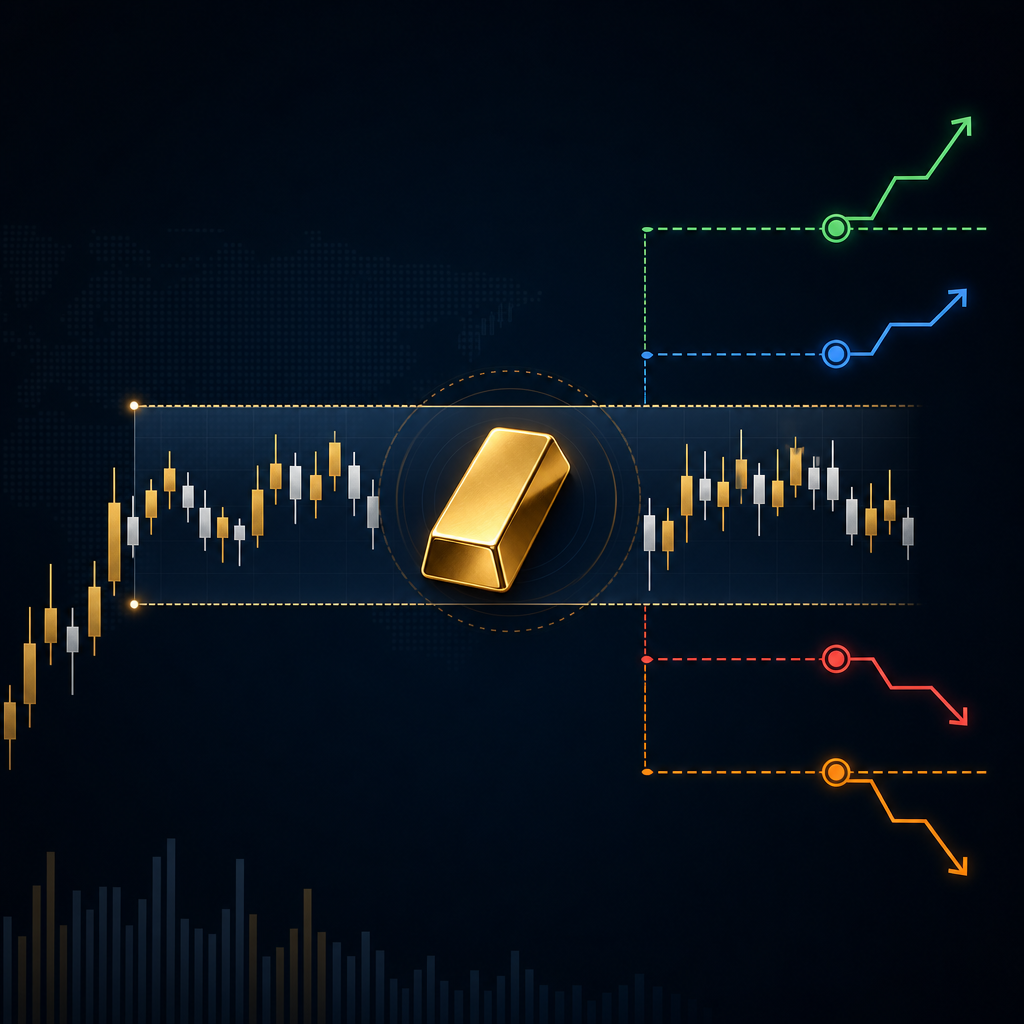
Most CPI/NFP losses aren’t “wrong direction.”
They’re execution losses: spread expansion, slippage, and partial fills.
What spread expansion looks like on XAUUSD
In normal conditions, a good broker might quote gold with a spread around $0.15–$0.30.
During the 30–90 seconds around CPI/NFP, that can jump to $0.60–$1.50 depending on liquidity.
That means you can start a trade down -$6 to -$15 per lot instantly.
Slippage: why your “perfect” signal becomes a bad trade
Let’s say a signal calls:
- Buy XAUUSD at $2652
- SL $2640 (12 dollars risk)
- TP $2676 (24 dollars reward, 1:2)
If you slip by $3 (filled at $2655), your risk becomes $15 and reward becomes $21.
Your R:R collapses from 1:2 to 1:1.4 before the market even moves.
A practical “spread/slippage gate” for the first 15 minutes
Use a simple rule:
- Gate 1 (Spread): If spread is above 3x normal, you don’t enter on market.
- Gate 2 (Slippage): If your last two market orders slipped more than $1.50, switch to limits only.
- Gate 3 (Platform health): If quotes freeze even once, you wait for the next 5-minute close.
This alone can save you from the “I was right but still lost” experience.
Broker reality check (and why it matters for signals)
Two traders can follow the same signal and get different results.
That’s not conspiracy; it’s routing, liquidity, and execution quality.
If you want a broker-agnostic way to protect yourself, focus on entry type and timing rather than speed.
For a deeper breakdown of gold execution costs, pair this article with our spread guide: XAUUSD spread explained for gold traders.
Limit vs Stop vs Market: The Best Order Types for CPI/NFP Gold Signals
During CPI/NFP, your order type is your risk management.
You can have the best analysis and still lose if you use the wrong tool.
| Order Type | Best Use in First 15 Minutes | Main Advantage | Main Risk | Our Rule of Thumb |
|---|---|---|---|---|
| Market | Only after confirmation (post-spike) | Guaranteed fill | Slippage + bad R:R | Use reduced size; avoid at release second |
| Limit | Retest entries after break | Controls price; reduces slippage | Missed trade if no retest | Preferred for signal followers |
| Stop | Breakout continuation when spread is stable | Catches momentum | Worst slippage in news spikes | Only if spread gate passes |
| Stop-Limit | Controlled breakout entries | Caps slippage | No fill in fast markets | Good compromise if your platform supports it |
Why limit orders often win for CPI/NFP gold trading strategy
The first move is frequently an “air pocket” move.
Price gaps through levels, then snaps back to test them.
A limit on the retest lets you buy $3–$8 cheaper than the breakout crowd.
When stop orders are justified
Stop orders can work when the release creates a clean trend day.
But you need conditions:
- Spread is stable under your threshold.
- The first 1-minute candle closes near its extreme (not a long wick).
- The 2nd and 3rd minute candles continue in the same direction.
If you don’t have those, stop orders become “paying top tick.”
Signal execution tip: pre-define your acceptable entry range
If a signal says Buy $2652, define a tolerance like:
- Acceptable fill: $2651.5 to $2653.5
- If outside range: wait for retest limit or skip
This keeps you from chasing a move that’s already done.
Volatility Filters That Prevent Whipsaws: ATR + Candle-Size Rules
If you want to trade XAUUSD during CPI safely, you need a volatility filter.
Not to avoid volatility—news is volatility—but to avoid chaotic volatility.
Filter #1: ATR-based “tradable expansion” threshold
Use ATR on M1 or M5 as a quick gauge.
Example approach:
- Check M5 ATR(14) 30 minutes before news.
- Let’s say it’s around $2.80.
- After news, if M5 candles are consistently $4–$7 with directional closes, that’s expansion with structure.
- If candles are $8–$15 with alternating wicks, that’s often liquidation/whipsaw.
The goal is to trade when volatility expands with direction, not when it expands randomly.
Filter #2: The “wick dominance” rule
Whipsaw candles have huge wicks and small bodies.
Rule:
- If the last 3 M1 candles have wicks bigger than bodies (on both sides), you wait.
- If you get 2 consecutive M1 closes in the same direction with bodies > 60% of total range, you can start looking for entries.
Filter #3: The “range reclaim” trap detector
Before CPI/NFP, gold often forms a tight range.
Example: $2646 to $2656 in the hour before release.
Trap pattern:
- News spikes above $2656 to $2668.
- Then price dumps back under $2656 within 2–3 minutes.
That’s a failed breakout, and it often leads to the opposite direction move.
Your filter is simple: don’t buy a breakout that can’t hold above the pre-news range high.
How this connects to signals
A premium signal can be technically correct and still be executed poorly if you enter during wick-dominant chaos.
So we combine signals with volatility gates.
That’s also why United Kings focuses heavily on London/NY session structure and execution, not just “calls.”
The First 15 Minutes: A Rule-Based Timeline (Minute 0 to Minute 15)
This is the core playbook.
You’re not trying to predict CPI or NFP.
You’re reacting with rules.
Minute 0 to 1: Observe only (no hero trades)
Your job is to watch:
- Spread behavior (does it blow out?)
- First candle direction and close (does it close near the extreme?)
- Whether price breaks the pre-news range
If you enter in the first 10 seconds, you’re basically paying the market’s widest spread and worst liquidity.
Minute 1 to 3: Identify the “true” direction attempt
We look for one of two outcomes:
- Continuation: 2–3 candles push the same way with strong closes.
- Reversal: spike fails, range is reclaimed, then the opposite side breaks.
Example continuation:
- Gold spikes from $2650 to $2663.
- Pulls back to $2658.
- Holds and pushes to $2670.
Example reversal:
- Gold spikes from $2650 to $2666.
- Immediately dumps to $2648.
- Breaks $2646 and accelerates to $2636.
Minute 3 to 7: Execute only if your gates pass
This is where most “good” entries happen.
You have initial direction, but you still have time for a retest.
Execution rules:
- Prefer limit on retest of the broken level.
- Use reduced size (often 25–50% of normal).
- Place SL beyond structure, not arbitrary.
Minute 7 to 15: Manage the trade like a professional
If you’re in profit, don’t let the market take it back.
Two practical management options:
- Scale out: take partial at 1R, let the rest run to 2R–3R.
- Trail behind structure: move SL behind the last M5 swing, not every tick.
Gold can retrace $6–$10 even in a strong move.
If you trail too tight, you’ll get stopped before the real continuation.
Post-Release Confirmation Checklist (The “Green Light” Before You Enter)
Confirmation isn’t about being late.
It’s about avoiding the exact setups that blow up accounts.
The 7-point confirmation checklist
- 1) Spread normalized: back near your acceptable range.
- 2) Pre-news range broken: price is outside the range, not inside it.
- 3) Range hold: broken level is holding (no immediate reclaim).
- 4) Candle quality: at least 2 closes in the same direction with solid bodies.
- 5) Retest opportunity: you can define an entry with a logical SL.
- 6) R:R still valid: you can still target 1:2 or 1:3 after slippage/spread.
- 7) Correlation check: DXY and USD/JPY aren’t violently contradicting the move.
Correlation check examples using today’s context
If gold is breaking above $2665 while DXY is also ripping above 106.80, be cautious.
That can happen, but it’s often unstable unless yields are falling sharply.
If USD/JPY dumps from 149.50 to 148.90 while gold breaks up, that’s cleaner risk-off confirmation.
How to use this checklist with United Kings signals
Signals give you direction and levels.
This checklist tells you when to execute those levels during news.
That’s how you avoid the common “entered at the worst possible second” problem.
If you want a broader framework for evaluating any provider’s execution quality, use our signals provider checklist.
Step-by-Step Trade Examples (Realistic CPI/NFP Scenarios on XAUUSD)
Let’s make this practical with two scenario templates you can reuse.
These are not guarantees—just structured examples using realistic prices in the $2610–$2690 zone.
Scenario A: CPI hot → gold sells off (break + retest short)
Pre-news: Gold ranges $2646–$2656 with price around $2650.
Release: First spike goes down to $2638, then bounces to $2647.
Plan: Short the retest of broken support.
- Entry: Sell limit $2646 (retest of range low)
- SL: $2658 (12 dollars risk)
- TP1: $2622 (24 dollars reward, 1:2)
- TP2: $2610 (36 dollars reward, 1:3) if momentum continues
Management: Take 50% at TP1, move SL to breakeven only after an M5 close below $2635.
This prevents getting shaken out by a $6–$8 pullback.
Scenario B: NFP mixed → whipsaw → then gold breaks higher (failed breakdown long)
Pre-news: Gold holds $2640 support, resistance $2665.
Release: Gold spikes down to $2632, then snaps back above $2640 within 2 minutes.
Trigger: That’s a failed breakdown.
- Entry: Buy limit $2644 on retest after reclaim
- SL: $2630 (14 dollars risk)
- TP: $2672 (28 dollars reward, 1:2)
Confirmation needed: At least two M1 closes above $2640 and spread back under your threshold.
Optional add-on: If price breaks $2665 and retests it cleanly, you can add a smaller position targeting $2685–$2690.
Why these examples work for signal traders
Notice we didn’t “guess” the number.
We traded structure: break, reclaim, retest, continuation.
That’s how you turn XAUUSD news volatility signals into controlled execution.
Risk Management for News: Position Sizing, Stops, and the “One-Trade Rule”
News trading punishes oversized risk.
Even a perfect setup can draw down first.
Position sizing: reduce size, not standards
A common professional rule is to trade CPI/NFP at 25–50% of your normal size.
If you normally risk 1% per trade, consider 0.25%–0.50% on news.
That keeps you emotionally stable and prevents revenge trading.
Stop placement: $10–$25 is normal—if it’s structural
In calm sessions, a $6 stop might work.
During CPI/NFP, gold can swing $8 in seconds.
So your stop must be:
- Beyond the retest invalidation point
- Outside the “noise” zone
- Still compatible with 1:2 or 1:3 targets
Example: If you buy $2644, an SL at $2639 might be too tight.
An SL at $2630 is wider but realistic if $2632 was the spike low.
The “one-trade rule” for the first 15 minutes
To avoid spiraling, limit yourself to one new position in the first 15 minutes.
If you get stopped, you don’t re-enter until a full M15 candle closes and you reassess.
This rule alone can cut your worst days in half.
Where to learn a complete framework
We’ve detailed position sizing, drawdown control, and signal-based risk rules here: risk management strategies when using forex signals.
It applies directly to gold, especially around CPI and NFP.
Common Mistakes Signal Traders Make on CPI/NFP (And the Fix for Each)
Let’s call out the real reasons traders get wrecked—even with good signals.
Mistake #1: Entering because the Telegram alert arrived
A signal is not a command.
It’s a plan that still needs execution conditions.
Fix: Use the spread + confirmation gates before you click buy/sell.
Mistake #2: Chasing a $15 candle with a $10 stop
This is how you donate to the market.
Fix: If the move already traveled most of the target distance, you wait for a retest or you skip.
Mistake #3: Moving stop to breakeven too early
Gold loves retesting.
During news, a retest is often $6–$10.
Fix: Move to breakeven only after structure confirms (e.g., M5 close beyond the key level).
Mistake #4: Ignoring the second wave (minute 8–15)
Many CPI/NFP moves have two legs.
The first is the reaction; the second is the repositioning.
Fix: If you missed the first leg, don’t force it—prepare for the second leg with a retest plan.
Mistake #5: Trading CPI and NFP the same way every time
CPI is often cleaner than NFP.
NFP is multi-variable and frequently whipsaws.
Fix: Tighten your gates for NFP: require more confirmation and reduce size further.
If you want more on surviving sudden volatility beyond scheduled news, read: how gold signals react to unexpected news events.
How United Kings Trades CPI/NFP: Signal Structure + Execution Rules
At United Kings, we treat CPI and NFP as execution events.
That means we care as much about how you enter as where you enter.
What you get in our premium gold signals
- Clear Entry, SL, TP levels (no vague “buy now” calls)
- Risk-aware setups designed for London and NY sessions
- Educational context so you understand the “why”
- A community of 300K+ active traders sharing execution feedback
We aim for an 85%+ win rate as a performance target, but we never present it as guaranteed.
Execution, broker conditions, and discipline still matter.
How to combine our signals with this playbook
Use this simple workflow:
- Before news: Mark levels + define no-trade conditions.
- At release: Observe spreads and the first range break.
- After release: Apply the confirmation checklist.
- Entry: Prefer limit on retest; reduce size.
- Management: Partial at 1R, aim for 2R–3R when structure supports it.
Where to follow the signals
We deliver signals primarily via Telegram for speed and clarity.
You can join our official channel here: United Kings Telegram signals channel.
Explore our signal categories
- Gold signals (XAUUSD) for structured entries around key sessions
- Forex signals if you also trade EUR/USD, GBP/USD, or USD/JPY
- Crypto signals if you diversify beyond FX/metals
FAQ: CPI & NFP Gold Trading Strategy (XAUUSD News Volatility Signals)
1) Is it better to trade CPI or NFP on XAUUSD?
CPI is often cleaner because it’s a direct inflation input into Fed expectations.
NFP can be more volatile and more “fake-out heavy” because multiple components can conflict.
2) What timeframe is best for the first 15 minutes after CPI/NFP?
Use M1 for candle-quality and spread behavior, and M5/M15 for structure and confirmation.
Your entries should be based on levels from M15/H1, not random M1 noise.
3) Should I use stop orders to catch the breakout?
Only if spreads are stable and the first candles show directional closes.
Otherwise, stop orders are the most slippage-prone tool during news.
4) How wide should my stop loss be on XAUUSD during CPI/NFP?
Many valid news setups require $10–$25 stops depending on structure.
The stop should sit beyond the invalidation point (spike low/high, range boundary, or swing).
5) Can beginners trade XAUUSD during CPI/NFP using signals?
Yes, but beginners should start on a demo and trade smaller size.
Your priority is learning execution: spread gates, confirmations, and risk control.
Risk Disclaimer (Read This Before Trading CPI/NFP)
Forex and gold trading involve significant risk and may not be suitable for all investors. CPI and NFP releases can cause extreme volatility, widened spreads, slippage, and rapid losses. Past performance does not guarantee future results. Signals and educational content are provided for informational purposes and are not financial advice. If you’re new, practice on a demo account first and only risk capital you can afford to lose.
Ready to Trade CPI & NFP Like a Pro (Without the Whipsaw)?
If you want structured XAUUSD news volatility signals with clear Entry/SL/TP, plus a community that actually cares about execution quality, join United Kings.
Start with our premium signal access on the United Kings signals page or go straight to Gold (XAUUSD) signals.
We offer three plans with a 48-hour money-back guarantee:
- Starter (3 Months): $299 (~$100/mo)
- Best Value (1 Year): $599 (~$50/mo) with 50% savings + FREE ebook
- Unlimited (Lifetime): $999 pay once, access forever
See full details and choose your plan here: United Kings pricing and plans.
Want the fastest start? Join the Telegram now and follow the next London/NY session setups: https://t.me/unitedkings1.
And if you want to explore more education, visit our United Kings blog for strategy guides built for real market conditions.