
FOMC day on gold (XAUUSD) can feel like the market is designed to punish you. One minute price is calm around $2650.00, the next minute it rips $18 up, dumps $26 down, and your stop gets hit even though your idea was “right.”
If you’ve ever tried to trade gold during a Fed rate decision and walked away thinking, “I should’ve just stayed out,” this guide is for you.
In this post, we’ll build a complete XAUUSD FOMC strategy built around a simple concept: pre-news range (the box) + post-release breakout (with rules). We’ll also cover the unglamorous part that actually decides your results: gold news trading risk management—spreads, slippage, position sizing, and hard cutoffs.
TL;DR: The FOMC Gold Trading Playbook
- Define a pre-news “box” (range) from the last 60–180 minutes before the decision; trade after the release, not before.
- Wait for the first spike to finish: let the initial 1–5 minute volatility burst print, then look for confirmation.
- Breakout rule: only trade a break when price closes outside the box and holds (or retests) with structure.
- False-break filter: avoid the first wick; use “close + retest” or “two closes” confirmation on M1/M5.
- Risk rules: widen SL to $10–$25, reduce size, add slippage buffers, and stop trading after 2 attempts.
- Execution matters more than bias: on FOMC, your fill quality and discipline often beat your macro opinion.
Why XAUUSD Moves So Violently on FOMC (And Why Your Usual Rules Fail)
Gold is a rate-sensitive asset because it competes with yield. When the Fed speaks, traders rapidly reprice the path of interest rates, real yields, and the dollar—three drivers that can move XAUUSD in seconds.
Right now, context matters. With XAUUSD around $2650 (+0.35% on the day), DXY near 106.80, USD/JPY around 149.50, and EUR/USD near 1.0520, the market is already positioned around a strong dollar regime. That means FOMC surprises can create sharp “position unwind” moves.
On a normal day, you can use a tight $6–$10 stop on gold with a clean structure break. On FOMC day, that same stop is often just “spread + wick food.” The first move after the release is frequently a liquidity sweep—price hunts stops above and below the range before choosing direction.
There are also microstructure reasons your usual strategy fails:
- Spread expansion: brokers widen spreads around the release. A 20–40 cent spread can briefly become $1.00+ on some feeds.
- Slippage: your stop loss may fill worse than expected, especially if you trade market orders into the spike.
- Thin liquidity: many liquidity providers pull quotes for milliseconds to seconds, creating gaps.
- Algorithmic reaction: the first burst is often headline-driven (rate decision) before the second burst (statement) and third burst (Powell Q&A).
So the goal isn’t to “predict” the Fed. The goal is to structure your trade around what price must do after the news to prove direction.
This is exactly why we prefer a pre-news box and a post-release breakout plan. It turns chaos into a checklist.
The Pre-News Range (“Box”) Concept: Your Anchor in a Chaotic Session
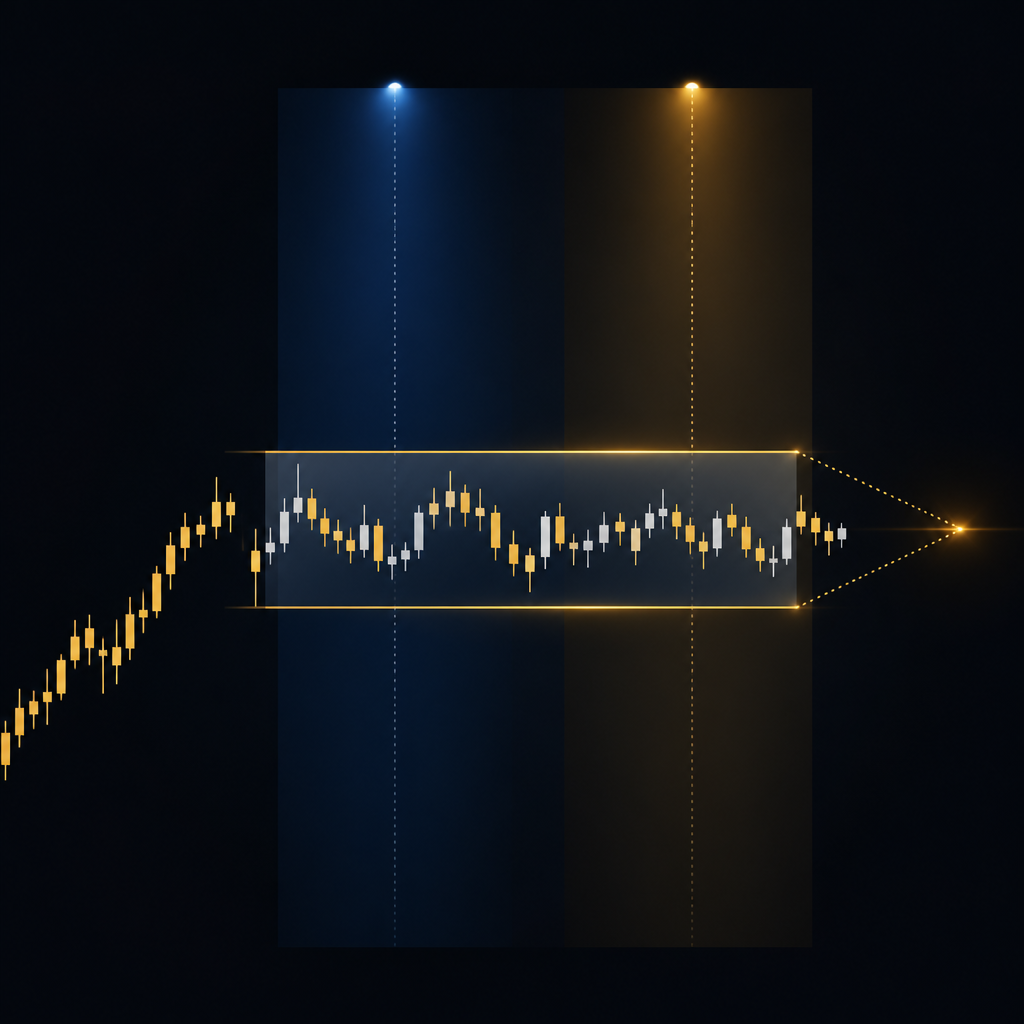
The “box” is simply the pre-FOMC consolidation range that forms as traders reduce risk and wait. Think of it as the market compressing like a spring.
On many FOMC days, XAUUSD will trade in a tight $8–$18 band in the hours leading into the decision. For example, gold might rotate between $2642 and $2658 from late London into early New York, then explode once the decision hits.
Your job is to define that range cleanly, because it becomes your breakout reference. If you draw it wrong—too wide or too narrow—you’ll either miss the move or get chopped.
How to draw the box (practical rules)
Use these rules to define a high-quality pre-news box:
- Time window: start with the last 90 minutes before the decision. If price is messy, expand to 180 minutes.
- Chart timeframe: identify the range on M15, refine levels on M5.
- Box boundaries: use the most respected swing high and swing low that price reacts to at least 2–3 times.
- Ignore single-wick extremes: if one candle spikes $3 beyond the range then snaps back, don’t build the box around that wick.
Let’s make it real. Suppose gold is trading $2650.00. In the 90 minutes before FOMC, price printed multiple rejections at $2657.80 and multiple bounces at $2643.20. Your box is $2643.20–$2657.80 (a $14.60 range).
That’s a usable box because it’s wide enough to avoid noise but tight enough to make a breakout meaningful.
What the box tells you (without predicting direction)
The box gives you three critical pieces of information:
- Where stops are: above the top and below the bottom—fuel for the post-news move.
- Where not to trade: inside the box after the release is chop territory until proven otherwise.
- Where to measure risk: your SL and invalidation can be tied to the box edges, not your emotions.
This is the mindset shift: on FOMC, you’re not trading “bullish or bearish.” You’re trading a range expansion event with strict confirmation.
FOMC Day Timeline: Decision, Statement, Powell—And When Gold Really Moves
Most traders treat FOMC like a single moment. In reality, it’s usually a sequence. Understanding the timeline helps you avoid entering during the most random minutes.
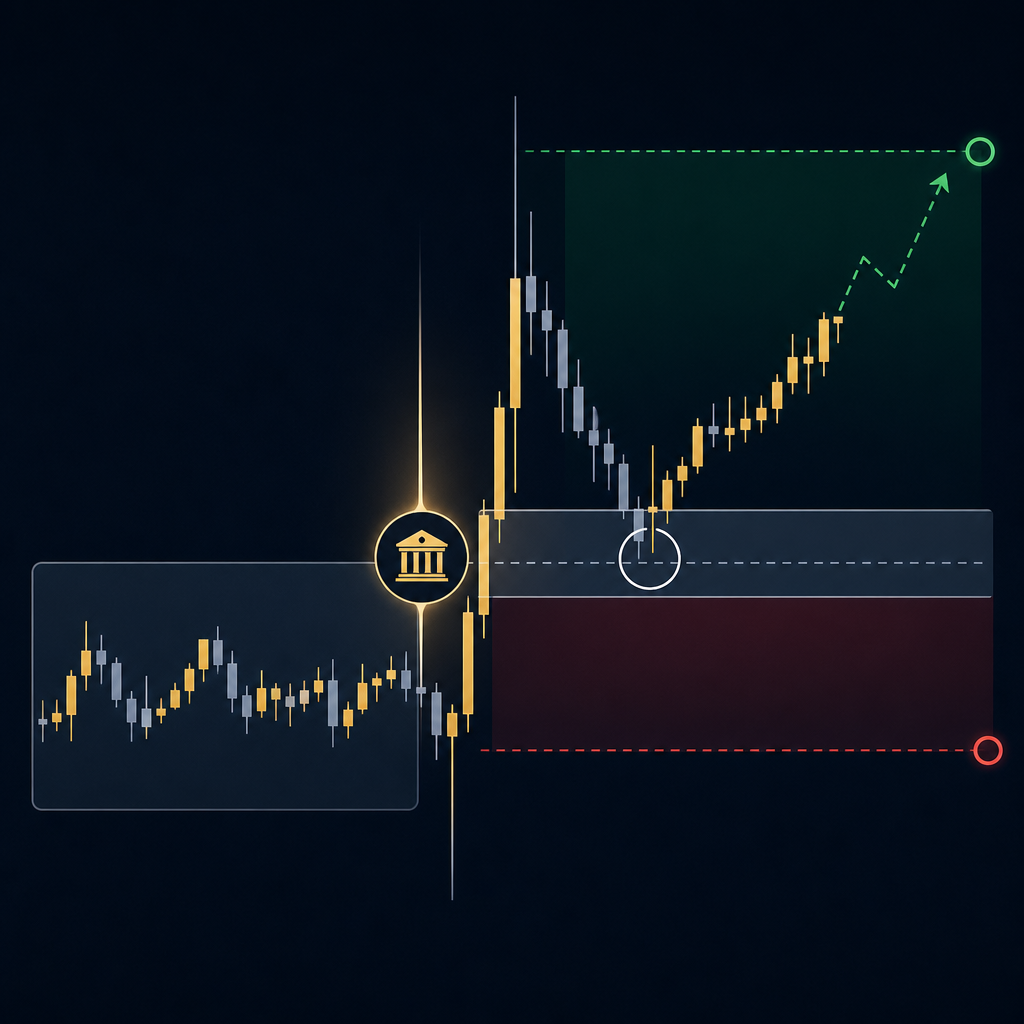
Typically, you’ll see three volatility waves:
- Wave 1 (Decision headline): the instant reaction to the rate decision.
- Wave 2 (Statement details): wording changes, dots, inflation language—this can reverse Wave 1.
- Wave 3 (Powell press conference): the “trend day” move often starts here, after the market interprets tone.
This is why the first spike is so dangerous. It’s often the least reliable. If you trade the first candle, you’re basically betting you won’t be the liquidity.
Our preferred timing windows (execution reality)
For signal-followers and discretionary traders, the cleanest windows are usually:
- Window A: 1–5 minutes after the release, after the first spike prints and spreads normalize.
- Window B: the first retest of the box edge (breakout-retest entry).
- Window C: 10–30 minutes later when structure forms a new high/low and gives a second-chance entry.
When gold is around $2650, a typical FOMC spike can be $12–$25 in under a minute. If your broker widens spread and you hit market buy at $2662, you might fill at $2664.50 and immediately see price snap back to $2652. That’s not “bad luck.” That’s the game.
So we design the plan to enter when the market has shown its hand, not when it’s still shuffling cards.
The Pre-News Checklist: What to Do 2 Hours Before the Fed Decision
Preparation is the edge on FOMC days. Not because it predicts direction, but because it prevents impulsive entries and prevents you from trading when conditions are untradeable (spreads, liquidity, platform lag).
Step-by-step pre-news checklist
- Mark the event time on your platform and set a reminder 15 minutes before.
- Check correlated context: DXY (106.80), USD/JPY (149.50), and US yields if available. You’re not trading them, but they explain gold’s reaction.
- Draw the box using the last 90–180 minutes. Example: $2643.20 support, $2657.80 resistance.
- Identify “magnet levels” near the box: round numbers like $2650, $2660, $2640, and prior day high/low.
- Set risk mode: reduce size to 25–50% of normal, widen stops, and decide your max attempts (we recommend 2).
- Plan your entry type: prefer stop orders or limit-on-retest, avoid market orders during the first spike.
- Know your no-trade conditions: if spread is unusually wide pre-release, or your platform is lagging, skip.
One practical example: if your normal gold position is 0.20 lots with a $10 stop, on FOMC you might trade 0.10 lots with a $18 stop. Your dollar risk stays similar, but you survive the noise.
This aligns with the risk principles we teach across our community and in our dedicated guide on risk management strategies when using trading signals.
Also, if you follow signals, you want clarity on how the provider handles news. At United Kings, our premium Telegram signals come with clear Entry/SL/TP and execution notes—especially around London and NY session volatility. You can see how we structure our service on the United Kings Gold Signals page.
The Post-Release Breakout Plan: Confirmation Rules That Stop You Getting Whipsawed
Now the core of the strategy: how to trade the breakout after the release using the pre-news box as your map.
The simplest version is “price breaks the box, you trade in that direction.” But on FOMC, that gets you trapped because the first break is often a fake.
We use a confirmation model designed for high-impact news:
Rule 1: Let the first spike finish
Wait for at least one of these to happen:
- A full M1 candle closes after the spike, showing where price actually settled.
- Spreads return closer to normal (you’ll see it in your platform).
- Price stops printing consecutive long wicks in both directions.
In practice, this is often 60–180 seconds. That patience alone can save you a week’s worth of mistakes.
Rule 2: Breakout must be a close outside the box
If your box top is $2657.80, a wick to $2666 that closes back at $2655 is not a bullish breakout. It’s a stop hunt.
We want a close outside the box, ideally on M1 or M5. Example:
- M1 closes at $2661.20 (above $2657.80).
- Next candle holds above $2657.80 or retests it and rejects.
Rule 3: Entry models (choose one)
Use one of these two entry models depending on volatility:
- Model A (Break + Retest): Enter on a pullback to the box edge. Example: breakout above $2657.80, retest to $2658.20–$2659.00, then buy.
- Model B (Two-Closes): Enter after two consecutive M1 closes outside the box in the same direction. This reduces fakeouts but may enter later.
On FOMC, Model A is often cleaner because it gives you a defined invalidation: if price retests and fails back inside the box, you’re wrong quickly.
But Model B is safer when spreads are still unstable, because you avoid placing orders during the retest chop.
Rule 4: Targets are measured, not guessed
Instead of “TP wherever,” use a risk-reward framework. If you risk $15, aim for $30 (1:2) or $45 (1:3) when volatility supports it.
Example bullish breakout trade:
- Box: $2643.20–$2657.80
- Entry: Buy $2659.00 on retest
- SL: $2644.00 (risk $15)
- TP1: $2689.00 (reward $30, 1:2)
- TP2: $2704.00 (reward $45, 1:3) if conditions allow (note: beyond our example range, so treat as extended scenario)
Within today’s realistic range guidelines ($2610–$2690), TP1 at $2689.00 is a practical “FOMC expansion” target.
False Breakouts on FOMC: The Filters That Keep You Out of the Trap
False breakouts are not random on FOMC. They’re often engineered by liquidity seeking. Price runs one side of the box to trigger stops and breakout traders, then reverses hard to run the other side.
So your edge comes from filtering. Here are the filters that matter most.
Filter 1: Wick-to-body imbalance
If the breakout candle has a huge wick and tiny body, it’s telling you there was rejection. Example: price spikes to $2668, but closes at $2658.50. That’s not strength.
Prefer break candles that close near their extremes. A bullish breakout candle closing at $2664 after breaking $2658 is stronger than one closing at $2659.
Filter 2: “Back inside the box” rule
This single rule saves accounts: if price closes back inside the box, you do not chase.
Instead, you wait for either:
- A fresh breakout with a new close outside, or
- A full reversal setup (breakout failure) with confirmation.
Filter 3: Breakout failure reversal (advanced but powerful)
Sometimes the best trade is the opposite direction after a failed break. Example:
- Gold breaks above $2657.80 to $2666, then closes back inside at $2654.
- Next candle breaks below $2649 and accelerates.
- This is a classic “failed breakout” that can run to the box low $2643.20 and beyond.
A conservative way to trade this is to wait for a retest of the broken level (e.g., $2657.80 acting as resistance) and then sell with structure.
Filter 4: Spread/volatility sanity check
If your platform spread is still wide, your “perfect” setup is not perfect. Your stop might be effectively smaller than you think.
Practical rule: if spread is more than 2–3x your normal for gold, wait. On many brokers, normal spread might be $0.20–$0.40. If it’s $1.20, you’re paying a tax that changes the math.
This is also why we educate our community to treat news like a different market regime, not “business as usual.” If you want more on how signals behave under surprise conditions, read how gold signals react to unexpected news events.
Risk Rules for Trading Gold on FOMC: Spreads, Slippage, Position Sizing, Cutoffs
This section is the difference between “a strategy” and “a survivable strategy.” On FOMC, you can be right and still lose if your execution and risk rules are not adapted.
Rule 1: Use wider stops, smaller size (keep risk constant)
Gold can swing $10–$25 quickly on release. If you insist on a $6 stop, you’re gambling.
A practical FOMC stop framework:
- Conservative: $10–$12 stop (only if box is tight and spreads are stable)
- Standard: $15–$18 stop
- High volatility: $20–$25 stop (rare, but sometimes necessary)
Then reduce lot size so your dollar risk stays the same. If you normally risk $100 with a $10 stop, and you now need an $18 stop, reduce size by ~44%.
Rule 2: Build a slippage buffer into your plan
Assume your fill could be worse by $0.50 to $2.00 depending on broker conditions. That means:
- Don’t put SL exactly on the box edge—place it beyond structure with room.
- Avoid market entries during the first spike; prefer retests or confirmed closes.
Rule 3: Hard cutoff on attempts (2 strikes rule)
FOMC can bait you into revenge trading. We use a simple rule: max 2 attempts on the day’s FOMC setup.
Attempt 1: breakout-retest buy/sell. Attempt 2: second confirmed setup. After that, stop. The market will still be open tomorrow, and your psychology will be intact.
Rule 4: Time cutoff (avoid late-session chop)
Many FOMC days trend for 30–90 minutes, then turn into a messy consolidation. If you missed the move, don’t force a late entry.
Practical cutoff: if you haven’t entered within 45–60 minutes after the decision (or after Powell starts speaking), only take trades with crystal-clear structure and reduced risk.
Rule 5: No hedging chaos
Some traders try to hedge both sides with pending orders above and below the box. This can work in theory, but in practice spreads and slippage can trigger both sides and lock you into a loss.
If you’re not highly experienced with news execution, avoid straddles. Trade one direction with confirmation.
If you’re using a signal service, you want these rules embedded in the call. That’s part of what we focus on in our United Kings Signals approach: clear levels, session timing, and risk notes so you can execute without improvising.
Example Trade Plans Using Today’s Market Context (XAUUSD Around $2650)
Let’s build two realistic scenarios using the current context: gold near $2650, DXY strong at 106.80, USD/JPY near 149.50. We’ll keep gold prices within the $2610–$2690 guideline.
Scenario A: Bullish breakout after a dovish surprise
Pre-news box: $2643.20 low, $2657.80 high.
Release hits. Gold spikes down to $2638 (liquidity sweep), then rips up through $2657.80 and closes M1 at $2661.20.
- Entry trigger: wait for retest of $2657.80–$2659.00 and a bullish rejection on M1/M5.
- Entry: Buy $2659.00
- SL: $2644.00 (below box low + buffer)
- TP1: $2689.00 (1:2)
- Management: at +$15 (1R), consider moving SL to reduce risk or take partials depending on your plan.
Why this works: you’re not buying the spike. You’re buying the acceptance above the range, using the range as structure.
Scenario B: Bearish breakout after a hawkish tone (or risk-off USD bid)
Pre-news box: same $2643.20–$2657.80.
Release hits. Gold spikes up to $2667, then collapses and closes M1 back inside the box at $2652. Next candle breaks $2648 and accelerates.
- Entry trigger: sell the retest of the broken mid-level or box low break + retest.
- Entry: Sell $2646.50 after a retest rejection
- SL: $2661.50 (risk $15)
- TP1: $2616.50 (reward $30, 1:2)
- TP2: $2601.50 (1:3) as an extended target (note: slightly below our $2610 guideline; treat as rare extension)
Within the guideline, TP1 at $2616.50 is a realistic “range expansion” objective if the move is clean.
What about EUR/USD and GBP/USD on FOMC?
Even if you focus on gold, watching majors can help you interpret dollar strength. With EUR/USD at 1.0520 and GBP/USD at 1.2680, a broad USD surge often pressures gold lower, while a USD dump can help gold break higher.
If you also trade forex, keep your risk separated. Don’t take three USD trades at once (e.g., XAUUSD short + EUR/USD short + GBP/USD short) unless you intentionally want concentrated exposure.
For traders who want both markets covered with coordinated risk, our Forex Signals and gold signals are designed to complement each other—especially around London and NY session volatility.
Comparison Table: FOMC Execution Styles (Which Fits Your Skill Level?)
Not all FOMC trading approaches are equal. Some are high-risk, high-stress. Others are slower but more repeatable.
| Approach | When You Enter | Pros | Cons | Best For |
|---|---|---|---|---|
| Pre-news prediction | Before the decision | Best price if you’re right | Pure guess; can gap against you; high stress | Advanced macro traders only |
| Straddle pending orders | Stops above & below the box | Captures fast moves | Can trigger both sides; spread/slippage destroys edge | Experts with top-tier execution |
| Break + retest (our core) | After close outside + retest | Filters fakeouts; clear invalidation; repeatable | May miss the very first part of the move | Most traders, signal followers |
| Two-closes confirmation | After 2 closes outside the box | Even safer confirmation; fewer traps | Later entry; smaller R:R sometimes | Conservative traders |
| Wait for post-Powell trend | 10–45 minutes later | Cleaner structure; spreads normalized | Not every FOMC trends; patience required | Busy traders, lower stress style |
Step-by-Step Execution: Turning the Plan Into a Repeatable Routine
A strategy only works if you can execute it under pressure. FOMC pressure is real: fast candles, fast P/L swings, and the urge to “do something.”
Here’s a routine you can follow like a script.
Step 1: 60–120 minutes before
- Draw your box (M15/M5).
- Mark key levels: $2650, $2660, $2640, plus prior day high/low.
- Decide your risk: fixed $ amount per attempt.
Step 2: 5 minutes before
- Stop taking random trades.
- Check spread behavior.
- Confirm your order types (no accidental market orders).
Step 3: At release (do nothing)
- Hands off for the first 60–180 seconds.
- Watch where the candle closes relative to the box.
Step 4: Identify the direction of acceptance
- Acceptance above: close outside + hold above + retest holds.
- Acceptance below: close outside + hold below + retest rejects.
- No acceptance: price whips above and below and closes inside—wait.
Step 5: Place the trade with buffers
- Entry on retest or two-closes.
- SL beyond box edge with extra room for slippage.
- TP at 1:2 first; consider partials.
Step 6: Manage like a professional (not a gambler)
- If price returns inside the box and holds, consider cutting early.
- If price runs +1R quickly, avoid getting greedy; protect downside.
- If stopped out, wait for the second setup. No instant re-entry.
This routine is also how we coach traders inside our community—simple rules, repeated consistently, especially during high-impact events when emotions spike.
If you’re new to executing signals under pressure, you’ll also benefit from browsing the education hub on our blog where we break down execution, timing, and risk in practical terms.
Mistakes Traders Make on FOMC (And How to Avoid Them)
Most FOMC losses don’t come from “bad analysis.” They come from predictable mistakes. Fix these and your results can change dramatically.
Mistake 1: Trading inside the box after the release
Inside the pre-news range, the market is still undecided. You’re paying spread and slippage to be chopped.
Fix: treat the box like a no-trade zone until you have acceptance outside.
Mistake 2: Using normal-day stops and normal-day position size
On FOMC, volatility is not normal. A $10 move can happen in seconds, and a $15 wick is common.
Fix: widen SL to $15–$20 and cut size so your dollar risk stays controlled.
Mistake 3: Chasing the first candle
The first candle is often a trap. If you buy at $2665 because you’re afraid of missing out, you’re usually the liquidity for the reversal back to $2650.
Fix: wait for close + retest or two closes. Missing the first $5 is fine if you catch the next $25.
Mistake 4: Overtrading multiple USD pairs simultaneously
If you short gold and also short EUR/USD and GBP/USD, you’ve tripled your USD exposure. If the USD whipsaws, you get hit three times.
Fix: pick your best setup. Or reduce risk across all positions so your total exposure stays consistent.
Mistake 5: Ignoring broker conditions
Some brokers handle news better than others. If your platform freezes or spreads explode, your strategy can’t function.
Fix: test your broker on a demo during news. If execution is poor, trade smaller or avoid the event.
We also recommend beginners practice on demo first—especially for FOMC—because it’s a different environment than normal session trading.
How Signal Followers Should Trade FOMC Days Safely (Without Second-Guessing)
If you use signals, FOMC days can be confusing. You might receive a clean entry/SL/TP, but price is moving so fast that you wonder whether to follow it, delay it, or skip it.
Here’s how to approach FOMC as a signal follower in a professional way.
1) Prioritize execution quality over perfect entries
On FOMC, a “perfect” entry might not be fillable. If the signal is a breakout-retest buy at $2659.00 and price retests only to $2659.40, you have choices:
- Either accept a small slippage (within a pre-defined tolerance), or
- Skip the trade rather than chase.
Define your tolerance before the event. Example: max $0.50–$1.00 worse fill on gold during news. If it’s more, skip.
2) Follow the SL exactly (don’t “give it room” randomly)
Giving room after entry is usually emotional. If you want a wider stop, you must reduce size before entering, not after you’re in drawdown.
3) Use the “two attempts” rule
If a signal gets stopped out during the whipsaw, don’t immediately jump into a random second trade. Wait for the next confirmed setup or the provider’s update.
4) Communicate and learn
One advantage of a large active community is context. United Kings has 300K+ active traders, so you’re not trading alone. You can compare execution notes, spreads, and broker behavior in real time.
If you want to see how our service is structured across markets, visit our signals page and our dedicated gold signals section. If you also trade other markets, we cover multiple asset classes including crypto signals for diversification (with separate risk considerations).
5) Use FOMC as an education day if you’re new
If you’re a beginner, it’s completely acceptable to watch and learn. Track how the box breaks, how the retest behaves, and how spreads change. Then trade the next event with more confidence.
Putting It All Together: A Complete FOMC Day Template You Can Reuse
Let’s compress everything into a reusable template. Save this section and use it every FOMC.
FOMC XAUUSD Box + Breakout Template
- Market snapshot: XAUUSD ~$2650, DXY 106.80, USD/JPY 149.50, EUR/USD 1.0520, GBP/USD 1.2680.
- Draw pre-news box: last 90–180 minutes. Mark top and bottom (e.g., $2657.80 / $2643.20).
- No-trade zone: inside the box post-release until acceptance is proven.
- Confirmation: close outside box + hold/retest OR two closes outside.
- Entry: retest entry preferred; avoid market entries in the first spike.
- SL: $10–$25 from entry depending on volatility, placed beyond box edge with buffer.
- TP: 1:2 first target; extend to 1:3 only if trend is clean and spreads normalize.
- Risk: reduce size to 25–50% of normal; max 2 attempts; stop after 45–60 minutes if no clean setup.
If you want an even more structured process, combine this with your broader risk framework and journaling. Consistency beats adrenaline.
FAQ: Trading Gold (XAUUSD) During FOMC Days
1) Should I trade gold before the FOMC decision?
Most traders shouldn’t. Pre-news price is often random and designed to position liquidity. The higher-probability approach is to define the box pre-news and trade after the release with confirmation.
2) What timeframe is best for the pre-news box and breakout confirmation?
Draw the box on M15 and refine on M5. For confirmation, M1 closes help you read acceptance quickly, while M5 closes reduce noise. Many traders use M1 for timing and M5 for confirmation.
3) How wide should my stop loss be on FOMC for XAUUSD?
Commonly $10–$25 depending on volatility and box size. A typical balanced choice is $15–$18, with reduced lot size so your dollar risk stays controlled.
4) Why do I get stopped out even when price later goes my direction?
Because the first move is often a liquidity sweep. Spreads widen, wicks expand, and price hunts stops around the box edges. Using close-based confirmation and retest entries helps avoid being the liquidity.
5) Can I use the same plan for CPI or NFP?
The box + breakout concept works for many high-impact events, but each event has different volatility patterns. CPI often produces a single violent impulse; FOMC can create multiple waves (decision, statement, Powell). Adapt your timing rules accordingly.
Risk Disclaimer (Read Before You Trade)
Trading forex and gold (XAUUSD) involves significant risk and may not be suitable for all investors. Spreads can widen and slippage can occur during high-impact news like FOMC, which may increase losses beyond expectations. This article is for educational purposes only and does not constitute financial advice. Past performance does not guarantee future results. If you are new, consider practicing on a demo account and only risk capital you can afford to lose.
Ready to Trade FOMC With Clear Levels and Real Risk Rules?
If you want to trade London and New York sessions with structured entries, SL/TP levels, and a community that treats risk like a first-class rule—not an afterthought—join United Kings.
We provide premium Telegram signals for forex and gold with a historical 85%+ win rate target methodology (no guarantees), clear execution notes, and education alongside signals. You also get access to a 300K+ active trader community so you’re never trading major news alone.
- Starter (3 Months): $299 (~$100/mo)
- Best Value (1 Year): $599 ($50/mo) with 50% savings + FREE ebook
- Unlimited (Lifetime): $999 pay once, access forever
Explore membership options on our pricing page, then join the live channel on Telegram: United Kings Telegram signals community.
48-hour money-back guarantee included—so you can evaluate the service with confidence and see if our FOMC execution style fits your trading.