
You get the alert: “US CPI in 10 minutes.”
Gold is trading around $2650, DXY is near 106.80, and you already know what can happen next: a 30–80 dollar spike, a brutal whipsaw, and a stop-out that feels unfair.
This is exactly why an XAUUSD CPI trading strategy can’t be “just press buy/sell and pray.”
In this playbook, we’ll build a step-by-step signal execution plan for CPI and PCE releases with spread filters, slippage rules, confirmation logic, and risk-based sizing—the stuff that separates professional execution from chaos.
TL;DR (Save this checklist)
- Don’t market-execute into the first spike. Your edge comes from post-spike confirmation, not guessing the first 5 seconds.
- Use hard filters: if spread is above your threshold (example: $0.60–$1.20 on XAUUSD depending on broker), you skip or wait.
- Plan two windows: a 0–2 minute “no-trade” window and a 2–15 minute confirmation window for entries.
- Size smaller than normal: CPI/PCE volatility can double; reduce risk per trade to 0.25%–0.75% for most accounts.
- Confirmation beats prediction: trade the reclaim/hold of a level (e.g., $2658 reclaim) with a defined SL ($12–$20) and 1:2–1:3 RR.
- Execution matters as much as direction: slippage caps, limit/stop-limit usage, and “cancel if not filled” rules protect you.
If you want ready-to-execute setups with clean Entry, SL, and TP levels (and the discipline rules around them), explore our premium Gold Signals or the full United Kings signals suite.
1) Why CPI & PCE Move XAUUSD So Violently (and Why Whipsaws Happen)
CPI and PCE are not just “economic news.” They are Fed policy inputs, and Fed policy is a core driver of real yields and the US dollar—two of the biggest forces behind gold’s intraday direction.
When inflation prints higher-than-expected, markets often price in a more hawkish Fed path (or fewer cuts). That can push real yields up and strengthen the dollar, which often pressures gold.
When inflation prints softer-than-expected, markets may price in cuts sooner. That can weaken the dollar, lower real yields, and boost gold—sometimes fast.
So why the whipsaw?
Because CPI/PCE is a liquidity event and a positioning event at the same time.
- Liquidity event: spreads widen, market makers step back, and the order book thins. Small orders can move price more than usual.
- Positioning event: funds and banks are positioned ahead of the release. The first move can be a stop-run before the “real” direction appears.
- Headline vs details: CPI headline may be hot, but core or MoM details may be cooler (or vice versa). Algorithms react in layers.
In practical terms, gold at $2650 can print $2668, slam to $2638, then grind to $2675—all within 10 minutes.
If your only plan is “buy if it’s bullish,” you’ll likely buy the top of the first spike and get stopped in the reversal.
The professional mindset for CPI/PCE
We’re not trying to be the fastest clicker. We’re trying to be the best executor of a repeatable plan.
That means you define, in advance, what conditions must be true to enter. If they aren’t true, you don’t trade. This is how news trading becomes a system instead of gambling.
2) The CPI vs PCE Difference: What to Expect in Speed, Spread, and Follow-Through

Both CPI and PCE can move XAUUSD hard, but they don’t always behave the same in the first minutes after release.
CPI is usually the bigger “event risk” for retail and institutional traders alike. It often produces the sharpest initial spike, the widest spreads, and the most aggressive stop-hunts.
PCE matters deeply to the Fed (especially Core PCE), but the market reaction can be more nuanced—sometimes smaller initial spikes, sometimes cleaner follow-through, depending on what else is happening (Fed week, payrolls, risk-off headlines).
Practical execution implication
For CPI, you should assume maximum spread and slippage risk in the first 30–90 seconds.
For PCE, you still respect volatility, but you may find more “tradable” pullbacks within 2–8 minutes after the release.
Comparison table: CPI vs PCE for gold news trading
| Factor | CPI (Consumer Price Index) | PCE (Personal Consumption Expenditures) |
|---|---|---|
| Typical initial XAUUSD reaction | Very sharp, often 20–60+ dollars in minutes | Moderate to sharp, often 10–40 dollars in minutes |
| Spread widening risk | High (especially first 0–90 seconds) | Medium to high (often slightly less extreme) |
| Whipsaw probability | High (headline/core conflicts are common) | Medium (but still present) |
| Best execution approach | Wait for post-spike confirmation; avoid instant market orders | Confirmation + pullback entries; be selective with spreads |
| Common trap | Buying/selling the first candle and getting reversed | Overtrading a smaller move; chasing late entries |
The key: your plan should not depend on “CPI bullish = buy.” It should depend on price behavior + execution conditions.
That’s also why a premium signal service must include more than direction. At United Kings, our approach emphasizes session timing (London/NY), clean levels, and execution rules—the same logic you’ll see in this guide.
3) Pre-News Preparation: Levels, Liquidity, and the 30-Minute Routine
The biggest CPI/PCE mistake is starting your thinking at the moment of release. By then, it’s too late.
Your edge begins 30–60 minutes before the number hits.
Step-by-step: the 30-minute pre-news routine
- Step 1: Mark the “range of control.” On gold, identify the last 2–4 hours’ high/low. Example: Asian + early London range between $2636 and $2662.
- Step 2: Mark 3 key levels. A nearby resistance, a nearby support, and the midpoint. Example: resistance $2662, support $2636, midpoint $2649.
- Step 3: Identify the trend context. Is price making higher highs into the release, or compressing? Compression often leads to wider spikes.
- Step 4: Check DXY and USD/JPY. With DXY around 106.80 and USD/JPY near 149.50, you’re watching for synchronized USD strength/weakness after the print.
- Step 5: Decide your “no-trade” window. For most traders, it’s 0–2 minutes after release (sometimes 0–5 if spreads are wild).
Why levels matter more than forecasts
In news trading, the market often targets liquidity first. That means it hunts obvious stops above highs and below lows.
If the pre-news high is $2662, you should expect a spike to $2666–$2672 is possible even if the “true” direction is down.
So instead of predicting, you prepare for two scenarios:
- Break-and-hold: price breaks $2662 and holds above it after a pullback → bullish continuation setup.
- Break-and-fail: price spikes above $2662, then closes back below and fails retest → bearish reversal setup.
Pre-news positioning: what we do (and what we avoid)
We generally avoid holding oversized positions into CPI/PCE unless it’s part of a broader swing plan with wide risk parameters.
For signal execution, we prefer reactive entries with confirmation. That’s also consistent with how we teach execution in our educational content across the United Kings blog.
4) Spread & Slippage: The Filters That Save You (Even With the Right Direction)
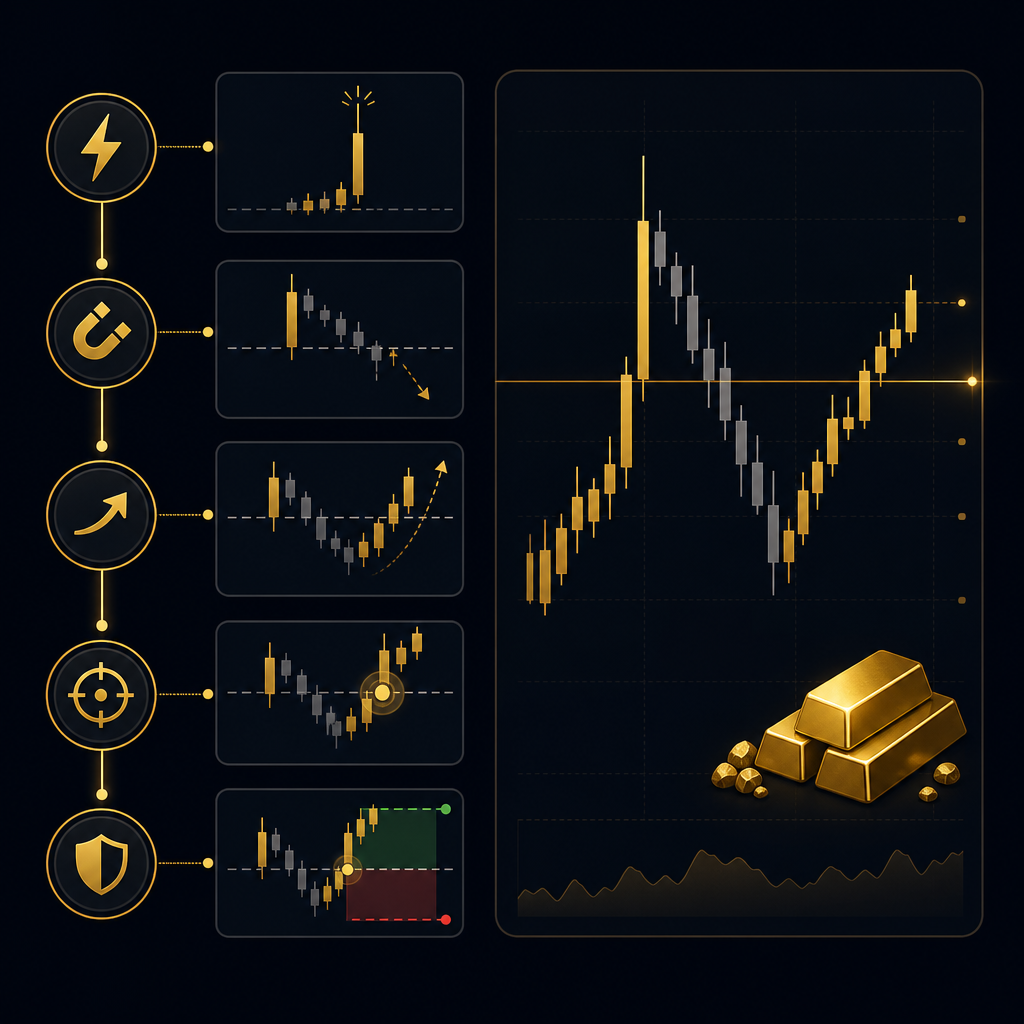
Here’s the truth: you can be right on direction and still lose because of execution costs.
During CPI/PCE, spreads can widen and slippage can hit hard—especially on market orders, stop orders, or thin liquidity moments.
Define your spread filter (example numbers)
On many brokers, XAUUSD spread in normal conditions might be around $0.15–$0.35.
During CPI, it can temporarily expand to $0.80–$2.50+ depending on broker, account type, and liquidity provider.
A practical filter looks like this:
- Green zone: spread ≤ $0.50 → normal execution allowed.
- Yellow zone: spread $0.50–$1.20 → only trade with confirmation + reduced size.
- Red zone: spread ≥ $1.20 → skip or wait (no exceptions for most traders).
These thresholds vary by broker, but the concept is universal: if spreads are screaming, your edge is bleeding.
Slippage rules: your “max pain” cap
Slippage is the difference between your requested price and your actual fill.
In CPI/PCE conditions, a “small” slippage on gold can be $0.50–$2.00. A bad fill can be $3–$10 in extreme moments.
Build a rule like:
- Max acceptable slippage: $1.50 per order (or $2.00 if you’re trading wider stops).
- If slippage exceeds cap: cancel re-entry attempts for 60–180 seconds and reassess spreads.
Order type guidance (practical)
- Market orders: fastest, but worst slippage risk. Avoid in first spike.
- Limit orders: control price, but may miss fills. Good for pullback entries.
- Stop orders: can get slipped badly in news. Use carefully, ideally with a confirmation trigger.
The hidden cost: stop-loss slippage
Traders focus on entry slippage but forget that stops can slip too.
If you place a $15 stop and the market gaps through it by $5, your real stop becomes $20. That can break your risk model instantly.
This is why we combine smaller risk with confirmation entries around inflation releases.
If you want deeper execution and risk frameworks, pair this article with our guide on risk management strategies when using signals.
5) Timing Windows: The “No-Trade” Zone and the Confirmation Zone
News trading isn’t just “what to trade.” It’s when.
For CPI and PCE, the market often gives you three distinct phases:
- Phase 1: The spike (0–30 seconds). Algorithms and liquidity vacuum. Spreads widest.
- Phase 2: The whipsaw (30 seconds–2 minutes). Stop-hunts, reversals, and fakeouts.
- Phase 3: The confirmation (2–15 minutes). Directional intent becomes clearer; pullbacks become tradable.
Our practical timing rule
For most traders following signals, the best balance is:
- No-trade window: first 2 minutes after release.
- Primary execution window: 2–8 minutes after release (best for confirmation entries).
- Secondary window: 8–15 minutes after release (if structure forms and spreads normalize).
Why the 2–8 minute window works
By minute 2, you often see whether the first move was a liquidity sweep or a genuine breakout.
You also get a chance to see whether DXY and yields are confirming. With DXY near 106.80, a post-release surge to 107.20 often aligns with gold weakness. A drop to 106.30 often aligns with gold strength.
Example timing scenario (realistic prices)
Gold is at $2650 pre-CPI.
- 8:30:00 – spike to $2668 (spread jumps to $1.40 → red zone, no trade).
- 8:31:00 – slam to $2642 (whipsaw, still no trade).
- 8:33:00 – price reclaims $2652 and holds above $2649 midpoint; spread back to $0.55 (yellow/green boundary).
Now you have a structured environment to execute a plan rather than react emotionally.
6) The Post-Spike Confirmation Model (Our Core CPI/PCE Execution Logic)
This is the heart of the playbook: we don’t trade the spike; we trade the confirmation after the spike.
Think of the spike as the market clearing stops and discovering liquidity. Think of the confirmation as the market revealing intent.
The 4-step confirmation sequence
- Step A: Spike and sweep. Price makes an extreme (above resistance or below support).
- Step B: Pullback. Price snaps back toward the pre-news range or key level.
- Step C: Level decision. Price either reclaims and holds (continuation) or fails and rejects (reversal).
- Step D: Entry trigger. Enter on the retest/close with a defined invalidation (SL).
Bullish confirmation example (CPI softer, gold bid)
Pre-news range: $2636–$2662. Price spikes to $2674, then pulls back to $2662.
- Confirmation: A 1–3 minute candle closes above $2662 and the next pullback holds $2660–$2662.
- Entry: Buy $2663 after the hold.
- Stop loss: $2648 (15 dollars risk).
- Take profit 1 (1:2): $2693 (30 dollars).
- Take profit 2 (1:3): $2708 (45 dollars) if volatility stays elevated.
Notice: we’re not buying the first candle at $2674. We’re buying the retest and hold near $2662 with controlled risk.
Bearish confirmation example (CPI hotter, gold offered)
Gold spikes above resistance to $2669, then collapses to $2640 and bounces back to retest $2650.
- Confirmation: Price fails to reclaim $2650–$2652 and prints a rejection candle.
- Entry: Sell $2648 after the rejection.
- Stop loss: $2665 (17 dollars).
- Take profit 1 (1:2): $2614 (34 dollars).
- Take profit 2 (1:3): $2597 (51 dollars) if momentum and DXY confirm.
The confirmation “must-haves” (non-negotiable)
- Spread is back to acceptable levels (your filter).
- A level is clearly defended (hold) or clearly rejected (fail).
- Your SL is logical (beyond the level, not inside noise).
- RR is at least 1:2 to justify the volatility risk.
This is the same execution discipline we expect when members follow our XAUUSD gold signals during high-impact releases.
7) Position Sizing for CPI/PCE: How to Survive the Volatility Spike
Most CPI blow-ups aren’t caused by “bad analysis.” They’re caused by normal position size in abnormal conditions.
If gold’s average 5-minute range doubles, your position size should usually shrink.
A simple CPI/PCE risk framework
- Conservative (recommended for most): risk 0.25%–0.50% per trade.
- Moderate: risk 0.50%–0.75% per trade.
- Aggressive (experienced only): risk 1.00% max, with strict slippage/spread caps.
Gold pip/value clarity (so sizing isn’t guesswork)
On many platforms, XAUUSD moves in $0.01 increments. A $1.00 move equals 100 “pips” (platform-dependent).
Instead of getting lost in pip naming, focus on dollars: if your stop is $15 away, you are risking $15 per ounce-equivalent of your position.
Your lot size determines what $15 means in account currency. Because contract specs differ by broker, the safest approach is:
- Use your platform’s position size calculator, or
- Place a test order on demo and confirm P/L for a $1 move.
Example sizing (conceptual)
Account: $10,000. Risk: 0.50% = $50.
Setup: Buy $2663 with SL $2648 → risk = $15.
You want $50 max loss, so your position size should be such that a $15 adverse move equals ~$50. That’s the entire sizing logic.
Two CPI-specific sizing rules that prevent disasters
- Rule 1: Reduce size if spread is in the yellow zone. If spread is $0.90 (not terrible, not great), cut size by 25–50%.
- Rule 2: One bullet only. Limit yourself to one CPI/PCE attempt per release unless your plan explicitly allows a second entry after a full reset.
If you’re building consistency with signals, you’ll benefit from pairing this with our beginner-friendly execution guide: Forex signals Telegram for beginners (the execution principles apply to gold too).
8) A Step-by-Step CPI/PCE Signal Execution Plan (Entry, SL, TP, and “Cancel” Rules)
Let’s turn everything into a clean, repeatable operating procedure you can run every CPI and PCE.
Assume current context: XAUUSD ~ $2650, EUR/USD 1.0520, GBP/USD 1.2680, USD/JPY 149.50, DXY 106.80.
Step 1: 60–30 minutes before release
- Mark the last 2–4 hours high/low on XAUUSD.
- Mark two “decision levels” above and below price (example: $2662 and $2636).
- Write down your spread thresholds (green/yellow/red) so you don’t improvise.
Step 2: 15 minutes before release
- Close or reduce any random positions that aren’t part of the plan.
- Decide your maximum risk for the event (example: 0.50%).
- Check your platform stability and internet (news is not the time for tech surprises).
Step 3: Release moment (0–2 minutes)
- No market orders.
- Watch: where did price spike? Above resistance or below support?
- Watch: spread. If it’s in the red zone, you’re not trading yet.
Step 4: Confirmation window (2–8 minutes)
- Wait for a pullback toward your decision level.
- Only execute if price shows a hold or rejection at that level.
- Place entry with a pre-defined SL and TP based on 1:2 or 1:3 RR.
Step 5: Execution rules (the “professional” part)
- Rule: Cancel if not filled quickly. If your limit entry doesn’t fill within 60–120 seconds and price runs away, cancel it. Don’t chase.
- Rule: One adjustment max. If spread widens again, don’t keep modifying orders. Either hold your plan or step aside.
- Rule: Move to breakeven only after structure. Example: after price moves 1R in your favor and forms a higher low (for longs) or lower high (for shorts).
Step 6: Post-entry management (8–30 minutes)
- Scale partial profits at 1:2 if volatility remains high.
- Trail the remainder behind a logical structure level (not a random $3 trail).
- If price returns inside the pre-news range and stalls, consider exiting early.
This is exactly how we want members to execute our high-impact alerts inside United Kings Signals: rules-first, emotions-second.
9) Avoiding the Top 7 CPI/PCE Traps (Chasing, Overtrading, and “Revenge Entries”)
Inflation releases don’t just test your strategy. They test your psychology.
Most traders don’t lose because they lack a setup. They lose because they abandon their own rules under pressure.
Trap #1: Trading the first 5 seconds
The first candle is often the worst fill of the day. Even if you catch direction, spreads and slippage can destroy your RR.
Trap #2: Confusing “fast” with “correct”
Speed feels like skill. In reality, confirmation is skill. Let the market show you the level.
Trap #3: Ignoring spread filters because “it’s CPI”
That’s exactly when filters matter most. If spread is $1.80 and your stop is $12, your trade is already compromised.
Trap #4: Setting stops inside the noise
During CPI, a $6–$8 flicker is common. If you place a $7 stop, you’re basically paying tuition.
Use realistic SL distances: typically $10–$25 from entry in this playbook, aligned to the level being defended.
Trap #5: Overleveraging because “the move is guaranteed”
Nothing is guaranteed. CPI can reverse twice. PCE can fade by NY lunch. Risk small so you can trade the next release.
Trap #6: Taking multiple entries in the same minute
That’s how slippage stacks. If you miss it, you miss it. Your plan must include “no chase” language.
Trap #7: Revenge trading after a stop-out
If you get stopped on CPI, your next decision is the most important one: do nothing for 5–10 minutes.
Let spreads normalize. Let structure form. Then reassess. This single habit saves accounts.
For more on how we handle abnormal events and sudden volatility, read: how gold signals react to unexpected news events.
10) Realistic CPI/PCE Trade Walkthroughs at $2650 (With Confirmation and RR)
Let’s put the plan into two “as-if-live” walkthroughs using realistic prices in the $2610–$2690 band.
Walkthrough A: CPI prints softer, gold breaks up but tries to trap buyers
Pre-news: Gold consolidates around $2650. Range: $2641–$2661.
Release: spike to $2672 in 20 seconds. Spread hits $1.30 (red). No trade.
Minute 2–4: price pulls back to $2661 and wicks to $2658. Spread compresses to $0.55.
Confirmation: a 1–3 minute candle closes above $2661, then a retest holds $2660.
- Entry: Buy $2662
- SL: $2647 (15 risk)
- TP1: $2692 (30 reward, 1:2)
- TP2: $2707 (45 reward, 1:3) if momentum persists
Management: at $2692, take partial and move SL to a structure-based level (for example, below the last 3-min higher low), not automatically to entry if price is still volatile.
Walkthrough B: PCE prints hotter, gold sweeps lows then confirms down
Pre-news: Gold is at $2653. Support at $2642, deeper support $2628.
Release: initial drop to $2634, then a quick bounce to $2648. Spreads are $0.95 (yellow).
Confirmation: price fails to reclaim $2650 and prints a rejection. Next candle breaks $2642.
- Entry: Sell $2640 on the break/retest
- SL: $2657 (17 risk)
- TP1: $2606 (34 reward, 1:2)
- TP2: $2589 (51 reward, 1:3) if risk-off accelerates
Note: If spread widens back above $1.20 during your entry attempt, you skip. Missing a trade is cheaper than paying a bad fill.
What these examples teach
- You’re trading levels + behavior, not headlines.
- Your SL is placed where the trade idea is invalidated, not where it “feels safe.”
- Your RR is planned before entry, so you’re not improvising in the heat.
11) How to Use Signals Around CPI/PCE Without Getting Whipsawed
Signals are powerful around inflation releases—if you execute them with rules.
But CPI/PCE is also where signal-followers can get hurt if they treat every alert like a calm-market setup.
Signal execution rules we recommend
- Confirm the timing: is the signal intended for pre-news, immediate post-news, or confirmation window?
- Respect the spread filter: if your broker spread is in the red zone, you wait—even if the signal triggers.
- Use the provided SL/TP exactly unless you have a documented reason (and experience) to adjust.
- Reduce size automatically on CPI/PCE compared to normal London/NY setups.
- No “late entries”: if price is already 60–70% to TP, you skip and wait for the next setup.
What a “good” CPI/PCE signal looks like
A professional-grade gold signal during CPI/PCE should include:
- Entry price (or entry zone)
- Stop loss placed beyond the invalidation level
- Take profit targets aligned to 1:2 or 1:3
- Context note (e.g., “post-spike reclaim,” “break-and-retest,” “wait for close above”) so you know it’s confirmation-based
Where United Kings fits (and why community matters)
United Kings is built for traders who want both signals and execution clarity.
We share premium Telegram signals for forex and gold with a historically strong win-rate profile (often quoted as 85%+ by our community), but we also emphasize that risk and execution decide your personal results.
With 300K+ active traders in the community, you also get the benefit of shared experience—how spreads behaved on different brokers, what the post-news structure looked like, and whether the move is extending or fading.
If you’re also trading majors alongside gold, you can explore our Forex Signals (EUR/USD at 1.0520 and USD/JPY at 149.50 can be excellent CPI companions). If you diversify beyond metals and FX, we also offer Crypto Signals, though crypto has its own volatility profile.
12) Your CPI/PCE Gold News Trading Checklist + FAQ
Before you trade the next CPI or PCE, copy this checklist into your notes.
CPI/PCE XAUUSD execution checklist (printable)
- 1) Levels marked: pre-news range high/low + 2 decision levels.
- 2) Risk set: 0.25%–0.75% max per attempt (most traders).
- 3) No-trade window: first 2 minutes after release.
- 4) Spread filter active: green/yellow/red thresholds defined.
- 5) Confirmation required: reclaim/hold or fail/reject at a key level.
- 6) RR planned: minimum 1:2, ideally 1:3 when structure allows.
- 7) Cancel rules: cancel limits if not filled in 60–120 seconds; no chasing.
- 8) One attempt rule: avoid multiple rapid re-entries.
FAQ
1) Is CPI or PCE better for gold news trading?
CPI usually creates bigger immediate volatility, which can mean bigger opportunity but also bigger spread/slippage risk. PCE can be cleaner for confirmation trades, but it depends on the macro backdrop and whether it’s near an FOMC meeting.
2) Should I place pending orders before the release?
For most traders, no. Pre-placing orders can lead to terrible fills and slippage during the spike. If you do use pending orders, use strict slippage caps and be prepared to cancel quickly if conditions change.
3) What’s a reasonable stop loss on CPI/PCE for XAUUSD?
In this playbook, typical CPI/PCE stops are $10–$25 depending on the level and volatility. The SL should sit beyond invalidation, not inside the noise of the event.
4) How do I know if the move is real or a fakeout?
Use the post-spike confirmation: wait for a pullback and see whether price holds above a breakout level (bullish) or fails to reclaim it (bearish). Combine that with spread normalization and, ideally, USD confirmation (DXY behavior).
5) Can beginners trade CPI/PCE with gold signals?
Beginners can participate, but it’s smarter to start on demo and trade smaller size. CPI/PCE is advanced because execution costs and psychology are amplified. Build confidence with calm-session setups first, then scale into news trading.
Risk Disclaimer (Read This)
Trading forex and gold (XAUUSD) involves significant risk and is not suitable for all investors. CPI/PCE news trading can produce extreme volatility, widened spreads, and slippage that may exceed your planned stop loss. Past performance does not guarantee future results. Signals and educational content are provided for informational purposes only and do not constitute financial advice. Always use proper risk management, consider practicing on a demo account, and only trade with money you can afford to lose.
Join United Kings: Get CPI/PCE-Ready Gold Signals (With Clear Rules)
If you want CPI/PCE setups that come with Entry, SL, TP and execution guidance designed for London and NY session conditions, join the United Kings community.
- Explore our full premium trading signals offering
- Start with dedicated XAUUSD Gold Signals for active traders
- Compare our 3 plans: 3 Months $299 (Starter), 1 Year $599 (Best Value, ~50% savings + FREE ebook), Lifetime $999 (Unlimited)
- Join our Telegram now: United Kings signals channel on Telegram
Questions before joining? Visit our About United Kings page or reach out via contact. We also offer a 48-hour money-back guarantee—so you can evaluate the service with confidence.
Your next CPI or PCE doesn’t have to be a coin flip. Trade it with a plan, execute it with rules, and let the market confirm the move before you commit risk.