
You’re watching XAUUSD at $2650. CPI drops in minutes, spreads start creeping wider, and your Telegram signal pings right as the first 5-second candle explodes both ways.
If you’ve ever been slipped $3–$8 on gold, stopped out by a 1-minute wick, then watched price run 200–400 pips without you—this CPI & PCE playbook is for you.
This guide is built around the real execution problems that kill news trades: spread blowouts, slippage, whipsaws, and over-leverage. We’ll turn those problems into rules.
Primary keyword note: This is a practical XAUUSD CPI strategy you can use with gold trading signals during U.S. inflation releases.
TL;DR — CPI & PCE Gold News Trading (The Safe Execution Rules)
- Don’t “wing it” at the release. Build a pre-set execution plan (orders, risk, and no-trade zones) before CPI/PCE hits.
- First 60 seconds are a trap for most accounts. Your edge is often in the 5–30 minute window after direction confirms.
- Spread control is a strategy. If spread is above your limit (example: > $0.60–$1.20 on XAUUSD depending on broker), you don’t trade.
- Pending orders beat panic clicks when volatility is extreme—but only with a defined no-trade zone and slippage rules.
- Risk caps save you. Use a hard daily loss limit (example: 1.0%–2.0%) and a per-trade cap (example: 0.25%–0.50%) for CPI/PCE.
- Signals work best with a checklist. Follow a step-by-step execution flow so you can copy the Entry/SL/TP cleanly.
Why CPI & PCE Move Gold So Violently (And Why Traders Get Wrecked)

CPI and PCE aren’t just “news.” They’re rate expectations in disguise.
Gold (XAUUSD) reacts because inflation data changes how markets price the Fed’s next move, which hits real yields and the U.S. dollar.
Current market context (realistic levels)
- XAUUSD: ~$2650.00 (+0.35% 24h)
- EUR/USD: 1.0520
- GBP/USD: 1.2680
- USD/JPY: 149.50
- DXY: 106.80
When CPI/PCE surprises, DXY can jump 0.4–0.8 in minutes, and gold can swing $15–$35 fast.
On XAUUSD, that’s 150–350 pips (since $1.00 ≈ 10 pips on most brokers).
The “CPI candle” problem: the market moves in layers
In the first 10–60 seconds, price is often dominated by liquidity grabs.
That’s why you’ll see a 1-minute candle that spikes up $12, dumps $18, then closes near the open.
Most retail traders lose here because they confuse movement with direction.
CPI vs PCE: why both matter
CPI is the headline event that triggers the biggest immediate reaction.
PCE (especially Core PCE) is the Fed’s preferred inflation gauge, so it can drive a more “policy-clean” move—sometimes less explosive, but more trend-following afterward.
Your job isn’t to predict the number. Your job is to execute a plan that survives spreads and volatility.
If you want signals that are built for these conditions (Entry, SL, TP, and session timing), see our premium rooms on United Kings Gold Signals and the broader United Kings Signals page.
The CPI & PCE News Trading Mindset: You’re Managing Execution Risk First
News trading isn’t “high IQ trading.” It’s high-discipline execution.
The best CPI/PCE traders aren’t the fastest clickers. They’re the ones with rules that prevent self-sabotage.
The 3 execution risks that matter more than your entry
- Spread expansion: Your broker widens spreads exactly when you want precision. A $0.30 spread can become $1.50+.
- Slippage: Market orders fill where liquidity exists, not where you clicked. On CPI, $2–$6 slippage is common on some feeds.
- Whipsaw: Price sweeps both sides of the range, stops you out, then trends.
This is why our plan focuses on pre-set orders, no-trade zones, and risk limits for the first 5–30 minutes.
What “good” looks like on a CPI/PCE trade
Let’s define a clean outcome.
You risk 0.35% on one trade with a $15 stop.
You target 1:2 or 1:3, so $30–$45 profit potential.
Even if you only take 2–4 CPI/PCE setups per month, the math can work—if you avoid the “death by a thousand bad fills.”
Signals + rules beat vibes
Signals are powerful when they’re executed consistently.
If you’re still learning how to read and execute alerts professionally, pair this guide with our educational posts inside the United Kings blog and the execution frameworks we share in Telegram.
Our community is built around London and New York session timing, which is exactly where CPI and PCE volatility lives.
CPI vs PCE for XAUUSD: Volatility, Timing, and What to Expect
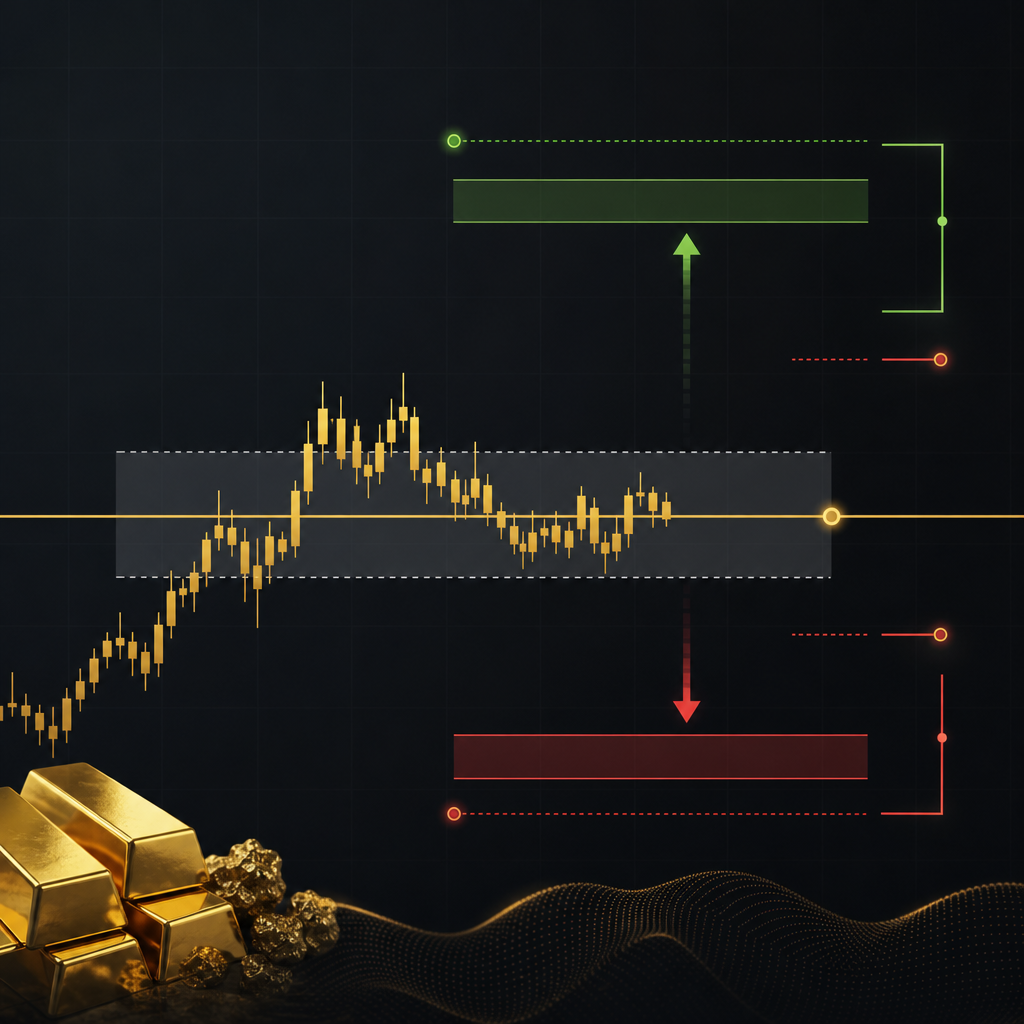
CPI and PCE can both move gold hard, but the “shape” of the move differs.
Your execution plan should respect those differences.
Release timing and typical behavior
CPI is usually released at 8:30 AM New York.
PCE often drops at 8:30 AM New York as well (depending on the month and data calendar).
That means you’re trading during the most liquid window of the day, but also the most aggressive algorithmic window.
How gold reacts through DXY and yields
At the moment, DXY is around 106.80.
If CPI prints hotter than expected, DXY can spike, and gold often dumps quickly (example: $2650 → $2632).
If CPI prints cooler, DXY can drop, and gold can rip higher (example: $2650 → $2675).
But here’s the part most traders miss: the first move can be a fake.
The second move (2–10 minutes later) is often the “real” positioning move.
What changes when volatility is elevated
When gold is already volatile (like now, with price holding near $2650 and reacting to macro headlines), CPI/PCE can create range expansion days.
That means the 30-minute range after the release can exceed the entire Asian session range.
Your strategy should assume:
- Stops need room: typically $10–$25 on gold for news setups.
- Targets should be meaningful: 1:2 to 1:3 is realistic when the move follows through.
- Position sizing must shrink: news is not the time to “size up.”
If you want to trade CPI/PCE but also diversify with major FX pairs, our Forex Signals cover EUR/USD, GBP/USD, and USD/JPY—pairs that often move in sync with the same inflation narrative.
Market Orders vs Pending Orders on CPI/PCE: Which One Fits Your Broker?
This is the decision that determines whether you get a clean fill or a messy one.
There’s no universal “best.” There’s the best choice for your spread, your platform, and your rules.
Comparison table: Market vs Pending orders for CPI/PCE gold trading
| Execution Method | Best For | Main Risk | Rule to Control Risk |
|---|---|---|---|
| Market Order | Post-release confirmation (5–30 min), when spread normalizes | Slippage and emotional late entries | Only enter after candle close + spread < limit |
| Stop Pending (Buy Stop/Sell Stop) | Breakout strategy with pre-set triggers | Triggered by wick; bad fills in spread spikes | No-trade zone + minimum trigger distance + max slippage rule |
| Limit Pending (Buy Limit/Sell Limit) | Fade/mean reversion after spike (advanced) | Catching a falling knife; news continuation | Only at pre-defined liquidity levels + smaller risk |
The practical truth: most traders should not market-buy the first candle
If you market buy the first CPI spike at $2662 and your fill comes at $2666, you’re instantly down $4.
Then spread snaps back, price wicks to $2654, and you panic close—right before it rallies to $2680.
That’s not a strategy problem. That’s an execution problem.
When market orders are the right choice
- When you’re entering after confirmation (example: 5-minute close above a key level).
- When spread is back inside your rule (example: under $0.60–$0.90).
- When you’re copying a signal that’s built for post-release structure, not the initial spike.
When pending orders are the right choice
- When you have a defined breakout box and you want automatic execution.
- When you can place orders far enough away to avoid the first wick (example: 8–15 pips / $0.80–$1.50 away, depending on volatility).
- When you accept that some trades will be skipped because the spread rule blocks them.
Pending orders are not “set and forget.” They’re “set, monitor spread, and cancel fast if conditions fail.”
The Pre-News Checklist (30 Minutes Before CPI/PCE): Your Setup Foundation
The best CPI/PCE trades are decided before the data hits.
Not the direction—your rules.
Step-by-step: 30-minute pre-news routine
- Mark the current price and session context. Example: XAUUSD $2650, London has already moved $18, NY is about to open.
- Identify the nearest liquidity zones. Example levels in today’s range: $2638 (support), $2664 (mid), $2678 (resistance).
- Draw your “CPI box.” Use the last 15–30 minutes range. Example: $2646–$2656 (a $10 box).
- Define your no-trade zone. Typically the box itself plus buffer. Example: no trades inside $2645–$2657.
- Check spreads and execution conditions. If your broker is already widening spreads 10 minutes early, you plan to trade later (5–30 min window).
- Set your risk cap for the event. Example: max 0.75% total risk across CPI, with max 0.35% per attempt.
- Decide your order type. Pending breakout or post-confirmation market entry. No switching mid-chaos.
What to write down (yes, literally)
News trading is emotional because it’s fast.
Writing your rules forces you to slow down.
- Spread limit: “No trade if spread > $0.90.”
- Max slippage: “Cancel if slippage > $2.00.”
- Max attempts: “Two attempts only.”
- Time window: “No entries in first 60 seconds.”
How this aligns with signal execution
When a CPI/PCE signal arrives, you should already know if you’re allowed to trade.
If your checklist says “no trades inside the box,” you don’t improvise because the alert is exciting.
Inside the United Kings Telegram, our signals are designed with clear Entry, SL, and TP levels.
But your personal execution rules (spread, slippage, and risk caps) are what keep those signals tradable during news.
If you’re new to evaluating signal quality, keep our beginner checklist handy: Forex trading signals provider checklist.
Building No-Trade Zones and “CPI Boxes” on XAUUSD (The Anti-Whipsaw Tool)
The no-trade zone is the simplest tool that saves the most money.
It prevents you from trading inside the exact area where spreads and wicks do the most damage.
What is a CPI box?
A CPI box is the pre-release consolidation range, typically 15–30 minutes before the print.
Think of it as the market “holding its breath.”
Example with current levels:
- XAUUSD oscillates between $2647 and $2656 into the release.
- Box size is $9 (90 pips).
How to set a no-trade zone (step-by-step)
- Mark the box high and low. Example: high $2656, low $2647.
- Add a buffer. In news conditions, add $1–$2 beyond each side. Example: no-trade zone becomes $2645–$2658.
- Only trade outside the zone. If price is inside, you wait. If it breaks and holds, you execute.
Why buffers matter on gold
Gold wicks are not polite.
A “breakout” that only clears the box by $0.30 can be nothing more than spread expansion.
That’s why many pro traders require a minimum clearance, like:
- Trigger distance: $1.00–$2.00 beyond the box edge.
- Confirmation: a 1-minute or 5-minute close beyond the level.
Two common whipsaw patterns (and how the no-trade zone blocks them)
Pattern 1: Double sweep. CPI hits, price sweeps above $2656 to $2664, then dumps below $2647 to $2639, then trends up.
If you trade inside the box or too close to the edge, you get chopped.
Pattern 2: Spread breakout. Your chart shows $2657, but the actual bid/ask is wide and you’re filled at $2660.
The buffer and spread rule keep you out.
This is also why we recommend reading how gold signals behave in chaotic events: how gold signals react to unexpected news events.
The 5–30 Minute Execution Window: Where Most CPI/PCE Profits Actually Happen
If you only remember one idea from this guide, make it this:
You don’t need the first move. You need the clean move.
Why the first 60 seconds are structurally dangerous
Liquidity is thin at the exact microsecond the number hits.
Algorithms reprice faster than retail platforms can display stable spreads.
That creates:
- Erratic fills
- Stop hunts around obvious highs/lows
- False breaks that reverse instantly
The “confirmation sequence” (simple and effective)
Here’s a practical confirmation flow for XAUUSD after CPI/PCE:
- Minute 0–1: No trade. Observe the spike and where it stalls.
- Minute 1–5: Identify the new range. Mark spike high/low.
- Minute 5–15: Wait for a break and close beyond a key level (box edge, VWAP, or prior swing).
- Minute 15–30: Execute pullback entries or continuation entries with normalizing spreads.
Example scenario: CPI cooler than expected (gold bullish)
Gold is at $2650 pre-release.
CPI prints cooler, gold spikes to $2672, then retraces to $2660.
A disciplined entry might look like:
- Entry: Buy $2662 after a 5-minute close above $2660
- Stop loss: $2648 (risk $14)
- Take profit 1: $2690 (reward $28, 1:2)
- Take profit 2: $2704 (reward $42, 1:3) if volatility supports it
This fits the guideline range ($2610–$2690) for examples, with realistic stops ($10–$25) and a clean R:R.
Example scenario: CPI hotter than expected (gold bearish)
Gold fails to hold $2650, dumps to $2636, bounces to $2644, then rolls over.
- Entry: Sell $2642 after rejection
- Stop loss: $2656 (risk $14)
- Take profit: $2614 (reward $28, 1:2)
The key is not speed. It’s structure and spread discipline.
Pre-Set Orders for CPI/PCE: The “Bracket + Cancel” Method (Step-by-Step)
If you insist on trading the initial breakout, do it with a method that limits chaos.
The cleanest approach for many traders is a bracket strategy with strict cancellation rules.
What is the bracket + cancel method?
You place a Buy Stop above the CPI box and a Sell Stop below it.
When one triggers, you immediately cancel the other (OCO behavior).
This method is designed to catch the directional move while avoiding emotional clicking.
Step-by-step bracket setup (with realistic numbers)
Assume the 30-minute CPI box is $2647–$2656.
- Define buffer: $1.50 beyond each edge.
- Buy Stop: $2657.50 + $1.50 = $2659.00
- Sell Stop: $2647.00 − $1.50 = $2645.50
- Stop loss placement: Use the opposite side of the box + buffer.
- For buy: SL near $2645.50 (risk ~$13.50)
- For sell: SL near $2659.00 (risk ~$13.50)
- Take profit: 1:2 and 1:3 targets.
- Buy TP1: $2659 + $27 = $2686
- Buy TP2: $2659 + $40.5 = $2699.50 (only if conditions allow)
- Sell TP1: $2645.5 − $27 = $2618.5
The cancellation rules (non-negotiable)
- Cancel both orders if spread exceeds your limit before the release.
- Cancel the untriggered side the moment one side fills.
- Cancel all orders if price triggers and instantly re-enters the no-trade zone (a classic whipsaw signal).
- Time stop: If neither triggers within 10–15 minutes, cancel. The edge decays.
How to avoid “wick triggers”
The biggest weakness of pending stops is getting triggered by a wick and reversed.
Two mitigations:
- Use a wider trigger distance (example: $2.00 instead of $1.00) on high-volatility days.
- Trade smaller size so you can survive a wider stop without increasing account risk.
If you want to go deeper on execution mechanics (MT4/MT5 order types, slippage realities), our platform comparisons help—but today we’re focused on a simple, repeatable CPI/PCE playbook.
Spread Control & Slippage Rules: The Hidden Edge in CPI/PCE Gold Trading
Most CPI losses come from “invisible costs.”
You can have the correct direction and still lose because of spread and slippage.
Define your spread limit (and treat it like a seatbelt)
On normal conditions, XAUUSD spread might be $0.20–$0.40.
On CPI/PCE, it can jump to $1.00–$3.00 on some brokers.
A practical rule set:
- Conservative: No trade if spread > $0.60
- Moderate: No trade if spread > $0.90
- Aggressive (not recommended for beginners): No trade if spread > $1.20
Pick one and stick to it for 3 months.
Slippage: set a maximum “damage allowance”
Slippage is not always avoidable, but it can be bounded.
If your platform supports it, use maximum deviation settings.
Practical slippage rules for CPI/PCE on gold:
- Max slippage: $2.00 (20 pips) for market entries
- Max slippage: $3.00 (30 pips) for pending stop triggers
- If exceeded: do not chase. Wait for the 5–30 minute plan.
The “spread snapback” trap (real example)
You buy $2660 on a breakout.
Spread is $1.80, so your effective entry is closer to $2661.80.
Ten seconds later, spread normalizes to $0.40.
Your P/L instantly looks worse, and you panic—right as the move is actually starting.
This is why we measure conditions first, then trade.
Broker reality: not all feeds are equal
Two traders can trade the same CPI signal and get different outcomes.
Different liquidity providers, different execution models, different slippage.
So your plan must be robust enough to survive “average” fills.
That’s also why our community focuses on repeatable London/NY session setups, not one-off lottery spikes.
If you’re choosing a provider and want a risk-first framework, keep this resource saved: risk management strategies when using forex signals.
Risk Limits for CPI/PCE: Position Sizing, Daily Caps, and “Two-Attempt Max”
Inflation releases are where traders blow weeks of progress in 10 minutes.
The cure is not “better entries.” It’s hard risk ceilings.
Rule 1: Per-trade risk must be smaller on news
If you normally risk 1.0% per trade, CPI/PCE is not the time.
A common professional approach is to cut risk in half or more.
Practical ranges:
- Beginner: 0.10%–0.25% per attempt
- Intermediate: 0.25%–0.50% per attempt
- Advanced: 0.50% max (only with proven execution)
Rule 2: Event risk cap (CPI/PCE maximum loss)
Set a maximum total loss for the event.
Example: 0.75% total across all CPI trades that day.
If you lose 0.35% on the first attempt and 0.40% on the second, you’re done.
No revenge trades.
Rule 3: Two attempts max (why it works)
CPI/PCE often has two phases:
- Phase A: initial spike and sweep
- Phase B: real trend after positioning
Two attempts allow you to participate in both phases without spiraling.
Position sizing example (simple and realistic)
Let’s say your account is $5,000 and you risk 0.35% on CPI.
That’s $17.50 risk.
Your stop is $14 on gold (e.g., buy $2662, SL $2648).
That’s 140 pips.
So your position size must be small enough that 140 pips = $17.50 loss.
Your broker’s contract specs vary, so use a position size calculator or your platform’s risk tool.
Risk management for signal followers
Signals provide the map (Entry/SL/TP).
Your job is to choose the correct lot size for your account and risk cap.
If you want a premium signal room that emphasizes clarity and discipline, United Kings focuses on structured alerts and education alongside execution.
Learn more about our approach on our About page.
Step-by-Step Signal Execution Plan for CPI & PCE (0–30 Minutes After Release)
This is the exact workflow we recommend if you’re trading CPI/PCE with signals and want to avoid the common traps.
It’s designed to be followed like a checklist, not interpreted like art.
Phase 1: 0–1 minute (observation only)
- No entries unless you are an experienced news trader with tested pending-order rules.
- Watch the first spike high/low.
- Check spread. If it’s beyond your limit, you already know you’re waiting.
Phase 2: 1–5 minutes (define the battlefield)
- Mark the spike high and spike low on your chart.
- Identify whether price is holding above/below the pre-news box.
- Look for a “base” forming (a tight range after the spike).
Phase 3: 5–15 minutes (confirmation entry)
This is where most disciplined traders should be active.
You’re looking for a close beyond a meaningful level and a clean retest.
Bullish example (cool inflation):
- Price breaks above $2660 and closes a 5-minute candle at $2663.
- Retest holds $2660–$2661.
- Entry: $2662–$2664
- SL: $2649 (risk $13–$15)
- TP: $2688 (1:2) and $2698 (stretch if volatility stays high)
Bearish example (hot inflation):
- Price breaks below $2640 and closes a 5-minute candle at $2637.
- Retest fails at $2640–$2642.
- Entry: $2639–$2641
- SL: $2653 (risk $12–$14)
- TP: $2615 (1:2)
Phase 4: 15–30 minutes (manage like a pro, not a gambler)
- Reduce risk after TP1: consider moving SL to breakeven only after structure supports it.
- Don’t “micro-manage” the trade every tick. Use candle closes (1m/5m) for decisions.
- If price returns to the no-trade zone and chops, accept the scratch or small loss.
The one rule that prevents most revenge trades
If you miss the move, you missed it.
There will be another CPI, another PCE, another NFP.
Signals help you stay aligned with a plan, but discipline keeps you in the game.
Realistic CPI/PCE Trade Templates (Copy-Paste Frameworks You Can Reuse)
You don’t need a new strategy every month.
You need a few templates that fit different post-news behaviors.
Template A: Post-news breakout continuation (most common)
Use when: price breaks out and holds above/below a key level for 5–15 minutes.
- Entry trigger: 5-minute close beyond level + retest hold
- SL: beyond retest swing (typically $10–$18)
- TP: 1:2 first, 1:3 optional if trend is strong
Example (bullish): Buy $2664, SL $2650 (risk $14), TP $2692 (reward $28).
Template B: Spike-and-base (high probability if base is clean)
Use when: CPI spikes, then forms a tight base for 10–20 minutes before the next expansion.
- Mark the base high/low (often $4–$8 range).
- Enter on break + close beyond base.
- SL on the opposite side of base.
Example: Base forms $2668–$2674.
- Buy on close above $2674 at $2676
- SL $2662 (risk $14)
- TP $2704 (1:2) if volatility supports it; otherwise TP $2700 area management
Template C: Mean reversion (advanced, smaller risk)
Use when: price overextends into a major daily level and instantly rejects.
This is not for beginners because continuation can crush limit entries.
- Entry: Sell limit near a major resistance after rejection (example: $2686–$2689)
- SL: $2702 (risk $13–$16)
- TP: $2656 (reward $30+, 1:2)
Where signals fit into templates
A good CPI/PCE signal should tell you:
- Exact Entry (or entry zone)
- Hard SL
- TP levels (often multiple)
- Context (breakout, retest, or base)
That’s how we structure alerts in United Kings—clear levels, not vague commentary—so you can execute fast when it matters.
Common CPI/PCE Mistakes (And the Fix for Each One)
Most traders don’t fail because they lack information.
They fail because they repeat the same execution errors under pressure.
Mistake 1: Trading inside the no-trade zone
You feel like you’re “getting a better price.”
In reality, you’re volunteering to be chopped.
Fix: Only trade outside the CPI box + buffer. If price re-enters, step back.
Mistake 2: Oversizing because “news moves more”
Yes, it moves more.
That’s exactly why your size must be smaller.
Fix: Cut your normal risk by 50% or more. Use event risk caps.
Mistake 3: Chasing after missing the first move
Gold moves from $2650 to $2678, you buy $2677, then it retraces $12.
Now you’re emotionally attached.
Fix: Only enter on a retest or base break. If no setup forms, no trade.
Mistake 4: Moving stops during volatility
Traders widen stops to “give it room,” then the loss becomes 3x.
Or they tighten stops and get wicked out.
Fix: Set SL based on structure before entry. If SL is too big, reduce size or skip.
Mistake 5: Ignoring correlated markets
Gold rarely moves alone on CPI/PCE.
Watch DXY (106.80 area now) and USD/JPY (149.50) for confirmation.
Fix: If gold is bullish but DXY is ripping higher, be cautious. Wait for confirmation.
If you want to discuss a specific CPI/PCE day and your execution, you can reach our team via United Kings contact or join the live community on Telegram.
How United Kings Signals Fit CPI/PCE Trading (Execution, Sessions, and Community)
Signals don’t replace your responsibility.
They replace the need to invent a plan under pressure.
What you get in a premium CPI/PCE-ready signal
- Clear Entry (exact or zone)
- Defined SL (no ambiguity)
- Multiple TPs for scaling (especially useful on volatile days)
- Session awareness (London and New York focus)
- Education alongside alerts so you learn the “why,” not just the “what”
Our edge is structure + discipline
United Kings is built for traders who want repeatability.
We focus on high-quality setups, not constant noise.
We also trade where the liquidity is: London and NY.
That matters because CPI/PCE volatility is only useful if you can execute with reasonable spreads.
Community and accountability
Trading alone makes it easier to break rules.
In a community of 300K+ active traders, you see how others manage the same volatility—without emotional spirals.
To see our full offering, start here:
Pricing plans (3 options) + guarantee
We keep pricing simple and transparent on United Kings pricing:
- Starter (3 Months): $299 (~$100/mo)
- Best Value (1 Year): $599 ($50/mo) with 50% savings + FREE ebook
- Unlimited (Lifetime): $999 pay once, access forever
You also get a 48-hour money-back guarantee, so you can evaluate the service without feeling trapped.
For the fastest access to alerts and community discussion, join our official Telegram: United Kings Telegram signals channel.
FAQ: CPI & PCE News Trading for XAUUSD (Signals, Orders, and Risk)
1) Is it better to trade CPI or wait for PCE for gold?
CPI usually creates the biggest immediate volatility, while PCE can produce cleaner follow-through when it shifts Fed expectations.
If you struggle with whipsaws, focus on the 5–30 minute post-release window for both.
2) What is a realistic stop loss for gold during CPI?
For CPI/PCE conditions, a typical SL is $10–$25 from entry, depending on the structure and volatility.
If you need a $35 stop to “make it work,” size down or skip.
3) Should I use pending orders or market orders on CPI?
Pending orders can reduce emotional execution, but they increase wick-trigger risk.
Market orders are often safer after confirmation when spreads normalize.
4) What spread is too high to trade XAUUSD on news?
It depends on your broker, but many disciplined traders set a cutoff around $0.60–$1.20.
If your spread is $2.00+ at the release, you’re likely paying too much “tax” to have an edge.
5) Can beginners trade CPI/PCE using gold trading signals?
Beginners can participate, but it’s best to demo trade first and use reduced risk (0.10%–0.25%).
Your goal is clean execution, not adrenaline.
Risk Disclaimer (Read This Before You Trade CPI/PCE)
Trading forex and gold (XAUUSD) involves significant risk and is not suitable for every investor.
News events like CPI and PCE can cause extreme volatility, widened spreads, slippage, and rapid losses.
Past performance does not guarantee future results. No signal provider can guarantee profits.
If you’re new, practice on a demo account first and use strict risk management on every trade.
Final CTA: Get CPI/PCE-Ready XAUUSD Signals (With a Real Execution Framework)
If you want to trade gold during CPI and PCE without getting trapped by spreads and whipsaws, you need two things:
- High-quality signals with clear Entry, SL, and TP
- A strict execution plan for the first 5–30 minutes after the release
That’s exactly what we build at United Kings.
Join the community of 300K+ active traders, get premium Telegram alerts, and learn the execution rules that keep you consistent.
Start here: United Kings Gold Signals for XAUUSD or view all options on our 3 pricing plans (3 Months $299, 1 Year $599 with 50% savings + FREE ebook, Lifetime $999).
Want instant access? Join the official channel now: https://t.me/unitedkings1.