If you’ve ever watched XAUUSD jump $12 in one minute… then reverse $18 the next… you already know the pain.
You’re not “bad at trading.” You’re trading gold during a news whipsaw without a plan built for how liquidity actually behaves around CPI, PPI, Fed speakers, and surprise headlines.
Right now gold (XAUUSD) is hovering around $2650 (+0.35% on the day), with DXY near 106.80, USD/JPY around 149.50, EUR/USD near 1.0520, and GBP/USD around 1.2680. That’s a classic “tight spring” setup: the dollar is firm, yields matter, and gold can whip hard when inflation or Fed expectations shift.
This guide is your XAUUSD news trading plan for executing gold signals during high-volatility releases—without getting chopped to pieces. We’ll build a step-by-step execution framework using OCO orders, spread guards, and time-based kill-zones so you know exactly when to trade, when to pause, and how to protect your fills.
TL;DR: XAUUSD News-Whipsaw Survival Plan (Quick Takeaways)
- Stop trading “market orders into the candle.” Use OCO orders gold style: two pending entries around key levels so you only get filled if price proves direction.
- Use a spread filter XAUUSD rule. If spread widens beyond your threshold (example: 35–60 points depending on broker), you pause execution to avoid bad fills.
- Define kill-zones. Pre-news (10–15 mins before) and the first 1–3 mins after release are often the highest slippage risk—stand down unless you have a specific breakout plan.
- Trade levels, not headlines. CPI/PPI/Fed comments matter, but your execution should be level-based with clear invalidation (SL) and measured targets (1:2 to 1:3 RR).
- Use smaller risk on news. If your normal risk is 1%, consider 0.25%–0.50% for news spikes, especially if you’re newer.
- Follow a repeatable checklist. Same steps every event: map levels → place OCO → apply spread/volatility guard → respect kill-zones → manage exits.
Why XAUUSD Whipsaws So Violently on CPI, PPI, and Fed Speakers

Gold is not “random” on news. It’s reacting to liquidity, positioning, and how the market reprices real yields and the USD in seconds.
When CPI prints, the first move is often a liquidity sweep. Price shoots to a nearby level, triggers stops, fills breakout traders, and then snaps back when the order book thins.
Here’s what’s happening under the hood in a typical CPI minute:
- Spreads widen because liquidity providers protect themselves from adverse selection.
- Slippage increases because the price is moving faster than the broker can fill at the displayed quote.
- Stop clusters get hunted above/below obvious levels (Asian range highs/lows, round numbers like $2650, prior day high/low).
- Algos react first, then discretionary traders chase, then the market mean-reverts—often within 30–180 seconds.
In today’s context (gold near $2650), a “normal” 5-minute candle might be $2–$4. During CPI, that can become $12–$25. That’s the difference between a clean stop and a stop that gets tagged even if you’re “right.”
Another reason XAUUSD is especially whippy: it’s a global instrument. London and New York liquidity overlap can turn a news print into a two-way auction, especially when DXY is elevated (like 106.80) and USD/JPY is sensitive near psychological zones (like 149.50).
So the goal isn’t to “predict CPI.” The goal is to survive the first wave, get positioned only when price confirms, and avoid the worst fills.
If you want a broader foundation on how gold reacts to shocks, pair this guide with our related breakdown on how gold signals react to unexpected news events. This article goes deeper on execution mechanics.
The Core Concept: Trade Confirmation with OCO Orders (Not Hope)
An OCO order (“One Cancels the Other”) is the cleanest way to trade gold news spikes without guessing direction. You place two pending orders: one above resistance and one below support. Whichever triggers first becomes your trade, and the other cancels automatically.
That matters because on CPI day, gold can print a fake move in one direction and reverse instantly. If you only place one order, you’re basically betting on the headline. With OCO, you’re letting price prove itself.
What an OCO setup looks like on XAUUSD (realistic example)
Assume XAUUSD is ranging pre-news between $2643 and $2657, with the current price near $2650.
- Buy Stop: $2660.0 (break above range + buffer)
- Sell Stop: $2640.0 (break below range + buffer)
- OCO Link: if buy triggers, sell cancels; if sell triggers, buy cancels
Now add risk parameters:
- Buy scenario SL: $2647.0 (13 dollars risk)
- Buy TP1 (1:2): $2686.0 (26 dollars reward)
- Buy TP2 (runner 1:3): $2699.0 (39 dollars reward) — only if volatility supports it
And for the sell:
- Sell scenario SL: $2653.0 (13 dollars risk)
- Sell TP1 (1:2): $2614.0 (26 dollars reward)
- Sell TP2 (runner 1:3): $2601.0 (39 dollars reward) — only if conditions are clean
Notice what we’re doing: we’re not trying to “be right.” We’re building a two-scenario plan with symmetrical risk. The market chooses the direction.
Why buffers matter (and how big they should be)
The biggest mistake with OCO orders gold traders make is placing entries too close to the range. If you put the buy stop at $2658.0 and sell stop at $2642.0, the first whipsaw wick can fill you and reverse.
A practical buffer for XAUUSD around news is often $2–$5 beyond the level you care about, depending on your broker and the event (CPI tends to need more buffer than a mid-tier Fed speaker).
OCO isn’t magic. It’s just the most disciplined way to say: “I only participate if price breaks structure.”
If you’re executing signals with a community, OCO also reduces decision fatigue. United Kings signals always come with Entry, SL, and TP levels, which makes OCO-style execution easier to standardize inside our gold signals workflow.
Spread Guards: The “Invisible Stop Loss” You Must Respect
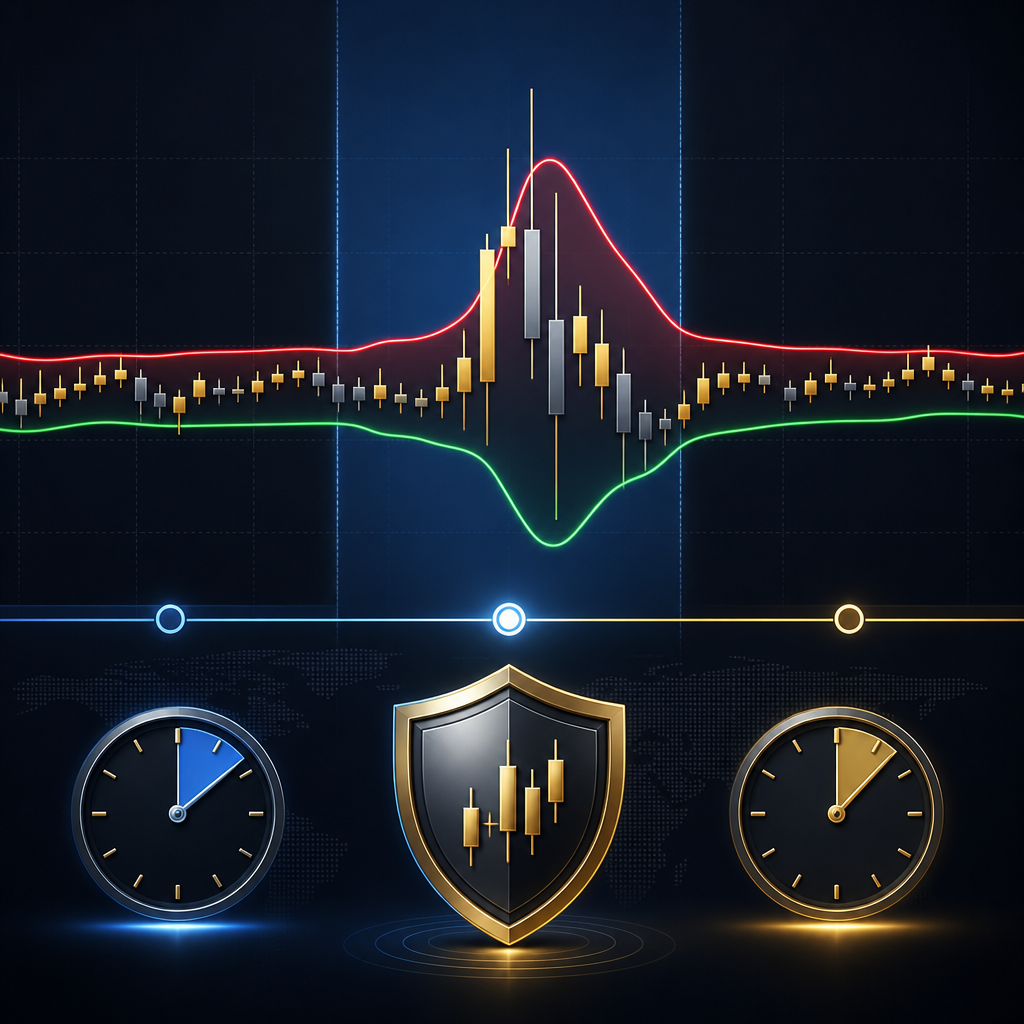
During news, your biggest enemy is often not direction. It’s the fill.
Gold can be at $2650 on the chart, but your broker may show a bid/ask that’s temporarily $2649.2 / $2651.4. That’s a $2.2 spread. On a fast candle, it can widen more.
This is why we use a spread filter XAUUSD rule—also called a spread guard. If spreads are too wide, you do not execute new trades, and you avoid modifying stops in the chaos.
Practical spread guard thresholds (realistic ranges)
Spread is broker-dependent, but here are realistic guidelines many serious traders use:
- Normal conditions: 10–25 points (roughly $0.10–$0.25 depending on platform quoting)
- High volatility but tradable: 25–45 points
- Red zone (no new entries): 45–70+ points
If you don’t know how your broker quotes XAUUSD points, test it on demo during a news event and record the max spread you see.
Why spread guards save you from “perfect analysis, bad P&L”
Let’s say your OCO buy stop triggers at $2660.0 with a $13 stop at $2647.0. In normal conditions, that’s reasonable.
But if spread is wide and you get slipped to $2662.5, your risk is no longer $13. It’s $15.5. Your 1:2 target becomes harder to reach, and your position sizing is now wrong.
Even worse: wide spreads can stop you out without price truly trading there on the mid-chart candle. It feels like a “stop hunt,” but it’s often just the bid/ask mechanics.
How to implement a spread guard (step-by-step)
- Step 1: Decide your maximum acceptable spread for news (example: 45 points).
- Step 2: Add a platform alert or watch the spread box (MT4/MT5 show it; many brokers also show it in the symbol properties).
- Step 3: If spread exceeds your threshold, you pause new entries and wait for normalization.
- Step 4: Only re-enable execution when spread stays below threshold for 30–60 seconds.
This single rule eliminates a huge percentage of “I got wicked out” stories.
For a broader risk framework when you’re following signals, keep our guide bookmarked: risk management strategies when using forex signals. The principles apply directly to gold.
Volatility Filters: When the Candle Is Too Fast to Trade
Spread is one filter. Volatility is the second.
There are moments on CPI where spreads look okay, but the candle speed is insane. You place an order, and the market moves $6 before your finger leaves the screen. That’s a volatility problem, not a spread problem.
Two simple volatility filters that work (without overcomplication)
1) 1-minute range filter
If the last completed 1-minute candle has a range above a threshold (example: $8–$12), you stand down for the next minute. You let the first impulse settle.
2) “Two-candle rule” after release
Wait for the first two 1-minute candles after the release to close. If the second candle holds direction (doesn’t fully retrace the first), then you consider executing the breakout continuation.
This reduces the chance you’re trading the initial stop sweep.
Why this matters at $2650
At current levels, gold is sitting in a zone where round-number behavior is common. $2650 is a magnet. During news, price can spike to $2662, snap back to $2648, then rip to $2680.
If you chase the first spike, you often become liquidity for the reversal. A volatility filter forces you to trade the second phase: the phase where the market either confirms or fails.
How to combine volatility filters with OCO orders
Here’s a practical approach:
- Place your OCO orders 5–10 minutes before news (only if spreads are normal).
- If the first 1-minute candle after release is above your “range threshold,” you do nothing—let the OCO sit but avoid manual interference.
- If you get triggered during the chaos, you accept that slippage can happen and manage risk smaller.
- If you don’t get triggered, you reassess after 2–3 minutes and decide whether to keep the OCO or cancel it.
The point is not to be “active.” The point is to be selective.
In our United Kings community (300K+ traders), the traders who last are the ones who treat news like a procedure, not entertainment. If you want daily execution structure beyond news days, start from the main United Kings signals hub and choose your market focus.
Kill-Zones: The Time Windows Where You Pause (and Why)
Most traders think kill-zones are only about “best times to trade.” For news, kill-zones are also about best times to not trade.
In a news-whipsaw plan, kill-zones define when you:
- Stop placing new orders
- Avoid moving SL to breakeven too early
- Pause signal execution (even if a setup looks tempting)
The three kill-zones we use for XAUUSD news events
Kill-Zone A: Pre-news freeze (T-15 to T-0)
Fifteen minutes before CPI/PPI/FOMC minutes, spreads can start widening and price can “pre-position.” This is when false breakouts are common.
Rule: No new discretionary entries. If you use OCO, it must already be placed and validated by spread/volatility rules.
Kill-Zone B: The first spike (T+0 to T+3 minutes)
This is the danger zone. Most stop runs happen here. Your job is to survive it.
Rule: No manual market orders. Let pending logic do its job. If you didn’t plan it, you don’t trade it.
Kill-Zone C: The re-price window (T+3 to T+15 minutes)
This is where the market decides whether the first move was real. Continuations and reversals both happen here, but they’re more tradable because spreads normalize and structure forms.
Rule: You can re-enable execution if spread and volatility filters pass. This is often the “professional window.”
How kill-zones align with London & New York sessions
United Kings focuses heavily on London and NY session trading because that’s when gold liquidity is deepest and signals are cleaner.
But on news, even those sessions can become chaotic. Kill-zones help you keep the same discipline regardless of time of day.
Example: A US CPI release during NY morning can create a 20-minute storm. If you treat the first 3 minutes as “untradable,” you instantly reduce the number of emotional, low-quality trades you take.
A simple kill-zone checklist you can screenshot
- Is this within T-15 to T+3 of a major release? Pause new entries.
- Is spread above threshold? Pause everything.
- Has price printed two 1-minute closes post-news? If yes, evaluate continuation.
- Are we back inside the pre-news range? If yes, cancel breakout orders and reassess.
This is what it means to have a plan that survives whipsaws.
Pre-News Mapping: Levels That Actually Matter on XAUUSD
OCO orders only work if you place them around meaningful levels. On gold, “meaningful” usually means levels where stops cluster and where large orders previously defended price.
At $2650, you’ll typically see sensitivity around:
- Round numbers: $2650, $2660, $2675
- Prior day high/low: e.g., $2668 high, $2632 low (example ranges)
- Asian session range: the high/low from roughly 00:00–06:00 UTC (varies by broker)
- London breakout points: the first expansion after London open
Step-by-step: Map levels in 7 minutes (fast routine)
- Step 1: Mark the Asian range high/low (example: $2657 / $2643).
- Step 2: Mark the prior day high/low (example: $2668 / $2632).
- Step 3: Mark the nearest clean swing high and swing low on H1 (example: $2676 swing high, $2624 swing low).
- Step 4: Identify the “decision zone” where price is currently sitting (example: $2648–$2652).
- Step 5: Choose OCO trigger levels beyond the range with a buffer (example: buy stop $2660, sell stop $2640).
That’s it. You don’t need 30 indicators. You need levels that other traders see.
What not to do (common pre-news mistakes)
- Don’t place triggers inside the range. That’s where noise lives.
- Don’t set SL too tight. A $5 stop on CPI is often a donation. Use $10–$25 depending on structure.
- Don’t widen SL “because news.” If you widen SL, you must reduce lot size to keep risk constant.
Pre-news mapping is boring. That’s why it works.
If you want a broader execution framework for following alerts (not only news), our guide on United Kings blog expands on daily routines, checklists, and timing.
Step-by-Step Signal Execution Plan (OCO + Guards + Kill-Zones)
Now let’s put it all together into a repeatable plan you can run on every CPI, PPI, or major Fed speaker.
This is the exact kind of “system thinking” professional traders use: you define rules before the adrenaline hits.
Phase 1: 60–30 minutes before news (Preparation)
- Check the calendar: identify the release time and expected volatility.
- Record current price context: XAUUSD ~$2650, DXY ~106.80, USD/JPY ~149.50.
- Mark levels: Asian high/low, prior day high/low, nearest H1 swing points.
- Decide if you’re trading the event or skipping it (skipping is a valid strategy).
Phase 2: 30–15 minutes before news (Build the box)
- Define the pre-news range box (example: $2643–$2657).
- Choose triggers with buffer (example: buy stop $2660, sell stop $2640).
- Set SL based on structure (example: $13–$20 away, not random).
- Set TP1 at 1:2 and TP2 at 1:3 if volatility supports it.
Phase 3: 15 minutes to release (Kill-Zone A: Freeze)
- Activate spread guard: if spread is above threshold, cancel plans.
- Stop manual trading. No “quick scalps.”
- Confirm your OCO orders are correct size and linked properly.
Phase 4: Release to +3 minutes (Kill-Zone B: Let it print)
- No market orders.
- No revenge modifications.
- If triggered, accept the fill and manage according to plan.
- If not triggered, wait for two 1-minute closes before changing anything.
Phase 5: +3 to +15 minutes (Kill-Zone C: Trade the re-price)
- If price breaks and holds beyond your trigger level, manage for continuation.
- If price snaps back into the box, consider canceling remaining pending orders.
- If spread normalizes and structure forms, you can execute a secondary setup (only if rules allow).
Phase 6: +15 to +60 minutes (Normalization)
- Trail stops only after structure forms (new higher low / lower high).
- Partial profits at TP1 reduce emotional pressure.
- Journal the event: spread max, slippage, what you followed, what you broke.
This plan is simple enough to follow under stress, but strict enough to protect you from the worst whipsaws.
Comparison Table: Market Orders vs OCO vs Waiting for Confirmation
Most losses on news come from choosing the wrong execution method, not the wrong direction. Here’s a clear comparison you can use to decide how you’ll trade the next CPI.
| Method | Best For | Main Risk | News Whipsaw Survival | Recommended? |
|---|---|---|---|---|
| Market order at release | Experienced traders with fast execution + deep broker trust | Massive slippage, spread spikes, emotional chasing | Low | No (most traders) |
| Single pending order | Directional bias setups (rarely clean on CPI) | Wrong-side sweep triggers you, then reverses | Medium-Low | Sometimes |
| OCO orders (buy stop + sell stop) | Two-scenario breakout plans around key levels | False breakouts if triggers too close; slippage still possible | High | Yes |
| Wait 2–3 minutes, then trade structure | Conservative traders; continuation or reversal after first spike | Misses the first move; fewer trades | Very High | Yes (especially beginners) |
Realistic Trade Scenarios at $2650: Two CPI Outcomes (With Numbers)
Let’s walk through two realistic CPI-style outcomes using the current context. These are not predictions. They’re execution examples that show how your plan behaves when the market gets violent.
Scenario 1: CPI hotter than expected (USD up, gold down)
Pre-news range is $2643–$2657. You place OCO triggers:
- Sell stop: $2640.0
- SL: $2653.0 (risk $13)
- TP1: $2614.0 (reward $26, 1:2)
- TP2: $2601.0 (reward $39, 1:3)
Release hits. Gold spikes up first to $2662 (stop sweep), then dumps hard. Your sell stop triggers at $2640.
Within 2 minutes, price trades $2622. You take partial profit near TP1 logic (maybe at $2618–$2614 depending on speed). You move SL only after a lower high forms (not instantly).
Key point: if you had sold market during the first spike, you probably would have been stopped. The OCO plan avoids the “first move trap.”
Scenario 2: CPI cooler than expected (USD down, gold up)
Same box. Same OCO triggers:
- Buy stop: $2660.0
- SL: $2647.0 (risk $13)
- TP1: $2686.0 (reward $26, 1:2)
- TP2: $2699.0 (reward $39, 1:3)
Release hits. Gold dumps first to $2638 (liquidity grab), then reverses violently. Your buy stop triggers at $2660 as the reversal confirms.
Price accelerates to $2682, pulls back to $2672, then pushes $2688. You scale at TP1 and let a runner attempt TP2 if spreads remain stable.
Key point: you didn’t need to predict direction. You needed a structure-based trigger plus risk control.
Where most traders sabotage these scenarios
- They move SL to breakeven too early and get tagged on the pullback.
- They cancel the “other side” manually and then regret it when the reversal happens.
- They increase lot size because “news is a big opportunity.”
News rewards discipline, not excitement.
Position Sizing for News: Keep Risk Constant Even When Stops Are Wider
On news, your stop often needs to be wider. That doesn’t mean your risk should be bigger. Your lot size must adapt.
Here’s the simplest way to think about it:
- If your stop doubles, your lot size should roughly halve (to keep the same $ risk).
- If spreads are unstable, reduce risk again (because effective risk increases via slippage).
A practical risk template for gold news trading
If you normally risk 1% per trade on calmer setups, consider this ladder:
- Beginner on news: 0.25% risk
- Intermediate: 0.50% risk
- Advanced with proven stats: 0.75%–1.00% risk (selectively)
Remember: CPI can produce a perfect setup and still slip you $2–$5. That slippage is part of your real risk.
Why constant risk is your “anti-tilt” weapon
Most blow-ups happen like this:
- Trader loses on the first whipsaw.
- Trader doubles size to “make it back.”
- Trader gets caught in the second whipsaw and wipes the week.
Constant risk breaks that cycle. One loss stays one loss.
If you’re building a long-term approach around signals, you’ll like our broader education on execution and discipline inside our forex signals and gold coverage. The market changes, but risk principles don’t.
Broker & Platform Reality: OCO on MT4/MT5, cTrader, and Workarounds
Not every platform supports true OCO orders the same way. Some brokers offer native OCO. Others require an EA, a script, or manual linking.
The goal is not to be “fancy.” The goal is to ensure you don’t end up filled on both sides during a spike.
Options for implementing OCO (practical)
- Native OCO (best): Platform/broker supports OCO linking directly.
- Pending + manual cancel (acceptable): Place both pendings; once one triggers, immediately cancel the other (only if spreads are normal and you can act fast).
- EA/script (common on MT4/MT5): Use an OCO management tool that cancels the opposite pending automatically.
“Spread guard” implementation by platform
- MT4/MT5: Watch spread in Market Watch; use alerts or EAs that block trading above X spread.
- cTrader: Many brokers show depth/spread clearly; you can set protective rules and use advanced order types.
- TradingView alerts + broker: Useful for level alerts, but execution still depends on broker integration.
The news execution truth nobody likes
Even with perfect tools, you can still get slipped. That’s why we combine:
- OCO entries (direction confirmation)
- Spread filters (fill quality)
- Kill-zones (timing discipline)
- Reduced risk (survival)
Tools don’t replace judgment. They support it.
If you want help aligning your platform setup with real signal execution, our Telegram community is where traders share broker-specific tips and templates daily: United Kings Telegram trading community.
Post-Entry Management: How to Avoid Getting Shaken Out After You’re Right
Getting the entry right on news is only half the battle. The other half is not getting shaken out by the first pullback after the spike.
Gold loves to do this: break out $10, pull back $6, then continue another $20. If you move SL too aggressively, you’ll be right and still lose.
Three post-entry rules that work on XAUUSD news days
1) Partial profit at 1:1 or 1:1.5 (optional)
On news, you can reduce pressure by taking a small partial earlier than usual. Example: if you risk $13, consider taking 20–30% off around +$13 to +$20 if volatility is extreme.
2) Move SL based on structure, not emotion
Instead of “SL to BE when I’m +$5,” use: SL to BE only after a new higher low (for buys) or lower high (for sells) forms on M1/M5.
3) Use time stops if price stalls
If you’re in a breakout trade and after 10–15 minutes price is back inside the pre-news box, the breakout may be failing. Exiting early can be smarter than hoping.
Example management on a buy from $2660
- Entry: $2660
- SL: $2647
- Price spikes to $2678, pulls back to $2670, then prints a higher low at $2671.
- Now you can consider moving SL up (maybe to $2656–$2660 depending on structure).
This keeps you in the trade while the market breathes.
Don’t confuse “tight management” with “good management”
Tight management feels professional. But on news, it often just guarantees you get tapped out.
Professional management is rule-based. It’s boring. It’s consistent.
Common Mistakes That Cause News Whipsaw Losses (And the Fix)
Let’s call out the patterns that wipe traders out during CPI/PPI/Fed speaker days. If you recognize yourself in any of these, good—because it means you can fix it fast.
Mistake #1: Trading inside the pre-news range
This is the “I’ll scalp a quick $3” mindset. On news day, that $3 scalp can turn into a $15 drawdown instantly.
Fix: Only trade beyond the box with confirmation (OCO triggers + buffer).
Mistake #2: Ignoring spread
You can have the perfect level and still lose because your fill is trash.
Fix: Hard spread guard. If spread is above threshold, you do nothing.
Mistake #3: Widening SL without reducing lot size
This is how a “normal” 1% risk turns into 2%–3% risk without you realizing it.
Fix: If SL increases from $10 to $20, reduce lot size roughly by half.
Mistake #4: Canceling the opposite pending too early
News loves to fake one way and go the other. Canceling early is basically saying, “I’m sure now.”
Fix: Let OCO do its job. If you must intervene, do it only after 2–3 minutes and structure confirmation.
Mistake #5: Overtrading the aftermath
After a wild CPI candle, traders feel like they must “make something happen.” That’s when you take low-quality setups.
Fix: Define a max trades rule for the event (example: 1–2 trades total). After that, you stop.
These fixes sound simple, but they’re powerful because they address the real enemy: your execution under stress.
How United Kings Signals Fit This Plan (Without Overpromising)
A good signal is not just “buy” or “sell.” For news trading, a useful signal must be structured so you can execute with rules.
At United Kings, we focus on:
- Clear Entry, SL, TP levels so you can place pending/OCO logic cleanly.
- London & NY session focus where liquidity is strongest and execution is typically cleaner.
- Education alongside signals so you understand the why, not just the what.
- Community scale with 300K+ active traders sharing execution feedback and broker conditions.
We also maintain a performance-driven culture. Many traders join because they’re looking for a premium Telegram experience with a historically strong win-rate profile (often cited as 85%+), but it’s important to say this clearly: no win rate eliminates risk, and no provider can guarantee profits—especially on news.
What we can do is help you trade like a pro: define the plan, execute it consistently, and manage risk so one event doesn’t take you out.
If you’re comparing providers, use our due-diligence resource: forex trading signals provider checklist. It will save you from hype-driven decisions.
FAQ: XAUUSD News Trading Plan, OCO Orders, and Spread Filters
What is the best XAUUSD news trading plan for CPI?
The most robust approach is a two-scenario breakout plan using OCO pending orders beyond the pre-news range, combined with a spread filter and strict kill-zones (no manual trading in the first minutes).
Do OCO orders work on gold during high volatility?
Yes, but they don’t remove slippage risk. OCO helps you avoid guessing direction and reduces the chance of getting trapped by the first fake move, especially if your triggers include a buffer beyond key levels.
What spread filter XAUUSD threshold should I use?
It depends on your broker, but many traders treat 45+ points (or the equivalent on your platform) as a “no new entries” zone during news. The best method is to demo-test your broker during CPI and record typical spread spikes.
Should beginners trade gold during Fed speakers and CPI?
Beginners should start on demo and consider waiting 2–3 minutes after the release before trading. If you trade it live, reduce risk (0.25%–0.50%) and follow a strict checklist to avoid emotional decisions.
How do I join United Kings gold signals?
You can explore our premium offerings on the United Kings gold signals page and the broader signals overview. For plan details, see United Kings pricing.
Risk Disclaimer (Read Before You Trade News)
Risk warning: Forex and gold (XAUUSD) trading involves significant risk and may not be suitable for all investors. News events can cause rapid price movements, widened spreads, and slippage that can exceed your planned risk. Past performance does not guarantee future results. No signal provider can guarantee profits. If you are new, practice on a demo account first and use strict risk management.
Final CTA: Trade News Spikes with a Plan (Not Panic)
If you’re serious about trading gold around CPI, PPI, and Fed speakers, the edge isn’t a secret indicator. It’s execution discipline: OCO entries, spread guards, kill-zones, and consistent risk.
When you’re ready to stop improvising and start executing premium-level setups with clear Entry/SL/TP guidance, join the United Kings community.
- 300K+ active traders
- Premium Telegram forex & gold signals with structured levels
- Educational support alongside signals
- 3 plans: Starter (3 Months $299), Best Value (1 Year $599 with 50% savings + FREE ebook), Unlimited (Lifetime $999)
- 48-hour money-back guarantee
Explore plans on our pricing page, then join us on Telegram: United Kings signals channel.
News will always be volatile. With the right playbook, it doesn’t have to be deadly.