
Ever felt like CPI day turns your “perfect” XAUUSD setup into a 40-dollar whipsaw in 60 seconds?
You’re not imagining it.
Inflation releases like US CPI and Core PCE are built to move the dollar, real yields, and therefore gold.
And on days like today—XAUUSD hovering around $2650 (+0.35% over 24h), DXY near 106.80, USD/JPY around 149.50—the market is already “tight” and reactive.
This guide is a repeatable, rule-based playbook for trading CPI and PCE on XAUUSD and major USD pairs without donating to the first spike.
We’ll use a 3-Phase Signal Filter: Pre-Release (build bias), Spike (avoid traps), Reversal/Continuation (confirm structure).
TL;DR — CPI & PCE News Trading Playbook (3-Phase Filter)
- Phase 1 (Pre-Release): Build a bias using DXY + yields proxy behavior, key levels, and London/NY structure—not your feelings.
- Phase 2 (Spike): Don’t market-buy the first candle. Wait for spreads to normalize and for a 2-step confirmation (break + retest or sweep + reclaim).
- Phase 3 (Reversal/Continuation): Trade the post-news structure with defined SL/TP rules (gold SL typically $10–$25, target 1:2 to 1:3).
- Gold (XAUUSD) reacts to real yields: Hot inflation usually pressures gold first, then the second move often reverses if positioning is crowded.
- Best execution windows: London pre-positioning + NY release + 15–45 minutes after when structure becomes tradable.
- Signals help when rules are strict: You want clear Entry/SL/TP and a community to avoid impulse trades—exactly how we trade at United Kings.
Why CPI & Core PCE Move XAUUSD and USD Pairs So Violently

CPI and Core PCE aren’t just “news.”
They’re the market’s fastest way to reprice Fed expectations.
And Fed expectations are the market’s fastest way to reprice the dollar (DXY) and real yields.
Gold is extremely sensitive to those two forces.
When inflation prints hotter-than-expected, traders often assume the Fed stays tighter for longer.
That tends to lift the dollar and yields, which can push XAUUSD lower in the first reaction.
But here’s the trap.
Gold is also a macro hedge, and it trades positioning and liquidity as much as it trades “logic.”
So the first move can be a liquidity hunt—especially when price is sitting around obvious levels like $2650, with round numbers above ($2660/$2670) and below ($2640/$2630).
Core PCE is even more “Fed-relevant” because it’s the inflation measure the Fed references most.
That means Core PCE can create a cleaner trend day than CPI.
But it can also create a deeper fakeout if the market has already priced the outcome.
Today’s context: why the current tape matters
With DXY at 106.80, USD is not weak.
With USD/JPY around 149.50, yen weakness is still a theme and volatility can spike on any shift in yields.
EUR/USD near 1.0520 and GBP/USD near 1.2680 tell us USD demand is still present, even if intraday swings happen.
In this kind of environment, CPI/PCE can produce two-move days:
- Move 1: headline reaction (spike + spread widening).
- Move 2: the “real move” once liquidity is collected and structure forms.
The goal of this playbook is to put you on the second move more often.
The 3-Phase Signal Filter: The Framework We Use (and Why It Works)
Most traders lose on CPI/PCE for one reason.
They try to trade an information event like it’s a normal technical setup.
News trading needs a different lens: liquidity first, structure second, direction third.
Our 3-Phase Signal Filter forces that order.
Phase 1 — Pre-Release (Build a tradable bias)
This is not “predict the number.”
This is “prepare the map.”
You define key levels, likely liquidity pools, and what price must do after the release to confirm direction.
Phase 2 — Spike (Avoid the first liquidity sweep)
The first 30–120 seconds often exist to:
- Trigger breakout entries.
- Hit tight stop losses.
- Fill institutions at better prices.
We treat the spike as data, not a signal.
Phase 3 — Reversal/Continuation (Trade the post-news structure)
After the spike, the market leaves clues.
It either holds a break and trends, or it fails and reverses.
This is where you can trade with defined risk: $10–$25 SL on gold and a 1:2 or 1:3 target.
Who this playbook is for (and who it’s not)
This framework is built for traders who want repeatable execution.
It works whether you trade manually or follow premium alerts, as long as you respect the filter.
If you need to be in the market every second of the release, this will feel “slow.”
But slow is often what survives CPI.
Phase 1 (Pre-Release): Build Bias Without Guessing the Print
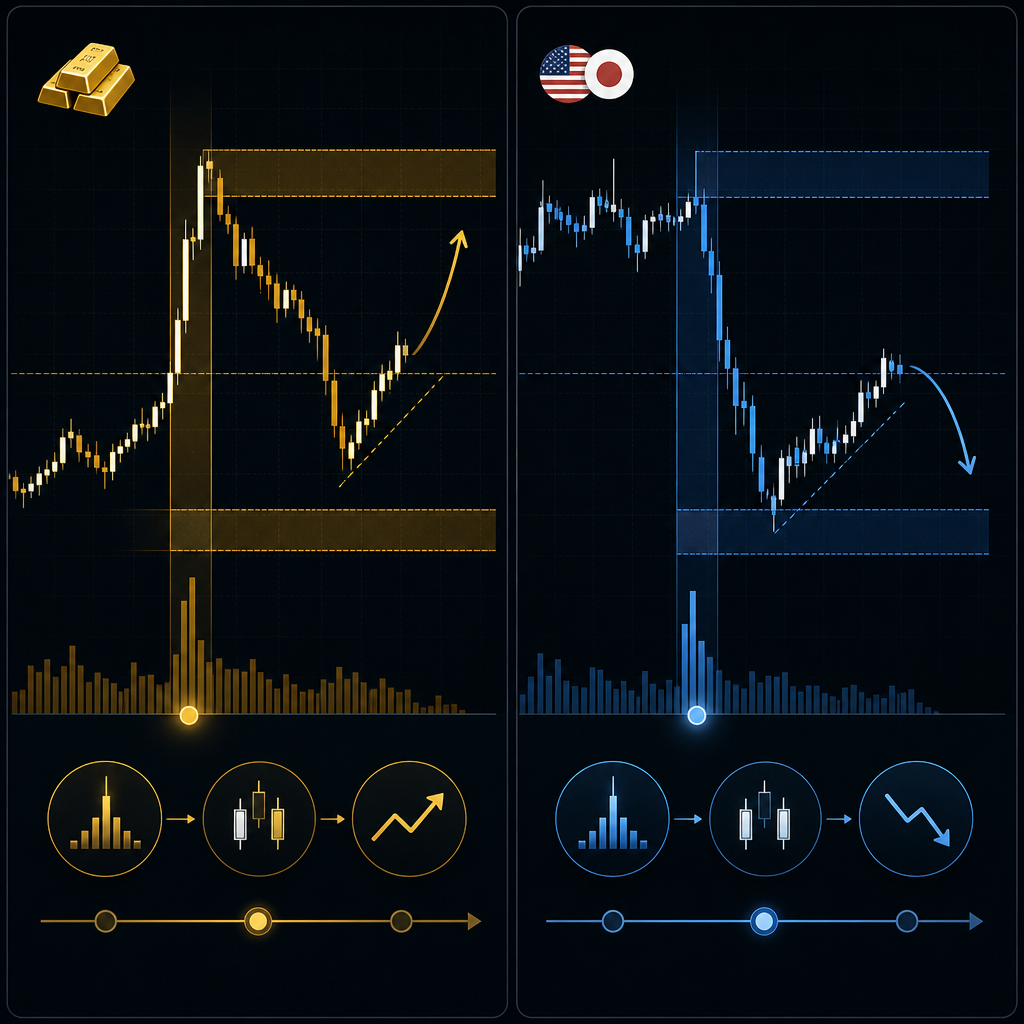
The smartest CPI/PCE traders don’t guess the number.
They define if-then scenarios using price, levels, and positioning.
That’s how you stop CPI from turning into gambling.
Step-by-step pre-release checklist (30–60 minutes before)
Step 1: Mark the “news box.”
On XAUUSD, draw the last 4 hours high/low into the release.
Let’s say gold is ranging between $2642 and $2663 ahead of CPI.
That 21-dollar box is your first map.
Step 2: Mark the obvious liquidity levels.
- Round numbers: $2650, $2660, $2670.
- Prior day high/low: for example $2684 and $2620.
- Session highs/lows: London high, Asian low.
On CPI day, price often sweeps one side of the range before committing.
Step 3: Build a dollar bias using DXY and USD/JPY behavior.
You don’t need the bond market on your screen.
In practice, DXY and USD/JPY can act as “yields proxies” intraday.
If DXY is grinding higher into the event (near 106.80) and USD/JPY is holding 149.50 or pushing up, the market is leaning USD-bullish.
That doesn’t mean CPI must be hot.
It means positioning risk is skewed.
Step 4: Define your two scenarios (A and B).
- Scenario A (USD bullish): Gold breaks below $2642, retests from below, then continues to $2622 or $2615.
- Scenario B (USD bearish): Gold breaks above $2663, retests, then runs to $2685 or $2690.
Notice what we did.
We didn’t predict CPI.
We predicted what we’ll do after the market shows its hand.
Pre-release timeframes that actually help
Use higher timeframes for levels, lower timeframes for triggers.
- H1/H4: major support/resistance and trend.
- M15: the “news box” range.
- M1–M5: only for post-news confirmation, not pre-news overtrading.
If you want a deeper foundation on how liquidity behaves around these levels, pair this playbook with our guide on market liquidity and signal-based trading (browse related posts and concepts there).
Phase 2 (The Spike): How to Avoid Whipsaws, Slippage, and Spread Traps
The CPI/PCE spike is where most accounts bleed.
Not because the direction is impossible.
Because execution breaks down.
What the spike is really doing
In the first seconds after release, liquidity providers widen spreads.
Market orders get filled worse than expected.
Stops get hit even if your analysis is correct.
That’s why we treat the spike as a filter, not a trade.
Rules for Phase 2 (non-negotiable)
- No market orders in the first 30–60 seconds.
- No tight stops under $8–$10 on gold during news volatility.
- No revenge trades if you miss the move—Phase 3 is where the edge lives.
The “Two-Candle Rule” (simple, effective)
Wait for:
- Candle 1: the impulse spike (often oversized).
- Candle 2: the response candle (does it hold or reject?).
If Candle 2 fully retraces Candle 1, you’re likely in a whipsaw environment.
If Candle 2 holds most of Candle 1 and price forms a base, you may have continuation.
Gold example: spike down then reclaim (classic trap)
Assume XAUUSD is at $2650 pre-release.
CPI prints hot, and gold spikes down to $2632 in seconds.
Retail sells the breakdown.
Then price snaps back above $2642 and reclaims $2650.
That reclaim is information: the breakdown may have been liquidity collection.
USD pair example: EUR/USD false break
EUR/USD at 1.0520 might spike to 1.0495 then reverse to 1.0540.
If you sold the first break with a 10–15 pip stop, you likely got clipped.
If you waited for structure, you could have traded the reversal with defined risk.
Comparison table: three ways traders approach CPI/PCE
| Approach | When you enter | Pros | Cons | Best for |
|---|---|---|---|---|
| Instant breakout | First 5–15 seconds | Catch the full move if lucky | High slippage, spread traps, stop hunts | Advanced traders with fast execution |
| 3-Phase Signal Filter | After spike + confirmation | Lower whipsaw rate, clearer invalidation | May miss the first 10–20% of move | Signal followers and rule-based traders |
| No-news trading | 2–24 hours after | Normal spreads, cleaner charts | Miss volatility opportunities | Swing traders, beginners |
Phase 3 (Reversal/Continuation): The Post-Release Structure That Pays
Phase 3 is where CPI/PCE becomes tradable.
The spike creates extremes.
Then the market chooses: accept the new price or reject it.
Your job is to trade that acceptance/rejection with rules.
The two post-news patterns we focus on
1) Break-and-retest continuation
Price breaks a key level, then retests it with smaller candles and holds.
That’s your entry trigger.
2) Sweep-and-reclaim reversal
Price sweeps a high/low, then closes back inside the range and reclaims the midpoint.
That’s your reversal trigger.
XAUUSD continuation example (risk-defined)
Pre-release box: $2642–$2663.
After CPI, gold breaks below $2642 and prints $2630.
Then it retests $2642 from below and rejects.
A rule-based sell could look like:
- Entry: $2638 (after retest rejection)
- Stop loss: $2653 (15 dollars risk)
- Take profit 1 (1:2): $2608 (30 dollars)
- Take profit 2 (1:3): $2593 (45 dollars) — only if volatility supports it
In today’s guideline range, you can adjust targets to realistic levels like $2620 and $2610 if the move is smaller.
The key is the structure: break, retest, rejection.
XAUUSD reversal example (the “reclaim $2650” trade)
Gold spikes down to $2632 then reclaims $2642 and $2650.
Now you wait for a pullback to hold above reclaimed levels.
- Entry: $2652 (after hold above $2650)
- Stop loss: $2639 (13 dollars risk)
- Take profit (1:2): $2678 (26 dollars)
- Stretch (1:3): $2691 (39 dollars)
That’s how you turn CPI chaos into a structured trade.
FX pair example: USD/JPY continuation after CPI
USD/JPY at 149.50 spikes to 150.20.
Instead of chasing, you wait for a retest of 149.90–150.00.
If it holds, you can target a continuation leg while keeping a defined invalidation.
This is especially relevant when DXY is firm near 106.80.
Pre-Release Bias for XAUUSD: Levels, Sessions, and “Where Stops Live”
Gold trades like a magnet around liquidity.
On CPI/PCE, that magnet effect gets stronger.
Your pre-release job is to identify where stops are clustered so you’re not surprised by the sweep.
Key gold levels to track in the $2610–$2690 zone
Using the current context (XAUUSD ~ $2650), here’s a clean way to map levels:
- Immediate pivot: $2650 (psychological + often a midpoint)
- Near resistance: $2663–$2668 (range high / intraday supply)
- Upper targets: $2684–$2690 (prior swing / round number)
- Near support: $2642–$2638 (range low / demand)
- Lower targets: $2622–$2610 (prior low zone)
These are not magic numbers.
They’re decision points where CPI/PCE often forces acceptance or rejection.
Session behavior: why London and NY matter most
United Kings focuses heavily on London and NY session trading because that’s where liquidity is deepest.
On CPI/PCE days, London often sets the trap.
NY often triggers the real move.
That means your pre-release bias should include:
- Where London built the range.
- Whether London trended or chopped.
- Whether price is sitting at the top/bottom of that range into the release.
The “where stops live” concept (simple version)
Stops tend to cluster:
- Above obvious highs (like $2663).
- Below obvious lows (like $2642).
- Just beyond round numbers ($2670, $2630).
On CPI/PCE, the first spike often runs one of those clusters.
That doesn’t mean the trend is real.
It means liquidity was collected.
How we integrate this into signals
In our premium gold signals, you’ll usually see entries placed after the market shows acceptance.
We prefer confirmation over prediction, especially around CPI and Core PCE.
That’s one reason our community sticks to a ruleset rather than chasing candles.
USD Pairs on CPI/PCE: Which Ones Behave Best (and Why)
Not all USD pairs react the same way to inflation news.
Some pairs trend cleanly.
Others whipsaw because both currencies have competing narratives.
With EUR/USD at 1.0520, GBP/USD at 1.2680, and USD/JPY at 149.50, here’s how to think about CPI/PCE selection.
USD/JPY: the “yield amplifier”
USD/JPY is highly sensitive to rate differentials.
When CPI/PCE shifts yield expectations, USD/JPY can trend hard.
But it can also spike violently and reverse if there’s policy risk or intervention fear.
That means you trade it with the same 3-phase filter and slightly wider breathing room.
EUR/USD: the “positioning battlefield”
EUR/USD can whipsaw because the euro has its own rate narrative.
Still, CPI/PCE can create clean moves when the USD side dominates.
On a hot print, a move from 1.0520 down toward 1.0480 is plausible intraday.
On a cool print, a squeeze toward 1.0560–1.0580 can happen quickly.
GBP/USD: the “emotion pair”
GBP/USD often moves like EUR/USD but with extra volatility.
From 1.2680, CPI/PCE can push it 60–120 pips on a strong surprise.
That’s opportunity, but only if you avoid the spike trap.
Pair selection rule for signal followers
If you’re following forex signals during CPI/PCE, don’t try to trade everything.
Pick one “A pair” and one “B pair.”
- A pair: USD/JPY (if yields theme is dominant) or XAUUSD (if you specialize in gold)
- B pair: EUR/USD or GBP/USD (whichever has cleaner structure pre-release)
Fewer instruments means better execution and fewer emotional decisions.
SL/TP Rules for CPI & PCE: Risk Management That Survives Volatility
CPI/PCE doesn’t just test your strategy.
It tests your risk model.
Even a great entry can lose if your stop is placed where the spike naturally hunts.
Gold SL rules (XAUUSD)
For gold in the $2610–$2690 zone, a practical CPI/PCE stop is often:
- $10–$15 for post-confirmation entries in calmer conditions.
- $15–$25 when volatility is elevated and spreads are jumpy.
The stop should sit beyond the structure that invalidates your idea.
Not “as tight as possible.”
FX SL rules (pip guidance)
For majors during CPI/PCE, stops depend on the pair:
- EUR/USD: often 15–35 pips for post-news structure trades.
- GBP/USD: often 20–45 pips.
- USD/JPY: often 20–50 pips depending on volatility.
These are guidelines, not fixed rules.
Your structure and timeframe decide the final number.
TP rules: why 1:2 is the baseline
On CPI/PCE, you want asymmetric payoff because win rate can dip.
A 1:2 risk-reward allows you to be wrong more often and still grow.
A 1:3 is possible on trend days, but only when structure supports continuation.
Position sizing: the simplest safe approach
Decide your account risk per trade first.
Many disciplined traders use 0.5% to 1% risk per CPI/PCE setup.
Then calculate lot size based on stop distance.
If you want a full framework, keep our risk guide bookmarked: risk management strategies when using forex signals.
Trade management rule that reduces stress
- At +1R, consider moving SL to breakeven only if structure supports it.
- At TP1, consider partials (e.g., 50%) and let the rest target the next level.
This prevents “winner to loser” outcomes that are common on news days.
Execution: Orders, Timing, and How to Reduce Slippage on News
On CPI/PCE, your strategy can be correct and your fill can still ruin the trade.
So execution is part of the edge.
Market vs limit orders during CPI/PCE
Market orders are dangerous during the spike because spreads widen.
Limit orders can be better, but only after structure forms, otherwise you get filled in the middle of chaos.
A practical approach is:
- Wait for Phase 2 to finish.
- Enter Phase 3 using a limit on the retest, or a stop order after a confirmed break (depending on broker conditions).
Timing windows that work (realistic)
- 0–1 minute after release: observation only (spike).
- 1–5 minutes: look for reclaim or acceptance; no rush.
- 5–15 minutes: best window for first structured entry (break/retest or sweep/reclaim).
- 15–45 minutes: continuation legs and secondary entries if trend persists.
This is how you avoid being the liquidity for someone else’s fill.
Broker reality: spreads and freezes
Some brokers widen gold spreads aggressively on CPI/PCE.
That can turn a $12 stop into a stopout even if price never truly invalidated.
So your plan must include buffer and patience.
If you’re building a signal-following routine, keep your setup simple and consistent.
That’s also why many traders prefer structured alerts from a provider rather than improvising mid-spike.
Signal execution tip: don’t “edit” the plan emotionally
If your signal says Entry $2652, SL $2639, TP $2678, your job is to execute or skip.
It’s not to “improve it” by tightening SL to $2646 because you’re scared.
That’s how good signals turn into bad outcomes.
Putting It Together: A Full CPI/PCE Trade Blueprint (XAUUSD + USD Pair)
Let’s walk through a realistic example using the current market context.
We’ll use XAUUSD around $2650, DXY 106.80, and USD/JPY 149.50.
Blueprint Part 1: Pre-release plan (Phase 1)
You mark:
- Gold range: $2642–$2663.
- Key pivots: $2650, $2670, $2630.
- Targets: $2684–$2690 up, $2622–$2610 down.
You observe DXY holding firm near 106.80.
You note USD/JPY stable near 149.50.
Bias: mild USD strength, but you will only trade after confirmation.
Blueprint Part 2: The spike (Phase 2)
CPI releases.
Gold spikes up first to $2672, then dumps to $2640.
That’s classic two-way liquidity.
You do nothing for the first minute.
You watch whether price accepts below $2642 or reclaims above $2650.
Blueprint Part 3: The trade (Phase 3)
Price reclaims $2650 and holds.
You wait for a pullback to $2652–$2650 and a bullish close on M5.
Trade plan:
- Buy Entry: $2652
- SL: $2639 (13 dollars)
- TP1: $2678 (26 dollars, 1:2)
- TP2: $2688 (36 dollars, ~1:2.7)
Meanwhile, you check USD/JPY.
If USD/JPY fails to hold gains and rolls over below 149.30, that supports USD weakness and strengthens the gold long thesis.
What if the opposite happens?
If gold breaks below $2642, retests, and rejects, you flip to the short blueprint.
The filter doesn’t care about ego.
It cares about structure.
Where United Kings signals fit in
Most traders struggle with the “wait” part.
That’s where a disciplined signal framework helps.
If you want alerts designed for real trading conditions (Entry, SL, TP), explore our United Kings signals and especially our XAUUSD-focused gold signals.
Common CPI/PCE Mistakes (and the Fix for Each)
If you’ve lost money on CPI/PCE before, it’s usually one of these.
The good news is each mistake has a clean fix.
Mistake 1: Trading the number, not the chart
You see “hot CPI” and smash sell on gold.
But gold was already oversold and sitting on demand at $2638–$2642.
Fix: trade acceptance/rejection, not headlines.
Mistake 2: Stops too tight for news volatility
A $6 stop on gold during CPI is often a donation.
Fix: use a stop beyond structure, typically $10–$25 depending on conditions.
Mistake 3: Overtrading multiple pairs
You trade XAUUSD, EUR/USD, GBP/USD, USD/JPY all at once.
You can’t manage it, and you end up reacting emotionally.
Fix: pick one or two instruments and execute the filter.
Mistake 4: Moving the goalposts mid-trade
You enter long gold at $2652 targeting $2678.
At $2666 you panic and close.
Then it runs to $2685 without you.
Fix: define TP1/TP2 before entry and stick to it.
Mistake 5: Ignoring the second move
You miss the spike and think the day is over.
But the best Phase 3 setups often appear 10–30 minutes later.
Fix: schedule your trading window and be present for structure.
If you want more context on how gold behaves when news surprises hit, read: how gold signals react to unexpected news events.
How to Use Forex Signals During News Without Blindly Copying
“Forex signals during news” can be powerful.
They can also be dangerous if you treat them like a copy-paste lottery ticket.
The right way is to combine signals with a simple execution protocol.
The Signal-Follower Protocol (news edition)
1) Confirm the phase.
Is the signal meant for the spike or the post-news structure?
At United Kings, we aim for clarity so you know whether it’s a continuation entry or a reversal setup.
2) Check your spread and platform stability.
If gold spread is abnormally wide, you either reduce size or wait for normalization.
3) Match the signal’s stop distance to your account risk.
Don’t change SL because you want bigger lot size.
Change lot size because SL is part of the strategy.
4) Use alerts, not adrenaline.
Set price alerts at key levels like $2650, $2663, $2642.
Then let the market come to you.
Why community matters on CPI/PCE days
News days are psychological pressure cookers.
A serious community helps you stay consistent.
United Kings has 300K+ active traders sharing execution notes, session context, and education alongside the signals.
That combination is how you build skill, not dependency.
Where to start if you’re new
If you’re still building confidence, start with demo trading on CPI/PCE.
Then transition to small risk once you can follow the filter without breaking rules.
For a beginner-friendly foundation, you can also read: how to use forex signals on Telegram (beginner guide).
FAQ: CPI & PCE News Trading Strategy for XAUUSD and USD Pairs
1) Is CPI or Core PCE better for trading XAUUSD?
Both can move gold hard.
Core PCE is often more directly tied to Fed messaging, while CPI can create bigger initial spikes due to broader media focus.
Use the same 3-phase filter for both.
2) How long should I wait after CPI to trade?
Typically 1–5 minutes minimum to let the spike settle.
Many of the cleanest Phase 3 entries appear in the 5–15 minute window after release.
3) What stop loss is reasonable for gold during CPI/PCE?
For post-confirmation trades, many setups use $10–$25 depending on volatility and structure.
Too tight increases stop hunts; too wide ruins position sizing.
4) Can I trade CPI with a small account?
Yes, but only with strict risk control.
Keep risk per trade small (often 0.5%–1%), avoid overtrading, and consider demo practice first.
5) Do signals work during CPI and PCE?
Signals can help if they’re built around structure and risk rules.
No provider can remove risk or guarantee outcomes, especially during high-impact news.
The advantage is clarity: defined Entry/SL/TP and a repeatable framework.
Risk Disclaimer (Read This Before Trading CPI/PCE)
Forex and gold trading involves significant risk and may not be suitable for all investors. CPI and Core PCE releases can cause rapid price swings, slippage, and wider spreads. Past performance does not guarantee future results. No strategy or signal can guarantee profits. If you’re new, consider practicing on a demo account first and use strict risk management.
Join United Kings: Premium CPI/PCE-Ready Gold & Forex Signals
If you want CPI/PCE trades with clear Entry, SL, and TP levels, plus a community that trades the real sessions (London + NY), United Kings is built for you.
We provide premium Telegram signals for gold and major forex pairs, with a process designed to reduce impulse decisions on high-volatility days.
- 85%+ win rate target with disciplined execution (no guarantees, just a proven process)
- 300K+ active traders in the community
- Educational content alongside signals so you improve, not just follow
- 48-hour money-back guarantee for peace of mind
Start here based on what you trade most:
- Get United Kings Gold Signals (XAUUSD)
- Get United Kings Forex Signals (USD pairs)
- View all United Kings Signals
Want pricing options first?
We offer 3 plans: Starter (3 Months $299), Best Value (1 Year $599 with 50% savings + FREE ebook), and Unlimited (Lifetime $999).
See the full breakdown on our United Kings pricing page.
And if you want the fastest access to the community and live updates, join our Telegram now: United Kings official Telegram channel.
Your next CPI/PCE day doesn’t need to be chaos. Use the 3-phase filter, trade the structure, and let disciplined signals do the heavy lifting.