
Ever watched gold rip 20–30 dollars in one direction… right before the London close… and then snap back like nothing happened?
If you trade XAUUSD long enough, you’ll see this pattern repeat. The move looks “obvious” in hindsight, but in real time it’s noisy, emotional, and full of late-session whipsaws.
This guide is a London close reversal XAUUSD playbook built for signal-based execution. We’ll use strict time filters, structure confirmation, and volatility rules so you’re not guessing.
TL;DR (London Close Reversal Strategy for XAUUSD)
- Best window: Focus on the last 60–120 minutes before the London close and the first 30–60 minutes after, when positioning shifts and liquidity thins.
- Core idea: Fade exhaustion into a key level (prior high/low, session extreme, supply/demand) only after a structure break + retest.
- Time filter saves you: If the reversal hasn’t confirmed by your cutoff time, you skip—no “hope trades” into NY chop.
- Stops and targets: For XAUUSD around $2650, typical SL is $10–$25; targets aim 1:2 to 1:3 (e.g., risk $15 to make $30–$45).
- Volatility filter: Avoid entries when spreads widen or candles become erratic (common around unscheduled headlines and late-session illiquidity).
- Signals + rules: A signal is the “what.” This article gives you the “when” and “how” so execution stays consistent.
Why London Close Reversals Happen in XAUUSD (and Why Traders Misread Them)

Gold is a global market, but it behaves differently depending on who is active. London is a heavyweight for metals flow, and the transition into the New York afternoon often changes the order book.
When London approaches the close, you frequently see:
- Position squaring from intraday desks.
- Stop runs above/below obvious session highs/lows.
- Liquidity thinning that exaggerates moves.
- NY-only flow taking control after London steps back.
In the current context, gold is trading around $2650.00 (+0.35% on the day). The Dollar Index is around 106.80, with USD/JPY near 149.50—a backdrop that often keeps gold reactive to USD swings and real-rate expectations.
Here’s the trap. Traders see a late London push (say, from $2652 to $2678) and assume “breakout continuation.” Then price tags $2682, stalls, and dumps to $2660 in 20 minutes.
That dump isn’t random. It’s often a combination of stop-hunt + exhaustion + a shift in who is providing liquidity.
Another reason traders misread it is timeframe mismatch. The move looks huge on M1 and M5, but on M15 it might be a wick into a daily supply zone. On H1 it may be a clean rejection of a prior swing high.
So the London close reversal isn’t “magic.” It’s a behavioral pattern that shows up when (1) price is extended into a known level, (2) late-session liquidity invites stop runs, and (3) structure flips.
Our job is to trade it like a system. That means time windows, confirmation rules, and risk parameters—especially if you’re executing from United Kings gold signals and want to avoid taking every alert at the worst possible moment.
Define the London Close Window (Time Filters That Actually Matter)
A “London close strategy” fails when traders can’t define the close. We need a repeatable time box that matches how gold liquidity shifts.
For XAUUSD, we treat the London close as a process window, not a single minute.
Our practical London close windows for XAUUSD
- Pre-close build-up: last 120 minutes before London close.
- Execution window: last 60 minutes before London close through the first 30 minutes after.
- Hard cutoff: if confirmation hasn’t occurred by 60 minutes after London close, we stand down.
Why the cutoff? Because late NY can turn into range chop. You’ll see $6–$12 oscillations that look tradable, but spreads, slippage, and random spikes eat your edge.
Time filters are not optional. They’re the difference between trading a known behavioral pattern and gambling on random candles.
Time filter rules (simple and strict)
- Rule 1: Only consider reversal setups if price has made a new session extreme within the last 90 minutes (e.g., new high at $2682 or new low at $2622).
- Rule 2: Only enter after a structure break + retest (details below). No “first touch” entries.
- Rule 3: If price is still making new highs/lows into the final 10–15 minutes, you wait. Let the stop run finish.
- Rule 4: If spreads widen or your broker’s execution becomes inconsistent, you reduce size or skip.
These rules help you align signal execution with market microstructure. If you want a broader session framework, pair this with our session-based guidance in the United Kings blog and your existing routine.
Most traders don’t lose because their “idea” is wrong. They lose because they trade the idea at the wrong time of day.
What Counts as “Exhaustion” on XAUUSD Near the London Close?
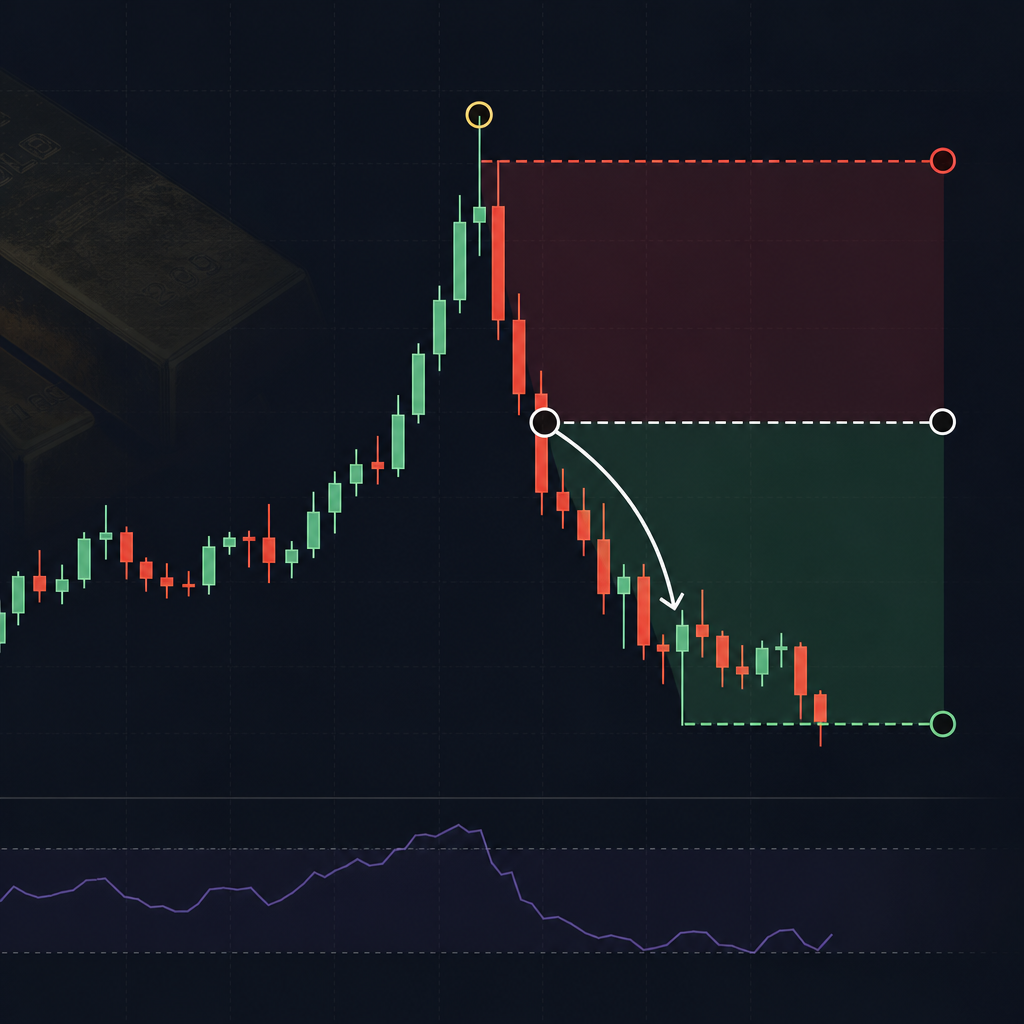
Exhaustion is a word traders throw around, but we need definitions you can apply quickly—especially if you’re reacting to a Telegram alert.
On gold around $2650, exhaustion near London close usually shows up as one of three signatures:
1) Displacement spike into a level (the “last push”)
Price accelerates into a prior high/low or a supply/demand zone with larger candles than earlier in the session.
Example: gold trades from $2660 to $2680 in 25 minutes, tags $2682, then prints a long upper wick back to $2672.
This is often a stop run above an obvious high. The wick itself is not the entry. It’s the warning.
2) Failed continuation after a breakout (the “trap”)
Price breaks above a session high (say $2676), holds for a few minutes, then drops back below and can’t reclaim it.
On M15, you’ll often see a close back inside the range. That’s the market saying: “Breakout buyers are now liquidity.”
3) Momentum divergence + level confluence (the “quiet exhaustion”)
Gold makes a marginal new high, but momentum indicators (RSI/MACD) don’t confirm. We don’t trade indicators alone, but divergence can be a secondary filter.
In practice, we care more about structure: did price sweep liquidity and then break the micro trend?
Exhaustion checklist (use this before any reversal entry)
- Is price at/near a mapped level (prior day high/low, session high/low, supply/demand)?
- Did we see a liquidity sweep (take the high/low) within the execution window?
- Did the move show compression then expansion (tight range then spike)?
- Is there a clear invalidation point for the stop (not “somewhere above”)?
If you can’t answer these quickly, you’re not ready to trade it live. That’s where a structured signal feed helps—because the setup is defined, and you’re not inventing a narrative candle by candle.
For traders who rely on alerts, this is also why we emphasize Entry, SL, and TP clarity in our premium trading signals. A reversal strategy collapses without precise invalidation.
Structure Confirmation: The Only Reversal Trigger We Trust (Break + Retest)
The London close reversal strategy becomes consistent when you stop trying to pick tops and bottoms.
Instead, you wait for the market to prove the reversal with structure.
The core trigger: Break of micro structure (BMS) + retest
In an up-move into London close, price is making higher highs and higher lows on M5/M15. A reversal needs to break that rhythm.
Here’s the sequence for a bearish reversal (fade the late push up):
- Liquidity sweep: price takes the session high (e.g., $2682 above $2676).
- Impulse down: price drops and breaks the last higher low (e.g., breaks below $2670).
- Retest: price rallies back toward the broken level ($2670–$2672) and rejects.
- Entry: short on rejection confirmation, with SL above the sweep high.
This is the difference between “I think it will reverse” and “It already reversed; now I’m entering on the pullback.”
Concrete example with today-like prices
Let’s say XAUUSD is trading around $2650 and runs late London to $2682.
- Session high prior: $2676
- Sweep high: $2682
- Last higher low (micro structure): $2670
Price sells off from $2682 to $2668 (breaks $2670). Then it retests $2670–$2672 and stalls.
A clean trade plan could be:
- Sell entry: $2671.50
- Stop loss: $2686.50 (15 dollars risk)
- TP1 (1:2): $2641.50 (30 dollars)
- TP2 (1:3): $2626.50 (45 dollars)
Notice what we did. We didn’t short the wick at $2682. We waited for the break and used the retest for a tighter, more logical entry.
What timeframe should you use?
- Bias mapping: H1/H4 for key levels and trend context.
- Trigger: M15 for structure breaks, M5 for retest precision.
- Avoid: M1 triggers unless you are extremely experienced (too much noise near the close).
This structure-first approach pairs well with signal execution. If a signal arrives during the window, your job is to check: “Has structure confirmed yet?” If not, you wait—no matter how tempting the move looks.
Volatility & Spread Filters: How to Avoid London Close Chop and Slippage
London close is not just about direction. It’s also about execution quality.
Gold can move $5 in seconds. Around the London close, that can be a gift or a trap depending on spreads and volatility regime.
The volatility filter (practical, not academic)
We want volatility that is directional, not random. A good reversal has an impulse break, then a controlled retest.
A bad environment looks like this:
- Wicks on both sides of candles.
- Rapid alternation of green/red candles with no net progress.
- Price jumping $3–$6 between ticks (thin liquidity).
In those conditions, even a correct idea can lose due to poor fills.
Spread filter (simple rule you can apply instantly)
Before you enter, check your current spread. If your normal XAUUSD spread is, for example, $0.20–$0.40 (2–4 cents in some quotes, broker dependent), but it widens materially, you adjust.
- If spread is 2x normal: reduce size or demand a better entry (wait for retest).
- If spread is 3x+ normal: skip the trade unless you’re already in from earlier.
This matters most when your SL is $10–$15. A bad fill of $1–$2 is a meaningful percentage of your risk.
ATR-based sanity check (optional)
If you use ATR on M15, you can quickly sense if the market is “too hot.”
- If M15 ATR is unusually elevated and candles are massive, you may need wider stops (which can ruin R:R).
- If M15 ATR is too low, the reversal may not have enough room to hit 1:2 before stalling.
We’re not trying to forecast. We’re trying to avoid bad environments.
This is also why we advise traders to combine signals with a risk framework. If you haven’t already, keep our risk management guide for signal traders open as a checklist. The best strategy still fails with sloppy execution.
Signal-Based Playbook: Step-by-Step Rules (Entry, SL, TP, and Timing)
Now we turn the concept into a repeatable routine. If you’re receiving alerts in Telegram, this is how you translate them into disciplined execution.
Step 1: Map your London close “battle zones” (10 minutes)
Before the window starts, mark these levels on H1:
- Prior day high/low.
- Current day high/low.
- London session high/low.
- Nearest H1 supply/demand zone (fresh, untested preferred).
In our current pricing range, you might have a prior high near $2685 and a demand pocket around $2625–$2632. These become your realistic reversal targets.
Step 2: Identify the “exhaustion leg” (during the last 90 minutes)
We only care if price is extended into one of those zones. If gold is drifting sideways around $2650 with no sweep, there’s no edge.
We want the market to show its hand: a stop run into $2680–$2690 or a flush toward $2610–$2620.
Step 3: Wait for structure confirmation (non-negotiable)
For a bearish reversal:
- Price sweeps highs.
- Breaks the last higher low on M15.
- Retests and rejects.
For a bullish reversal, invert the logic.
Step 4: Choose your entry style (2 options)
- Conservative: enter on the retest rejection (best for beginners and signal followers).
- Aggressive: enter on the break candle close (higher win-rate risk, worse average R:R).
In a London close environment, conservative entries often outperform because they avoid the first whipsaw.
Step 5: Place stop loss where the idea is invalidated
For a bearish reversal, SL usually goes above the sweep high by a buffer.
- If entry is $2671.50 and sweep high is $2682, an SL at $2686.50 gives breathing room.
- That’s $15 risk, inside our $10–$25 guideline.
For bullish reversals, SL goes below the sweep low.
Step 6: Set take profits with session logic (not just R:R)
Yes, we want 1:2 or 1:3. But we also want targets that price can actually reach before NY liquidity fades.
- TP1: nearest opposing structure (e.g., mid-range or prior consolidation).
- TP2: session open level or prior day close area.
Example continuation after short entry $2671.50:
- TP1 $2641.50 (1:2)
- TP2 $2626.50 (1:3)
Step 7: Apply a time-based exit rule
Time filters don’t only control entries. They also protect profits.
- If price hasn’t moved at least 0.8R–1.0R within 45–60 minutes after entry, consider reducing exposure.
- If the market starts printing heavy wicks and spreads widen, don’t “wait it out.” Protect the trade.
This is how you avoid giving back gains in late-session chop.
Comparison Table: London Close Reversal vs London Open Breakout vs NY Continuation
Most traders mix strategies across sessions and then blame themselves for inconsistency. The truth: each session has a different personality.
Use this comparison to decide when the London close reversal is the right tool.
| Strategy | Best Time Window | Market Behavior | Typical XAUUSD Risk (SL) | Best For | Main Risk |
|---|---|---|---|---|---|
| London Close Reversal | Last 60 min pre-close + first 30–60 min post-close | Stop runs, exhaustion, structure flips | $10–$25 | Fading extended moves with confirmation | Late-session whipsaw, spread widening |
| London Open Breakout | First 60–120 min of London | Range breaks, trend initiation | $8–$20 | Momentum traders, clean directional days | False breakouts, news spikes |
| NY Continuation | First 90 min of NY (especially overlap) | Trend continuation, macro follow-through | $10–$30 | Trading with USD flows and data momentum | Reversals after data, sudden risk-off shifts |
If you want a dedicated London breakout framework, we already have a London-open playbook on the site. The London close reversal is different: it’s about late-session exhaustion and timed mean reversion.
Signal traders often do best when they choose one “A+ window” per day. London close can be that window—if you respect the filters.
Two High-Probability London Close Reversal Setups (Bearish & Bullish Templates)
Let’s turn the strategy into two templates you can screenshot and reuse.
These are not predictions. They’re if/then patterns that show up repeatedly.
Template A: Bearish London Close Reversal (Sweep High → Break → Retest)
Context: Gold has been pushing higher into the close, often supported by a soft USD move. EUR/USD around 1.0520 and DXY around 106.80 can still produce intraday swings that push XAUUSD into a final spike.
Conditions:
- Price approaches a mapped resistance zone (e.g., $2678–$2688).
- New session high is printed within the execution window (e.g., $2682).
- M15 closes back below the breakout level (e.g., back under $2676).
- Micro structure breaks (below last higher low, e.g., $2670).
Execution:
- Entry: sell retest $2670–$2673 after rejection.
- SL: above sweep high + buffer (e.g., $2686–$2688).
- TP1: 1:2 toward $2640–$2645.
- TP2: 1:3 or next demand zone $2625–$2632.
Management: If price hits TP1, consider moving SL to breakeven on remaining position. If the market becomes illiquid and starts wicking, take partials.
Template B: Bullish London Close Reversal (Sweep Low → Break → Retest)
Context: Gold sells off into the close, often with a USD bid (DXY firm) or risk-off headlines. GBP/USD at 1.2680 and EUR/USD at 1.0520 can drift lower with USD strength, pressuring gold.
Conditions:
- Price approaches mapped support (e.g., $2620–$2630).
- New session low prints (e.g., flush to $2618).
- M15 closes back above the breakdown level (e.g., reclaims $2626).
- Micro structure breaks upward (above last lower high, e.g., $2632).
Execution:
- Entry: buy retest $2628–$2632 after bullish rejection.
- SL: below sweep low + buffer (e.g., $2608–$2610 if sweep was $2618; risk $18–$22).
- TP1 (1:2): if risk is $20, target $40 up (e.g., entry $2630 → TP $2670).
- TP2 (1:3): target $60 up (e.g., $2690 area if structure allows).
Management: If price can’t reclaim the broken level within 30–45 minutes, reduce exposure. Bull reversals that work usually move quickly.
Risk Management for London Close Reversals (Position Sizing, R-Multiples, and Drawdown Control)
London close reversals can be high R:R. They can also be high stress.
Your edge disappears if one bad fill or one revenge trade wipes out a week of progress.
Use fixed risk per trade (not fixed lot size)
Gold volatility changes. Your lot size should change with it.
- Choose a fixed risk: many disciplined traders use 0.5% to 1% per trade.
- Calculate position size based on SL distance ($10–$25 typical here).
Example: If your account is $10,000 and you risk 1% ($100) with a $15 stop, your size is set so that $15 move against you equals $100 loss.
If your stop needs to be $25 because volatility is elevated, your size must be smaller. Same risk, different lot size.
Trade in R-multiples (so you don’t get emotional)
Define R = your risk. If you risk $15, then:
- 1R = $15
- 2R = $30
- 3R = $45
Now your decisions become systematic. “I’ll take partial at 2R” is clearer than “I’ll take profit when it feels high.”
Daily loss limits (especially for session strategies)
Because London close is a specific window, you don’t need many trades.
- Max 1–2 attempts per day for this setup.
- Stop for the day after -2R (two full losses) or after one loss + one scratch if execution feels poor.
London close can bait you into “one more trade” because the candles keep moving. The limit protects you from that.
Correlation awareness (don’t double your risk accidentally)
If you’re also trading USD pairs, remember gold is heavily USD-sensitive.
In today’s context (DXY 106.80, USD/JPY 149.50), a USD spike can hit gold and EUR/USD simultaneously.
- If you short XAUUSD and also short EUR/USD, you may be effectively doubling down on USD strength.
- Consider reducing size or choosing the single best setup.
If you want a deeper framework, we’ve laid it out step-by-step in risk management strategies when using forex signals. The principles apply directly to gold.
Common Mistakes Traders Make at the London Close (and How to Fix Them)
This strategy is simple on paper. In live markets, a few predictable mistakes destroy it.
Mistake 1: Trading the first wick (no confirmation)
A wick into $2682 is not a short signal. It’s a clue.
Fix: Require the break of micro structure + retest. If that doesn’t happen, there is no trade.
Mistake 2: Ignoring the time cutoff
Traders enter too late because they “don’t want to miss it.” Then they get chopped for 40 minutes and stopped out by a random spike.
Fix: Set a hard rule: if your trigger hasn’t occurred by your cutoff, you skip. Missing a trade is a cost of doing business.
Mistake 3: Stops placed where everyone places them
If you short at $2671.50 and put SL at $2682.10 (right on the high), you’re inviting a stop run.
Fix: Place SL beyond the sweep high with a buffer. In gold, $3–$6 buffers are often the difference between a win and a stop-out.
Mistake 4: Taking 1:1 targets in a reversal environment
London close reversals can deliver $20–$50 moves. If you take $10 and exit, you’re not paying yourself for the risk.
Fix: Structure targets for 1:2 and 1:3 when the setup is clean. Take partials if needed, but keep a runner.
Mistake 5: Treating every day like a reversal day
Some days trend hard into NY and never mean-revert. If you keep fading a trend day, you’ll bleed.
Fix: Use higher timeframe bias. If H4 is in a strong trend and there’s no major resistance nearby, be more selective with reversals.
Signal traders can avoid many of these mistakes by using a checklist. If you’re newer, also read our beginner guide to Telegram forex signals—the execution psychology is identical even if the instrument is gold.
How We Use United Kings Signals With London Close Rules (A Practical Workflow)
Signals are powerful, but only if you execute them in the right context.
Here’s a workflow you can adopt whether you’re trading manually or semi-automating alerts.
1) Pre-session prep (15 minutes)
- Check gold price context (today: around $2650).
- Mark key zones on H1/H4.
- Note USD context: DXY ~106.80, USD/JPY ~149.50.
- Scan for major scheduled events (CPI, FOMC, NFP). If high-impact news is imminent, you tighten rules or skip.
For unexpected headlines, gold can spike through levels without respecting structure. That’s why we also recommend understanding how signals behave during volatility shocks in our guide to gold signals during unexpected news.
2) During the London close window: “signal + filter” execution
When a United Kings alert drops in our Telegram channel, you apply three quick filters:
- Time filter: Are we inside the London close execution window?
- Structure filter: Has the break + retest occurred?
- Volatility filter: Are spreads and candle behavior stable enough to execute?
If all three pass, you execute with the provided Entry/SL/TP. If one fails, you wait or skip.
3) Trade management: partials + time-based decisions
- At +1R, consider moving SL closer (only if structure supports it).
- At +2R, take partial profits and reduce emotional load.
- If price stalls into your cutoff, protect the trade rather than hoping.
4) Post-trade review (5 minutes)
Write down:
- Did you follow the time window?
- Was there a sweep + structure break?
- Did you enter on retest or chase?
This is how you turn a strategy into a skill.
United Kings is built around this exact philosophy: premium signals + education. Our community has 300K+ active traders, and we focus heavily on London and NY session trading because that’s where the cleanest intraday opportunities tend to appear.
FAQ: London Close Reversal Strategy for XAUUSD
1) What is the best timeframe for the London close reversal on XAUUSD?
Use H1/H4 to map levels and trend context. Use M15 to confirm the structure break, and M5 to fine-tune the retest entry. Avoid M1 unless you’re experienced, because noise and spread effects increase near the close.
2) How many trades should I take per London close window?
Usually 0–2. The edge is in selectivity. If you take 4–6 trades in the same window, you’re likely trading chop, not the reversal pattern.
3) What stop loss size is typical for this strategy on gold?
In the $2610–$2690 environment, most clean setups use $10–$25 stops, placed beyond the sweep extreme with a buffer. If you need a $35 stop to “make it work,” the setup is often too messy.
4) Can I use this strategy with gold trading signals?
Yes—this article is designed for that. The signal gives you the direction and levels, while the London close rules help you decide when to execute and when to skip due to timing, structure, or volatility.
5) What if the reversal starts earlier than the London close?
Then it may not be a London close reversal. It could be a mid-session mean reversion or a reaction to data. You can still trade it, but don’t label it as this strategy unless it occurs inside your defined time window and shows the sweep + structure confirmation.
Risk Disclaimer (Read Before You Trade)
Trading forex and gold (XAUUSD) involves significant risk and may not be suitable for all investors. Losses can exceed deposits when using leverage. This article is for educational purposes and does not constitute financial advice. Past performance is not a guarantee of future results. Always use stop losses, consider demo trading if you’re a beginner, and only risk capital you can afford to lose.
Join United Kings: Trade London & NY Sessions With Premium XAUUSD Signals
If you want to stop guessing around the London close and start executing with structure, timing, and clear levels, we built United Kings for exactly that.
Inside our premium gold signals and forex signals, you get clear Entry, SL, and TP levels with a performance-focused approach and a community of 300K+ active traders.
- Monthly: $199/mo (cancel anytime)
- Lifetime: $499 pay once, access forever + FREE ebook
See both plans on our pricing page, then join the live community on United Kings Telegram.
Bonus: We offer a 48-hour refund window for access or billing problems (conditions apply—see refund policy). Choose your plan, apply the time filters from this playbook, and trade the London close like a professional—one clean setup at a time.


