
Ever had a clean XAUUSD setup… then the 4PM London Fix hits and your trade gets wicked out by $12, only to run $30 in your original direction?
If you trade gold signals, you’ve probably felt that specific kind of frustration.
This guide is built for that moment. In today’s market context—XAUUSD around $2650 (+0.35% on the day), DXY near 106.80, USD/JPY around 149.50, and majors like EUR/USD 1.0520 and GBP/USD 1.2680—liquidity pockets matter more than ever.
And the 4PM London Gold Fix is one of the biggest liquidity events gold traders face daily.
TL;DR — How to trade XAUUSD signals around the 4PM fix
- The 4PM fix (London time) often triggers fast, two-sided volatility in XAUUSD due to benchmark pricing flows and liquidity rebalancing.
- Use a no-trade window to avoid whipsaws: typically 15–20 minutes before and 5–10 minutes after the fix if spreads/ATR expand.
- Prefer confirmed entries (retest/close confirmation) over breakout chasing; many fix moves are liquidity sweeps.
- Place wider-but-rational stops (often $15–$25) and reduce position size to keep risk constant.
- Define no-trade zones around obvious liquidity (equal highs/lows, round numbers like $2650/$2660) where stop hunts are common.
- If you must trade the fix, trade it like an event: pre-plan, limit orders only when justified, and accept fewer trades with better execution.
What is the 4PM London Gold Fix (and why gold reacts so violently)?
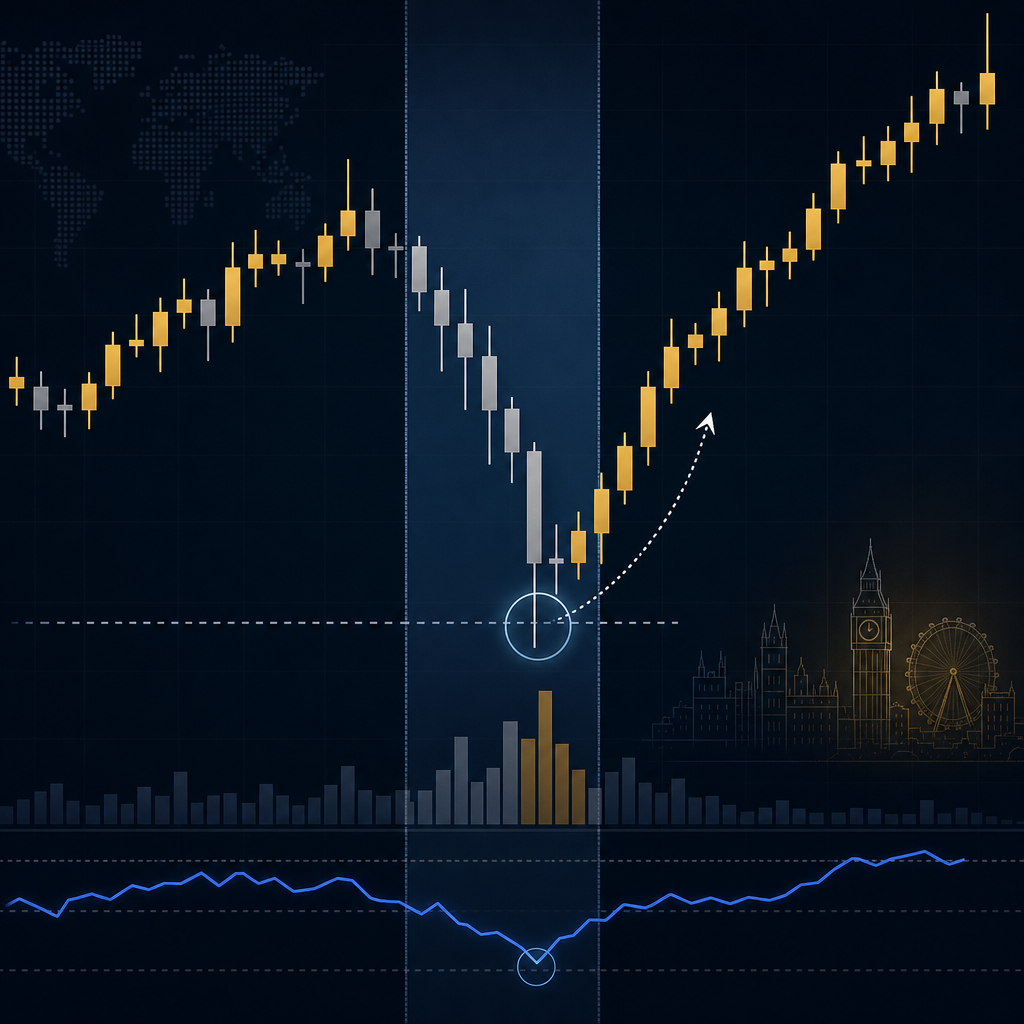
The 4PM London Gold Fix is a benchmark pricing process used by institutions to reference gold’s value for valuation, hedging, and settlement.
Even if you’re trading XAUUSD on a CFD broker, the fix still matters because large participants tend to cluster activity around benchmark windows.
That clustering changes the microstructure: liquidity appears, disappears, and reappears in bursts.
In practical trading terms, the fix is a daily moment where gold can print a $8–$20 impulse in minutes, then reverse and run the opposite way.
Why the fix creates “two-way” price action
Gold is not just a speculative instrument. It’s also a balance-sheet and hedging tool.
Around the fix, you often see:
- Benchmark-related orders: institutions aligning exposure at the reference price.
- Dealer hedging: market makers adjusting inventory as flows hit.
- Stop runs: price pushing into obvious liquidity (equal highs/lows) to fill larger orders.
- Spread expansion: brokers widen spreads during fast conditions, increasing slippage risk.
This is why a “perfect” technical breakout at 15:58 can fail at 16:02.
It’s not that the chart pattern is broken. It’s that the order flow regime temporarily changes.
How this differs from other volatility events (NFP, CPI, FOMC)
News events inject new information. The fix injects concentrated execution.
That matters because fix volatility is often mean-reverting after the liquidity sweep, while news volatility can trend for hours.
So the fix is less about predicting the “direction” and more about surviving execution and trading the post-fix structure.
Today’s market context: why the fix matters even more near $2650
With XAUUSD around $2650, gold is trading in a psychologically dense region.
Round numbers like $2650 and $2660 tend to attract resting orders: take profits, stop losses, and breakout entries.
When the fix hits, price often attacks those clusters.
If you’ve been trading recently, you’ve likely noticed how quickly gold can move even without major headlines.
That’s the hallmark of liquidity-driven volatility.
Cross-market pressure: DXY and USD/JPY as volatility amplifiers
With DXY near 106.80, the dollar is relatively firm.
That doesn’t automatically mean gold must fall, but it increases sensitivity to intraday USD swings.
USD/JPY around 149.50 also matters because yen volatility can spill into broader risk positioning.
When USD pairs move sharply into London close, gold can “catch the wave” during the fix window.
What this means for signal execution
If your gold signal says “Buy XAUUSD @ 2648, SL 2633, TP 2678,” the signal might be technically valid.
But execution at 15:59 can turn a good idea into a bad fill.
So the goal isn’t to change the strategy. It’s to adapt timing, stop logic, and no-trade rules to the fix window.
If you’re using professional Telegram signals, this is where a provider’s trade management matters.
At United Kings, we focus heavily on London and NY session execution and teach traders how to avoid the “event window traps” that destroy expectancy over time.
You can explore our premium signal formats on United Kings gold signals and see how we deliver clear Entry, SL, and TP levels for real-world conditions.
London Fix volatility patterns in XAUUSD (what to expect on the chart)

Fix behavior is not random. It’s repetitive enough that you can build rules around it.
Not rules that “predict” the fix. Rules that keep you from donating money during the worst liquidity conditions.
Here are the most common patterns we see when gold is trading in the $2610–$2690 band.
Pattern 1: Liquidity sweep → reversal → trend continuation
Gold prints equal highs near $2658 for an hour.
At 15:59–16:03, price spikes to $2664, triggers breakout buys and stop losses, then snaps back below $2658.
Within 20–40 minutes, it resumes the original trend (often down if the broader impulse was bearish).
This is the classic “stop run” that punishes breakout traders.
Pattern 2: Compression into the fix → expansion after
Price ranges tightly, maybe a $6–$8 box like $2646–$2654.
Spreads look normal until the last few minutes.
Then the fix produces a clean break, and the post-fix move continues for $15–$25.
This is where patience pays. The best trade is often after the fix, not during it.
Pattern 3: Two-sided whipsaw (the “trap candle” sequence)
You’ll see a 5-minute candle spike up $10, followed by a 5-minute candle spike down $14.
Both sides get filled. Both sides get punished.
This is exactly why we define no-trade zones and require confirmation.
Pattern 4: Fix move aligns with NY order flow (best-case scenario)
Sometimes the fix simply accelerates an already clear NY-driven trend.
Example: gold is trending up from $2622 to $2650 during NY morning, then the fix adds another impulse to $2668.
In this case, the fix is not a reversal trigger. It’s a momentum add-on.
The key is structure: higher lows, clean pullbacks, and no obvious equal highs being hunted.
Comparison table: trading before, during, and after the 4PM fix
Most traders treat the fix like a single moment. Professionals treat it like a window with changing conditions.
Use this comparison to decide when your signal execution is most likely to match the intended risk profile.
| Window (London time) | Typical behavior | Execution risk | Best trade type | What to avoid |
|---|---|---|---|---|
| 15:30–15:45 | Positioning, early liquidity probing | Medium | Retest entries with tight structure | Market orders into thin pullbacks |
| 15:45–16:05 (pre-fix to fix) | Stop runs, spread widening, fast spikes | High | Mostly no-trade; event-style execution only | Breakout chasing, tight stops |
| 16:05–16:20 | Post-fix stabilization, direction reveals | Medium | Confirmation entries (close + retest) | Entering mid-candle after a $12 spike |
| 16:20–17:00 | Continuation or mean reversion trend develops | Low–Medium | Trend continuation or reversal setups | Ignoring higher timeframe levels |
The core problem: slippage, spread spikes, and “false fills” on gold signals
Let’s be blunt: most traders don’t lose around the fix because their analysis is wrong.
They lose because their execution assumptions break.
A signal that expects a $15 stop behaves differently when your spread widens and you get slipped $2–$5.
What slippage looks like in real numbers
Imagine a United Kings-style signal (example for education):
- Buy XAUUSD @ 2649.50
- SL @ 2634.50 (risk: $15)
- TP1 @ 2679.50 (reward: $30, 1:2)
During normal conditions, you might get filled at 2649.60 and life is fine.
During the fix, you might get filled at 2652.10.
Now your risk is effectively $17.60 and your reward shrinks unless you adjust targets.
That one fill can turn a positive-expectancy system into a coin flip.
Why “tight stops” are not disciplined stops during the fix
A tight stop is only disciplined if it’s placed beyond invalidation.
During the fix, the market often prints temporary invalidation to access liquidity.
So a $10 stop that works at 13:00 can be a guaranteed donation at 16:00.
Signal traders: the hidden cost of copying without a time filter
If you copy signals exactly as received—without a time filter—you’ll naturally take more trades during the fix window.
Not because the provider is wrong. But because your broker’s execution and your reaction time are different.
This is why we recommend pairing signals with execution rules and risk controls.
For a broader framework, keep our risk guide bookmarked: risk management strategies when using forex signals.
No-trade zones: your #1 tool to avoid fix whipsaws
If you only take one concept from this article, make it this: define no-trade zones around the fix.
No-trade zones are not “fear.” They are a professional acceptance that some minutes have worse pricing.
In gold, a single bad fill can erase a week of disciplined gains.
Time-based no-trade zone (the default rule)
For most retail traders, a practical baseline is:
- No new entries from 15:45 to 16:05 London time
- Resume only when spreads normalize and a candle closes with structure
If your broker is known for aggressive spread widening, extend it to 15:40–16:10.
If volatility is already elevated (for example, gold has moved $25 in the last hour), extend it further.
Price-based no-trade zones (liquidity pools)
Time filters help, but price filters are what save you on the days when the fix starts early.
Common fix liquidity pools in the $2610–$2690 range include:
- Equal highs/lows on M5–M15 (two or more touches)
- Round numbers: $2650, $2660, $2670
- Previous day high/low and London/NY session highs/lows
- Unfilled fair value gaps (if you use that framework)
If price is sitting 1–3 dollars below an equal-high pool right before the fix, that’s not a “breakout ready” market.
That’s a “stop run loading” market.
Spread/ATR no-trade filter (the professional upgrade)
Add a simple condition:
- If your XAUUSD spread is above your normal by 2x, do not enter.
- If the last 5-minute candle range is above $8–$10 repeatedly, wait for stabilization.
This keeps you out when the market is effectively “auctioning” price rather than trending.
Step-by-step: a practical XAUUSD London fix strategy for signal traders
This is the execution playbook you can run daily.
It’s designed for traders who receive gold signals (Entry/SL/TP) and want to avoid the fix trap without missing the best post-fix move.
Step 1: Mark the fix window on your chart
On your platform, mark:
- 15:45–16:05 London time as a red zone (no new entries by default)
- 16:05–16:20 as an amber zone (confirmation only)
Do this once and save it as a template.
Your future self will thank you.
Step 2: Identify the nearest liquidity pools (5-minute work)
Before 15:45, quickly scan M15 and M5:
- Where are the equal highs?
- Where are the equal lows?
- What’s the nearest round number (e.g., $2650 or $2660)?
Write down two levels above and two below current price.
Example at $2650:
- Above: 2658 (equal highs), 2666 (previous swing high)
- Below: 2642 (swing low), 2636 (previous day midpoint/structure)
Step 3: Decide your mode: “avoid,” “confirm,” or “event-trade”
Most days, you should be in avoid or confirm mode.
Event-trading the fix is optional and should be reserved for experienced traders with fast execution.
- Avoid: no entries in the red zone, manage existing trades only.
- Confirm: enter only after a close + retest post-fix.
- Event-trade: pre-set limit orders at levels with defined invalidation and reduced size.
Step 4: If a signal arrives near the fix, apply the “timing override”
Here’s a simple rule that improves expectancy immediately:
- If a signal arrives within 20 minutes of the fix, do not market-enter.
- Convert it into either a post-fix confirmation entry or a limit at retest.
Example:
- Signal: Sell 2652.00, SL 2668.00, TP 2620.00
If it’s 15:50 London time, you wait.
After 16:05, if price spikes to 2660–2664 then closes back below 2652 on M5, you sell the retest with a stop that respects the new swing.
Step 5: Execute with a “two-candle confirmation”
In the amber zone (16:05–16:20), require:
- Candle 1: impulse (the sweep)
- Candle 2: close that confirms direction (back inside range or breaking with acceptance)
This single filter cuts many false breakouts.
Entries around the fix: confirmation, retests, and “acceptance” rules
The fix punishes traders who confuse a spike with a breakout.
So your entry model must be based on acceptance—price holding beyond a level—rather than merely touching it.
Entry model A: Post-fix retest entry (highest quality for signal traders)
This is the bread-and-butter approach.
Let the fix sweep liquidity, then trade the retest when the market shows its hand.
Example scenario near current prices:
- Gold trades at $2650 into the fix.
- Fix spike runs to $2663.
- Price snaps back and closes M5 below $2656.
- Retest to $2656 fails.
A practical entry could be:
- Sell 2655.50–2656.00
- SL 2670.50 (about $14.5–$15)
- TP1 2626.50 (about $29, 1:2)
- TP2 2611.50 (about $44, near 1:3)
This aligns with how gold actually moves after liquidity sweeps.
Entry model B: Breakout with acceptance (only when structure is clean)
Sometimes the fix creates a real breakout.
But you only treat it as real if price accepts above the level.
Rules:
- Wait for an M5 close beyond the level by $2+ (not just a wick).
- Wait for a second candle that does not reclaim the breakout level.
- Enter on the first pullback that holds.
Example:
- Break above $2660, close at $2663.
- Next candle holds above $2660 and prints higher low.
- Buy pullback at $2661.50.
Entry model C: Fade the sweep (advanced, but powerful)
This is the “sell the stop run” or “buy the flush” approach.
It works best when the sweep hits a very obvious liquidity pool (equal highs/lows) and immediately rejects.
But it requires fast recognition and disciplined stops.
If you’re newer, stick to retests and acceptance entries.
Stops around the fix: wider-but-rational SL placement (without increasing risk)
The fix forces you to separate two concepts:
- Stop size (distance in dollars)
- Risk size (money you lose if SL hits)
Professional traders often widen stops during event windows but reduce position size so the dollar risk stays constant.
Why $10 stops often fail between $2610–$2690 during fix conditions
In normal intraday conditions, a $10 stop might be fine.
During fix volatility, a single M5 candle can be $10–$15.
That means your stop is inside “noise,” not beyond invalidation.
A practical stop framework for the fix window
Use these guidelines for XAUUSD around $2650:
- Retest entries: SL beyond the sweep high/low + buffer (often $15–$20)
- Acceptance breakouts: SL below the acceptance level + structure (often $18–$25)
- Fade trades: SL beyond the extreme wick + buffer (often $12–$18)
The goal is not “big stops.” The goal is logical stops that survive the liquidity hunt.
How to keep risk constant when widening stops (simple math)
Let’s say you typically risk $100 per trade.
If your normal stop is $10, your size is based on that.
If your fix stop must be $20, you cut size roughly in half.
Same risk. More survival.
This is exactly how you avoid the common trap: “I used a wider stop and lost more.”
You only lose more if you don’t adjust size.
Where traders place stops that the fix targets
Avoid placing stops:
- Exactly below a round number (e.g., long from 2651 with SL 2649)
- Exactly below equal lows (the fix loves those)
- Inside the last M5 candle range during 15:55–16:05
If you want more structure-based guidance on signal execution, pair this with our broader execution article on the blog hub: United Kings trading blog.
Take profits and trade management: how to avoid giving back post-fix gains
The fix can give you fast profit—then take it back even faster.
So you need a plan for partials, break-even, and trailing that matches gold’s behavior.
Use 1:2 and 1:3 targets, but respect nearby structure
In the $2610–$2690 band, gold often reacts sharply at prior session highs/lows.
So even if your 1:3 target is “mathematically perfect,” you should check whether a major level sits in front of it.
Example:
- Sell 2656, SL 2671 (risk $15)
- 1:2 target = 2626
- But if price has a major demand zone at 2632, you may take partial at 2632 and let the rest run.
A simple post-fix management model (works for most signal traders)
- At +1R (e.g., +$15), consider moving SL to a safer level (not always break-even if structure says otherwise).
- At TP1 (1:2), take 50–70% off.
- Let the remainder target 1:3 or a key level like previous day high/low.
Gold can retrace $8–$12 even in a strong move.
If you move to break-even too early, you’ll often get tagged out and watch price continue.
When to avoid break-even entirely
If your entry is post-fix and the market is still “shaky,” break-even is often a trap.
Instead, trail behind a higher low/lower high on M5 or M15.
This aligns your stop with structure, not emotion.
Realistic trade examples around $2650 (good trades vs. fix traps)
Let’s make this concrete with scenarios that match current market levels.
These are educational examples, not promises or guarantees.
Example 1: The fix trap breakout (what not to do)
Time: 15:58 London.
Price: 2657.80, equal highs at 2658.
Trader buys the breakout at 2659.20 with SL 2649.20 ($10).
Fix spike runs to 2664.50, then dumps to 2648.80.
Stop hit, then price later rallies to 2675.
The idea wasn’t wrong. The timing and stop logic were wrong.
Example 2: Post-fix retest sell (disciplined execution)
Time: 16:08 London.
Fix sweep: 2663.80 high, rejection close back below 2656.
Retest: price returns to 2656.00, prints a lower high on M5.
- Sell 2655.80
- SL 2670.80 ($15)
- TP1 2625.80 ($30, 1:2)
- TP2 2610.80 ($45, 1:3)
This is a trade you can execute calmly.
No chasing. No guessing during the spike.
Example 3: Acceptance breakout buy (when the fix actually trends)
Time: 16:12 London.
Price breaks 2660, closes at 2663.20.
Next candle holds above 2660 and prints higher low at 2661.40.
- Buy 2662.00
- SL 2644.00 ($18)
- TP1 2698.00 ($36, 1:2) — note: this is slightly beyond our example band, so you may cap at 2688–2690 in current conditions
In the current guideline range, a more realistic TP1 might be 2688.00 ($26, ~1:1.4), then manage remainder toward 2690 if momentum persists.
The key lesson: acceptance breakouts often require more room and active management.
How to align United Kings gold signals with the fix window (execution rules)
Signals are a tool. Execution is the edge.
If you’re receiving entries, SL, and TP in real time, your job is to apply a consistent execution layer—especially around the fix.
Rule 1: If the signal triggers inside the red zone, switch to “confirm” mode
Instead of market-entering, you wait for:
- A post-fix close that supports the signal direction
- A retest that offers a cleaner entry
This alone reduces slippage dramatically for many traders.
Rule 2: Respect the signal’s invalidation, but adjust stop distance to volatility
Sometimes the signal SL is structurally correct, but too tight for fix conditions.
In that case, you can:
- Widen SL to the next structure point (within reason)
- Reduce lot size to keep risk constant
This is how professionals trade “wider stops” without gambling.
Rule 3: Use limit orders only when the level is pre-defined and logical
Blind limits during the fix are dangerous.
But a limit at a retest level (like 2656 after rejection) can be excellent.
The difference is intention: you’re not trying to catch a falling knife. You’re trading a known structure.
Rule 4: Communicate and learn inside a real community
One advantage of a serious signal service is context and education.
United Kings has a community of 300K+ active traders, and we regularly discuss session timing, volatility windows, and execution mistakes that don’t show up in backtests.
If you want to see the format and get updates, join our Telegram: United Kings Telegram trading community.
Common mistakes trading gold around the 4PM fix (and how to fix them)
Most fix losses come from a small set of repeatable errors.
Fix the process, and your results often improve without changing your strategy.
Mistake 1: Treating the fix like a normal minute
If you trade the fix like 14:00, you’ll use normal stops and normal entries.
The market will punish you for it.
Solution: time-based no-trade zone and confirmation rules.
Mistake 2: Chasing the first spike
The first spike is often designed to trigger orders.
Solution: two-candle confirmation or retest model.
Mistake 3: Moving stops emotionally during the sweep
Gold can move $12 in a minute during the fix.
Traders widen stops mid-trade, turning a planned $100 risk into $250.
Solution: pre-plan the stop and size. No changes unless your plan says so.
Mistake 4: Ignoring broker conditions (spread and execution)
Some brokers widen spreads aggressively.
Solution: spread filter. If spread is 2x normal, you wait.
Mistake 5: Overtrading after getting wicked out
The fix is emotional because it feels “unfair.”
Revenge trading after a wick-out is one of the fastest ways to blow a week.
Solution: if you get stopped during the fix window, take a 10-minute reset and only trade the next clean structure.
If you’re building a checklist for signal execution, you’ll also like our due-diligence guide: forex signals provider checklist for beginners.
Advanced filters: combining price action with volatility metrics (ATR, ranges, sessions)
Once you have the basic no-trade zones, you can add filters that further improve trade quality.
These filters are especially useful when gold is choppy around $2650 and you’re unsure whether the fix will sweep or trend.
Filter 1: 60-minute range expansion
Before the fix, measure the last 60 minutes high-to-low range.
If it’s already $25+, the fix is more likely to whipsaw than trend.
In that case, you tighten your rules: avoid entries until 16:20 and require a clearer structure break.
Filter 2: ATR-based stop sanity check
If your M15 ATR is, for example, $7–$9, then a $10 stop is barely 1–1.5 ATR.
During the fix, stops closer than ~2 ATR often get hit.
This is not a law. It’s a probability tool.
Filter 3: Session alignment (London close + NY flow)
The fix sits near a broader transition: London liquidity fades and NY dominates.
If NY is trending strongly (clear higher highs/higher lows), the fix is more likely to accelerate than reverse.
If NY is range-bound, the fix is more likely to do a sweep and revert.
Filter 4: Correlation check with DXY
Gold often moves inversely to the dollar, but not perfectly.
Still, a sharp DXY push around 106.80 can amplify gold’s fix move.
If DXY is breaking a key intraday level at the same time, expect bigger wicks and plan wider stops or no-trade.
Putting it all together: a daily 15-minute routine to trade the fix safely
You don’t need to stare at charts for hours.
You need a repeatable routine that protects you during the worst execution window and positions you for the best post-fix setups.
15 minutes before the fix (15:45–16:00)
- Mark current price (around $2650 today) and nearest liquidity pools.
- Check spreads and the last 3 M5 candle ranges.
- Decide: avoid or confirm mode.
- If you’re in a trade, reduce risk if needed (partial, tighten exposure) but avoid panic moves.
At the fix (16:00–16:05)
- No market orders.
- Observe which side liquidity is swept first.
- Note the extreme high/low of the sweep (these often become key reference points).
Immediately after (16:05–16:20)
- Wait for a close that confirms acceptance or rejection.
- Look for retest entries at the broken level.
- Set stops beyond the sweep extreme with a rational buffer ($15–$25 typical).
Post-fix continuation window (16:20–17:00)
- Trade the developed structure (trend continuation or reversal).
- Manage with partials at 1:2 and runners toward 1:3 when structure supports it.
- Stop trading if you take 2 losses in a row—fix days can be deceptive.
If you want signals that already account for session behavior and come with educational guidance, start here: United Kings premium trading signals and specifically our XAUUSD gold signals.
FAQ: London Fix volatility and trading XAUUSD signals
1) What time is the 4PM London Gold Fix in my timezone?
It depends on daylight savings and your local timezone. The safest method is to set your chart to London time or use a session indicator. Then mark 16:00 London time and build your no-trade window around it.
2) Should I always avoid trading XAUUSD during the fix?
Not always, but most traders should avoid new entries from about 15:45–16:05 London time. If you’re experienced, you can trade post-fix confirmation or structured retests. The highest-risk behavior is market-entering during the spike.
3) How wide should my stop loss be for gold around the fix?
In the $2610–$2690 price region, many fix-safe stops land in the $15–$25 range depending on structure. The key is to reduce position size so your account risk stays the same.
4) Why does gold sometimes reverse right after the fix?
Because the fix often triggers liquidity sweeps into obvious stop clusters (equal highs/lows, round numbers). Once those orders are filled, price can revert to the “real” direction driven by broader session flow.
5) Can I use forex pairs to confirm gold direction during the fix?
Yes. Watching DXY, EUR/USD, and USD/JPY can help you gauge whether the move is USD-driven. But confirmation should come from gold’s own acceptance/retest structure, not correlation alone.
Risk disclaimer (read before trading the 4PM fix)
Forex and gold trading involves significant risk and may not be suitable for all investors. Volatility around the London Fix can cause rapid price changes, spread widening, and slippage. Always use a stop loss, risk only what you can afford to lose, and consider practicing on a demo account if you’re a beginner. Past performance does not guarantee future results. United Kings provides educational content and trading signals, but we do not guarantee profits.
Join United Kings: trade XAUUSD with a plan, not hope
If you’re serious about trading gold around high-impact liquidity windows like the 4PM fix, you need two things: high-quality signals and execution rules.
United Kings delivers premium Telegram signals for forex and gold with a community of 300K+ active traders, focusing on London and NY session opportunities.
Our signals are built with clarity—Entry, SL, TP—and we aim for an 85%+ win rate through disciplined selection and management (no guarantees, and results vary by trader and execution).
Choose the plan that fits your commitment level on our pricing page:
- Starter (3 Months): $299 (~$100/mo)
- Best Value (1 Year): $599 (~$50/mo) + FREE ebook
- Unlimited (Lifetime): $999 (pay once)
Want instant access and real-time updates? Join the official channel now: United Kings signals on Telegram.
And remember: we back our service with a 48-hour money-back guarantee, so you can evaluate the quality and structure with confidence.