
If you’ve ever opened Telegram, seen “BUY EURUSD NOW 🔥”, and wondered whether you should press buy… you’re not alone.
Most beginners don’t fail because they can’t read a chart.
They fail because they don’t have a process for using forex signals—how to choose a provider, how to execute correctly, and how to manage risk when the market gets noisy.
This is the definitive forex signals guide for new traders who want structure, not hype.
TL;DR: Forex Signals for Beginners (Read This First)
- Signals are trade ideas, not magic. Your execution, spreads, and risk rules determine results.
- Only follow signals with full details: pair, direction, entry, stop loss (SL), take profit (TP), and management notes.
- Risk 0.5%–1% per trade when starting. Consistency beats “big wins.”
- Use a pre-trade checklist (spread, session, news, lot size). Most beginner losses come from skipping this.
- Track every signal you take (screenshots + journal). You can’t improve what you don’t measure.
- Choose a provider with proof + process. Look for clear SL/TP, session logic, and risk education.
We’ll use realistic current market context examples throughout: Gold (XAUUSD) around $2650, EUR/USD around 1.0520, GBP/USD around 1.2680, USD/JPY around 149.50, and DXY around 106.80.
1) What Forex Signals Actually Are (And What They Are Not)

Forex signals are structured trade ideas that tell you what to trade, where to enter, and where to exit.
A high-quality signal usually includes: the instrument (like EUR/USD), direction (buy/sell), entry price, stop loss, take profit targets, and sometimes a time window or a setup explanation.
That’s the “what.”
The “why” matters even more for beginners, because it’s how you avoid blindly clicking buttons.
Signals are not guaranteed profits
Even the best setup can fail.
Markets move on liquidity, positioning, and news—often in ways that punish obvious entries.
So treat signals as probability plays, not promises.
Signals can be manual, semi-automated, or fully automated
- Manual signals: A human analyst sends a trade idea based on technical/fundamental context.
- Semi-automated: An algorithm scans conditions, then a human confirms and sends.
- Automated/copy: Trades are executed automatically through a copier or EA.
Beginners often think automation is “safer.”
In reality, automation can amplify mistakes if spreads widen, execution slips, or you don’t understand risk.
Forex signals vs. gold signals vs. crypto signals
Most beginners start with major FX pairs because spreads are usually tighter and behavior is more stable than many altcoins.
Gold (XAUUSD) is popular because it moves fast and offers clear intraday opportunities—especially around London and New York sessions.
If you’re exploring instruments, United Kings offers dedicated pages for premium forex signals, XAUUSD gold signals, and even crypto signals—but the process you’ll learn in this guide applies to all of them.
The beginner’s mindset shift: signals don’t replace skill
Signals can accelerate your learning curve.
They can also become a crutch if you never learn execution and risk control.
Your goal in the first 30–60 days isn’t to “get rich.”
Your goal is to become a trader who can follow a plan under pressure.
2) How Forex Signals Work in Real Life (From Alert to Trade)
Let’s walk through what happens between receiving a signal and getting paid—or getting stopped.
Most beginners think the signal is the whole system.
Professionals know the signal is just the starting point.
A realistic signal example (EUR/USD)
Imagine you receive:
- Pair: EUR/USD
- Direction: BUY
- Entry: 1.0520
- SL: 1.0495 (25 pips)
- TP1: 1.0570 (50 pips)
- TP2: 1.0595 (75 pips)
This is a clean 1:2 to 1:3 type structure if executed properly.
But execution “properly” includes your spread, your fill, and your lot size.
Why beginners lose on good signals
- They enter late: price already moved 10–20 pips, ruining the risk-reward.
- They ignore spreads: especially during news or rollover, turning a 25-pip SL into an effective 30–35 pips.
- They oversize: risking 5% on one idea, then revenge trading after a loss.
- They “improve” the signal: moving SL wider “to be safe,” which usually increases loss size without improving probability.
Signals work best when you follow them like a pilot follows a checklist.
Not like a gambler follows a feeling.
Gold (XAUUSD) signal example using current context
Gold is around $2650 with mild daily strength (+0.35%).
A realistic intraday signal might look like:
- Instrument: XAUUSD
- Direction: SELL
- Entry: 2652.0
- SL: 2667.0 (15.0 points ≈ $15)
- TP: 2622.0 (30.0 points ≈ $30) 1:2
If your broker spreads widen from $0.20 to $1.20 during a spike, your entry and stop can be affected.
That’s why a beginner needs a process for when to execute, not only what to execute.
Signals are a communication system
Good providers don’t just send entries.
They send context: session bias, invalidation level, and what to do if price doesn’t trigger.
That’s one reason many traders prefer structured Telegram channels over random “VIP” groups.
If you want to see how a professional Telegram workflow looks, you can also review our beginner-focused page on using forex signals on Telegram.
3) Types of Forex Signals: Scalping, Day Trades, Swing Trades (What’s Best for Beginners?)
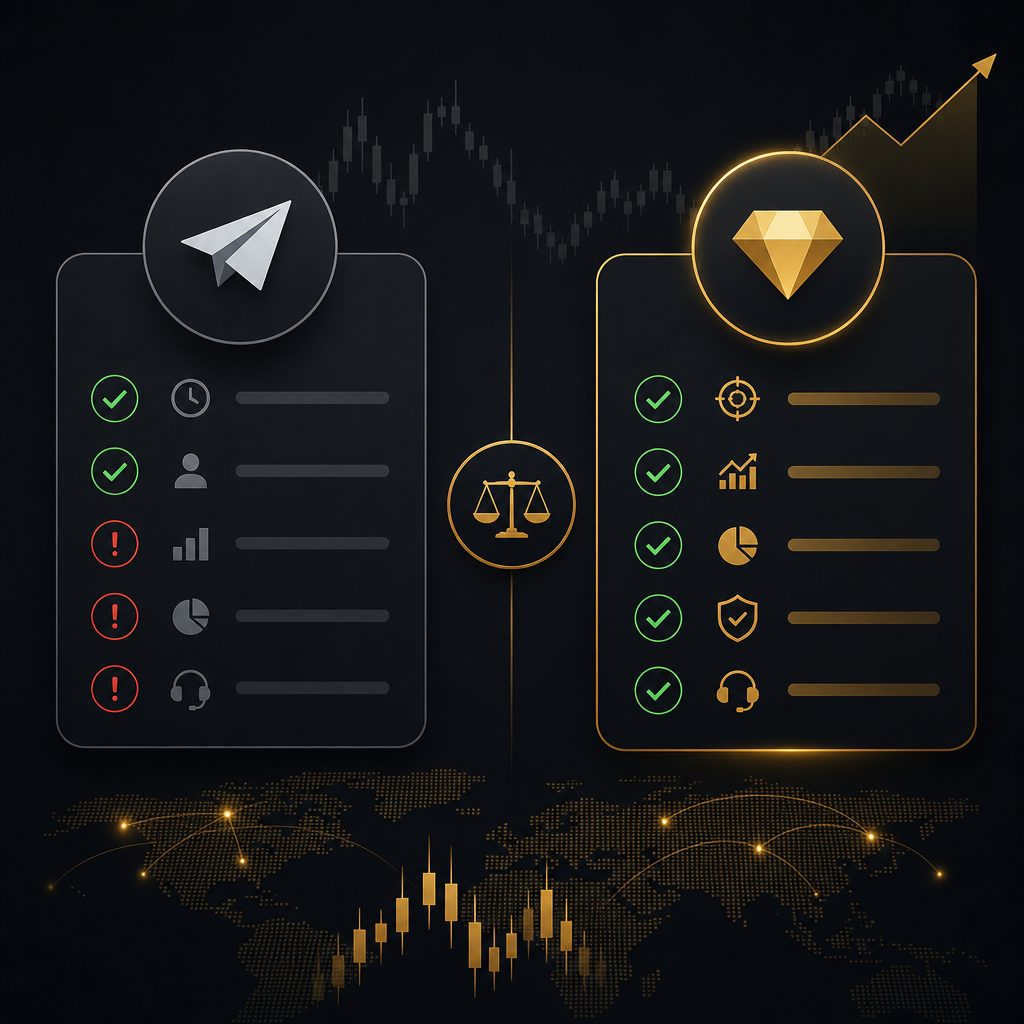
Not all signals fit your lifestyle.
Choosing the wrong signal style is one of the fastest ways to burn out.
Let’s break down the main types and what they demand from you.
Scalping signals
Scalps target small moves—often 5 to 20 pips on major pairs, or $3–$10 on gold.
They require fast execution, low spreads, and focus during key minutes.
Beginners can use scalping signals, but only if they can be present during the trade and accept higher noise.
Day trading signals
Day trades often target 30–100 pips on FX, or $15–$40 on gold.
They usually develop during London and New York sessions.
For many beginners, day trading signals are the sweet spot because you can learn intraday structure without holding overnight risk.
Swing trading signals
Swing trades can run for days.
They often need wider stops and patience through pullbacks.
If you have a job and can’t watch charts, swing signals may be the most practical—assuming you can emotionally tolerate open trade swings.
Which is best for beginners?
Most beginners do best with day trade signals on majors and gold.
Why?
- Clear session structure (London/NY liquidity).
- Less overnight surprise risk than swings.
- More time to execute than scalping.
At United Kings, our core focus is London and New York session trading because that’s where liquidity is deepest and signal logic is most repeatable.
It’s also where beginners can learn the fastest with fewer “random” moves.
Comparison table: signal styles for beginners
| Signal Style | Typical Hold Time | Pros | Cons | Beginner Fit |
|---|---|---|---|---|
| Scalping | 1–30 minutes | Fast feedback, many opportunities | Spread-sensitive, stressful, easy to overtrade | Medium (only with discipline) |
| Day Trading | 30 minutes–1 day | Great R:R, session structure, manageable pace | Requires being available during sessions | High |
| Swing Trading | 2–10 days | Less screen time, bigger targets | Overnight/news risk, wider stops, patience needed | High (for busy schedules) |
Your best choice is the one you can execute consistently.
Consistency beats intensity every time.
4) How to Choose a Forex Signals Provider (Beginner Checklist That Actually Works)
The signals industry has everything: real professionals, marketers, and outright scammers.
As a beginner, you don’t need to “guess.”
You need a checklist that filters providers fast.
The non-negotiables (what every signal must include)
- Exact entry (or a clear entry zone)
- Stop loss (hard invalidation level)
- Take profit (at least one target)
- Pair + direction
- Trade management notes (optional but powerful)
If a provider sends “BUY NOW” with no SL, it’s not a signal.
It’s a suggestion—and your account becomes the stop loss.
Proof and transparency (what to look for)
Be careful with screenshots that only show wins.
Instead, look for:
- Consistent formatting of signals over time
- Losses acknowledged with learning notes
- Clear risk guidance (0.5%–2% per trade, not “all in”)
- Session logic (why a trade is taken in London/NY)
At United Kings, we focus on clarity: Entry, SL, TP, and education alongside signals.
We also operate a large community of 300K+ active traders, which creates accountability and continuous feedback.
Why win rate alone is a trap
A provider can show 90% win rate by taking tiny profits and huge stops.
That’s not what you want as a beginner.
You want a provider that targets sensible risk-reward like 1:2 or 1:3 where possible.
United Kings targets a high-quality approach with an 85%+ win rate mindset, but always within real risk controls and with the reminder that past performance doesn’t guarantee future results.
Use a real checklist before paying
If you want a ready-made checklist, use our detailed guide: forex signals provider checklist for beginners.
It will help you avoid the most common traps: hidden martingale, no SL, fake “VIP,” and unrealistic claims.
Free vs premium signals: what changes?
Free signals can be okay for practice.
But they often lack consistency, support, and trade management.
Premium signals typically provide structured delivery, faster updates, and education—especially during volatile conditions like when DXY is elevated (around 106.80) and USD pairs can move sharply.
5) How to Use Forex Signals Step-by-Step (Beginner Execution Blueprint)
This is the part that turns “signals” into a repeatable routine.
Print this, save it, and follow it for your next 20 trades.
Your job is not to be clever.
Your job is to be consistent.
Step 1: Confirm your account settings before you trade
- Leverage: keep it reasonable (higher leverage increases mistakes).
- Lot size minimum: ensure you can risk small (micro lots help).
- Instrument specs: gold contract size varies by broker.
- Trading hours: know your broker’s rollover time.
Many beginners blow accounts because they can’t size small enough.
If your broker forces large minimum lots, change broker before changing strategy.
Step 2: Check spread and volatility (especially on gold)
When gold is around $2650, it can still move $10 in minutes during NY open or news.
If your spread is $0.20–$0.40, great.
If it’s $1.50–$3.00, your “edge” is being taxed.
Step 3: Check the economic calendar (2 minutes)
You don’t need to be a macro expert.
You just need to avoid entering 30 seconds before a high-impact release.
USD news can hit EUR/USD, GBP/USD, USD/JPY, and gold all at once—especially with DXY strong near 106.80.
Step 4: Calculate position size (risk first, not profit first)
Pick a fixed risk per trade.
For beginners: 0.5%–1% is enough.
Example on EUR/USD:
- Account: $1,000
- Risk: 1% = $10
- Stop: 25 pips
- Then your size should be about $0.40 per pip (roughly 0.04 lots on many brokers).
If you don’t know how to do this quickly, that’s normal.
But you must learn it before scaling.
Step 5: Place the trade correctly (orders matter)
- Market order: use if the signal is “execute now” and spread is normal.
- Limit order: use if the signal provides an entry level and you want a better fill.
- Stop order: use for breakouts (enter only if price confirms).
Beginners often use market orders everywhere.
That’s fine early on, but learn to use limit orders to protect your risk-reward.
Step 6: Set SL and TP immediately (no exceptions)
Your stop loss is your business expense.
Your take profit is your plan.
On gold, typical beginner-friendly stops are often $10–$25 from entry depending on volatility.
Step 7: Manage the trade like a system
If the signal says “move SL to breakeven at TP1,” do that.
If it says “close 50% at TP1,” do that.
Don’t invent management rules mid-trade.
6) Risk Management for Beginners Using Forex Signals (The Rules That Save Accounts)
Risk management is not a “bonus topic.”
It’s the difference between surviving long enough to learn and quitting after a bad week.
Signals can be excellent, but without risk rules you’ll still lose.
Rule 1: Risk a fixed percentage per trade
Beginners should start at 0.5%–1%.
That means if you lose 5 trades in a row (it happens), you’re down ~2.5%–5%—not 25%–50%.
This keeps your psychology stable.
Rule 2: Cap your daily loss
Set a daily max loss like 2%.
If you hit it, stop trading for the day.
This single rule prevents revenge trading, which is the #1 account killer for beginners.
Rule 3: Don’t stack correlated trades
If you take EUR/USD buy and GBP/USD buy at the same time, you’re often doubling exposure to USD moves.
With USD/JPY around 149.50 and DXY strong, USD flows can dominate.
So treat correlated trades as one “theme.”
Either reduce risk per trade or only take one setup.
Rule 4: Respect the stop loss (don’t move it wider)
Moving SL wider is a psychological trick to avoid being wrong.
But it changes your plan mid-flight.
If your stop is hit, the trade idea was invalidated.
Take the loss and move on.
Rule 5: Use realistic reward targets
Aim for signals with at least 1:2 when possible.
Example on gold at $2650:
- Buy 2640.0
- SL 2625.0 (risk $15)
- TP 2670.0 (reward $30) 1:2
Even with a 50% win rate, 1:2 can be profitable with discipline.
Rule 6: Reduce risk during high-volatility news
During FOMC, CPI, NFP, spreads widen and stops get hunted.
If you trade those sessions, cut risk (e.g., 0.25%–0.5%) or wait for the first spike to settle.
If you want deeper guidance, keep our dedicated resource bookmarked: risk management strategies when using forex signals.
7) Understanding Market Context: Sessions, DXY, and Why Signals Win More at Certain Times
Beginners often think price moves randomly all day.
It doesn’t.
Forex and gold have rhythms—driven by liquidity, sessions, and macro drivers.
London session: the “real” start for many pairs
London brings volume.
EUR/USD and GBP/USD often set their daily direction here.
That’s why many professional signal providers focus heavily on London open and the first 2–3 hours.
New York session: momentum and reversals
New York can continue London’s trend or reverse it.
It’s also where US data hits, which matters when DXY is elevated like 106.80.
Gold (XAUUSD) often makes its biggest moves during NY, especially around US releases.
Asian session: range-building and stop hunts
Asia can be quieter for EUR/USD and GBP/USD.
But it often builds ranges that later get broken in London.
For USD/JPY, Asia can be more active because of Japan-related flows.
How DXY affects your signals (simple version)
DXY is the US Dollar Index.
When DXY is strong (like 106.80), USD strength can pressure EUR/USD lower and support USD/JPY higher.
Gold sometimes moves inversely to USD, but not always—especially when safe-haven flows or yields dominate.
Beginner rule: don’t ignore the environment
If you’re taking a EUR/USD buy signal at 1.0520 while DXY is ripping higher, you need a strong technical reason.
That doesn’t mean you skip every counter-trend trade.
It means you demand better execution and tighter discipline.
Where to get signals that respect session logic
On United Kings, our signal approach is built around London and NY session behavior because it’s repeatable and liquid.
You can explore our full offering on the main United Kings signals page and see how we structure trade ideas for both forex and gold.
8) A Beginner’s Trade Management Plan (After You Enter, What Next?)
Entry is only one moment.
Trade management is the next 30 minutes to 8 hours.
This is where beginners either protect their edge—or give it back.
The three most common management styles
- Set-and-forget: Set SL/TP and walk away.
- Partial profits: Close part at TP1, let the rest run.
- Trailing stop: Move SL behind price as it trends.
Beginners usually do best with partial profits because it reduces emotional pressure.
You get paid while still giving the trade room to reach TP2.
Example: GBP/USD around 1.2680
Signal idea:
- BUY 1.2680
- SL 1.2645 (35 pips)
- TP1 1.2750 (70 pips)
- TP2 1.2785 (105 pips)
Management plan:
- At TP1: close 50% and move SL to entry (breakeven).
- Let remaining 50% aim for TP2.
This creates a “paid trade” after TP1.
It also reduces the urge to panic-close on small pullbacks.
Example: XAUUSD around $2650 with realistic SL/TP
Signal idea:
- BUY 2638.0
- SL 2623.0 (risk $15)
- TP1 2668.0 (reward $30)
- TP2 2683.0 (reward $45)
Gold can spike fast.
So a beginner-friendly plan is to secure partials at TP1 and avoid letting a +$25 move turn into break-even.
When to move to breakeven (and when not to)
Moving SL to breakeven too early is a classic mistake.
You get stopped out by normal noise, then price runs to TP without you.
A practical rule is: only move to breakeven after price hits a meaningful structure level or TP1.
Don’t manage trades emotionally
If you feel your heart rate rising, you’re probably oversized.
Reduce risk until you can follow the plan calmly.
That’s how you build consistency.
9) The Most Common Beginner Mistakes With Forex Signals (And How to Fix Them Fast)
You can save months by avoiding a few predictable errors.
These mistakes show up in almost every beginner’s journal.
The good news is they’re fixable with rules.
Mistake 1: Taking signals outside the intended session
A London setup taken late in NY often performs differently.
Liquidity changes, spreads change, and the “reason” for the trade may already be gone.
Fix: only take signals during the provider’s stated window.
Mistake 2: Entering after the move already happened
If a signal says buy EUR/USD at 1.0520 and you enter at 1.0540, you just added 20 pips of risk.
You also reduced reward.
Fix: use limit orders or skip the trade if it’s missed.
Mistake 3: Changing SL/TP because “it looks like it will go”
Beginners widen stops, then take tiny profits.
This flips the math against you.
Fix: pre-commit to SL/TP and only adjust based on the provider’s management rules.
Mistake 4: Overtrading after a win or a loss
After a win, you feel invincible.
After a loss, you want it back.
Both lead to impulsive trades.
Fix: cap trades per day (e.g., 1–3) and use a daily loss limit.
Mistake 5: Not tracking results
If you don’t track, you can’t tell whether the issue is the provider, your execution, or your psychology.
Fix: journal every trade with entry time, spread, screenshot, and notes.
Mistake 6: Expecting one provider to match every broker
Your results can differ due to spreads, slippage, and symbol pricing (especially on gold).
Fix: demo test signals on your broker for 2–4 weeks before scaling risk.
10) Building Consistency: A 30-Day Plan for Beginners Using Forex Signals
Consistency is built with repetition, not motivation.
Here’s a simple 30-day plan that turns signals into a skill-building system.
It’s designed for beginners who want to be profitable long-term.
Week 1: Setup and safety
- Trade on demo or smallest possible size.
- Set risk to 0.5% per trade (or demo equivalent).
- Take only 1–2 signals per day maximum.
- Journal: entry, SL/TP, session, spread, outcome.
Your goal is clean execution, not profit.
Week 2: Execution quality
- Start using limit orders where appropriate.
- Stop entering late. If missed, skip.
- Follow management rules exactly (partials, breakeven rules).
Most beginners improve results just by reducing late entries.
Week 3: Add context awareness
- Check DXY and major levels before trading USD pairs.
- Avoid high-impact news minutes unless the provider explicitly trades it.
- Reduce risk when volatility is elevated.
If gold is swinging $20–$30 quickly around $2650, you must respect that environment.
Week 4: Review and refine
- Calculate your win rate, average R, and biggest mistakes.
- Identify whether losses came from the signal failing or your execution failing.
- Create a “do not do” list (late entries, moving SL, overtrading).
At the end of 30 days, you should be calmer, more consistent, and more selective.
That’s the foundation of profitability.
11) Why United Kings Signals Are Built for Beginners (Without Treating You Like One)
Beginners don’t need more noise.
They need clarity, structure, and a community that reinforces good habits.
That’s the difference between “signals” and a real trading service.
What you get with United Kings
- Premium Telegram signals for forex and gold with clear Entry, SL, and TP levels.
- A community of 300K+ active traders learning and executing together.
- A focus on London and NY sessions where liquidity is strongest.
- Educational content alongside signals so you improve, not just follow.
- A results-driven approach with an 85%+ win rate target and robust trade structure (while acknowledging markets can change).
- A 48-hour money-back guarantee for added confidence when you start.
Where to start on the site
- Explore the full service overview on UnitedKings.net.
- See our full offering on the signals page.
- If your main focus is currencies, review our forex signals.
- If you want fast-moving opportunities, check our gold signals.
Pricing plans (3 options depending on your commitment)
We keep pricing simple and aligned with different trader goals:
- Starter (3 Months): $299 (about $100/month)
- Best Value (1 Year): $599 (about $50/month) with 50% savings + FREE ebook
- Unlimited (Lifetime): $999 (pay once, access forever)
You can review the current plans on our pricing section and choose what fits your timeline.
How to join the Telegram channel
If you want to see the signal delivery format and community updates, join our official Telegram here: United Kings Telegram signals channel.
For beginners, this is often the fastest way to build execution habits because you see structured trade ideas in real time.
FAQ: Forex Signals for Beginners
1) Are forex signals good for beginners?
Yes—if you use them as a structured learning tool and follow strict risk rules.
Signals can speed up your learning by showing you real setups, but you still need correct position sizing and disciplined execution.
2) How many signals should a beginner take per day?
Usually 1–3 is enough.
More trades often leads to overtrading and lower-quality execution, especially if you’re still learning spreads, sessions, and order types.
3) What is a good risk percentage when following signals?
Most beginners should start with 0.5%–1% per trade.
This keeps drawdowns manageable and helps you stay emotionally stable during normal losing streaks.
4) Can I use forex signals on a small account like $100 or $200?
You can, but it depends on your broker’s minimum lot size and spreads.
If you can’t risk small enough (like $0.50–$1 per trade), you may be forced into oversized positions.
In that case, use demo first or choose a broker that supports micro-lots.
5) Should I follow signals during major news events?
Only if the provider explicitly trades news and gives clear rules.
During high-impact releases, spreads and slippage can increase sharply, especially on gold and USD pairs.
Risk Disclaimer (Read Before You Trade)
Forex and gold trading involves significant risk and may not be suitable for all investors.
You can lose some or all of your capital, especially when trading with leverage.
Past performance does not guarantee future results, and no signal provider can guarantee profits.
If you are a beginner, consider practicing on a demo account and use strict risk management before trading live funds.
Final CTA: Start Using Forex Signals the Right Way (With a Proven Structure)
If you’ve read this far, you’re already ahead of most beginners.
You’re not looking for hype.
You’re looking for a repeatable process—and a signal service that respects risk.
Join United Kings to get premium forex and gold signals with clear Entry, SL, and TP levels, built around London and NY session logic, plus education and a community of 300K+ traders.
- Explore the full service: United Kings Signals
- Choose your plan (3 Months, 1 Year, Lifetime): United Kings pricing
- Join the official Telegram now: https://t.me/unitedkings1
Trade smart. Protect your capital. Build consistency.
We’ll see you inside United Kings.