If you’ve ever watched gold (XAUUSD) go from “dead” to “violent” in 10 minutes… you’ve probably been trading right into the London–New York overlap.
This is the 2–4 hour window where spreads often tighten, liquidity stacks up, and momentum spikes hard enough to hit a 1:2 R:R before you’ve finished your coffee.
But it’s also the window where overconfidence, late entries, and “one more trade” can wipe a week’s gains in a single chop cycle.
In this playbook, we’ll build a time-based, signal-friendly framework for London New York overlap trading—specifically for XAUUSD overlap strategy setups and the major FX pairs (EUR/USD, GBP/USD, USD/JPY), using realistic current levels: XAUUSD ~$2650, EUR/USD ~1.0520, GBP/USD ~1.2680, USD/JPY ~149.50, and DXY ~106.80.
TL;DR — The London–NY Overlap Signal Framework
- Trade the overlap in time blocks: prioritize the first 60–90 minutes after New York opens for momentum; avoid the “mid-overlap drift” unless a clean trend resumes.
- Use 3 filters before taking a signal: (1) spread ceiling, (2) volatility/ATR threshold, (3) structure confirmation (break + hold, or rejection + follow-through).
- XAUUSD risk rules: typical stop $10–$25; target 1:2 or 1:3 R:R; scale partials at +1R and trail behind structure.
- FX risk rules: stops based on session swing points; avoid micro-stops during overlap noise; target 20–60 pips depending on pair and volatility.
- Daily guardrails: max 2–3 trades during overlap; max daily loss 1.5%–3% (or 2 consecutive losses) then stop.
- Signals work best with execution discipline: pre-plan the time block, confirm filters, and execute entries/partials exactly—no “chasing.”
Why the London–New York Overlap Creates “Signal-Grade” Moves
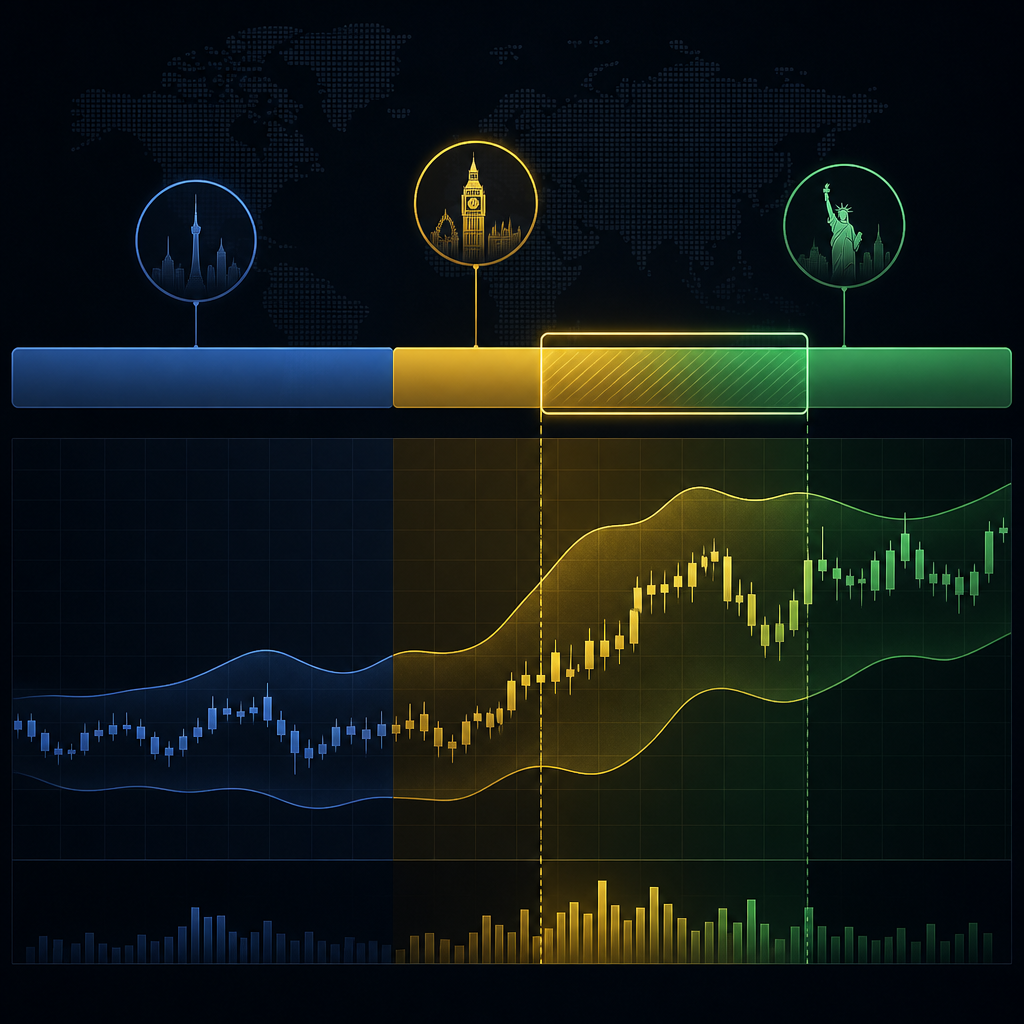
The overlap is where two major liquidity centers are active at the same time.
London has already built the day’s structure, and New York brings fresh order flow, US data reactions, and institutional rebalancing.
When those flows align, you get the cleanest kind of move for signal trading: directional expansion that respects levels.
What changes during overlap (and why you feel it)
Three things typically happen in the overlap window.
1) Spreads tighten. On good brokers, XAUUSD spreads can compress noticeably compared to the Asian session, and majors like EUR/USD can trade near their best spreads of the day.
2) Volatility increases. XAUUSD can print $8–$20 bursts quickly around $2650, especially when DXY (106.80) shifts or US yields move.
3) “Real” intraday levels get tested. London sets the range. New York either breaks it or rejects it. That break/reject is your signal edge.
Why overlap is ideal for a signal provider model
A premium signal is only as good as the execution environment.
During overlap, slippage risk often drops (not always—news can spike it), and the market is more likely to follow through to a planned TP.
This is why United Kings focuses heavily on London and NY session trading and publishes clear Entry, SL, and TP levels inside our premium channels on United Kings signals.
The goal is simple: trade when the market is most likely to pay you for being right.
Exact Time Blocks to Trade (and When to Stand Down)
The overlap is not one uniform “good time.”
It has phases, and each phase has different behavior.
Instead of “trade whenever,” we’ll use a schedule with time blocks and specific expectations.
Time block 1: Pre-NY positioning (30–60 minutes before NY open)
This is where you often see “range tightening” or a final London push.
For XAUUSD around $2650, you might see price compress between $2642 and $2654, printing smaller candles.
That’s not always a trade—often it’s a setup-building phase.
- What to do: mark London high/low, Asian range, and the nearest 4H support/resistance.
- What to avoid: taking breakouts before NY adds volume (false breaks are common).
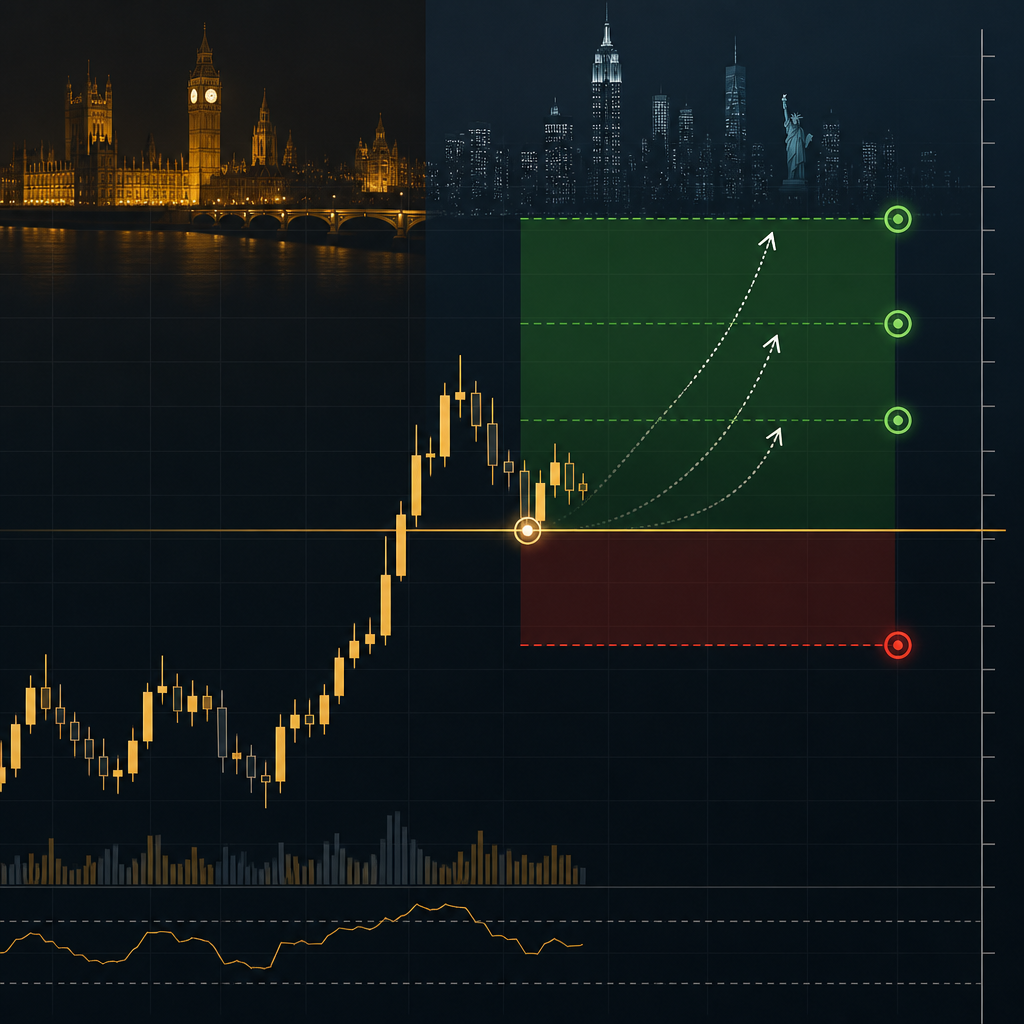
Time block 2: NY open impulse (first 60–90 minutes after NY open)
This is the “money window” for a lot of intraday signal strategies.
If London created a clean level—say XAUUSD rejects $2662 twice—NY can be the catalyst that finally breaks through and runs to $2682.
In FX, EUR/USD at 1.0520 may either reclaim 1.0540 or lose 1.0500 with speed.
- Best trade types: break-and-retest, trend continuation after a pullback, and rejection from a major session level.
- Execution priority: take A+ setups only; the market is fast, so your rules matter most here.
Time block 3: Mid-overlap digestion (next 60 minutes)
This is where traders get chopped.
After the initial impulse, price often ranges, retests, or mean-reverts.
Gold might oscillate $10–$14 around the midpoint (example: $2658–$2672) without committing.
- What to do: protect profits, trail stops, and wait for the next structure break.
- What to avoid: overtrading inside the range with tight stops.
Time block 4: Second push / US data continuation (optional window)
If there’s scheduled US data (or a strong trend day), the market may attempt a second expansion.
This is where you can catch the continuation leg—if your filters confirm it’s not just noise.
USD/JPY at 149.50, for example, may trend strongly if yields keep rising.
- Best trade types: continuation after consolidation, or retest of broken structure with clear momentum.
- Stand down if: spreads widen, ATR drops sharply, or the market becomes headline-driven.
Overlap Market Context: How XAUUSD & DXY Interact Right Now
At XAUUSD ~$2650 with a modest +0.35% 24h change, the market is not in “panic mode.”
But it’s still volatile enough that overlap bursts can be meaningful.
With DXY around 106.80, gold is often trading a push-pull between USD strength and safe-haven flows.
What to watch during overlap for gold
Gold reacts to yields, USD, and risk sentiment.
During overlap, if DXY spikes and yields climb, gold can drop $12–$25 quickly—especially if it loses a key intraday level like $2640.
But if equities wobble or headlines hit, gold can rally even with a firm dollar.
Practical correlation rules (not academic)
- If DXY is trending up strongly and gold is failing to reclaim prior highs, prefer gold shorts on rejection signals.
- If DXY stalls or reverses while gold holds higher lows, prefer gold longs on break-and-retest signals.
- If both gold and DXY rise, treat it as risk-off. Expect whipsaws and widen your “no-trade” zone unless structure is very clean.
For FX pairs, the overlap is where USD flows dominate.
EUR/USD at 1.0520 and GBP/USD at 1.2680 can move sharply on US data, while USD/JPY at 149.50 is extremely sensitive to yield moves and BoJ/Fed expectations.
Why this matters for forex signals session overlap
Your signal quality improves when the “why” aligns with the “where.”
A perfect technical level with no macro tailwind can still work—but during overlap, alignment increases follow-through probability.
This is why we pair technical triggers with context inside United Kings forex signals and United Kings gold signals.
The Overlap Filters: Spread, Volatility, and Structure (Your 3-Gate System)
If you only take one thing from this article, take this:
During overlap, you don’t need more trades—you need better filters.
We’ll use a simple “3-gate” checklist that you apply before every entry.
Gate #1: Spread ceiling (don’t pay the market to lose)
Spreads can tighten during overlap, but they can also blow out around data or thin moments.
Set a maximum spread you’ll accept, based on your strategy style.
- XAUUSD: if your typical stop is $15, a spread spike that adds $2–$4 is a major tax. Consider standing down if spread is abnormally high for your broker.
- EUR/USD & GBP/USD: spreads are usually tight, but sudden widening during news can invalidate a scalp entry.
- USD/JPY: watch for spread jumps during yield spikes or sudden headlines.
Practical rule: if the spread is “noticeably worse than normal,” it’s a no-trade until it normalizes.
Gate #2: Volatility threshold (ATR / range must be “alive”)
Overlap is famous for volatility—but not every day delivers it.
We want enough movement to justify the risk.
- XAUUSD: if 15-minute candles are consistently $1–$3, you’ll get chopped. If they’re $5–$10, your 1:2 target is realistic.
- EUR/USD: if the pair is moving 6–10 pips per 15 minutes, scalps can work. If it’s 2–4 pips, you’re paying spread for noise.
Use a simple ATR(14) on M15 or M5 as a “go/no-go.”
Gate #3: Structure confirmation (break + hold, or reject + follow-through)
This is where most traders fail: they enter on the first touch.
During overlap, first touches get faded.
We want one of two confirmations:
- Break + hold: price breaks a key level, then holds above/below it for at least one candle close (timeframe depends on your style).
- Reject + follow-through: price wicks into a level, closes away from it, then prints continuation (higher low for longs, lower high for shorts).
Signals become “tradable” when they pass all three gates.
That’s how you avoid taking a great-looking setup in a terrible environment.
XAUUSD Overlap Strategy: Step-by-Step Signal Execution (Entries, SL/TP, Partials)
Let’s turn the framework into an actual XAUUSD overlap strategy you can execute consistently.
We’ll use the current neighborhood: gold around $2650, and we’ll keep examples within $2610–$2690.
Step 1: Map the “session levels” before overlap begins
Before NY opens, mark:
- Asian high/low
- London high/low
- Yesterday’s high/low
- Nearest 4H swing level (support/resistance)
Example: London high prints at $2664 and London low at $2638.
Those become your “decision rails.”
Step 2: Choose one setup type for the day (don’t mix)
During overlap, mixing strategies causes overtrading.
Pick one primary setup:
- Break-and-retest continuation: best on trend days.
- Rejection reversal: best when price hits a major level and fails.
Step 3: Entry rules for a break-and-retest long (example)
Scenario: XAUUSD is compressing under $2664 and then breaks above during NY impulse.
- Trigger: M5 close above $2664, followed by a retest holding $2662–$2664.
- Entry: $2665 (after retest confirmation).
- Stop loss: $2650 (risk $15).
- TP1 (1R): $2680.
- TP2 (2R): $2695 (if within your day’s range; if not, use the next structure target like $2688–$2690).
Note: the guideline range cap is $2690, so in a realistic overlap day you might set TP2 at $2690 and trail the rest.
Step 4: Partial profit and trailing rules (simple and repeatable)
- At +1R (here, $2680): take 30%–50% partial.
- Move stop to break-even or -0.25R (to cover spread/fees).
- Trail the remainder behind a higher low on M5/M15 or behind a key level like $2664 once price is well above it.
This is how you get paid even if the second leg fails.
Step 5: Entry rules for a rejection short (example)
Scenario: Gold spikes to $2678 during NY open, but fails and closes back under $2670.
- Trigger: wick above $2675 with a bearish close under $2670, then a lower high.
- Entry: $2668.
- Stop loss: $2683 (risk $15).
- TP1 (1R): $2653.
- TP2 (2R): $2638 (London low).
This is a textbook overlap trade: fade the failed breakout and target the session low.
Major FX Pairs During Overlap: Pair-by-Pair Playbook (EUR/USD, GBP/USD, USD/JPY)
FX overlaps behave differently than gold.
Majors are often smoother, but they can still whipsaw around US releases.
Here’s how to adapt your overlap approach to each pair using current levels: EUR/USD 1.0520, GBP/USD 1.2680, USD/JPY 149.50.
EUR/USD overlap approach (range breaks + retests)
EUR/USD tends to respect clean intraday levels.
During overlap, focus on:
- London high/low breaks
- Round numbers like 1.0500 and 1.0550
- Previous day high/low magnets
Example setup: EUR/USD breaks below 1.0510, retests 1.0510–1.0515, then continues lower.
- Entry: 1.0508
- Stop: 1.0530 (22 pips)
- TP: 1.0464 (44 pips, 1:2)
GBP/USD overlap approach (momentum + wider stops)
GBP/USD is often more impulsive than EUR/USD.
It can run 30–60 pips quickly in overlap, then snap back.
Use slightly wider stops and avoid entering mid-candle.
Example: GBP/USD reclaims 1.2680, holds, then pushes to 1.2740.
- Entry: 1.2685
- Stop: 1.2655 (30 pips)
- TP1: 1.2745 (60 pips, 1:2)
USD/JPY overlap approach (yield-driven trend days)
USD/JPY at 149.50 is heavily sentiment and yield sensitive.
During overlap, it can trend strongly when US yields move.
But it can also whipsaw on BoJ commentary risk, so be selective.
Example: USD/JPY breaks above 149.60, retests 149.55, then continues.
- Entry: 149.62
- Stop: 149.32 (30 pips)
- TP: 150.22 (60 pips, 1:2)
For all three pairs, the overlap “edge” is the same: trade the break/reject of London structure with NY follow-through.
Comparison Table: Overlap Behavior by Instrument (What to Expect)
Use this table to adjust your expectations and your risk rules.
| Instrument | Overlap Personality | Typical Opportunity | Common Trap | Practical Risk Notes |
|---|---|---|---|---|
| XAUUSD | Fast, headline-sensitive, can trend or spike-reverse | $15–$40 intraday legs on strong days | Chasing after a $10 candle; getting wicked out | Stops often $10–$25; partial at +1R; avoid news spikes |
| EUR/USD | Clean levels, smoother follow-through | 20–50 pip overlap moves | Trading inside a tight range pre-data | Use structure-based stops; don’t scalp when ATR is dead |
| GBP/USD | More impulsive; loves stop runs | 30–70 pip momentum legs | Too-tight stops; late entries | Wider stops than EUR/USD; wait for candle close confirmation |
| USD/JPY | Yield-driven; can trend strongly | 40–100 pip trend legs on yield days | Headline whipsaws; intervention fear | Reduce size near major news; respect key round levels (149/150) |
The Signal Validation Checklist (Before You Tap “Buy/Sell”)
Most losses during overlap aren’t because the idea was wrong.
They happen because the trade was taken at the wrong time, with the wrong spread, or without confirmation.
Here’s a practical checklist you can run in under 30 seconds.
The 30-second overlap checklist
- Time block: Are we in the NY impulse window or just drifting mid-overlap?
- Spread: Is spread normal for this instrument right now?
- Volatility: Is M15 ATR healthy (candles not tiny)?
- Structure: Is this a break-and-hold or reject-and-follow-through?
- Space: Is there enough room to TP (at least 1:2) before the next major level?
- News: Is a high-impact US release due within the next 10–15 minutes?
Two “instant no” rules (save your account)
- No-trade if you missed the move. If gold already ran from $2645 to $2668 in one burst and you’re late, don’t chase. Wait for a retest.
- No-trade after 2 consecutive losses. Overlap can bait revenge trading. Your edge disappears when your psychology breaks.
If you want a deeper risk framework specifically for signal users, pair this guide with our dedicated risk resource: risk management strategies when using forex signals.
Risk Rules That Prevent Overtrading (Daily Loss Limits, Trade Caps, Cooldowns)
Overlap is where discipline matters most.
Because you can get multiple “almost” setups in a short time.
We’ll set hard rules that protect you from the overlap’s biggest enemy: overtrading.
Rule 1: Cap your overlap trades (quality over quantity)
For most retail accounts, a cap of 2–3 trades max during overlap is enough.
That forces selectivity.
It also prevents the “I’ll make it back” spiral that kills accounts.
Rule 2: Daily loss limit (percent-based)
Use a daily max loss that fits your risk tolerance.
- Conservative: 1.0%–1.5% max daily loss
- Moderate: 2.0% max daily loss
- Aggressive (not recommended for beginners): 3.0% max daily loss
Once hit, you stop trading for the day.
Not “one more setup.” Stop.
Rule 3: Consecutive-loss cutoff (behavioral guardrail)
Percent limits are great, but psychology is triggered by streaks.
So add: stop after 2 consecutive losing trades in overlap.
Even if you’re down only 0.8%.
Rule 4: Cooldown after a win (yes, after a win)
Wins can be as dangerous as losses.
After a clean 1:2 win on gold—say long from $2665 to $2690—your brain wants another hit.
Set a 15–20 minute cooldown before taking the next trade.
Rule 5: One risk model per week
Don’t change position sizing daily.
Pick a fixed risk-per-trade (example: 0.5% or 1.0%) and keep it consistent for at least a week.
This makes your performance measurable and prevents emotional sizing.
Execution Rules for Signals: Entries, Limits vs Market, and Slippage Control
Even a high-quality signal can lose if execution is sloppy.
During overlap, speed matters—but precision matters more.
Market order vs limit order (how to choose)
Use market orders when:
- The setup is breaking out with momentum
- Spread is normal
- Your entry is confirmation-based (after a candle close)
Use limit orders when:
- You’re trading a retest (break-and-retest)
- You have a precise level (example: buy $2662–$2664)
- You want to avoid chasing
How to handle “missed entries” without blowing up
Missed entries are normal in overlap.
What’s not normal is turning a missed entry into a bad entry.
- If price runs without retesting, skip.
- If price retests cleanly, take the planned entry.
- If price retests messy (multiple wicks, no hold), stand down.
Slippage control in fast markets
Slippage is most likely around US data and sudden headlines.
Practical overlap rules:
- Avoid opening new positions 1–2 minutes before high-impact releases.
- If you’re already in profit, consider partialing before the event.
- Widening stops “because news” is usually a mistake unless it was planned.
If you want a deeper dive on how signals behave when headlines hit, read: how gold signals react to unexpected news events.
Real Overlap Scenarios: 3 Trade Blueprints You Can Reuse
Let’s make this concrete with three reusable blueprints.
These are not “predictions.”
They are if-then frameworks you can apply to your own charts and to any quality signal feed.
Blueprint #1: XAUUSD break-and-retest continuation (trend day)
Context: Gold is holding above $2640 and making higher lows into NY open.
Plan: Buy the break above London high with confirmation.
- Level: London high $2664
- Entry: $2665 after retest holds
- SL: $2650
- TP1: $2680 (+1R)
- TP2: $2690 (+1.67R) plus trail remainder if momentum is strong
Management: Partial at TP1, move SL to BE, trail behind M5 higher lows.
Blueprint #2: EUR/USD range breakdown after NY impulse
Context: EUR/USD is stuck under 1.0530 all London session and fails twice.
Plan: Sell breakdown of the base when NY volume hits.
- Entry: 1.0508 after break + retest of 1.0510
- SL: 1.0530
- TP: 1.0464 (1:2)
Management: If price hits +1R, partial and trail above lower highs.
Blueprint #3: XAUUSD failed breakout reversal into London low
Context: Gold spikes into $2678 but can’t hold above $2670.
Plan: Sell the failed breakout and target the session low.
- Entry: $2668 on lower high confirmation
- SL: $2683
- TP1: $2653
- TP2: $2638
Management: If price chops around $2660–$2665 after entry, don’t tighten SL emotionally. Let structure decide.
How to Use United Kings Signals During Overlap (A Practical Workflow)
Signals don’t replace your brain.
They replace your guesswork.
To get the best results from a premium provider, you need a workflow that matches how overlap behaves.
Workflow: from alert to execution in 5 steps
- Step 1 — Confirm time block: Is this signal landing in NY impulse (best) or mid-overlap drift (be selective)?
- Step 2 — Check spread/volatility gates: if your platform spread is abnormal, skip or reduce size.
- Step 3 — Align with structure: does the entry match a break/retest or rejection pattern?
- Step 4 — Place orders precisely: use the exact Entry/SL/TP levels; avoid “improvising” tighter stops.
- Step 5 — Manage with partial rules: take partial at +1R and trail the rest if the market trends.
What “clear Entry, SL, TP” actually means in overlap
During overlap, clarity reduces hesitation.
Hesitation causes late entries.
Late entries cause poor R:R.
That’s why United Kings signals are designed to be executable: Entry, SL, and multiple TP levels, built for the sessions where momentum is most reliable.
If you’re still evaluating providers, you’ll like our due-diligence guide: forex trading signals provider checklist for beginners.
Where to follow the overlap calls
We deliver our premium Telegram alerts to a large community of traders.
You can join and follow updates here: United Kings Telegram channel.
To explore what’s included across instruments, start at our signals page, then choose between gold signals and forex signals.
Pricing, Plans, and Who Each Plan Fits (Overlap Traders Edition)
If you’re trading overlap consistently, you want consistency in access and education too.
United Kings offers three plans designed for different commitment levels and account sizes.
Starter (3 Months) — $299 (~$100/mo)
Best if you’re testing your execution process during overlap.
Three months is long enough to experience multiple market regimes: trend weeks, range weeks, and news-heavy weeks.
Best Value (1 Year) — $599 ($50/mo) + FREE ebook
This is the plan most serious traders choose because it reduces monthly cost and keeps you in the game long enough to build real stats.
It’s also the easiest way to avoid “subscription hopping,” which destroys learning curves.
Unlimited (Lifetime) — $999 (pay once)
Best if you already know you’ll be trading for years and want uninterrupted access.
Overlap strategies benefit from repetition and long-term pattern recognition.
See full details on the three plans at United Kings pricing.
And yes—there’s a 48-hour money-back guarantee, so you can evaluate fit without feeling trapped.
FAQ: London–New York Overlap Trading for XAUUSD & FX
1) What is the best timeframe for London New York overlap trading?
For signal execution, M5 and M15 are the most practical.
Use M15 to define structure and volatility, then M5 for entries and retests.
2) What’s a good stop loss size for XAUUSD during overlap?
Most overlap setups on gold need enough room to survive wicks.
In the $2610–$2690 environment, a typical SL is $10–$25 from entry, depending on structure and volatility.
3) How many trades should I take during the overlap?
For most traders, 2–3 trades max is a strong rule.
If you’re taking 6–10 trades in overlap, you’re likely reacting, not executing.
4) Can beginners trade the overlap using forex signals?
Yes, but beginners should start on a demo and focus on execution rules.
Overlap moves fast, so it rewards preparation and punishes impulsive clicks.
5) Why do I get chopped even when the signal direction is right?
Most often it’s one of three issues: you entered late, your stop was too tight for overlap volatility, or you traded mid-overlap drift without structure confirmation.
Use the 3-gate filter (spread, volatility, structure) and the daily guardrails.
Risk Disclaimer (Read This Before You Trade)
Forex and gold trading involves significant risk and may not be suitable for all investors. You can lose some or all of your capital.
Signals and educational content are provided for informational purposes only and do not constitute financial advice.
Past performance does not guarantee future results. Always use proper risk management, consider trading on a demo account if you’re new, and never risk money you cannot afford to lose.
Ready to Trade the Overlap With Rules (Not Hope)?
If you want a structured way to trade the London–New York overlap—without chasing, guessing, or overtrading—join the United Kings community.
We provide premium Telegram signals for forex and gold with clear Entry, SL, and TP levels, built around the sessions where spreads tighten and momentum is most tradable.
Explore the full offering on United Kings signals, or go straight to gold signals and forex signals.
Join our Telegram here: https://t.me/unitedkings1
When you’re ready, choose the plan that fits your goals—Starter (3 Months $299), Best Value (1 Year $599 with 50% savings + FREE ebook), or Lifetime ($999)—on our pricing page.
Trade the overlap like a professional: time blocks, filters, and risk rules—then let the market do the heavy lifting.