
You followed the gold signal perfectly… and still got a worse entry.
You received “XAUUSD Buy 2650, SL 2636, TP 2678” and hit market instantly. But MT4 throws a requote, MT5 fills you 0.60 higher, and the spread suddenly jumps from 18 points to 45 points. Now your risk is bigger, your R:R is smaller, and you’re wondering if the signal was the problem.
In reality, a huge chunk of “bad signal results” comes from execution friction: symbol settings, filling mode, deviation tolerance, broker specs, and session-based spread behavior. This is especially true on gold (XAUUSD) because it moves fast, gaps around liquidity pockets, and can widen spreads aggressively around session transitions and news.
This guide is a practical, step-by-step comparison of MT4 vs MT5 for XAUUSD signal execution. We’ll build a repeatable checklist to reduce requotes, spread shock, and slippage—so your results are closer to what the signal intended.
TL;DR: MT4 vs MT5 XAUUSD Execution (Quick Wins)
- MT5 usually fills faster and cleaner for XAUUSD because it supports multiple filling modes and better order routing—if your broker enables it.
- Most requotes come from “Instant Execution” on MT4/MT5. Prefer brokers/accounts that use Market Execution for gold.
- Set a realistic deviation (slippage tolerance) for gold: typically 20–60 points (=$0.20–$0.60) depending on volatility and session.
- Check XAUUSD symbol specs: contract size, digits, stop level, freeze level, and margin settings—these determine whether your SL/TP can be placed and how fills behave.
- Avoid spread shock by checking spreads at London open and NY open; if spread spikes above your threshold, delay entry or use a limit order.
- Standardize your pre-trade checklist so every signal is executed the same way—this alone can improve consistency more than switching strategies.
MT4 vs MT5 for XAUUSD: What Actually Matters for Execution

Most traders compare MT4 and MT5 like a feature war: more timeframes, more indicators, more order types. That’s fine, but for gold signal execution, only a few differences move the needle.
Execution quality for XAUUSD comes down to: how orders are sent, how they are filled, what the broker allows, and what the market is doing in that minute. MT4 and MT5 handle these areas differently.
With gold around $2650 (up roughly +0.35% on the day) and DXY near 106.80, we’re in a market where intraday swings of $8–$20 are common even on “normal” days. That means a small execution mistake—like accepting a $0.70 worse fill—can equal 7 points or more, which is a meaningful slice of your planned risk.
The execution friction triangle (platform × broker × session)
Think of XAUUSD execution as a triangle:
- Platform: MT4 vs MT5 settings, filling modes, order types, deviation parameters.
- Broker: symbol specs, liquidity, execution model (market vs instant), stop/freeze levels, spread behavior.
- Session: London and New York open/overlap, rollovers, news spikes, liquidity pockets.
Change one corner and your fills change. That’s why two traders can follow the same Telegram signal and get different outcomes.
So… is MT5 “better” for gold signals?
In many cases, yes—if your broker’s MT5 setup supports the best filling mode and market execution for XAUUSD. MT5 gives you more control and more transparency around order filling behavior.
But MT4 can still execute gold signals well when the broker uses market execution and you configure deviation properly. The real goal is not “MT5 superiority.” The goal is repeatable execution that matches the signal’s intended entry, SL, and TP.
Comparison Table: MT4 vs MT5 for XAUUSD Signal Execution
| Feature (XAUUSD Execution) | MT4 | MT5 | Why It Matters for Gold Signals |
|---|---|---|---|
| Execution types | Instant or Market (broker-dependent) | Instant, Market, Exchange (broker-dependent) | Instant execution increases requote risk during fast moves on XAUUSD. |
| Filling modes | Limited control; broker decides | Supports FOK / IOC / Return (broker-dependent) | Better control can reduce partial fills and unexpected behavior. |
| Order types | Market, Limit, Stop | Market, Limit, Stop, Stop Limit | Stop Limit can reduce slippage on breakouts if used correctly. |
| Deviation/slippage setting | “Deviation” in order window (market/instant) | “Deviation” + more consistent behavior with filling modes | Gold can move $0.30–$1.50 quickly; deviation must match volatility. |
| Depth of Market (DOM) | Basic/limited | More native DOM support | DOM helps advanced traders gauge liquidity before sending size. |
| Netting vs hedging | Usually hedging | Broker can offer netting or hedging | If you scale in/out on signals, account mode affects position management. |
| Stability & ecosystem | Huge legacy ecosystem | Modern, actively developed | Both are fine; execution quality depends more on broker + settings. |
XAUUSD Symbol Specs You Must Verify (Before Blaming Slippage)
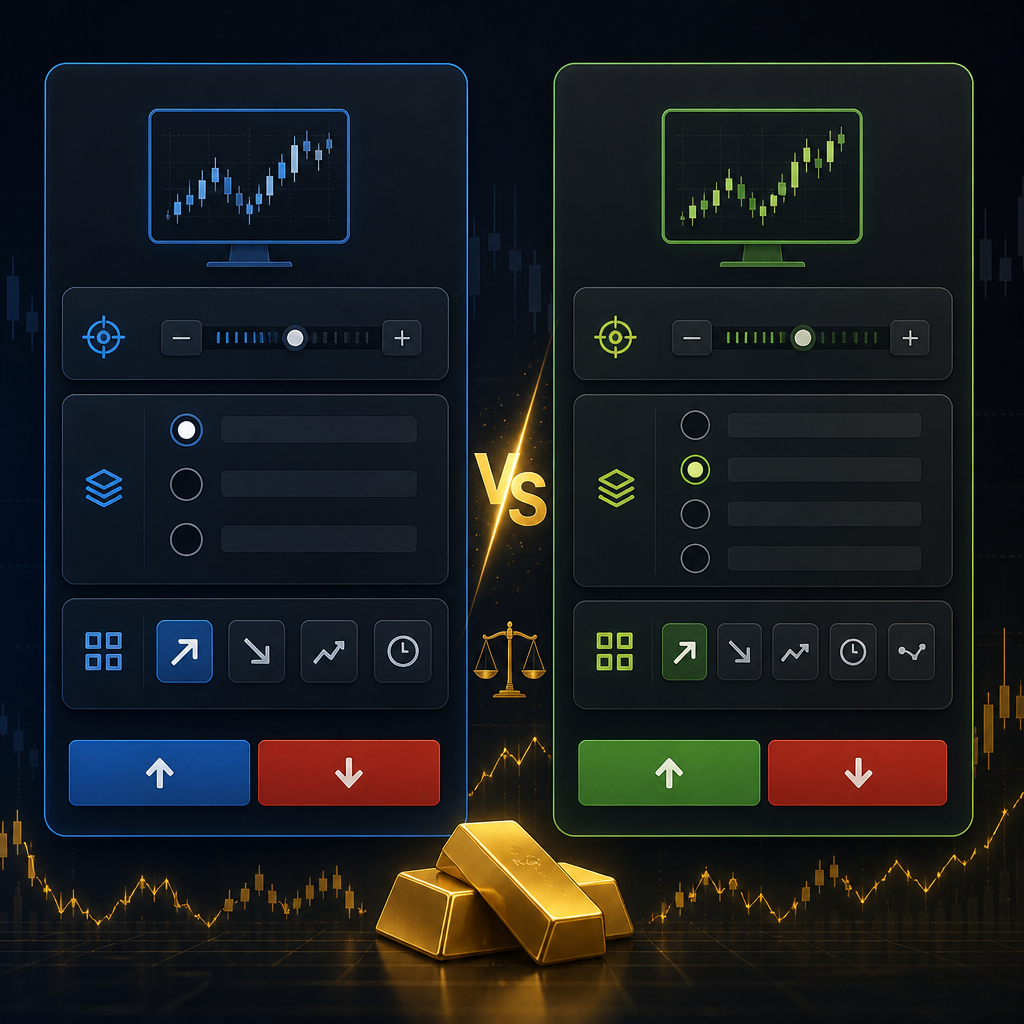
If you want fewer “invalid stops,” fewer rejected orders, and fewer surprise margin spikes, you need to understand the symbol specification of XAUUSD at your broker. This is the hidden layer that determines whether your signal can be placed exactly as received.
Gold is not standardized across brokers. One broker’s XAUUSD might be 2 digits, another 3 digits. One might use a different contract size. Another might enforce a larger stop level during volatility. If you don’t check this, your SL/TP might be too close, your lot size might risk more than you think, and your execution may suffer.
Step-by-step: where to find XAUUSD specs in MT4/MT5
- MT4: Market Watch → right-click XAUUSD → Specification.
- MT5: Market Watch → right-click XAUUSD → Specification (more fields shown).
Key fields that affect signal execution
- Digits / Point: Determines what “20 points” means. On many brokers, 10 points = $0.10. So 50 points = $0.50.
- Contract size: Often 100 oz per 1.00 lot, but confirm. This impacts pip value and risk.
- Stops level: Minimum distance (in points) you must place SL/TP away from current price. If stops level is 200 points, that’s $2.00 on many feeds.
- Freeze level: Distance where you cannot modify orders near market price. This can block fast SL adjustments during spikes.
- Margin / leverage: Gold leverage varies widely. If your leverage is lower than expected, spreads + margin can cause forced liquidation.
- Trading hours: Some brokers have a small daily break where spreads widen dramatically.
Real example: why your SL gets rejected
Let’s say you receive a signal: Sell XAUUSD 2650.00, SL 2662.00. That’s a $12 stop.
If your broker temporarily increases stop level to $15 during a volatility spike, your SL at 2662.00 may be rejected. You then either widen the SL (changing the signal) or delay entry (changing timing). Both outcomes change performance.
This is not the signal failing. It’s your symbol constraints colliding with the signal’s structure.
What to standardize across your accounts
If you trade gold signals seriously, keep your environment consistent:
- Use the same broker server for MT4/MT5 if possible.
- Use the same XAUUSD symbol (some brokers offer XAUUSD., XAUUSDm, GOLD, etc.).
- Confirm digits and point value so your deviation and spread thresholds are apples-to-apples.
If you’re building a full routine around signals, pair this with a consistent process from our broader guides on execution and discipline inside the United Kings blog.
Requotes vs Slippage vs Spread Shock (Know the Enemy)
Traders often use “slippage” as a catch-all complaint. But in XAUUSD execution, three different problems look similar in your P/L—and each has a different fix.
1) Requotes (most common on Instant Execution)
A requote happens when you try to buy/sell at a displayed price, but the broker responds: “price changed.” You must accept the new price or your order is canceled.
Gold around $2650 can move $0.20–$0.80 in seconds during London open. If you’re on instant execution, requotes become frequent. The fix is usually structural: use market execution and set deviation appropriately.
2) Slippage (market execution reality)
Slippage is the difference between your requested price and the actual fill. With market execution, slippage can be positive or negative, though most traders only notice the negative.
Example: You hit Buy at 2650.00, you get filled at 2650.50. That’s $0.50 slippage (50 points on many feeds). If your SL is 2636.00, your risk increased by $0.50 unless you adjust.
3) Spread shock (the silent killer)
Spread shock is when spreads widen suddenly and you enter/exit at a worse effective price even without “slippage.” It’s common:
- At session transitions (late Asia → London, London → NY).
- During low-liquidity minutes.
- Before/after high-impact news.
Example: XAUUSD spread is normally 18 points ($0.18). Suddenly it widens to 55 points ($0.55). If you market buy, you start the trade down an extra $0.37 immediately—without any “slippage” message.
Why this matters for signal execution
Signals are built on expected execution conditions. When you change those conditions, you change the strategy outcome.
This is why United Kings signals are designed with clear Entry, SL, and TP levels and why we emphasize execution discipline in our premium channels on United Kings gold signals. The more your fill matches the intended entry, the closer your results align with the signal’s edge.
MT4 XAUUSD Execution Settings: The Practical Checklist
MT4 is still widely used because it’s lightweight, familiar, and supported by many brokers. But for XAUUSD, MT4 needs a tighter checklist—especially if your broker uses instant execution or if spreads fluctuate.
Step-by-step: set up MT4 for fewer requotes
- Check execution type: In many MT4 brokers, this is account-dependent. If your orders show frequent requotes, ask support whether your XAUUSD is Instant Execution and if a Market Execution account is available.
- Use “Maximum Deviation”: In the MT4 order window, set deviation in points. For gold, a realistic starting range is 20–60 points ($0.20–$0.60) depending on session.
- Enable One-Click Trading carefully: Faster entries reduce missed fills, but only if your deviation is sensible. If deviation is too tight (like 5–10 points), one-click becomes one-click requotes.
- Confirm SL/TP distance: If stop level is high, place SL/TP slightly wider and then tighten after fill (only if freeze level allows).
Deviation guidance by session (practical numbers)
With XAUUSD near $2650 and typical intraday volatility:
- Asia session: 15–30 points ($0.15–$0.30) often works if spreads are stable.
- London open: 30–60 points ($0.30–$0.60) to avoid constant requotes.
- NY open / overlap: 40–80 points ($0.40–$0.80) if volatility is elevated.
These are not “magic” settings. They’re guardrails. If you set deviation too high, you may accept poor fills. If you set it too low, you’ll miss trades or get requoted repeatedly.
MT4 order type choice: market vs pending (when following signals)
If a signal says Buy now at 2650.00–2651.00, a market order is fine—if spreads are normal.
If spread is abnormally wide (say 50+ points), consider a Buy Limit at the top of the signal’s entry zone (e.g., 2650.80) rather than paying the spread shock. This is especially useful around London open when spreads can temporarily flare.
A realistic MT4 execution example
Signal: Buy XAUUSD 2650.00, SL 2636.00 (risk $14), TP 2678.00 (reward $28, 1:2).
- You set deviation to 50 points ($0.50).
- You get filled at 2650.40.
- Your “true” risk becomes $14.40 unless you adjust SL to 2636.40 (not always recommended if it breaks the plan).
The key is consistency: decide in advance whether you adjust SL/TP after slippage or keep the original levels and accept the slightly altered R:R.
MT5 XAUUSD Execution Settings: Filling Modes, Deviation, and Control
MT5’s biggest advantage for gold signal execution is not cosmetic. It’s structural: filling modes and more robust order handling. When your broker supports it properly, MT5 can reduce the “mystery” around why you got filled the way you did.
Step-by-step: find and set MT5 filling mode behavior
In MT5, filling modes are usually defined by the broker per symbol. You can view them in:
- Market Watch → right-click XAUUSD → Specification → look for “Filling mode.”
You may see one or more of these:
- FOK (Fill or Kill): Either filled completely at available price within deviation or not filled at all.
- IOC (Immediate or Cancel): Fill what’s available now, cancel the rest.
- Return: Allows partial fills and returns the remaining volume.
For most retail gold signal traders, FOK or IOC tends to be cleaner than Return. Partial fills can distort your planned risk if you don’t notice them.
Deviation in MT5: how to set it for gold
In the MT5 order window, you can set “Deviation” in points. Use the same session-based logic as MT4, but recognize MT5 often executes more smoothly when the broker’s liquidity is strong.
A practical baseline for XAUUSD:
- Normal conditions: 30–50 points ($0.30–$0.50).
- High volatility minutes: 60–90 points ($0.60–$0.90) if you must enter immediately.
If you’re trading United Kings signals during London and NY sessions (our primary focus), you want deviation wide enough to avoid missed entries but not so wide that you accept a bad fill that breaks the setup.
MT5 order types: where Stop Limit can help
MT5 supports Stop Limit orders. This is powerful for breakout-style entries where you want confirmation but don’t want uncontrolled slippage.
Example: price is 2648.80 and you want a breakout buy above 2651.00. You can set:
- Buy Stop at 2651.00 (simple, but can slip badly in fast spikes)
- Buy Stop Limit: stop at 2651.00, limit at 2651.40 (you only fill up to 40 points worse)
This can reduce slippage on XAUUSD during fast candles. The trade-off is missed entries if price jumps beyond your limit.
MT5 practical advantage: cleaner trade management for scaling
If you scale out at TP1 and let the rest run, MT5’s position management can be smoother—depending on whether your account is hedging or netting.
If you’re unsure how your account treats multiple entries, test on demo first. Execution consistency matters more than platform preference.
Broker & Account Type for Gold: The Hidden Execution Lever
You can have perfect MT4/MT5 settings and still get poor XAUUSD fills if your broker setup isn’t compatible with fast-moving metals. This is where many traders lose the game before it starts.
Execution model: Market vs Instant (what you should prefer)
- Market Execution: You accept the best available price within your deviation. Less requotes, more transparent slippage.
- Instant Execution: You request a specific price; broker can requote. In fast gold moves, requotes can be constant.
For signal execution—where speed and consistency matter—market execution is usually preferable. You’ll still get slippage, but you reduce the “requote loop” that causes missed trades and emotional chasing.
Account types: Standard vs Raw/ECN (and what to watch)
Many brokers offer:
- Standard: Wider spread, low/zero commission.
- Raw/ECN: Tighter spread, added commission.
For XAUUSD signals, raw accounts can reduce spread shock, but only if the broker’s liquidity is genuine and commissions are reasonable.
Don’t assume “ECN” automatically means better fills. Test it during London open and NY open with the same lot size and compare:
- Average spread (in points)
- Average slippage on market orders
- Frequency of rejected/modified orders
Server location and latency (the quiet execution killer)
If your broker server is far from your location, latency increases. On gold, a 200–400ms delay can be the difference between entering at 2650.10 and 2650.70 during a fast candle.
Practical steps:
- Choose the broker server closest to you (if multiple are offered).
- Use stable internet; avoid entering trades on weak mobile data during volatile minutes.
- If you trade size, consider a VPS near the broker’s server.
How to align broker choice with signal trading
If you’re still evaluating providers and setups, combine this execution guide with our due-diligence checklist at forex signals provider checklist for beginners. The same principles apply to gold: transparency, consistent spreads, and reliable execution.
Session-Based Spread Checks for XAUUSD (London & NY Focus)
Gold doesn’t trade the same way all day. The spread you see at 03:00 platform time might be totally different at London open or during the NY overlap.
Because United Kings focuses heavily on London and New York session trading, you need a simple routine to avoid spread shock—especially when gold is hovering around key psychological levels like $2650.
When spreads typically widen on XAUUSD
- Late Asia → pre-London: Liquidity can be thinner; spreads can “breathe.”
- London open: Fast repricing; spreads may widen briefly.
- NY open: Another repricing wave; stop hunts are common.
- Daily rollover: Many brokers widen spreads significantly for a short window.
Step-by-step: a 30-second spread check before entry
- Step 1: Open Market Watch and watch XAUUSD Bid/Ask.
- Step 2: Calculate spread in points (Ask - Bid).
- Step 3: Compare to your “normal” baseline from the last week.
- Step 4: If spread is above your threshold, choose an alternative entry method (limit order) or wait 1–3 minutes.
Practical thresholds (use your broker’s typical range)
As a starting point on many retail feeds:
- Normal: 15–30 points ($0.15–$0.30)
- Caution: 30–50 points ($0.30–$0.50)
- High risk: 50+ points ($0.50+)
If you’re about to enter a signal with a $12 stop and you pay $0.60 extra due to spread shock, you just increased effective cost by 5% of the stop. That’s not “small.”
How spread shock distorts your risk-reward
Example: Buy 2650.00, SL 2638.00 (risk $12), TP 2674.00 (reward $24, 1:2).
If spread shock effectively costs you $0.50 at entry, your risk becomes $12.50 while reward becomes $23.50. Your R:R drops from 1:2 to about 1:1.88. Over many trades, that matters.
If you want more on how spreads and volatility interact around catalysts, pair this with our survival-style guide: how gold signals react to unexpected news events.
Order Types for Gold Signals: Market, Limit, Stop, Stop Limit
Most execution problems come from using the wrong order type for the market condition. A “market order always” approach is simple, but gold punishes simplicity when volatility spikes.
With XAUUSD around 2650, EUR/USD near 1.0520, GBP/USD near 1.2680, and USD/JPY near 149.50, cross-market flows can hit gold quickly. A DXY push from 106.80 to 107.10 can move gold several dollars in minutes. Your order type should match the moment.
Market orders (best for speed, worst for spread shock)
Use market orders when:
- Spread is normal and stable.
- You’re entering within a tight signal zone and momentum is present.
- You accept controlled slippage via deviation settings.
Avoid market orders when spreads are flaring or price is spiking violently through levels.
Limit orders (best for price control)
Use limit orders when:
- The signal provides a zone (e.g., Buy 2648.80–2650.20).
- Spread is high and you don’t want to “pay up.”
- You expect a pullback to a level (support/resistance, EMA, demand zone).
Example: If signal is Buy 2650 and spread is wide, set a Buy Limit 2649.90 with SL 2636.90 and TP 2677.90 (keeping structure consistent). The risk is missing the trade if it runs without you.
Stop orders (good for breakouts, slippage-prone)
Stop orders trigger when price touches your level. On gold breakouts, this can lead to slippage if the candle gaps through your stop price.
Use stops when you need confirmation and accept that fill may be worse. Keep size smaller if volatility is high.
Stop Limit (MT5 advantage for controlled breakout entries)
Stop Limit is a hybrid: you trigger at one price, but you only fill up to a maximum worse price.
Example breakout plan:
- Stop at 2652.00
- Limit at 2652.50
- SL at 2639.50 (risk $13.00)
- TP at 2678.50 (reward $26.00, 1:2)
This reduces “surprise fills” that ruin the setup. The trade-off is more missed trades. For signal execution, that’s acceptable if your goal is quality fills rather than constant participation.
The Pre-Trade Settings Checklist (Copy/Paste Routine)
If you want consistent results from signals, you need a consistent execution routine. Not a complicated one. A repeatable 2-minute checklist you run before every XAUUSD entry.
This section is the “bookmark and reuse” part of the article. You can literally copy it into your notes and follow it daily.
Checklist Part A: Platform & symbol verification (once per week)
- Confirm symbol: Are you trading XAUUSD, XAUUSDm, GOLD, or XAUUSD.? Match it to your broker’s intended gold symbol.
- Check digits/point: Know what 10 points means on your feed.
- Check stop level and freeze level: Write them down. If they change during volatility, note the pattern.
- Confirm filling mode (MT5): Prefer FOK/IOC if available for your style.
- Confirm execution type: Market execution preferred for fewer requotes.
Checklist Part B: Before every signal entry (30–120 seconds)
- Step 1: Spread check — If spread is above your threshold, wait or use a limit/stop limit.
- Step 2: Volatility check — Look at the last 5–15 minutes: are candles $2–$4 wide? If yes, widen deviation slightly or reduce size.
- Step 3: Deviation setting — Set 30–60 points most of the time; adjust by session.
- Step 4: Lot size check — Confirm your dollar risk matches your plan (not your emotions).
- Step 5: SL/TP placement — Ensure stops level allows placement. If not, place trade first, then add SL/TP immediately if permitted.
- Step 6: Screenshot or journal note — Log spread and fill price. This helps you audit execution quality later.
Checklist Part C: After fill (10 seconds)
- Compare intended entry vs actual fill — If slippage is larger than your allowed tolerance, note it.
- Recalculate R:R quickly — If your 1:2 becomes 1:1.6 due to a bad fill, consider skipping the trade next time under similar conditions.
Execution consistency beats platform debates
Most traders lose money not because MT4 is “bad” or MT5 is “good.” They lose because they execute randomly: market order here, limit there, tight deviation one day, wide deviation the next.
If you want a structured approach to risk and execution while using signals, keep this guide alongside risk management strategies when using forex signals. The instruments differ, but the discipline is identical.
Real XAUUSD Signal Execution Scenarios (With Numbers)
Let’s bring this to life with realistic gold prices in the current range. Gold is around $2650, and we’ll use typical SL distances of $10–$25 with 1:2 or 1:3 targets.
Scenario 1: London open market buy (controlled slippage)
Signal: Buy XAUUSD 2650.00, SL 2638.00 (risk $12), TP 2674.00 (reward $24).
- Spread at entry: 22 points ($0.22) — normal.
- MT5 deviation: 50 points ($0.50).
- Fill: 2650.30 (30 points slippage).
Outcome: You gave up $0.30 of edge, but you avoided requotes and got in on time. Your R:R slightly reduces, but the trade structure remains intact.
Scenario 2: Spread shock at NY open (avoid with limit)
Signal: Sell XAUUSD 2646.50, SL 2659.50 (risk $13), TP 2620.50 (reward $26).
- You check spread: it’s 58 points ($0.58) — high risk.
- Instead of market selling, you place Sell Limit 2646.40.
- Spread normalizes to 24 points, you get filled without paying the spike.
Outcome: You improved effective entry and preserved the signal’s intended R:R. The risk was missing the trade if price dumped instantly.
Scenario 3: Breakout entry with Stop Limit (MT5)
Signal idea: Break above 2654.00 for continuation toward 2684.00.
- Set Buy Stop 2654.00, Buy Limit 2654.50 (max 50 points worse).
- SL 2641.50 (risk $13.00 from 2654.50 worst fill).
- TP 2680.50 (reward $26.00, 1:2).
Outcome: If price gaps to 2655.20, you won’t be filled (good for risk control, bad for participation). This is a professional-style tradeoff: you choose execution quality over FOMO.
Scenario 4: MT4 instant execution requote loop (what to do)
You try to buy 2650.00 during a fast candle. MT4 requotes twice. You finally accept 2651.10. Now your SL is still 2638.00, but risk increased by $1.10.
Fix options:
- Switch to a market execution account for XAUUSD if available.
- Increase deviation if market execution is used.
- If neither is possible, consider using pending orders more often during volatile minutes.
How United Kings Traders Standardize Execution (Without Overcomplicating)
At United Kings, our edge is not just “a signal.” It’s the full environment around the signal: timing, clarity, and execution discipline.
We operate with a large community (300K+ active traders) and we’ve seen the same pattern for years: traders who treat execution like a system get more consistent outcomes—even when they trade the exact same entries and exits.
What we include in premium signals (and why it matters)
- Clear Entry, SL, TP: So you don’t improvise under pressure.
- London & NY session focus: Liquidity is typically better; spreads are often more competitive (though still volatile at opens).
- Educational context: So you understand when to use market vs limit and how to handle spread spikes.
If you’re mainly trading gold, start at United Kings gold signals. If you also trade majors like EUR/USD and GBP/USD, you can combine it with United Kings forex signals for a diversified signal routine.
Execution rules we encourage (simple, repeatable)
- Rule 1: If spread is above your threshold, you don’t market in. You wait or you use a limit.
- Rule 2: If your fill is consistently worse than allowed deviation, you audit broker conditions.
- Rule 3: You don’t widen SL emotionally. If you change SL, you change lot size to keep $ risk constant.
- Rule 4: You demo-test any new broker/account/platform for at least 20 signal-like executions.
Where to get signals and execution support
Our premium signal streams and community discussions are accessible via our main signals hub at United Kings signals, and our Telegram channel at United Kings Telegram community.
FAQ: MT4 vs MT5 for XAUUSD Signal Execution
Is MT5 better than MT4 for XAUUSD execution?
Often yes, because MT5 supports more advanced filling modes and order types like Stop Limit. But broker execution model and spreads matter more than platform alone.
What deviation (slippage tolerance) should I set for gold on MT4/MT5?
A practical range is 30–60 points ($0.30–$0.60) in normal London/NY conditions. In higher volatility minutes, you may need 60–90 points, or switch to pending orders to control price.
How do I reduce requotes on MT4 when trading XAUUSD?
Requotes are most common on instant execution accounts. The best fix is using a market execution account for gold if your broker offers it. Otherwise, use pending orders more often and avoid entering during spread spikes.
Why does my SL/TP get rejected on XAUUSD?
Usually due to stop level or freeze level constraints in your broker’s symbol specifications. Check XAUUSD specs in Market Watch → Specification and ensure your SL/TP distances meet the minimum.
Should I trade gold signals during London open and NY open?
These sessions offer strong liquidity and movement, but spreads can widen briefly. If you trade those windows, do a quick spread check and consider limit/stop limit orders when spreads are abnormal.
Risk Disclaimer: Trading forex and gold (XAUUSD) involves significant risk and may not be suitable for all investors. You can lose more than your initial deposit. Past performance does not guarantee future results. Signals and analysis are for educational and informational purposes only, not financial advice. If you’re new, practice on a demo account before risking real money.
Join United Kings: Execute Gold Signals With More Consistency
If you’re serious about trading XAUUSD, don’t let sloppy execution steal your edge. Combine a clean MT4/MT5 setup with premium, clearly-structured signals and a community that trades the same sessions you do.
Explore our premium streams at United Kings signals and start with our dedicated gold signals. When you’re ready, choose a plan on our pricing page: Monthly $199/month or Lifetime $499 one-time with a FREE ebook. Every plan includes a 48-hour refund window (conditions apply—see refund policy).
Want the fastest access? Join the community now on Telegram: United Kings premium trading channel.
Your next improvement might not be a new strategy. It might be executing the same signal with fewer requotes, less spread shock, and tighter slippage control—every single time.


