
Ever followed a “high win-rate” signal… then watched your live account bleed?
Most traders don’t fail because signals are “bad.” They fail because they never validated how those signals behave under real trading conditions: variable spreads, commissions, session volatility, and the brutal truth of drawdown.
If you want to MT5 backtest forex signals or backtest XAUUSD signals properly, you need more than a quick “every tick” run with a fixed 10-point spread. You need a repeatable process that mirrors your broker, your execution, and the exact way signals are traded.
This guide shows you how to do that in MetaTrader 5, step-by-step, using a simple EA template that can execute signal rules—and using realistic spread/commission assumptions so you can decide what to follow, what to skip, and how to size positions.
TL;DR — Backtesting MT5 Signals the Right Way
- Use MT5 Strategy Tester with real conditions: variable spreads (or conservative fixed spreads), correct commissions, and the right tick model.
- Backtest the signal “execution model,” not the marketing: entries, SL/TP, time filters, and “one trade at a time” rules.
- Evaluate expectancy and drawdown together: a strategy can win 70% and still be untradable if drawdown is ugly.
- Break results by session: London and New York often outperform for XAUUSD and majors—prove it with data.
- Stress test spreads and slippage: XAUUSD around $2650 can move fast; widen spreads to see if edge survives.
- Use results to size risk: position sizing should come from worst-case drawdown and losing streaks, not vibes.
We’ll also show how to compare your own backtests against what you receive in a premium channel—so you can follow signals with confidence. If you want a benchmark, United Kings provides premium Telegram signals with clear Entry/SL/TP, focused on London/NY sessions, plus education and community support. You can explore our premium signals, dedicated gold signals, and forex signals anytime.
Why Backtesting Forex & XAUUSD Signals in MT5 Changes Everything
Signals feel easy when you only look at the last 10 wins posted in a Telegram channel. The market doesn’t care about screenshots. Your account only cares about the next 100 trades.
Backtesting forces you to answer the questions that actually matter: What’s the average win? What’s the average loss? How deep is the worst drawdown? How often do you hit a 5-loss streak? Does performance collapse during Asia? Does it survive news spikes?
Right now, gold (XAUUSD) is trading around $2650 (+0.35% on the day). EUR/USD sits near 1.0520, GBP/USD near 1.2680, USD/JPY around 149.50, and DXY around 106.80. That’s a “USD still strong” backdrop where gold can whip both ways—especially around data releases and US yields moves.
In this environment, a signal that targets a clean 1:3 RR might look perfect on paper. But in live trading, spreads widen, you enter a few seconds late, and suddenly your 25-pip stop becomes a 32-pip effective stop. On XAUUSD, a “tight” $12 stop can behave like $18 if spreads and slippage expand at the wrong moment.
MT5 is ideal for this kind of analysis because the Strategy Tester is more advanced than older platforms, and it lets you evaluate:
- Execution assumptions: spread, commission, and (to a limited extent) slippage behavior.
- Trade logic: time windows, one-trade limits, partial close rules (if coded), break-even rules, etc.
- Analytics: equity curve, drawdown, distribution of wins/losses, and trade-by-trade logs.
But here’s the catch: most traders use MT5 Strategy Tester incorrectly. They backtest with ideal conditions, then wonder why their live results don’t match.
Our goal in this article is to build a backtest workflow you can reuse every month to validate any signal set—whether it’s your own rules, a third-party provider, or a premium channel like United Kings (where we publish Entry/SL/TP with a structured approach and education alongside signals).
What You Should Backtest: Signal “Rules” vs Signal “Messages”

A common mistake is trying to backtest a Telegram message feed directly. That’s not backtesting. That’s data entry with a lot of room for bias.
To backtest properly, you need to translate a signal style into repeatable rules. Think of it as building a “signal execution model.” Even if the provider uses discretion, you can still backtest a close approximation that captures the core behavior.
Here are three realistic ways to define what you’re backtesting:
1) Backtest a mechanical signal framework
This is the cleanest approach. Example: “Trade XAUUSD breakouts of the London range with ATR-based stops.” If rules are objective, MT5 can test it precisely.
2) Backtest a semi-mechanical template that matches how signals are traded
This is what most signal followers should do. You define rules like:
- Only trade London + New York sessions.
- Use fixed SL/TP distances typical of the provider (e.g., XAUUSD SL $15, TP $30 for 1:2).
- Only one open position per symbol.
- Ignore signals during major news windows (optional filter).
Then you test whether the “style” has an edge.
3) Backtest a reconstructed historical signal log
If you have an export of signals (entries, SL, TP, timestamps), you can code an EA to replay them. This is powerful, but it depends on having clean data and consistent rules for missed entries, partial fills, and timeouts.
For most traders, option #2 is the sweet spot: you’re validating whether the approach is robust under realistic conditions, without pretending you can perfectly replicate every discretionary decision.
To make this practical, we’ll build a simple EA template that can execute a signal rule set. Then we’ll run it through MT5 Strategy Tester using realistic MetaTrader 5 strategy tester spreads and commissions.
One more important point: backtesting is not “proof” you’ll profit. It’s a filter. It helps you avoid strategies that are mathematically doomed and focus on those that have a measurable edge.
If you want a process to evaluate any provider before subscribing, pair this guide with our beginner-friendly checklist: forex trading signals provider checklist.
MT5 Strategy Tester: Data, Tick Models, and Why Spreads Matter
Most “too-good-to-be-true” backtests come from unrealistic assumptions. In MT5, the biggest culprits are the tick model and spread settings.
Let’s simplify what actually matters.
Tick data and modeling quality (what you can and can’t control)
MT5 can simulate price movement in different ways depending on your settings and broker data. In general:
- Every tick based on real ticks is the most realistic option if your broker provides quality tick history.
- Every tick (synthetic) can be less accurate, especially for scalping or tight stops.
- 1-minute OHLC is faster but can misrepresent intrabar behavior (bad for stop/limit accuracy).
If you trade XAUUSD with $10–$25 stops, tick realism matters. A $15 stop around $2650 can be hit by a quick spike that never shows clearly on a 1-minute model.
Spread types: fixed vs variable
In real life, spreads expand during:
- Session opens (London and New York)
- High-impact news (CPI, NFP, FOMC)
- Low liquidity (late Friday, rollover)
Gold spreads can be especially “elastic.” You might see 15–25 points in calm moments, then 60–120+ points during volatility. If your backtest assumes a fixed, tiny spread, your results will be inflated.
So what do we do? We run two backtests:
- Baseline: realistic average spread + commission.
- Stress test: worse spread + extra slippage assumption (or widened spread proxy).
If the strategy only works in the baseline but collapses in the stress test, it’s fragile. Fragile strategies break first when the market gets fast—exactly when you’re most tempted to trade.
Commission and swap: the silent killers
Forex majors like EUR/USD at 1.0520 can handle small costs. But if you’re scalping 6–10 pips, commission and spread can eat your edge.
For XAUUSD, costs can be even more meaningful because many traders aim for $20–$40 targets. A few dollars of extra cost per round trip changes expectancy.
In MT5, ensure the symbol’s contract specs match your broker: commission per lot, tick value, and swap. If you hold trades across rollover, swap can flip results from positive to negative.
Bottom line: the Strategy Tester is only as honest as your assumptions. Make those assumptions conservative, and you’ll avoid the most common backtesting trap.
Comparison Table: Backtest Modes for Forex vs XAUUSD Signals
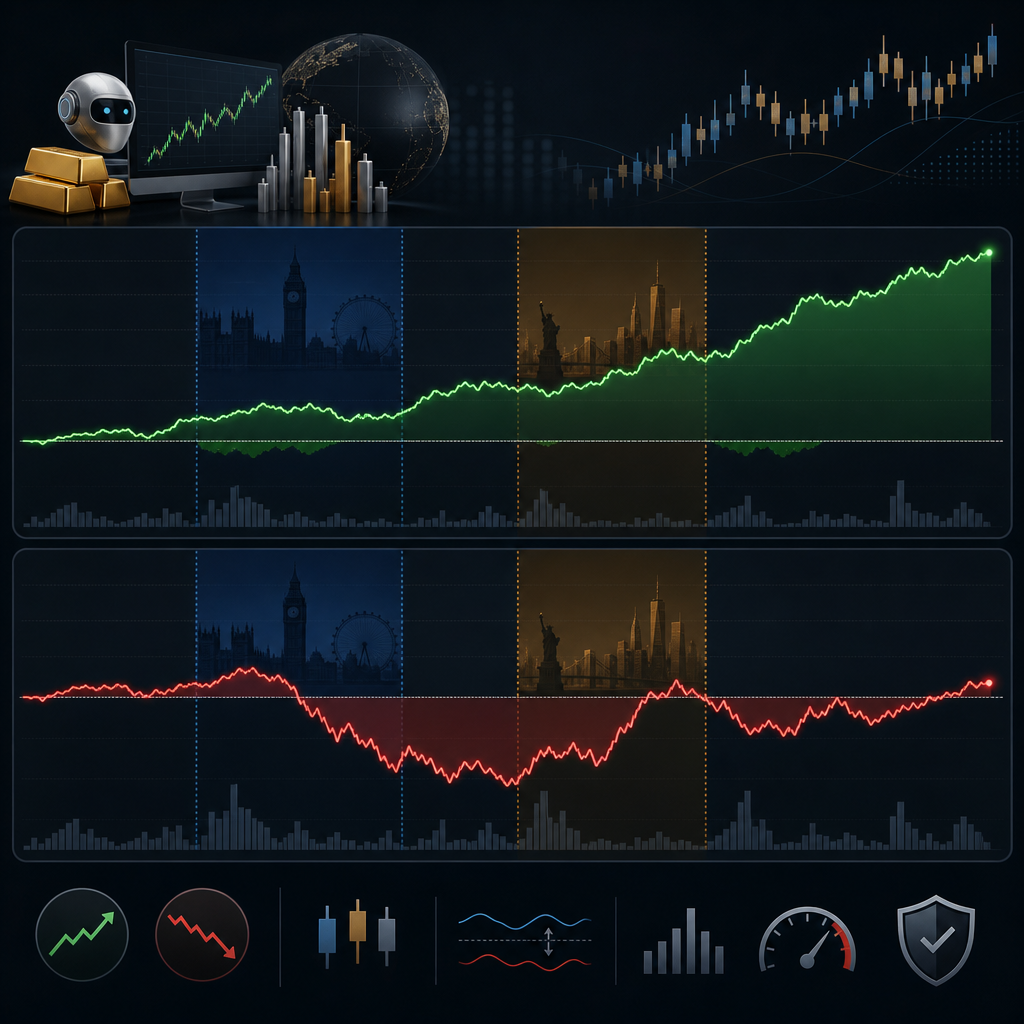
Different signal styles need different backtest settings. A 1:3 swing signal on GBP/USD is not tested the same way as a tight-stop gold scalp.
| Signal Type | Typical Holding Time | Best MT5 Model | Spread Approach | Key Metric to Watch | Common Backtest Trap |
|---|---|---|---|---|---|
| XAUUSD intraday (SL $10–$20) | 5–180 minutes | Every tick based on real ticks | Variable or conservative fixed | Max drawdown + slippage sensitivity | Using 1-min OHLC and tiny fixed spreads |
| Forex scalps (6–15 pips) | 1–30 minutes | Real ticks | Widened fixed (stress test) | Expectancy after costs | Ignoring commission and execution delay |
| Forex day trades (20–80 pips) | 1–24 hours | Real ticks or 1-min OHLC (if stops are wide) | Average spread ok + stress run | Profit factor + losing streaks | Over-optimizing filters to past data |
| Swing signals (100–400 pips) | Days to weeks | 1-min OHLC often sufficient | Average spread + swap included | Annualized return vs drawdown | Ignoring swap and weekend gaps |
Use the table as your “settings shortcut.” If you’re trading tight stops on gold around $2650, prioritize tick realism and cost realism. If you’re swing trading, prioritize swap, gaps, and drawdown.
Step-by-Step: Set Up MT5 Strategy Tester for Realistic Spreads & Commissions
Let’s set up MT5 like a professional test lab. The goal is to remove “backtest luck” and replace it with repeatable, conservative assumptions.
Step 1: Confirm symbol specifications match your broker
In MT5, right-click the symbol (XAUUSD, EURUSD, etc.) and open Specification. Record:
- Contract size
- Digits and tick size
- Tick value
- Typical spread
- Commission (if any)
- Swap long/short
Why this matters: if your XAUUSD tick value is different than expected, your risk per trade calculations will be wrong. And if commission is missing, your backtest will overstate results.
Step 2: Open Strategy Tester and pick the right model
Go to View → Strategy Tester. Select:
- Expert: your EA template (we’ll create it next)
- Symbol: start with XAUUSD, then repeat for EUR/USD and GBP/USD
- Period: M5 or M15 for intraday signals (common for gold)
- Model: Every tick based on real ticks
If real ticks aren’t available, use “Every tick” but treat results as “directional,” not definitive.
Step 3: Set a realistic testing window
Avoid cherry-picking. Use at least:
- 3–6 months for intraday systems
- 12–24 months for swing systems
Include different conditions: trending, ranging, high volatility, and quiet weeks.
Step 4: Configure spread assumptions (baseline + stress)
MT5’s spread handling depends on broker data and tester mode. Your practical approach:
- Baseline run: use the broker’s typical spread behavior (or set a conservative fixed spread if needed).
- Stress run: increase spread assumptions (e.g., +30–70% depending on symbol and your broker).
For example, if your XAUUSD typical spread is 25 points, stress test at 40–60 points. For EUR/USD, if typical is 12 points on a standard account, stress test at 18–25 points. The goal isn’t perfection—it’s robustness.
Step 5: Ensure commission and swap are included
On many brokers, commission is baked into the symbol settings. Confirm it’s applied in the tester. If you use a zero-spread + commission account, this step is non-negotiable.
Step 6: Disable “unrealistic” execution behavior
If your EA uses instant market orders, the tester will assume fills at modeled prices. In live trading, you’ll get slippage. You can approximate slippage by:
- Widening spread in stress tests
- Adding a “slippage points” parameter in your EA (if you code it)
Now you’re ready to test something meaningful—because you’re no longer pretending the market is frictionless.
Building a Simple EA Template to Execute Signal Rules (Without Overcoding)
You don’t need to be a full-time developer to backtest signals. You need a small EA that can translate signal logic into repeatable actions: enter, set SL/TP, and manage time filters.
We’ll outline a practical “EA template” concept you can implement in MQL5 or hire someone to code cheaply. The key is the structure, not fancy features.
The minimal features your signal-backtest EA needs
- Entry trigger: a condition (indicator, price action proxy, or time-based breakout).
- Fixed SL/TP: in points/pips or in price distance (gold dollars).
- One trade at a time: per symbol (prevents stacking that inflates risk).
- Session filter: trade only London/NY windows.
- Risk model: fixed lot or % risk per trade.
That’s enough to backtest most signal styles.
A realistic “signal-style” example for XAUUSD
Let’s say you want to mimic a common intraday gold signal behavior:
- Trade in London/NY only.
- Use a momentum trigger (e.g., EMA alignment + breakout of last swing).
- Stop loss: $15 from entry.
- Take profit: $30 (1:2 RR) or $45 (1:3 RR).
At gold near $2650, a buy might look like:
- Entry: 2652.00
- SL: 2637.00 (risk $15)
- TP1: 2682.00 (reward $30)
Or for a sell:
- Entry: 2646.50
- SL: 2661.50
- TP: 2616.50
This is exactly the kind of rule set that can be tested—because it’s measurable.
How to convert “signal messages” into EA inputs
If you have a signal log, you can store entries in a CSV and have the EA read it. But if you don’t, you can still test the provider’s style by matching:
- Average SL distance (gold: $10–$25; forex: 10–40 pips depending style)
- Average RR (1:2 or 1:3)
- Preferred sessions (often London/NY)
- Trade frequency (e.g., 1–3 trades per day)
This is how you validate whether a signal approach fits your broker conditions and psychology. If your backtest says the style has a 22% max drawdown, you’ll know whether you can emotionally survive it before going live.
For more on execution realism (latency, fills, and why MT5 can differ from live), see our related analysis on infrastructure: United Kings blog has multiple deep dives you can use to tighten your process.
Step-by-Step: Running Your First Backtest on XAUUSD at $2650
Let’s walk through a complete first run, using realistic gold conditions and a clean methodology. Even if you later test EUR/USD at 1.0520 or USD/JPY at 149.50, the workflow stays the same.
Step 1: Choose a timeframe that matches signal intent
If signals aim for $20–$45 moves, M5 or M15 is usually appropriate. M1 can be too noisy unless you’re scalping.
Pick M5 for this example.
Step 2: Select a meaningful date range
Use a period that includes both calm and volatile days. A good starting point is the last 6 months. Gold tends to show regime shifts; you want to see if your edge survives them.
Step 3: Define baseline costs
Set baseline assumptions that mirror your broker. If you can’t model variable spreads precisely, do this:
- Baseline spread: a conservative average (example: 30–40 points for XAUUSD).
- Commission: match your account type.
Then commit to a stress test later with worse costs.
Step 4: Configure the EA inputs (example values)
- SL_Dollars: 15.0
- RR_Multiplier: 2.0 (TP = $30)
- SessionFilter: London+NY
- MaxTradesPerDay: 2
- RiskPerTrade: 0.5% (or fixed lot for initial testing)
Why 0.5%? Because gold can deliver losing streaks. Starting conservative gives you more room to learn.
Step 5: Run the test and save the report
Run the test. Export:
- HTML report
- Trade list (CSV)
- Graph screenshots (equity and drawdown)
Don’t just look at net profit. Look at how profit was achieved.
Step 6: Repeat with stress conditions
Now widen the spread (or apply your slippage proxy):
- If baseline assumed 35 points, test 55 points.
- If your stop is $15, ask: does the strategy still survive when effective costs rise?
If performance drops slightly but remains profitable with similar drawdown, you have something robust. If it collapses, you’ve learned a valuable lesson for free—before risking capital.
How to Analyze MT5 Backtest Results Like a Signal Provider (Expectancy, DD, and Streaks)
Most traders open a report, see “Profit Factor 1.4,” and stop there. That’s not analysis. That’s hope.
You need to read a backtest the way a professional risk manager would.
1) Expectancy: the one number that tells the truth
Expectancy is your average profit per trade (in R or currency). A simple version:
- Expectancy = (Win% × Avg Win) − (Loss% × Avg Loss)
Example: Suppose your XAUUSD backtest shows:
- Win rate: 52%
- Average win: $28
- Average loss: $15
Expectancy ≈ (0.52×28) − (0.48×15) = 14.56 − 7.2 = $7.36 per trade (before considering compounding details). That’s meaningful.
Now compare that to a “high win-rate” strategy:
- Win rate: 75%
- Average win: $10
- Average loss: $30
Expectancy ≈ (0.75×10) − (0.25×30) = 7.5 − 7.5 = $0. One spread widening day and it’s negative.
2) Maximum drawdown: your psychological breaking point
Drawdown is not just a number. It’s the moment you stop following the plan.
If your backtest shows a 22% max drawdown, you should assume live drawdown could be worse. If you can’t tolerate that, you must reduce risk per trade.
This is where many traders blow accounts: they size for the best month, not the worst month.
3) Losing streaks: the hidden risk metric
Look at the longest losing streak and the distribution of streaks. If your system has a 7-loss streak historically, you must be sized to survive a 10-loss streak live.
For example, if you risk 2% per trade and hit 10 losses, you’re down ~20% (not counting compounding). That’s hard to recover from psychologically.
4) Trade frequency and overtrading risk
A system that takes 12 trades per day can look amazing in a backtest but be impossible to execute manually. If you follow Telegram signals, you also need a pace you can realistically manage.
This is why many of our traders prefer structured, session-focused execution. United Kings focuses heavily on London and New York session setups, and we publish clear Entry/SL/TP to reduce decision fatigue. If you want to see how a professional channel structures it, explore our XAUUSD gold signals and forex signals.
Session Breakdown: Testing London vs New York Performance in MT5
One of the most overlooked edges in forex and gold is time-of-day. You can have a strategy that is profitable in London and loses money in Asia. If you trade it all day, you average out to mediocre—or negative.
Because United Kings is heavily focused on London and New York sessions, it’s worth proving (with your own backtest) whether those sessions truly produce cleaner moves for your approach.
Why sessions matter more for XAUUSD and majors
Gold around $2650 can be calm for hours, then explode 1–2% in a short window when liquidity and participation spike. EUR/USD at 1.0520 and GBP/USD at 1.2680 also tend to trend more reliably when London and New York overlap.
USD/JPY at 149.50 can move sharply during US data and Tokyo flows, but many retail strategies still perform best when spreads are tight and momentum is real—often London/NY.
How to implement a session filter in your EA
Add inputs like:
- TradeStartHour (broker time)
- TradeEndHour
- AllowLondon, AllowNY
Then run separate tests:
- London only
- New York only
- London + NY
- All sessions (control group)
What to look for in session analytics
- Expectancy by session: which window produces the best average R?
- Drawdown by session: does Asia create choppy losses?
- Win rate vs RR stability: some sessions win more but with smaller wins.
Real example logic: If London-only gives you 0.18R expectancy with 10% drawdown, and “all sessions” gives 0.08R with 22% drawdown, the decision is obvious: trade less, earn more.
This is also how you decide whether to follow a provider’s “all-day” feed or focus only on their session calls. It’s not about being busy—it’s about being effective.
Stress Testing: Real Spread Data, Slippage Proxies, and News Volatility
Backtests fail in the real world for one reason: the market is not stable. Costs and volatility change.
To make your backtest useful, you must stress test it. This is especially true for gold and for any signal that trades around news.
Stress test #1: Widen spreads beyond “normal”
Create at least two scenarios:
- Normal conditions: typical spread/commission
- Volatile conditions: spread widened by 50–100%
For XAUUSD, if your baseline is 35 points, test 60–70 points. If your strategy dies under that, it’s likely too sensitive for real trading.
Stress test #2: Add a slippage proxy
MT5 doesn’t perfectly simulate real slippage in all cases. A practical workaround is to:
- Increase spread
- Move entries slightly worse (if your EA allows an entry offset)
Even a small offset matters. On EUR/USD, 1–2 pips can turn a marginal scalper negative. On XAUUSD, 20–50 points of “worse fill” can shift your RR enough to change the whole distribution.
Stress test #3: Filter out high-impact news windows
Some signal styles avoid news. Others trade it. You should test both realities.
Create a “news avoidance” setting: no new trades 15 minutes before and after major events. Then compare results.
If avoiding news improves expectancy and reduces drawdown, you’ve found a simple improvement you can apply immediately when following signals.
To understand how gold can behave when headlines hit, it helps to study real event reactions. We’ve broken that down here: how gold signals react to unexpected news events.
Stress test #4: Randomize sequence thinking (manual Monte Carlo mindset)
Even without fancy tools, you can do a “common sense” Monte Carlo check:
- Assume the worst losing streak could be 30–50% longer than backtest.
- Assume max drawdown could be 1.3× historical.
If that scenario would cause you to quit or blow risk limits, reduce risk per trade now—before the market forces you to.
Turning Backtest Results Into Position Sizing (Forex & Gold Examples)
Backtesting without position sizing is like measuring a car’s speed without checking the brakes. Your goal isn’t just to find a profitable curve—it’s to trade it safely.
Let’s turn results into a practical risk plan for both XAUUSD and forex.
Step 1: Define your maximum tolerable drawdown
Most traders overestimate what they can handle. A reasonable starting range:
- Conservative: 8–12% max DD
- Moderate: 12–20% max DD
- Aggressive: 20%+ (not recommended for most)
If your backtest max DD is 15%, plan as if it could be 20% live.
Step 2: Size risk per trade based on losing streaks
Let’s say your backtest shows a longest losing streak of 7 trades. Plan for 10.
If you risk 1% per trade, 10 losses is ~10% drawdown. If you risk 2%, that’s ~20%—and you’ll likely abandon the strategy at the worst time.
Gold (XAUUSD) sizing example at $2650
Assume:
- Account: $5,000
- Risk per trade: 0.5% = $25
- Gold stop: $15
Your position size should make a $15 move equal to $25 loss. Depending on your broker’s contract specs, that might be around 0.01–0.03 lots (varies widely). The point is the method: risk is defined by SL distance, not by lot size guessing.
Forex sizing example (EUR/USD at 1.0520)
Assume:
- Account: $10,000
- Risk per trade: 1% = $100
- Stop: 25 pips
That implies $4 per pip risk. You size the lot so that 1 pip ≈ $4. Again, your broker’s pip value depends on lot size, but the framework is universal.
Step 3: Adjust risk based on strategy quality (not emotions)
If your backtest shows:
- Expectancy is strong
- Drawdown is stable
- Stress tests still pass
Then you can gradually increase risk (e.g., from 0.5% to 0.75%). If stress tests fail, you reduce risk or avoid the strategy.
For a deeper, practical framework, use this guide: risk management strategies when using forex signals.
Common MT5 Backtesting Mistakes That Make Signal Results Look “Too Perfect”
If you’ve ever seen a backtest with a smooth equity curve and 3% drawdown on gold, you should immediately assume something is wrong.
Here are the mistakes that create fantasy results—and how to avoid them.
Mistake 1: Using a fixed tiny spread for XAUUSD
Gold spreads are not stable. If you test at 10 points when live is 30–60 points, you’re inflating results. Always run a stress test.
Mistake 2: Ignoring commission on low-target forex strategies
On EUR/USD scalps aiming for 8–12 pips, commission can be the difference between profit and loss. If your tester isn’t applying it, your results are fiction.
Mistake 3: Over-optimizing inputs until the past looks perfect
If you tweak your EMA periods from 20 to 21 to 22 until profit peaks, you’re curve-fitting. The market will punish that.
Use broad, sensible parameters and validate on out-of-sample data (different months).
Mistake 4: Testing only the “good months”
Gold around $2650 today might be trending, but your strategy must survive range chop too. Include both regimes.
Mistake 5: Not matching the way signals are executed
If the provider takes only one trade at a time but your EA stacks positions, you’re not testing the same thing. If the provider avoids Asia but you trade 24/5, you’ll get different results.
Make your EA reflect the execution reality.
Mistake 6: Confusing win rate with profitability
Win rate is a psychological metric. Expectancy is a financial metric. A 45% win rate with 1:3 RR can be excellent. A 75% win rate with 1:0.5 RR can be deadly.
Fix these mistakes and your backtests will look “worse”—but they’ll be far more useful. The goal is not to impress yourself. The goal is to protect your capital.
How to Use Backtesting to Choose Which Signals to Follow (A Practical Framework)
Backtesting isn’t just for algo traders. It’s a decision tool for signal followers.
Here’s a framework you can use to decide whether a signal style/provider is worth your time.
Step 1: Define what “good” looks like for you
Before you test anything, set your minimum standards:
- Max drawdown under X% (example: 15–20%)
- Profit factor above 1.2–1.4 (context matters)
- Expectancy positive after stress testing
- Trade frequency you can execute
Step 2: Test the provider’s “style” on your broker conditions
Even great signals can underperform on a broker with wider spreads or slow execution. Run baseline and stress tests that mirror your reality.
Step 3: Check session alignment
If your schedule only allows New York session, but the edge exists mainly in London, you’ll struggle. Backtest sessions separately and match your lifestyle.
Step 4: Decide your risk budget and scaling plan
Start small. If you’re new, demo trade first. Then go live with micro risk (0.25–0.5%) until you prove consistency.
Step 5: Monitor ongoing performance like a portfolio
Backtesting is the entry filter. Forward performance is the ongoing audit. Track:
- Monthly expectancy
- Drawdown vs historical
- Changes in spread conditions
If you want a real-world benchmark for structured signals, you can compare your findings with a premium channel that posts clear Entry/SL/TP and focuses on liquid sessions. United Kings has a large community (300K+ active traders) and provides educational guidance alongside signals. Start by reviewing our best forex signals overview and our beginner-friendly Telegram guide: forex signals Telegram for beginners.
FAQ: MT5 Backtesting Forex & XAUUSD Signals
1) What’s the best MT5 model for backtesting XAUUSD signals?
Use Every tick based on real ticks whenever possible. Gold often hits stops/targets via intrabar spikes, so 1-minute OHLC can misrepresent results—especially with $10–$25 stops.
2) How do I backtest signals with “real spread data” in MT5?
If your broker provides quality tick history, MT5 can reflect variable spreads more realistically in real-tick mode. If not, run a conservative fixed spread baseline and a widened-spread stress test. The goal is robustness, not perfection.
3) Can I backtest Telegram signals directly?
Only if you have a clean historical log (timestamps, entries, SL, TP) and you code an EA to replay those instructions. Otherwise, backtest the signal style by translating it into repeatable rules (session filters, SL/TP distances, trade limits).
4) What metrics matter most when backtesting forex signals?
Prioritize expectancy, max drawdown, and losing streak distribution. Win rate alone is misleading. Always evaluate performance after costs (spread + commission + swap where relevant).
5) How many trades do I need for a reliable backtest?
More is better. Aim for at least 200+ trades for intraday styles if possible, or at least 50–100 for slower swing systems. Also test across different market regimes (trends and ranges).
Risk Disclaimer: Forex and gold (XAUUSD) trading involves significant risk and may not be suitable for all investors. Backtesting is based on historical data and assumptions; past performance does not guarantee future results. Spreads, slippage, liquidity, and execution can differ materially in live markets. Never risk money you cannot afford to lose, and consider practicing on a demo account before trading live.
Join United Kings: Premium Forex & Gold Signals (Entry, SL, TP)
If you’ve read this far, you’re already ahead of most traders—because you’re choosing to validate before you risk.
When you’re ready to follow a structured signal service, United Kings delivers premium Telegram signals for forex and gold with clear Entry, SL, and TP levels, focused on London and New York session opportunities. We also provide educational context so you understand the “why,” not just the “where.”
- Community: 300K+ active traders
- Clarity: clean Entry/SL/TP formatting
- Focus: London & NY session trading
- Support: education alongside signals
- Confidence: 48-hour money-back guarantee
Explore our offerings:
Choose a plan that fits your timeline on our pricing page:
- Starter (3 Months): $299 (~$100/mo)
- Best Value (1 Year): $599 ($50/mo) + FREE ebook (50% savings)
- Unlimited (Lifetime): $999 (pay once, access forever)
And join the live community on Telegram: United Kings official Telegram channel.
Your next step: backtest the style, confirm it fits your broker and risk tolerance, then follow signals with a position size you can sustain. That’s how traders last long enough to win.