Gold at $2650 looks calm on the surface—up about +0.35% in the last 24 hours—but anyone who trades XAUUSD knows the truth.
Gold can sit still for 30 minutes, then print a $12 spike in two candles, take out both sides of the range, and only then choose direction.
If you’ve ever asked yourself, “How do people trade gold consistently without getting stopped out every day?” this xauusd trading guide is for you.
TL;DR: The fastest path to trading XAUUSD like a pro
- XAUUSD moves differently than forex pairs: it’s driven by real yields, USD flows (DXY 106.80), risk sentiment, and liquidity events—often in bursts.
- Best volatility is usually London + New York: build your plan around the London open, NY open, and high-impact US news.
- Risk management is the edge: typical XAUUSD stops are $10–$25; aim for 1:2 to 1:3 RR and avoid oversized lots.
- Use correlations smartly: gold often moves inverse to DXY and can align with JPY risk flows (USD/JPY 149.50) during risk-off moments.
- Trade a repeatable setup: pick 1–2 strategies (breakout retest, liquidity sweep reversal, trend pullback) and journal them.
- Signals help when they’re structured: you want clear Entry + SL + TP and session context—especially in fast markets.
1) What is XAUUSD—and why gold trading feels “different”

XAUUSD is the price of gold (XAU) quoted in US dollars (USD).
When you buy XAUUSD, you’re effectively long gold and short USD.
That sounds simple, but gold trading has a personality that surprises forex traders.
Gold is not “just another currency pair”
EUR/USD at 1.0520 can trend smoothly for hours.
Gold at $2650 often moves in impulses: it compresses, sweeps liquidity, then expands.
This is why many beginners feel like gold is “manipulated.” It’s usually not manipulation—it’s liquidity + leverage + macro flows.
What actually moves gold?
Gold reacts to a mix of macro and micro drivers.
In practical trading terms, the biggest recurring drivers are:
- US dollar strength (DXY 106.80): a stronger USD often pressures gold.
- Real yields: rising real yields tend to weigh on gold; falling real yields tend to support it.
- Risk sentiment: in risk-off moments, gold can catch bids alongside JPY and CHF flows.
- Central bank demand and reserve diversification: a slower burn driver that supports long-term trends.
- Event risk: CPI, NFP, FOMC, geopolitical headlines—gold can jump $15–$30 quickly.
Why spreads and execution matter more on XAUUSD
Gold can move $3–$5 in seconds around news.
If your broker widens spreads or your execution is slow, a “good setup” becomes a bad fill.
That’s also why structured, session-aware trade planning matters more here than on many major pairs.
Gold’s daily range: plan for reality
On an average day, gold can easily cover $20–$35 from low to high.
When volatility expands, $40–$60 days happen.
So if your stop is $7 and your target is $8, you’re often trading noise—not structure.
If you want a framework that keeps you out of random chop and focused on high-probability windows, you’ll like how we structure trades inside our premium gold signals—especially around London and New York liquidity.
2) Gold market fundamentals: the macro engine behind XAUUSD
Most traders treat fundamentals like “news that causes spikes.”
Professionals treat fundamentals like the wind direction—it doesn’t tell you the exact candle, but it tells you what’s more likely to work.
Real yields vs nominal yields (the gold reality check)
Gold is a non-yielding asset.
So when real yields (yield minus inflation) rise, gold often struggles because holding cash/bonds becomes more attractive.
When real yields fall, gold often finds support because the “opportunity cost” of holding gold drops.
DXY and gold: the relationship traders actually use
With DXY around 106.80, gold traders should always ask: Is USD strength the driver today, or is gold trading its own risk narrative?
Many intraday moves in gold are simply USD flows expressing themselves through the most liquid instruments.
But the correlation is not perfect.
Gold can rise even with a firm USD if the market is pricing risk, recession fears, or geopolitical stress.
Central banks and the “slow trend” component
Central bank buying doesn’t usually create 5-minute entries.
But it can provide a structural bid that changes how deep pullbacks go.
In other words: in a structurally bullish gold environment, dips to $2630 may be bought aggressively, while $2610 becomes a “line in the sand.”
Inflation data: why CPI matters more than you think
US CPI is one of the most important gold events.
Not because “inflation up = gold up” (that’s too simplistic).
Because CPI changes expectations for the Fed path, which changes yields, which changes USD, which changes gold.
Practical takeaway: build a daily bias in 3 questions
- Is USD strong or weak today? (DXY tone, major pairs like EUR/USD 1.0520)
- Are yields pushing risk-on or risk-off? (equities tone, USD/JPY 149.50 behavior)
- Is there major event risk? (CPI, NFP, FOMC; expect stop runs)
If you want a survival-style plan for news spikes, pair this guide with our breakdown on how gold signals react to unexpected news events.
3) XAUUSD trading sessions: when gold actually moves (and why)
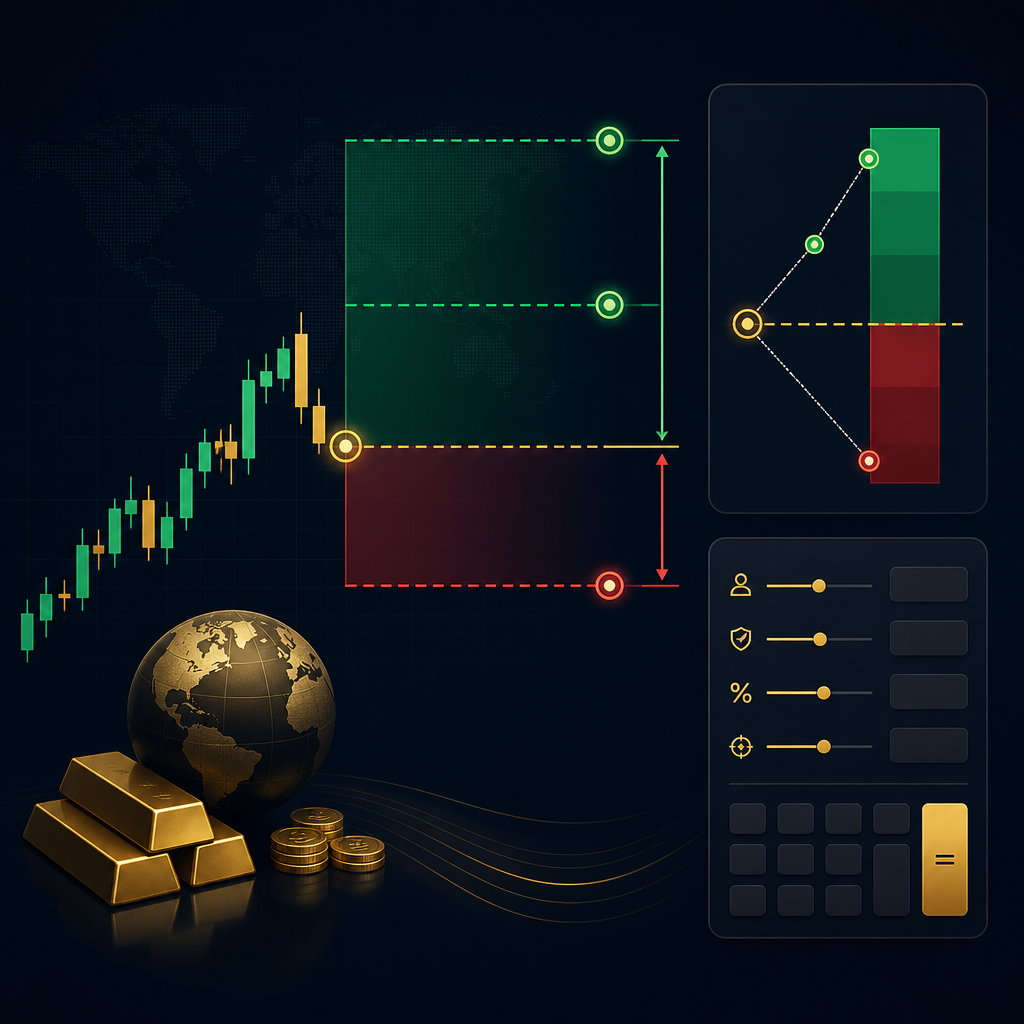
The biggest mistake new gold traders make is trading XAUUSD at random times.
Gold is tradable 24 hours, but it’s not equally “clean” 24 hours.
Asian session: range-building and traps
Asia often sets the initial range.
That range becomes liquidity for London.
If gold is at $2650 during Asia, you’ll often see price oscillate between, say, $2642 and $2656 with smaller candles.
Then London comes in and runs one side.
London session: the first real expansion window
London open is where many of the day’s best gold moves begin.
Liquidity increases, spreads tighten, and directional intent shows up.
A classic London pattern is a sweep of the Asian high/low followed by a strong reversal and continuation.
New York session: the “decision point”
New York often decides whether the London move continues or gets reversed.
US data releases also hit here, which can create fast $10–$25 swings.
If gold is trending up from $2635 to $2660 in London, NY can either:
- Continue to $2675–$2685 on momentum, or
- Fade the move and dump back to $2650 / $2640
London-NY overlap: the sweet spot
The overlap is where you often get the cleanest combination of liquidity and volatility.
This is why United Kings focuses heavily on London and NY session trading in our signals service.
Step-by-step: how to structure your day around sessions
- Mark the Asian range (high/low from Asia).
- Mark key levels from the prior day (high/low, close, and major swing points).
- Wait for London to show its hand: sweep + reclaim or breakout + retest.
- Trade only if RR is there: minimum 1:2, with SL $10–$25 depending on structure.
- Manage around NY: take partials or tighten stops before high-impact news.
If you want a broader session framework, our post on forex sessions and timing can help you align gold and FX timing without overtrading.
4) XAUUSD correlations: DXY, EUR/USD, USD/JPY, and risk sentiment
Gold is a global macro instrument.
So the fastest way to stop feeling “surprised” by XAUUSD is to watch what gold is responding to.
Gold vs DXY (106.80): the most common relationship
When DXY pushes higher, gold often faces headwinds.
When DXY softens, gold often finds room to rally.
But the key is timing.
Intraday, DXY can spike on data, and gold can whip in the opposite direction within seconds.
Gold vs EUR/USD (1.0520): the “USD proxy” view
EUR/USD is a major driver of DXY.
So if EUR/USD breaks down from 1.0520 toward 1.0480, that’s often USD strength, which can cap gold rallies.
Conversely, if EUR/USD reclaims a key level and squeezes higher, gold often breathes easier.
Gold vs USD/JPY (149.50): risk and yields in one chart
USD/JPY often reflects yield differentials and risk appetite.
When USD/JPY is ripping higher, it can signal rising yields and USD strength—often a tougher environment for gold.
When USD/JPY drops sharply (risk-off), gold can catch a bid as traders seek safety.
Gold vs GBP/USD (1.2680): less direct, still useful
GBP/USD can help confirm broad USD direction, but it’s more idiosyncratic.
Use it as a secondary confirmation, not a primary driver.
Correlation checklist you can use before every trade
- Is DXY trending or ranging? A trending DXY can overpower technical gold levels.
- Are EUR/USD and GBP/USD aligned? If both are falling, USD strength is likely real.
- Is USD/JPY stable or spiking? Spikes often mean yield-driven volatility.
- Is gold leading or lagging? If gold moves first, it may be risk-driven rather than USD-driven.
For a dedicated deep dive, our guide on gold vs USD correlation shows how to combine dual signals to avoid trading against the macro tape.
5) XAUUSD chart basics: pips, points, spreads, and the math of gold
Many beginners lose money on gold for a boring reason: they don’t understand the contract math.
So they risk 5x more than they think, then blame the market.
Gold “pips” vs dollars: what matters in real trading
On most platforms, XAUUSD moves in increments like 0.01, 0.10, or 0.1 depending on broker.
But what you should care about is the dollar move.
A move from $2650.00 to $2660.00 is $10.
That $10 can be your entire stop on an intraday trade.
Spread reality: your hidden cost
Gold spreads vary by broker and time of day.
During liquid hours, you might see tight spreads.
During rollover or news, spreads can widen dramatically.
If your stop is $10 and the spread widens by $1–$2 in fast conditions, your effective risk changes.
Stop placement: structure first, not “standard numbers”
Yes, many gold trades use $10–$25 stops.
But the correct stop is where the setup is invalidated.
Example:
- Entry: Buy $2648 after reclaiming a key level.
- Invalidation: below the sweep low at $2636.
- SL: $2635 (risk $13).
- TP1 (2R): $2648 + (2 × 13) = $2674.
- TP2 (3R): $2648 + (3 × 13) = $2687.
Position sizing: the only way to survive XAUUSD
Gold can punish oversized positions fast.
Your goal is to risk a fixed percentage per trade (many traders use 0.5%–1%).
Then adapt lot size to stop distance.
A $12 stop requires a smaller lot than a $25 stop if risk is constant.
Why beginners blow accounts on gold
- They use the same lot size for every trade.
- They place stops too tight in a $20–$35 daily range instrument.
- They revenge trade after a stop hunt.
- They trade low-liquidity hours and get chopped.
If you want a clean framework for this, our guide on risk management strategies when using signals applies perfectly to XAUUSD.
6) The best XAUUSD technical analysis toolkit (simple, not cluttered)
You don’t need 12 indicators to trade gold.
You need a small toolkit that answers three questions: trend, levels, and timing.
1) Market structure: higher highs/lows vs lower highs/lows
Start with structure on the 1H and 4H.
If gold is making higher highs and higher lows above $2610, you’re in a bullish structure.
Then drop to 15M/5M for entries.
2) Key levels that matter on gold
- Previous day high/low
- Asian session high/low
- Round numbers (e.g., $2650, $2660, $2680)
- Major swing points (visible on 4H)
Gold respects levels when liquidity is present.
It disrespects them when the market is hunting stops.
3) Moving averages (optional): use as a filter, not a trigger
A 50 EMA or 200 EMA can help define trend bias.
But don’t buy because price touched an MA.
Buy because structure + level + trigger align.
4) RSI (optional): divergence can help, but don’t overtrust it
Divergence on gold can work beautifully at extremes.
But in strong trends, RSI can stay overbought/oversold for a long time.
Use it to support a story, not to force a reversal.
5) Volume and liquidity concepts: the “why” behind the candle
Even if you don’t have centralized volume, you can read liquidity through price behavior.
Long wicks at a key level during London/NY often signal stop runs.
Fast reclaims often signal smart money positioning.
Step-by-step: a clean XAUUSD chart setup
- 4H: mark major swing highs/lows in the $2610–$2690 zone.
- 1H: mark previous day high/low and the Asian range.
- 15M: wait for a break/reclaim or sweep/reversal at those levels.
- 5M: take the entry only after a clear trigger candle and structure shift.
If you like trading with structured guidance, our XAUUSD gold signals are built around this exact idea: clear levels, session timing, and defined risk.
7) Three high-probability XAUUSD strategies (with real price examples)
Let’s make this practical.
Below are three XAUUSD strategy models that work across market conditions.
You don’t need all three at once.
Pick one that fits your personality, then master it.
Strategy A: Breakout + retest (trend continuation)
This works best when gold is trending and liquidity is strong.
Example scenario (gold around $2650):
- Gold consolidates between $2646 and $2654 during Asia.
- London breaks above $2654 and pushes to $2662.
- Price retests $2654–$2656 and holds.
Trade plan:
- Entry: Buy $2656 on retest confirmation.
- SL: $2644 (risk $12).
- TP1 (2R): $2680.
- TP2 (3R): $2692 (note: slightly above our guideline range, so you could cap at $2689–$2690 in practice).
Management tip: once price reaches +1R (around $2668), consider moving SL to reduce risk or take partial profit.
Strategy B: Liquidity sweep + reversal (mean reversion at key levels)
This is the classic “stop hunt” model that gold prints regularly.
Example scenario:
- Previous day low sits at $2632.
- NY pre-market dips to $2626 (sweeps liquidity).
- Within minutes, price reclaims $2632 and closes above it on 5M.
Trade plan:
- Entry: Buy $2634 after reclaim and micro structure shift.
- SL: $2620 (risk $14).
- TP1 (2R): $2662.
- TP2 (3R): $2676.
Why it works: the sweep clears weak longs, triggers breakout sellers, then reverses when liquidity is filled.
Strategy C: Trend pullback to a level (the “boring” money)
This is for traders who prefer confirmation and fewer trades.
Example scenario:
- Gold is in an uptrend from $2615 to $2668 over two sessions.
- Pullback returns to a prior breakout level at $2650.
- 15M prints a bullish rejection and holds above $2648.
Trade plan:
- Entry: Buy $2652.
- SL: $2637 (risk $15).
- TP1 (2R): $2682.
- TP2 (3R): $2697 (again, you may cap at $2689–$2690 depending on nearby resistance).
Which strategy should you choose?
Use this quick match:
- Breakout + retest: you like momentum and fast follow-through.
- Liquidity sweep reversal: you like fading extremes with confirmation.
- Trend pullback: you like patience and cleaner invalidation.
If you want to see how professional signal frameworks label entries/SL/TP, our guide on how Telegram forex signals work for beginners is a good companion—even if you only trade gold.
8) XAUUSD vs other markets: what to trade, when (comparison table)
Gold is powerful, but it’s not always the best instrument for your style.
Some days EUR/USD is cleaner.
Some days USD/JPY is more directional.
The pro move is to know what you’re choosing—and why.
Here’s a practical comparison to help you decide.
| Instrument | Typical Behavior | Volatility Profile | Best Sessions | Beginner Friendliness | When It’s the Best Choice |
|---|---|---|---|---|---|
| XAUUSD (Gold) | Impulse moves, stop runs, sharp reversals | Medium–High (often $20–$35 daily) | London + NY, overlap | Medium (needs risk discipline) | When macro/news drives momentum or when liquidity sweep setups appear |
| EUR/USD | Smoother trends, technical respect | Low–Medium | London, NY | High | When USD theme is clean and you want steadier movement |
| GBP/USD | More volatile than EUR/USD, sharper spikes | Medium | London, NY | Medium | When UK/US news drives direction and you can handle whipsaws |
| USD/JPY | Yield-driven trends, risk sentiment shifts | Medium | Asia, NY | Medium | When yields are moving and risk-on/off is strong (e.g., around 149.50 breaks) |
So… should you specialize in gold?
If you can only master one instrument, gold is a strong choice because it offers:
- Reliable liquidity during major sessions
- Clear reaction to macro events
- Enough range to hit 2R and 3R targets without forcing trades
But specialization only works if you respect its volatility.
Gold rewards patience and punishes “guessing.”
If you also want to diversify beyond gold, United Kings provides forex signals and even crypto signals so you can focus on the best opportunity of the day instead of forcing XAUUSD entries.
9) Risk management for XAUUSD: the rules that keep you in the game
If you take nothing else from this complete guide, take this:
Your strategy doesn’t matter if your risk is sloppy.
Gold is unforgiving to traders who size emotionally.
The “gold stop” reality: $10–$25 is normal
In the $2610–$2690 environment, a clean intraday setup often needs:
- $10–$15 stop for tight structure entries (5M/15M)
- $15–$25 stop for more volatile windows (NY open, data releases)
Anything tighter can work, but it must be justified by structure.
Risk-reward: why 1:2 is your baseline
Gold will stop you out sometimes even when you’re “right.”
That’s why 1:1 RR is often not enough.
With 1:2, you can be wrong more often and still grow.
Position sizing example (simple and realistic)
Let’s say your account is $2,000 and you risk 1% per trade.
That’s $20 risk.
If your stop is $15 on XAUUSD, your lot size must be calibrated so that a $15 move equals ~$20 loss.
Different brokers calculate gold contract values differently, so the exact lot will vary.
The rule stays the same: lot size adjusts to stop distance, not the other way around.
Daily loss limit: the professional circuit breaker
Gold can trigger revenge trading because moves are dramatic.
Set a daily max loss (example: 2% or 3%).
If you hit it, you’re done for the day.
This one rule can save months of progress.
Trade management: partials and break-even (use carefully)
Many traders move to break-even too early and get wicked out.
A better approach is:
- At +1R: consider partial profit or tighten slightly if structure supports it
- After a new higher low (for longs): trail below structure
- Before major news: reduce exposure or lock profit
Signals + risk: how to use them responsibly
A premium signal should give you Entry, SL, and TP.
Your job is to size correctly and follow rules.
That’s why our community content repeatedly reinforces position sizing and discipline—especially for XAUUSD.
If you’re evaluating providers, use our signal provider checklist to avoid vague “buy/sell now” channels.
10) A complete step-by-step XAUUSD trading plan (beginner to profitable)
Most traders don’t fail because they lack a strategy.
They fail because they don’t have a process.
Here’s a simple plan you can follow for the next 30 days.
Step 1: Choose your trading window (and protect it)
Pick one:
- London open (first 90 minutes)
- London-NY overlap
- NY open (first 90 minutes)
Do not trade randomly throughout the day.
Gold rewards focus.
Step 2: Define your “A+ setup” in one sentence
Example A+ setup:
“I only buy XAUUSD after a sweep of a key low and a 5M close back above the level, during London or NY.”
That’s it.
Everything else is noise.
Step 3: Build your pre-trade checklist
- What is the 4H/1H structure?
- Where are previous day high/low and Asian range?
- What is DXY doing around 106.80—trend or chop?
- Is there high-impact news in the next 60 minutes?
- Is my stop $10–$25 and placed beyond invalidation?
- Is RR at least 1:2?
Step 4: Execute with a fixed risk model
Risk the same percentage each trade.
Don’t increase risk after wins.
Don’t “make it back” after losses.
Step 5: Journal in a way that improves you
After each trade, record:
- Session (London/NY)
- Setup type (breakout, sweep reversal, pullback)
- Entry/SL/TP and RR
- Screenshot before and after
- One sentence: what you did right/wrong
Step 6: Review weekly and cut what doesn’t work
If you took 20 trades and 14 were outside your plan, your strategy isn’t the problem.
Your discipline is.
Cut the “B setups.”
Double down on the one pattern that pays.
If you want support while you build this routine, United Kings combines signals with education inside our community of 300K+ active traders. Start with our signals page and see how we structure entries for clarity.
11) Using XAUUSD signals the right way (without becoming dependent)
Signals can accelerate your learning and reduce decision fatigue.
But only if you use them as a framework—not as a crutch.
What a premium XAUUSD signal should include
- Entry price (or entry zone)
- Stop loss (clear invalidation)
- Take profit levels (at least TP1/TP2)
- Session context (London/NY timing)
- Trade idea (breakout, sweep, pullback)
This structure is exactly how we publish trades in United Kings.
We focus on London and NY session opportunities and prioritize clarity.
How to follow signals with professional risk control
- Copy the levels (Entry/SL/TP) exactly as provided.
- Calculate your lot size based on SL distance and your % risk.
- Don’t chase if price already ran $8–$12 away from entry.
- Respect the stop. If invalidated, it’s invalidated.
- Track performance like a system, not like a lottery ticket.
The “dependency trap” and how to avoid it
If you only take signals without learning, you’ll panic the first time volatility shifts.
So do this instead:
- For each signal, identify: level, structure, and trigger.
- Ask: “Would I take this trade without the signal?”
- Over time, you start seeing the same setups yourself.
Where United Kings fits (and why traders stay)
Traders stay when signals are consistent, structured, and supported.
United Kings offers:
- Premium Telegram signals for forex and gold
- 85%+ win rate reported by our community tracking (no profit guarantees)
- Clear Entry, SL, TP levels
- Educational content alongside signals
- 48-hour money-back guarantee
If you want to see what “good” looks like in the signal world, start with our curated guide to the best Telegram channels for gold trading signals, then compare the structure to what you’re currently using.
12) Common XAUUSD mistakes (and the exact fixes)
Gold doesn’t bankrupt traders.
Bad habits do.
Here are the mistakes I see most often—and what to do instead.
Mistake 1: Trading gold like EUR/USD
Gold needs room.
If you use a $6 stop in a market that can swing $20–$35 daily, you’ll get stopped by noise.
Fix: place SL beyond structure, usually $10–$25, and size down.
Mistake 2: Entering mid-range with no edge
Buying at $2650 in the middle of a $2640–$2660 range is not a strategy.
Fix: trade at the edges (sweep/reclaim) or after a breakout + retest.
Mistake 3: Moving to break-even too early
Gold loves to retest.
Many good trades die at break-even because traders fear being wrong.
Fix: only move SL after structure confirms (new higher low / lower high).
Mistake 4: Overtrading the chop hours
Some hours are designed to frustrate you.
Fix: trade London/NY windows, not boredom.
Mistake 5: Ignoring the calendar
Trading 5 minutes before CPI with a tight stop is gambling.
Fix: reduce size, widen stop with structure, or wait until after the first spike.
Mistake 6: Not having a “max pain” rule
One bad day shouldn’t erase a month.
Fix: daily loss limit and “stop trading after 2 losses” rule for beginners.
If you want a more general framework for avoiding common signal-following errors, read top mistakes to avoid when relying on gold signals.
FAQ: XAUUSD trading guide questions traders ask every day
1) Is XAUUSD good for beginners?
Yes, but only if you respect volatility.
Beginners should start on demo, use smaller risk (0.25%–0.5%), and trade only London/NY windows.
2) What is the best timeframe to trade gold?
Use a top-down approach.
Many traders read bias on 4H/1H, then execute on 15M/5M for precision.
3) How much should my stop loss be on XAUUSD?
Typical intraday stops are often $10–$25, depending on structure and volatility.
Stops should sit beyond the level that invalidates your setup, not at a random number.
4) Why does gold spike and reverse so often?
Because gold is liquidity-driven.
It frequently runs highs/lows to trigger stops and fill larger orders, then reverses when liquidity is absorbed.
5) Can I trade XAUUSD using signals?
Yes.
Signals work best when they include Entry, SL, TP, and session context, and when you apply strict position sizing and a daily loss limit.
Risk disclaimer (read before you trade)
Trading forex and gold (XAUUSD) involves significant risk and is not suitable for every investor. You can lose some or all of your capital. Past performance is not indicative of future results. No signal, strategy, or analysis can guarantee profits. If you’re new, practice on a demo account first and only trade with money you can afford to lose. Consider seeking independent financial advice if needed.
Join United Kings: premium XAUUSD signals + education (Telegram)
If you want to stop guessing and start trading gold with structure, join the United Kings community.
We deliver premium Telegram forex and gold signals with clear Entry, SL, and TP, built around London and New York session opportunities.
- Community: 300K+ active traders
- Structured trade levels and education alongside signals
- Three plans on our pricing page: Starter (3 Months $299), Best Value (1 Year $599 with 50% savings + FREE ebook), and Unlimited (Lifetime $999)
- 48-hour money-back guarantee
Start here: explore our gold signals and forex signals, then join our Telegram to get the live alerts: United Kings Telegram trading room.
Your next step: pick one XAUUSD strategy from this guide, commit to it for 30 days, and let structured execution do the heavy lifting.