
If you’ve ever watched XAUUSD explode 300–800 pips in seconds on CPI or NFP and thought, “How do I trade this without getting wrecked?” you’re not alone.
Trading gold on U.S. CPI and Non-Farm Payroll days can feel like trying to catch a falling knife… while the knife is on fire.
But it doesn’t have to be chaos.
In this guide, we’ll build a rule-based XAUUSD news volatility plan you can repeat every month—focused on a 30-minute pre-news preparation and a safer post-spike entry model.
TL;DR: The CPI & NFP XAUUSD Playbook (Read This First)
- Don’t trade the first candle. Your edge is usually after the stop-run spike, not during it.
- Mark pre-news liquidity zones (Asian range + London/NY swing levels) and wait for a sweep + reclaim.
- Use a volatility-adjusted no-trade window: typically 2–5 minutes before and 3–10 minutes after the release, depending on spreads and ATR.
- Trade the pullback, not the headline. Your highest-probability entry is the first controlled retrace to a reclaimed level.
- Risk is non-negotiable. Gold SLs are usually $10–$25 from entry on news days, with 1:2 to 1:3 R:R targets.
- Have a “no trade” rule. If spreads are wild or structure is unclear, skip it and live to trade the next setup.
Why CPI & NFP Move Gold So Violently (And What Matters Right Now)

To trade XAUUSD during CPI and NFP, you need to understand what gold is really reacting to.
Gold is not just “risk-off” or “inflation hedge.” In the short term, it’s a real-yield and USD sensitivity instrument that also absorbs positioning, options flows, and liquidity gaps.
Right now, we’re in a market context where:
- XAUUSD is around $2650.00 (up roughly +0.35% in the last 24h).
- DXY is elevated near 106.80, which often creates push-pull tension for gold.
- USD/JPY is around 149.50, keeping “rates and dollar strength” in focus.
- EUR/USD is near 1.0520 and GBP/USD near 1.2680, showing USD strength remains a key theme.
So why do CPI and NFP matter so much?
CPI is a direct input into rate expectations. If inflation prints hotter than expected, markets often price “higher for longer,” pushing yields up and pressuring gold—at least initially.
NFP affects the labor side of the Fed’s dual mandate. A strong jobs print can lift yields and the dollar, while a weak print can do the opposite.
But here’s the twist: the first move is often a liquidity event, not the “true direction.”
On CPI/NFP, gold frequently does a two-step:
- Step 1: A stop-run spike hunts liquidity above/below obvious levels (previous highs/lows, Asian range, round numbers like $2650, $2660, $2640).
- Step 2: A repricing move follows, often after spreads normalize and the market re-anchors to structure.
Your job is to stop trying to predict Step 1—and instead build rules to trade Step 2.
This is exactly how our community approaches volatility events inside United Kings Gold Signals: define levels, wait for the sweep, then execute with clear entry/SL/TP.
The Core Mindset: You’re Not Trading CPI or NFP—You’re Trading Liquidity
Most traders lose on news days for one reason: they confuse “information” with “tradable structure.”
Yes, CPI and NFP are important. But your broker feed, your spread, and your execution speed are not competing with institutions on the first 3 seconds.
So we flip the approach.
We treat CPI/NFP as a liquidity extraction event that creates a high-quality pullback opportunity if (and only if) structure confirms.
What liquidity looks like on XAUUSD
Liquidity is where orders cluster. On gold, the most common magnets are:
- Asian session range high/low (often 20–60 pips wide, sometimes more).
- London session swing points (especially the first impulse high/low).
- Previous day high/low and previous week high/low.
- Round numbers like $2640, $2650, $2660, $2675.
- Equal highs/lows (double tops/bottoms) and obvious trendline touches.
On CPI/NFP, price often spikes to one of these magnets, triggers stops, then reverses hard.
That’s why the “spike candle” is dangerous. It’s engineered to be untradeable for most retail traders.
What we’re hunting: the reclaim
Instead of guessing direction, we wait for:
- Sweep: price takes a key high/low.
- Reclaim: price closes back inside the range or back above/below the broken level.
- Pullback: price retests the reclaimed level with reduced volatility.
This is the backbone of the post-spike entry rules you’ll learn below.
If you want a broader foundation on how gold behaves across sessions, pair this article with our market education inside United Kings blog, then apply the rules here specifically to CPI/NFP.
Pre-News vs Post-News Trading: What’s Safer for Most Traders?
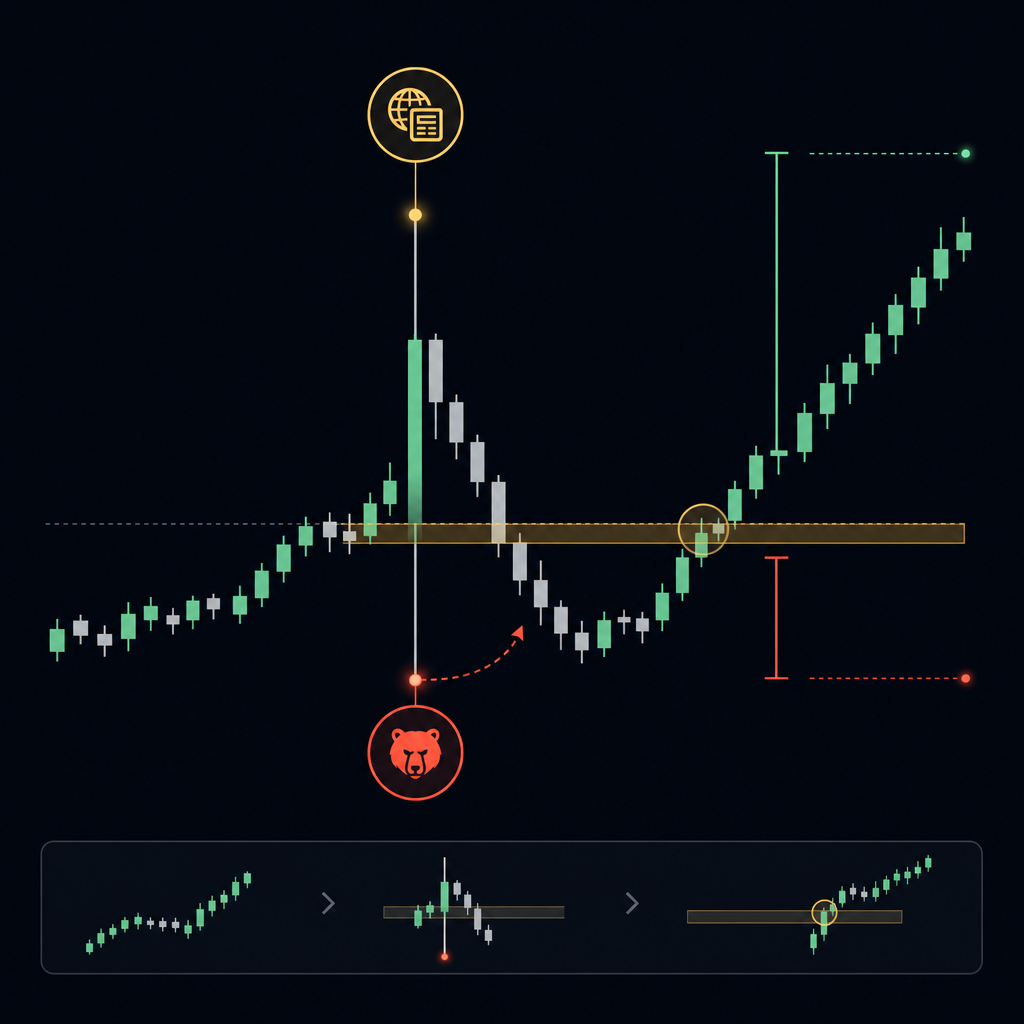
Let’s be blunt: trading the first 30–90 seconds after CPI/NFP is where accounts go to die.
Slippage is real. Spreads widen. Your stop can get filled worse than your planned risk. Even if your analysis is right, execution can make you wrong.
That’s why we prioritize a post-spike pullback entry model.
Here’s a practical comparison.
| Approach | When You Enter | Pros | Cons | Best For |
|---|---|---|---|---|
| Pre-news position | 5–30 min before release | Great R:R if you catch direction | Gambling on headline; can get wicked out both sides | Advanced traders with tight risk rules |
| Instant breakout | 0–30 sec after release | Feels exciting; big candles | Worst spreads/slippage; false breaks; emotional decisions | Usually nobody (unless pro infra) |
| Post-spike pullback (our focus) | 2–15 min after release | Structure becomes clearer; spreads normalize; repeatable rules | May miss part of move; requires patience | Most retail traders and signal followers |
| Late continuation | 20–90 min after release | Trend may stabilize; cleaner setups | R:R can be worse if move already extended | Conservative traders |
Notice what’s consistent: the safest approach is the one where you let the market reveal its hand.
This is also why premium signal services matter on news days. You want clean levels, clear invalidation, and rules that stop you from revenge trading. That’s how we structure alerts inside United Kings Signals—especially during London and New York sessions when liquidity is deepest.
The 30-Minute Pre-News Plan (Step-by-Step Checklist)
This is the part most traders skip. Then they wonder why they panic at release time.
Your goal in the last 30 minutes before CPI/NFP is simple: build a map.
Not a prediction. A map.
Step 1: Check the volatility baseline (ATR + recent range)
Open XAUUSD on M15 and H1.
Look at the last 5–10 candles on M15 and estimate typical movement. If gold has been moving $3–$6 per 15 minutes, then a $15 spike is “news normal.”
In our current context around $2650, it’s common to see pre-news compression like:
- Range: $2642 to $2656 (about $14, or 1400 pips).
- Then a release spike: $18–$35 in under a minute.
This tells you your stop and position size must be adapted. A $7 stop might be fine on a quiet day, but on CPI it’s often just “noise.”
Step 2: Mark the three liquidity zones (non-negotiable)
On your chart, mark:
- Asian range high/low (roughly 00:00–06:00 broker time, adjust to your feed).
- London swing high/low (the most obvious impulse before NY).
- Previous day high/low (PDH/PDL).
Example levels (realistic around today’s price):
- Asian high: $2658
- Asian low: $2641
- PDH: $2666
- PDL: $2628
You don’t need perfect. You need consistent.
Step 3: Define your “no-trade window” before the release
This is where most “news strategies” fail: they don’t include behavior rules.
Here’s a simple volatility-adjusted guideline:
- Low volatility day: no-trade from T-2 minutes to T+3 minutes.
- Normal CPI/NFP day: no-trade from T-3 minutes to T+7 minutes.
- Extreme conditions (spreads jump, platform lag): no-trade from T-5 minutes to T+10 minutes.
During the no-trade window, you do one thing: watch how price attacks your zones.
Step 4: Decide your “one setup only” rule
News days can tempt you into overtrading.
So set a cap:
- Max trades: 1–2 setups for the entire event.
- Max daily risk: 0.5%–2% depending on experience.
- Hard stop: if you lose once, you stop trading the event.
If you want a deeper framework for sizing and daily loss limits, use our dedicated guide on risk management strategies when using forex signals. The principles apply perfectly to gold.
How to Mark Pre-News Liquidity Zones That Actually Matter
Not all lines are equal. On CPI/NFP, you want zones that other traders also see.
The more obvious the level, the more likely it becomes a stop pool.
Zone #1: The Asian range (your “launchpad”)
Gold often consolidates in Asia, then expands in London/NY.
On news days, the Asian range becomes a clean reference point for:
- Stop runs above the high or below the low
- Re-entries back into the range
- First pullback retests
Example: Asian range is $2641–$2658 with price around $2650 pre-news.
If CPI hits and price spikes to $2668 (sweeping PDH at $2666), then slams back below $2658, that’s information.
It says: the market used above-$2658 liquidity to fill orders, then rejected.
Zone #2: Previous day high/low (institutional magnets)
PDH/PDL are popular because they’re used by day traders, algos, and risk managers.
On CPI/NFP, a common pattern is:
- Spike takes PDH by $2–$6
- Immediate reversal
- Pullback to PDH from the other side
This creates a clean “level-to-trade-from” that’s not based on emotions.
Zone #3: The “compression box” (last 30 minutes)
Draw a box around the last 30 minutes pre-release.
This box often becomes the battlefield. If price re-enters and holds inside the box after the spike, you can trade the retest with defined invalidation.
Example: 30-minute box is $2646–$2655.
After CPI, price spikes down to $2632 (sweeping PDL $2628 is close), then rips back into the box and closes above $2646.
Now you have a play: buy the pullback into $2646–$2648 with a defined stop below the reclaim low.
Avoid the “too many lines” trap
If you have 20 levels, you have none.
On news days, keep it to:
- Asian high/low
- PDH/PDL
- One local swing high/low
- One round number cluster (like $2650)
That’s enough structure to trade XAUUSD during CPI without paralysis.
The First Spike: How to Identify the Stop-Run (Without Getting Trapped)
Let’s talk about the candle everyone wants to trade—and shouldn’t.
The first spike on CPI/NFP is usually a stop-run candle.
It’s designed to do at least one of these:
- Trigger breakout buys above resistance
- Trigger breakout sells below support
- Hit both sides (whipsaw) and destroy tight stops
Three signs it’s a stop-run spike (not a real breakout)
1) It sweeps a major level and instantly returns.
Example: gold spikes from $2650 to $2672, taking PDH $2666 and Asian high $2658, then falls back under $2658 within 1–3 minutes.
2) The wick is massive relative to the body.
If the candle has a $20 range but closes near the open, the market is “clearing” orders, not trending.
3) Spreads are abnormal and fills are messy.
If your platform shows spread jumping from, say, 20–40 pips to 80–200 pips, you’re not trading price action. You’re trading broker conditions.
Your rule: let the first spike complete
We use a simple rule that saves accounts:
- No entries on the first spike candle.
- No market orders during the no-trade window.
- Wait for a close back above/below a key level on M1 or M5.
Waiting feels like missing out. But it’s actually where your edge begins.
What to watch instead (a calm checklist)
- Did price sweep Asian high/low or PDH/PDL?
- Did it close back inside the pre-news range?
- Is there a clear “reclaim level” you can anchor risk to?
- Are spreads back to normal?
If you can’t answer these, you don’t trade.
And if you want to understand how gold behaves when unexpected headlines hit outside scheduled releases, our guide on how gold signals react to unexpected news events complements this CPI/NFP plan perfectly.
Post-Spike Entry Rules: The Safer Pullback Setup (Our Main Strategy)
This section is the “money.”
The post-spike pullback is where you can build a repeatable NFP gold trading strategy without needing lightning execution.
The setup in one sentence
Trade the first pullback after a sweep-and-reclaim of a major liquidity level, with a volatility-appropriate stop and a 1:2 to 1:3 target.
Rule-based criteria (print this)
- Level: price must sweep a key level (Asian high/low, PDH/PDL, or obvious swing).
- Reclaim: price must close back beyond the level (M1 or M5 close).
- Pullback: price must retest the level with smaller candles (reduced momentum).
- Trigger: enter on a rejection pattern (engulfing, pin bar, or break of micro-structure).
- Invalidation: stop goes beyond the spike extreme or beyond the retest structure.
Example 1: CPI spike up, then short the pullback
Assume pre-news price is $2650 and PDH is $2666.
- CPI hits: price spikes to $2676 (sweep PDH).
- Within minutes, price drops and closes back below $2666 (reclaim down).
- Price pulls back to retest $2666–$2668.
Entry: Sell at $2667 on rejection.
Stop loss: Above spike retest / above $2678 (about $11 risk).
Take profit (1:2): $2667 - (2 × 11) = $2645.
Take profit (1:3): $2667 - (3 × 11) = $2634.
This fits our guideline: SL $10–$25, targets 1:2 or 1:3.
Example 2: NFP spike down, then buy the pullback
Assume Asian low is $2641 and price is $2652 pre-news.
- NFP hits: price dumps to $2630 (sweep Asian low).
- Price snaps back and closes above $2641 (reclaim up).
- Price pulls back into $2641–$2643.
Entry: Buy at $2642.
Stop loss: $2627 (about $15 risk).
Take profit (1:2): $2642 + 30 = $2672.
Take profit (1:3): $2642 + 45 = $2687.
Now you’re trading with structure, not adrenaline.
The “two tries only” rule
Sometimes the first retest fails.
So we use:
- Attempt #1: first pullback entry.
- Attempt #2: only if price reclaims again and forms a clearer base.
- No attempt #3. If it’s messy, it’s not your trade.
Stops, Targets, and Position Sizing for CPI/NFP Gold Volatility
On news days, your strategy can be perfect and still lose if your risk model is wrong.
This is where most traders blow up: they keep the same lot size they use on a normal Tuesday.
Gold doesn’t care that you “usually risk $5 stops.” CPI will eat that for breakfast.
Volatility-adjusted stop placement (practical rules)
For XAUUSD in the $2610–$2690 zone, a CPI/NFP stop is commonly:
- Aggressive: $10–$12 (only if structure is extremely clean)
- Normal: $12–$18
- Conservative: $18–$25 (if wicks are large or retest is deeper)
Where do you place it?
- Beyond the spike extreme (safer, but larger stop)
- Beyond the retest swing (tighter, but higher chance of stop-out)
Choose one method and stick to it. Random stops create random results.
Targets: why 1:2 is the baseline and 1:3 is the bonus
News trades can run far, but they can also reverse violently.
That’s why we like:
- TP1 at 1:2 (bank something)
- TP2 at 1:3 (if momentum continues)
- Move SL to breakeven only after structure confirms (not instantly)
Example: Buy $2642, SL $2627 (risk $15).
- TP1: $2672 (+$30)
- TP2: $2687 (+$45)
That’s clean, measurable, and repeatable.
Position sizing: the simplest safe formula
Decide your max risk per trade (in dollars), then divide by stop size (in dollars).
Example:
- Account: $5,000
- Risk per trade: 1% = $50
- Stop size: $15
You want a position size where $15 move against you equals $50 loss.
If you’re not sure how your broker calculates XAUUSD pip value, trade smaller or use a demo until you can verify.
Beginners should treat CPI/NFP as an “advanced environment.” Demo first, then go live small.
If you’re following a signal provider, make sure you understand how to execute entries and manage partials. Our educational posts inside forex signals on Telegram for beginners will help you avoid common execution mistakes that show up most on news days.
Timing Rules: The No-Trade Window, Spread Filter, and Session Context
Even the best setup is trash if you trade it at the wrong time.
So we use three timing filters: clock time, spread, and session liquidity.
1) Clock time: your volatility-adjusted no-trade window
We introduced the window earlier. Here’s how to apply it with discipline.
- T-30 to T-10: mark zones, reduce distractions, no new swing trades.
- T-10 to T-3: only observe; if you’re in a trade, consider reducing exposure.
- T-3 to T+7: no market orders; no chasing; let the spike complete.
- T+7 to T+20: hunt the pullback entry; spreads should normalize.
- T+20 to T+60: continuation or reversal trades if structure is clear.
If your broker is slow or spreads stay wide, extend the window. Your plan must be broker-aware.
2) Spread filter: the “if spread is crazy, we don’t trade” rule
This sounds obvious, but traders ignore it because they feel FOMO.
Use a simple filter:
- If spread is 2–3× normal, you wait.
- If spread is 4× normal or you see price “jumping,” you skip the event.
Skipping is a strategy.
3) Session context: London vs New York behavior
United Kings focuses heavily on London and NY session trading because that’s where liquidity is deepest and levels respect more often.
CPI and NFP releases typically hit during the New York morning. That means:
- Liquidity is high, but volatility is also extreme.
- Moves can be cleaner after the first 5–15 minutes.
- Reversals can happen near NY lunch if the move is overextended.
So if you miss the first post-spike pullback, you may still get a second opportunity later—just don’t force it.
Common CPI/NFP Traps on XAUUSD (And the Rules That Save You)
Let’s make this practical by naming the traps.
If you can recognize the trap in real time, you stop donating money to the market.
Trap #1: The “breakout that isn’t”
Gold breaks above $2666 on CPI, you buy, and within 60 seconds it’s back at $2652.
Rule to avoid it: you only trade after a sweep-and-reclaim plus a pullback retest.
Trap #2: The revenge trade after slippage
You enter, get slipped 200–400 pips, and now you’re emotionally “behind.”
Rule to avoid it: if you experience abnormal slippage once, you stop trading the event. Your broker conditions are telling you something.
Trap #3: The double spike (both sides get swept)
This is common on NFP: first spike up, then spike down, then trend.
Rule to avoid it: wait for the second reclaim and trade the first clean pullback after volatility compresses.
Trap #4: Trading too big because “news always moves”
Yes, it moves. But it can move against you just as fast.
Rule to avoid it: reduce size on news days or keep risk constant by widening stop and reducing lots.
Trap #5: Confusing analysis with execution
You can be directionally right and still lose if you enter at the wrong time.
Rule to avoid it: you don’t enter until spreads normalize and your trigger candle confirms.
If you’re relying on signals, these traps are why you want a provider that sends clear Entry, SL, and TP levels and teaches you how to execute. That’s a core part of our approach at United Kings, alongside educational content for the community of 300K+ active traders.
Two Full Trade Blueprints You Can Repeat Every Month (CPI + NFP)
Now we’ll put everything together into two repeatable blueprints.
Use these as “if/then” scripts. When the market does X, you do Y.
Blueprint A: CPI “Sweep High → Reclaim → Short Pullback”
- Pre-news (T-30): mark Asian high/low and PDH/PDL. Note current price near $2650.
- Release: price spikes above PDH (example: $2676).
- Confirmation: M1/M5 closes back below PDH ($2666).
- Entry zone: $2666–$2669 retest.
- Trigger: bearish rejection candle or micro lower high break.
- SL: above $2678–$2685 depending on wick size ($10–$18 typical).
- TP1: 1:2 target (example: $2645).
- TP2: 1:3 target (example: $2634).
Invalidation logic: if price reclaims and holds above PDH after retest, you’re wrong. Exit or don’t enter.
Blueprint B: NFP “Sweep Low → Reclaim → Buy Pullback”
- Pre-news (T-30): mark Asian low ($2641) and PDL ($2628).
- Release: price spikes down to $2630–$2625 area.
- Confirmation: close back above $2641 (reclaim).
- Entry zone: $2641–$2644 retest.
- Trigger: bullish engulfing / pin / micro break up.
- SL: below $2627–$2631 ($10–$18 typical; up to $25 if chaotic).
- TP1: 1:2 (example: $2672).
- TP2: 1:3 (example: $2687).
Management rule: if price hits 1:1 quickly then stalls, consider partial profits. News moves can snap back.
Where most traders improve instantly
Not by finding a new indicator.
By doing these three things:
- Trading fewer setups
- Waiting for reclaim + pullback
- Keeping risk consistent
That’s the essence of a professional XAUUSD news volatility plan.
How We Trade CPI/NFP at United Kings (Signals + Education + Execution)
If you’ve read this far, you already think like a serious trader: rules, structure, risk.
The question becomes: how do you execute this consistently month after month—especially when you’re busy, emotional, or second-guessing?
This is where a premium signal service can help, if it’s built the right way.
What “premium” should mean on news days
On CPI/NFP, you don’t need 20 alerts. You need one high-quality plan with clear numbers.
At United Kings, our Telegram signals are designed to be:
- Clear: Entry, SL, and TP levels you can place without guessing.
- Session-aware: focused on London and New York where setups respect liquidity.
- Risk-first: we emphasize position sizing and avoiding overtrading.
- Educational: we explain the “why,” not just the “buy/sell.”
We also maintain a performance-driven culture with an 85%+ win rate target across our strategy set, while staying compliant: no guaranteed profits and past performance doesn’t guarantee future results.
Where to start if you want signals for gold and forex
- Explore our full offering on United Kings Signals.
- For gold-specific setups, see Gold Signals.
- If you also trade majors like EUR/USD and GBP/USD, add Forex Signals to stay aligned with USD drivers like CPI/NFP.
If you’re comparing providers, use a checklist. Our guide on choosing a forex signals provider helps you evaluate transparency, risk rules, and execution quality.
Pricing plans (3 options)
We keep plans simple and built for serious traders:
- Starter (3 Months): $299 (about $100/month)
- Best Value (1 Year): $599 (about $50/month, 50% savings + FREE ebook)
- Unlimited (Lifetime): $999 (pay once, access forever)
You can review the three plans on our pricing page.
And if you want to talk to the team before joining, our contact page is open.
FAQ: Trading XAUUSD on CPI & NFP Days
1) Is it better to trade CPI or NFP for gold?
Both can move gold aggressively. CPI often drives rate expectations more directly, while NFP can create whipsaws. For most traders, the same post-spike pullback rules work on both.
2) How long should I wait after CPI/NFP to enter a gold trade?
A practical window is 7–15 minutes after release, once spreads normalize and you get a sweep-and-reclaim plus a pullback. If conditions are extreme, wait longer or skip.
3) What stop loss size is reasonable on CPI/NFP for XAUUSD?
Typically $10–$25 depending on wick size and structure. Tight stops get hunted on news. Adjust lot size so your dollar risk stays consistent.
4) Should beginners trade gold during CPI or NFP?
Beginners should demo trade first and treat CPI/NFP as advanced sessions. If you go live, trade small and focus on execution rules rather than excitement.
5) Can I follow signals on CPI/NFP days safely?
You can, but you must still manage risk and understand that spreads and slippage can affect fills. Use signals that provide clear Entry/SL/TP, and avoid chasing during the first spike.
Risk Disclaimer (Read Before You Trade)
Forex and gold trading involves significant risk and may not be suitable for all investors. You can lose more than your initial deposit if trading leveraged products. CPI and NFP releases can cause extreme volatility, widened spreads, and slippage. Past performance does not guarantee future results. Nothing in this article is financial advice. If you’re new, practice on a demo account and use strict risk management.
Final CTA: Get CPI/NFP-Ready with United Kings (Gold + Forex Signals)
If you want to stop improvising on news days and start trading a repeatable plan, we’ll help you do it.
Join the 300K+ trader community and get premium Telegram alerts with clear Entry, SL, and TP levels—built for London and New York session opportunities.
- Start with our dedicated XAUUSD gold signals for CPI/NFP weeks.
- Or access the full suite via United Kings Signals.
- Choose your plan on United Kings pricing (3 Months $299, 1 Year $599, Lifetime $999).
Want instant access? Join our official Telegram now: United Kings Signals on Telegram.
Bonus confidence: we offer a 48-hour money-back guarantee so you can test the service risk-free (terms apply).