You get a clean XAUUSD signal… and then CPI hits.
Gold is trading around $2650, the 24-hour change is mildly positive, and everything looks normal.
Then spreads widen, candles turn into $10–$20 whipsaws, and what should’ve been a simple entry becomes a stressful guessing game.
This guide is built for one exact problem: how to trade XAUUSD during news (CPI, NFP, FOMC) without letting spreads, slippage, and fakeouts destroy your edge.
TL;DR: The 30-Minute Lockdown + Spread Filter System
- Use a 30-minute lockdown rule: avoid new XAUUSD entries in the 30 minutes before and after CPI/NFP/FOMC unless your spread filter says conditions are acceptable.
- Run a spread filter checklist: if spread and volatility exceed your thresholds, delay or skip the signal—even if the setup is perfect.
- News conditions require different risk: cut position size (often 30–60%) and widen stops intelligently (not randomly) to avoid noise stops.
- Prefer “confirm-then-enter” execution: let the first spike print, then trade the second move with structure (break + retest, or sweep + reclaim).
- Plan your exits in advance: use 1:2 or 1:3 R:R, partials, and time-based exits when liquidity is unstable.
- Consistency beats excitement: the best traders don’t “win the news,” they avoid bad fills and protect their weekly expectancy.
Why XAUUSD Becomes Dangerous During CPI, NFP, and FOMC
Gold (XAUUSD) is already volatile compared to most major FX pairs.
When CPI, NFP, or FOMC drops, XAUUSD can go from “tradable volatility” to “execution chaos” in seconds.
At the time of writing, gold is hovering near $2650.
That’s right in a zone where a single headline can shove price from $2652 → $2668 and then back to $2646 before you can blink.
What actually changes during high-impact news
In normal London/NY conditions, your broker might show a tight spread and stable fills.
During news, three things shift at once.
- Liquidity pulls back: market makers widen quotes, and depth disappears.
- Spread expands: your cost to enter rises instantly, sometimes 3–10x normal.
- Slippage increases: your order fills at a worse price than requested, especially with market orders or tight stop orders.
Now combine that with algorithmic reactions.
News bots hit both sides, triggering stop clusters and running liquidity above/below obvious levels.
Why gold is uniquely sensitive
Gold is heavily tied to real yields, USD strength, and risk sentiment.
Right now, the DXY is around 106.80, USD/JPY near 149.50, EUR/USD around 1.0520, and GBP/USD around 1.2680.
When CPI surprises, DXY can jump, yields can spike, and gold reacts violently.
But the first reaction isn’t always the real move.
Often, XAUUSD prints a “headline spike,” then reverses as the market digests details like core CPI, wages, or dot plots.
The hidden killer: execution quality
Most traders think news losses come from being “wrong.”
In reality, many losses come from bad execution—wide spread entries, slippage into stops, and stops placed where news noise lives.
That’s why we treat news as an execution problem first, and a strategy problem second.
If you’re following signals from a premium provider like United Kings, your edge comes from structure and timing.
But you still need rules for when not to press the button.
The “30-Minute Lockdown Rule” (The Core Framework)
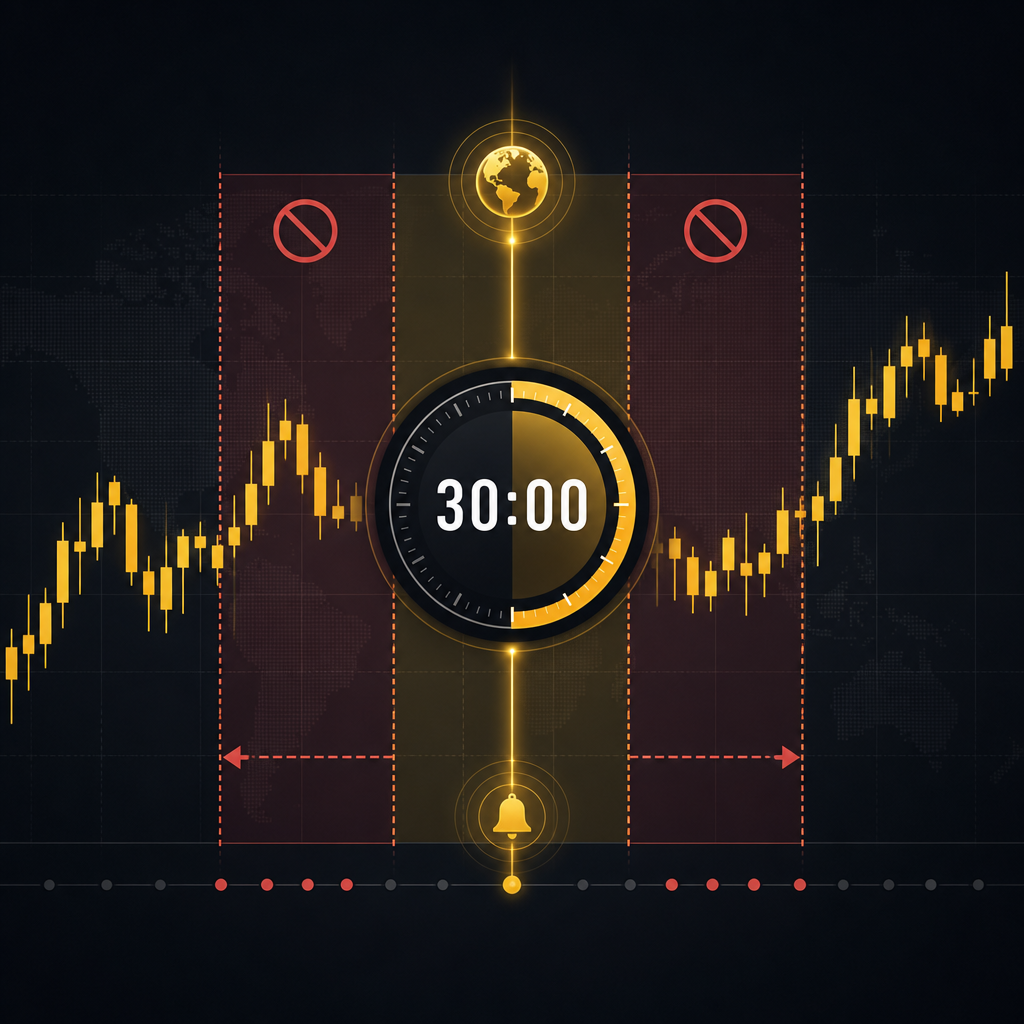
The 30-minute lockdown rule is simple.
We avoid opening new XAUUSD trades 30 minutes before and 30 minutes after high-impact releases (CPI, NFP, FOMC rate decision, Powell press conference).
This isn’t fear.
This is respecting how spreads and liquidity behave during scheduled shocks.
Why 30 minutes works better than “5 minutes”
Many traders only avoid the last 2–5 minutes before news.
But spreads and liquidity often start deteriorating earlier, especially on gold.
In the final 30 minutes, you’ll often see:
- Price compress into a tight range (a volatility coil).
- Stop clusters build above/below obvious highs/lows.
- Brokers begin widening spreads “pre-emptively.”
If you enter during this coil, your stop is likely sitting exactly where the first spike hunts.
What “lockdown” actually means
Lockdown isn’t “do nothing.”
Lockdown means you switch modes from execution to preparation.
- No new entries (unless spread filter passes, explained next).
- No revenge trades if you miss the move.
- Manage existing positions with predefined rules (reduce risk, tighten exposure, or hedge only if your plan allows).
A practical example around CPI
Let’s say CPI is at 13:30 London time.
Gold is trading at $2650 at 13:00.
You receive a signal: Buy XAUUSD @ 2648–2650, SL 2636, TP 2672.
Under normal conditions, that’s a clean 1:2 setup (12 risk, 24 reward).
But during the 30-minute pre-news window (13:00–13:30), spreads may widen and slippage may turn your 2649 entry into 2653.
Now your risk is bigger, your R:R is worse, and your stop is more likely to be hit by noise.
Lockdown says: do not execute yet.
After the release: why we still wait
The first 1–5 minutes after CPI is usually the most chaotic.
But the next 10–30 minutes can still be unstable.
Gold might spike up to $2668, then dump to $2642, then grind back to $2658.
If you trade the first spike, you’re competing with machines.
If you trade after the first wave, you’re trading structure again.
The Spread Filter Checklist (Execute, Delay, or Skip)
The lockdown rule is your time filter.
The spread filter checklist is your market condition filter.
It answers one question: Is execution quality good enough to justify taking this signal right now?
Why spread matters more than you think
On XAUUSD, spread is effectively a tax on every trade.
If your normal spread is, say, $0.20–$0.50, you can trade tight structure.
If spread blows out to $1.50–$3.00 during news, your stop and take-profit logic changes.
A $2.00 spread on gold is not “just $2.”
It’s a direct hit to your entry price, your break-even, and your probability of being stopped out.
The checklist (simple, measurable thresholds)
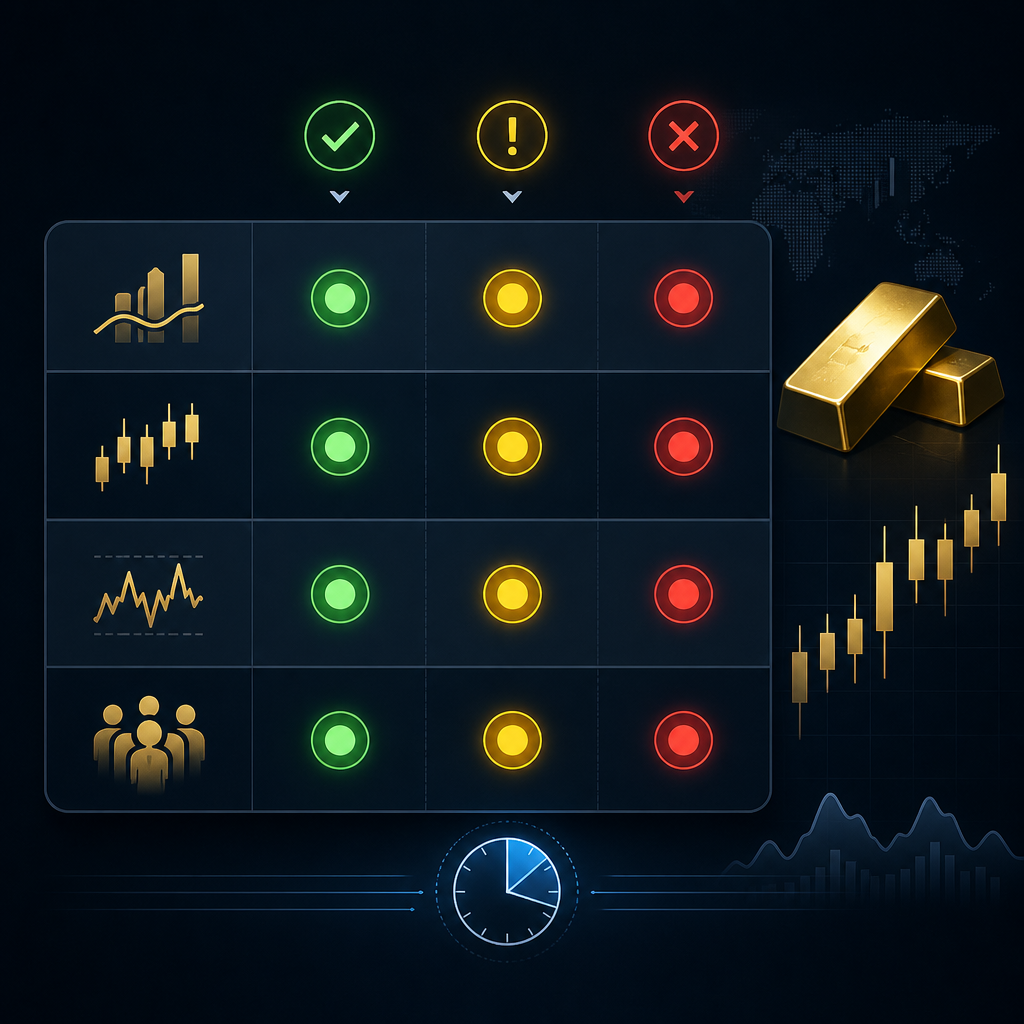
Use a three-state decision: Green (execute), Yellow (delay), Red (skip).
- Spread state
- Green: spread ≤ $0.60
- Yellow: $0.60–$1.20
- Red: ≥ $1.20
- 1-minute candle size (volatility proxy)
- Green: typical 1m candle ≤ $2.50
- Yellow: $2.50–$5.00
- Red: ≥ $5.00 consistently
- Slippage/Fill quality (your last 2–3 fills)
- Green: slippage ≤ $0.30
- Yellow: $0.30–$0.80
- Red: ≥ $0.80 or frequent re-quotes
If you get two Reds, you skip.
If you get one Red and multiple Yellows, you delay.
If you’re mostly Green, you can execute—ideally with confirmation (we’ll cover that).
What about brokers with “fixed” spread?
Fixed spread often means the cost shows up elsewhere.
During news, you may see more slippage, more re-quotes, or slower execution.
So even if spread looks stable, keep the slippage and candle-size filters.
How this saves real money (numeric example)
Assume a signal: Sell XAUUSD @ 2658, SL 2672 (14 risk), TP 2630 (28 reward).
In Green conditions, you might get filled at 2658.2.
In Red conditions, you might get filled at 2656.8 or 2659.5 depending on order type and spike.
That 1–2 dollars of execution drift can turn a 1:2 trade into 1:1.6.
Over 50 trades, that expectancy damage is huge.
News-Specific Execution: Market Orders vs Limit Orders vs Stop Entries
During CPI/NFP/FOMC, the order type you choose can matter as much as direction.
Signals are often shared as “Entry zone + SL + TP.”
Your job is to translate that into an execution method that respects news conditions.
Market orders (fast, but most exposed to slippage)
Market orders fill immediately, but at the best available price.
During news, “best available” can be far from what you saw on screen.
Use market orders only when:
- Your spread filter is Green.
- You’re trading after the first spike (post-lockdown or late in the post window).
- You can tolerate small slippage without breaking your R:R.
Limit orders (price control, but risk of no-fill)
Limit orders protect your entry price.
But during news, price may jump over your limit and never come back.
Limit orders work best for “retest entries.”
Example:
- Gold spikes from $2650 → $2666 on CPI.
- Then it retraces to retest $2656–$2658.
- You place a limit buy at $2657, SL $2645, TP $2681.
This avoids chasing the spike and keeps your risk math clean.
Stop entries (confirmation, but can be the worst fills)
Stop orders trigger when price hits a level.
During news, stops can trigger right at the peak of a spike.
That’s how traders get filled long at $2668 and watch price snap back to $2652 in 10 seconds.
If you use stop entries, use them only when:
- Spread is Green/low Yellow.
- The breakout has structure (not a single candle).
- You have a “max slippage rule” mentally (if filled too far, you cancel the trade plan).
Best practice for signal followers
If you’re trading with United Kings, you’ll typically receive clear levels.
Your safest news execution pattern is:
- Wait for the spike.
- Let the spread normalize.
- Enter on confirmation (break + retest, or sweep + reclaim).
This is how you keep the signal’s edge intact instead of donating it to spread and slippage.
Stop Loss and Take Profit Placement for News Volatility (With Real Levels)
News volatility forces a decision: do you keep tight stops and accept more stop-outs, or widen stops and reduce size?
Professionals usually do the second.
Widen stops to survive noise, and cut position size to keep risk constant.
Typical XAUUSD stop distances in this environment
In normal conditions, many intraday gold trades use $6–$12 stops depending on structure.
During CPI/NFP/FOMC, that’s often too tight.
A realistic news stop range is often $10–$25 from entry, aligned to structure.
Structure-first stops (not random numbers)
Use price structure to place stops:
- Below/above the news sweep low/high.
- Beyond a key 5m/15m swing point.
- Outside a consolidation range that formed after the spike.
Example (post-CPI reclaim long):
- Price spikes down to $2638, then reclaims $2650.
- You enter long at $2652 on a 5m close above 2650.
- SL: $2640 (12 risk) below the reclaim zone and above the extreme low.
- TP1: $2676 (24 reward, 1:2)
- TP2: $2688 (36 reward, 1:3)
This uses a stop that makes sense, not a “round $10.”
Take profit logic during news
News moves can trend hard, but they can also snap back.
So we like a two-layer exit approach:
- TP1 at 1:2 to pay yourself.
- TP2 at 1:3 if momentum holds, often with a trailing stop under 5m swings.
Example (news fade short):
- Gold spikes up to $2674 then fails to hold above $2668.
- You sell at $2666.
- SL: $2680 (14 risk)
- TP1: $2638 (28 reward)
- TP2: $2624 (42 reward)
Those targets sit inside the $2610–$2690 guideline range and reflect realistic post-news travel.
The “time stop” that most traders ignore
If price doesn’t move in your favor within a defined time window, you exit.
During news, if a trade hasn’t progressed after 20–40 minutes, conditions may be shifting.
A time stop prevents you from holding a dead position into the next volatility wave.
Risk-Adjusted Position Sizing: How to Trade Smaller Without Feeling “Small”
Most traders blow up news days because they keep the same lot size.
But volatility isn’t the same.
So your position size shouldn’t be the same either.
The rule: keep $ risk constant, not lot size
Decide your fixed risk per trade (example: 1% of account).
Then adjust lot size based on stop distance and execution conditions.
If your normal stop is $10 and news stop is $20, your size should be roughly cut in half.
Simple sizing example (conceptual, broker-agnostic)
Assume you normally risk $100 per trade.
Normal day:
- Stop = $10
- Size = “1R per $10 move” (your platform calculates the lot)
News day:
- Stop = $20
- Size = 50% of normal
Now your emotional state improves instantly.
You can let the trade breathe without panicking over every $3 wick.
Add a “news haircut” based on spread state
We also reduce size based on the spread filter state.
- Green: 100% of your planned (news-adjusted) size
- Yellow: 50–70%
- Red: 0% (skip)
This is how professionals keep drawdowns shallow.
They don’t need to trade every signal.
They need to trade the signals that can be executed cleanly.
What if you’re following signals on Telegram?
Telegram signals are fast.
That’s the point.
But during news, speed without filters is a trap.
So your workflow should be:
- Read the signal.
- Check the calendar and lockdown window.
- Run the spread filter checklist.
- Compute size based on stop distance + spread state.
If you’re new to Telegram-based execution, the Forex signals Telegram beginners guide is a good foundation.
The High-Impact News Playbook (CPI vs NFP vs FOMC)
Not all news events behave the same.
CPI tends to create sharp repricing in yields and USD.
NFP often triggers violent first moves and reversals due to revisions and wage components.
FOMC can create multiple waves: the statement, the rate decision, the press conference, and sometimes dot plots.
| Event | Typical XAUUSD Behavior | Highest Risk Window | Best Execution Style | Common Trap |
|---|---|---|---|---|
| CPI | Fast spike + second move once details hit | 0–5 min after release | Wait for spike, trade reclaim/retest | Chasing the first candle |
| NFP | Whipsaw, stop hunts, then trend | 0–15 min after release | Confirmation entries, smaller size | Assuming first move is “the move” |
| FOMC | Multiple volatility waves across 60–120 min | Statement + Powell Q&A | Trade later wave, wider stops, partials | Overtrading every headline |
How DXY context changes the gold reaction
With DXY around 106.80, the USD is relatively firm.
That often means gold’s upside can be “harder” unless yields soften.
So on a hotter CPI, you may see DXY pop and gold dump sharply.
But on a softer CPI, gold can rip higher as real yields drop.
Use “two-step confirmation” on all three events
We like a simple rule:
- Step 1: Let the first spike print (liquidity hunt).
- Step 2: Trade the second move with structure (reclaim/retest).
This aligns perfectly with the lockdown concept.
You’re not trying to be first.
You’re trying to be right with good execution.
Step-by-Step: The Exact 10-Min Workflow to Trade XAUUSD Signals Around News
This is the playbook you can run every time you see CPI, NFP, or FOMC on the calendar.
It’s designed for signal followers who want consistency, not adrenaline.
Step 1: Identify if you’re in a lockdown window
Check the time.
If you’re within 30 minutes before the release, you’re in lockdown.
If you’re within 30 minutes after the release, you’re still in lockdown unless spread filter is Green and structure is clear.
Step 2: Mark the “pre-news box” on 5m/15m
Draw the high and low of the last 30 minutes before the release.
That range often becomes the liquidity target.
Example:
- Pre-news high: $2658
- Pre-news low: $2646
Expect the first spike to attack one side.
Step 3: Run the spread filter checklist
Check:
- Current spread (Green/Yellow/Red)
- 1-minute candle size
- Recent slippage quality
If Red, you skip.
If Yellow, you delay and reduce size.
If Green, continue.
Step 4: Decide your execution style (3 options)
- Execute immediately (rare during news): only if Green and you’re not in the spike.
- Delay and confirm (most common): wait for reclaim/retest.
- Skip: if spread/slippage is unacceptable or price action is pure chaos.
Step 5: Adjust your stop and size
Pick a stop based on structure, typically $10–$25.
Then reduce size to keep $ risk constant.
Add a “news haircut” if spread state is Yellow.
Step 6: Place TP1 and TP2 before entering
Decide the trade management in advance.
Example long from $2652:
- SL: $2640 (12)
- TP1: $2676 (24)
- TP2: $2688 (36)
Step 7: If filled, manage like a professional
- Don’t move stops impulsively.
- Consider partial at TP1.
- Trail remainder under 5m swings once in profit.
Step 8: If not filled, don’t chase
Missed trades are part of surviving news.
Chasing is how you turn a good plan into a bad week.
Realistic News-Day Scenarios (Using Today’s Market Context)
Let’s turn the framework into realistic situations around $2650.
These examples are not promises.
They’re templates you can use to think clearly when the market is loud.
Scenario A: CPI spike down, reclaim long (classic)
Gold is at $2650 pre-CPI.
CPI prints softer than expected.
The first reaction is weird: gold spikes down to $2639 (liquidity sweep), then rips back above $2650.
Your plan:
- Wait for a 5m close above 2650.
- Enter long at $2652.
- SL at $2640 (12 risk).
- TP1 at $2676 (24 reward).
- TP2 at $2688 (36 reward).
Spread filter: if spread is $0.40–$0.60, Green.
If spread is $1.50, Red—skip even if the setup looks perfect.
Scenario B: NFP whipsaw, break + retest short
Gold is at $2656 pre-NFP.
NFP prints strong, wages hot, USD bids.
Gold dumps to $2640, bounces to $2654, then fails.
Your plan:
- Sell the retest failure at $2650–$2652.
- SL at $2666 (14–16 risk depending on entry).
- TP1 at $2622–$2624 (about 1:2).
- TP2 at $2610–$2612 (about 1:3 if momentum continues).
This is a “second move” trade, not a first candle gamble.
Scenario C: FOMC multiple waves, trade the later wave
Gold is around $2650 into FOMC.
First wave: statement causes a spike up to $2668.
Second wave: Powell sounds hawkish, gold dumps to $2642.
Third wave: market re-prices, gold forms a base and reclaims $2655.
Your plan is to trade the later, cleaner wave:
- Enter long at $2656 after reclaim + retest.
- SL at $2642 (14 risk).
- TP1 at $2684 (28 reward).
- TP2 at $2690 (34 reward; slightly under the top of the guideline range).
FOMC is where overtrading kills accounts.
One good trade is enough.
How United Kings Traders Handle News: Sessions, Selectivity, and Signal Discipline
At United Kings, we focus heavily on London and New York sessions.
That’s where liquidity is deepest and where gold signals tend to perform best when executed with discipline.
But “best” doesn’t mean “always.”
News changes the game.
Signal discipline beats signal volume
A premium signal is only premium if you can execute it properly.
That’s why we teach members to use filters and rules, not just entries.
If you want the full ecosystem—signals plus education—start with our main United Kings signals page.
Gold-focused members should use gold-specific channels and context
Gold moves differently from EUR/USD or GBP/USD.
News sensitivity is higher, and spread behavior can be more aggressive.
That’s why many members prefer staying inside our dedicated gold signals workflow, especially around CPI/NFP/FOMC.
Where most traders go wrong with Telegram signals during news
- They treat every signal as mandatory. Professionals treat signals as opportunities, filtered by conditions.
- They ignore execution. Spread and slippage can erase the edge of a good setup.
- They keep the same size. News volatility requires adaptive sizing.
If you’re building your process, you’ll also benefit from our broader risk framework in risk management strategies when using forex signals.
What “85%+ win rate” means (and what it doesn’t)
United Kings has historically reported an 85%+ win rate.
That number is based on our tracking methodology—see results and methodology for how it’s calculated.
It does not mean every news trade wins.
It does not mean profits are guaranteed.
It means we focus on repeatable processes, high-quality setups, and clear Entry/SL/TP communication.
The Spread Filter Checklist (Printable) + Decision Tree
When the market is moving fast, you don’t want to “think harder.”
You want to think simpler.
Use this checklist every time you plan to trade XAUUSD signals during news.
Checklist: Execute, Delay, or Skip
- 1) Are we in the 30-minute lockdown window?
- If yes: default is no new entries.
- If no: proceed normally, but still check spread.
- 2) What is the live spread right now?
- ≤ $0.60: Green
- $0.60–$1.20: Yellow
- ≥ $1.20: Red
- 3) What is the average 1-minute candle size in the last 5 minutes?
- ≤ $2.50: Green
- $2.50–$5.00: Yellow
- ≥ $5.00: Red
- 4) How are your fills today?
- Slippage ≤ $0.30: Green
- $0.30–$0.80: Yellow
- ≥ $0.80 / re-quotes: Red
- 5) Is there post-spike structure (retest/reclaim) on 5m?
- If no: delay.
- If yes: execute with adjusted risk.
Decision tree (fast rules)
- Two Reds: Skip the signal.
- One Red: Delay until it clears, or skip if time-sensitive.
- Mostly Yellow: Delay + reduce size.
- Mostly Green: Execute (prefer confirmation).
Pro tip: keep a “news journal”
Write down spread, slippage, and your decision.
After 10 news events, you’ll know exactly which brokers, sessions, and events give you the cleanest execution.
That’s how you turn a checklist into a personal edge.
Common Mistakes Traders Make Trading Gold Signals During News (And Fixes)
If you want to improve quickly, don’t add indicators.
Remove mistakes.
Here are the most common news-day errors we see from otherwise solid traders.
Mistake 1: Trading the first candle
The first candle is often a liquidity hunt.
Fix: wait for the reclaim/retest or break/retest.
If you feel “late,” remember: being late with structure is better than being early with chaos.
Mistake 2: Keeping the same stop size
A $7 stop during CPI is asking to be clipped.
Fix: use structure-first stops in the $10–$25 range, then cut size.
Mistake 3: Ignoring spread state
Traders obsess over direction and ignore the cost of entry.
Fix: if spread is Red, you skip—no debate.
Mistake 4: Overtrading FOMC
FOMC can produce 3–5 tradable swings.
That doesn’t mean you should trade 3–5 swings.
Fix: choose one high-quality wave and treat the rest as noise.
Mistake 5: Moving SL because “it will come back”
News volatility makes traders emotional.
They widen stops after entry without adjusting size, turning a planned 1% risk into 3–5%.
Fix: decide SL before entry and accept the outcome.
Mistake 6: Confusing “signals” with “certainty”
Signals are probabilities.
Even the best providers lose trades.
Fix: focus on process, not single outcomes, and use demo trading until execution is consistent.
FAQ: Trading XAUUSD Signals During High-Impact News
1) Can I trade XAUUSD signals during CPI, NFP, or FOMC?
Yes, but you should treat it as a different environment.
Use the 30-minute lockdown rule and a spread filter checklist to decide whether to execute, delay, or skip.
2) What spread is “too high” for gold during news?
As a practical rule, if spread is ≥ $1.20 and stays elevated, conditions are often not worth trading.
Your broker and account type matter, so track your own data and adjust thresholds.
3) Should I widen my stop during news?
Usually, yes—if you also reduce position size to keep your risk constant.
For gold, news stops often fall in the $10–$25 range depending on structure and volatility.
4) Is it better to trade gold or forex pairs during news?
It depends on the event and your execution quality.
Gold can offer bigger moves, but spreads and whipsaws can be harsher.
If you want diversification, explore our forex signals alongside gold setups.
5) Where can I get reliable gold signals with clear SL/TP?
United Kings provides premium Telegram signals with clear Entry, SL, and TP levels, plus educational guidance.
You can start on our gold signals page and join the Telegram community at https://t.me/unitedkings1.
Risk Disclaimer (Read This Before You Trade)
Trading forex and gold (XAUUSD) involves significant risk and may not be suitable for all investors.
High-impact news can cause extreme volatility, widened spreads, slippage, and rapid losses.
Past performance does not guarantee future results, and no signal provider can guarantee profits.
If you are a beginner, consider practicing on a demo account before trading live, and never risk money you cannot afford to lose.
Join United Kings: Trade Gold News Days With a Real Process
If you’re serious about trading gold around CPI, NFP, and FOMC, you don’t need more hype.
You need clear levels, session timing, and a repeatable execution framework.
Explore our full offering on the United Kings signals page, and if gold is your main focus, start with premium XAUUSD gold signals.
We offer three plans on our pricing page: Starter (3 Months) $299, Best Value (1 Year) $599 with 50% savings + FREE ebook, and Unlimited (Lifetime) $499 pay once.
For fast access and daily updates, join our Telegram here: United Kings Telegram channel.
Remember: the goal isn’t to “win the news.”
The goal is to protect execution quality, control risk, and let the best opportunities pay you over time.