If you’ve ever watched gold (XAUUSD) drift sideways during Asia… then explode the moment London liquidity hits, you’re not imagining it.
This is exactly why the XAUUSD Asian range breakout is one of the cleanest, most repeatable intraday frameworks we use for building London breakout gold signals with clear rules.
Right now, gold is trading around $2650 (up roughly +0.35% on the day). DXY is firm near 106.80, USD/JPY is elevated around 149.50, and EUR/USD sits near 1.0520. That mix can create “compressed then expanded” price action—perfect conditions for a session-range approach when you apply filters properly.
TL;DR — The Asian Range Breakout Playbook (XAUUSD)
- Define the Asian range as the high/low from a fixed time window (we’ll give two practical options) and trade the first London expansion.
- Two entries: (1) Break + retest for higher accuracy, (2) Momentum break for speed—both require specific candle/volatility conditions.
- Stops are invalidation-based: typically $10–$25 from entry, usually beyond the opposite side of the range or beyond the retest swing.
- Targets are systematic: scale out at 1R, then aim for 1:2 or 1:3 using measured moves (range projection) and nearby liquidity levels.
- False-break filters matter: spread, ATR expansion, and “reclaim/close back inside the box” rules save you from chop.
- Execution beats theory: use a checklist, risk a small fixed % per trade, and follow one playbook consistently (or follow our structured entries via United Kings gold signals).
Why the Asian Range Matters for XAUUSD (and Why London Breaks It)
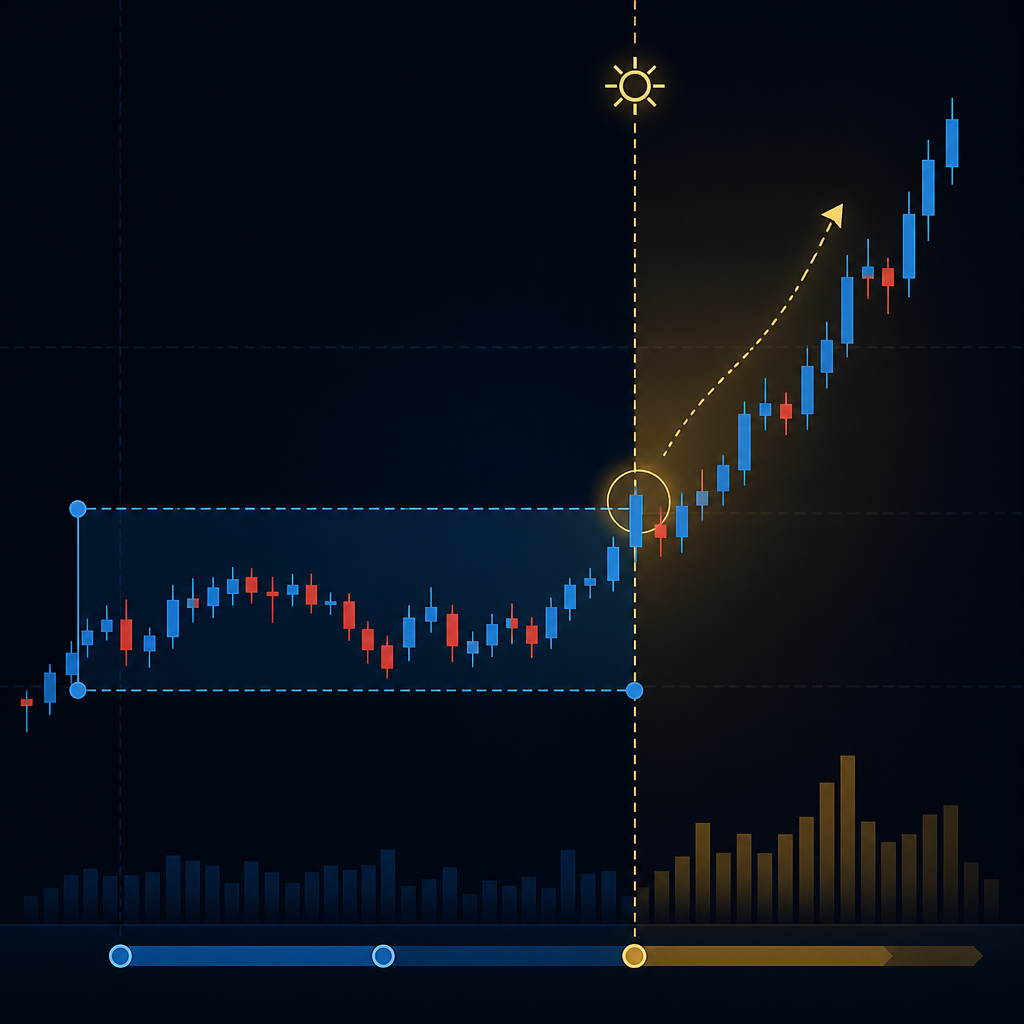
Gold trades 24 hours, but it doesn’t trade equally all day. Liquidity comes in waves.
The Asian session often prints a relatively contained “box” as Tokyo and early Asia participants position. Then London arrives with deeper liquidity, tighter spreads, and a different class of participants—banks, funds, and macro flows.
That transition is where your edge lives. A box forms. Stops cluster above the high and below the low. Then London tests one side, and if there’s real order flow behind it, price expands quickly.
What you’re really trading: liquidity and imbalance
When price consolidates for hours, it builds resting orders on both sides. Breakouts aren’t magic; they’re often a stop run + continuation if the move is supported by fresh participation.
In current conditions—gold around $2650, DXY near 106.80—you can see bursts of volatility when USD moves or yields react. That’s why a session-range framework helps: it gives you a stable reference point even when headlines are noisy.
What makes XAUUSD different from EUR/USD breakouts
Gold is more “gappy” intraday. It can travel $8–$20 in minutes when momentum hits. That’s a gift if your entry is clean, and a disaster if you chase.
Compared to EUR/USD at 1.0520 or GBP/USD at 1.2680, XAUUSD is more sensitive to risk sentiment and real yields. That means breakouts can be stronger—but also more prone to fake first moves.
The goal of this strategy
We’re not trying to predict the day’s high or low. We’re trying to capture the first high-probability expansion out of the Asian range during early London, using rules that are easy to execute and easy to audit.
If you want a broader foundation first, browse our trading blog for complementary concepts like volatility, liquidity, and signal execution.
How to Define the XAUUSD Asian Range (Two Practical Methods)
Your results depend heavily on one decision: how you draw the box.
Most traders fail here by changing the range window daily. Consistency matters more than “perfect.” Pick a definition you can repeat, backtest, and execute under pressure.
Method A (Simple): Fixed time window box
Define the Asian range as the high and low from a fixed window such as:
- 00:00 to 06:00 London time (common and clean)
- Or 23:00 to 06:00 London time if you want to include late US drift
Once the window ends, you “lock” the box. No adjusting. No redrawing.
Example: During Asia, gold trades between $2640 (low) and $2652 (high). Your Asian range is $12.
Method B (Structure-based): First consolidation into Tokyo
Some days Asia trends. If you force a box on a trending session, you’ll get messy signals.
Structure-based definition: identify the first clear consolidation that lasts at least 90 minutes during Asia, then mark its high/low. This requires more discretion, but can better reflect “where liquidity is resting.”
For a signal service, we prefer Method A because it’s rule-based and repeatable. For discretionary traders, Method B can add nuance once you’ve mastered the basics.
Range quality checklist (don’t skip this)
- Range size: ideally $8–$18 for XAUUSD. Too small = noise. Too large = poor R:R.
- Clean boundaries: multiple touches near high/low without messy spikes.
- Location: is the box forming near a higher-timeframe level (previous day high/low, weekly open)? That can amplify the breakout.
In the current $2610–$2690 environment, a typical Asian box might be $10–$15 wide. That’s perfect for a $10–$25 stop and a 1:2–1:3 target plan.
Asian Range Breakout vs London Open Breakout: What’s the Difference?
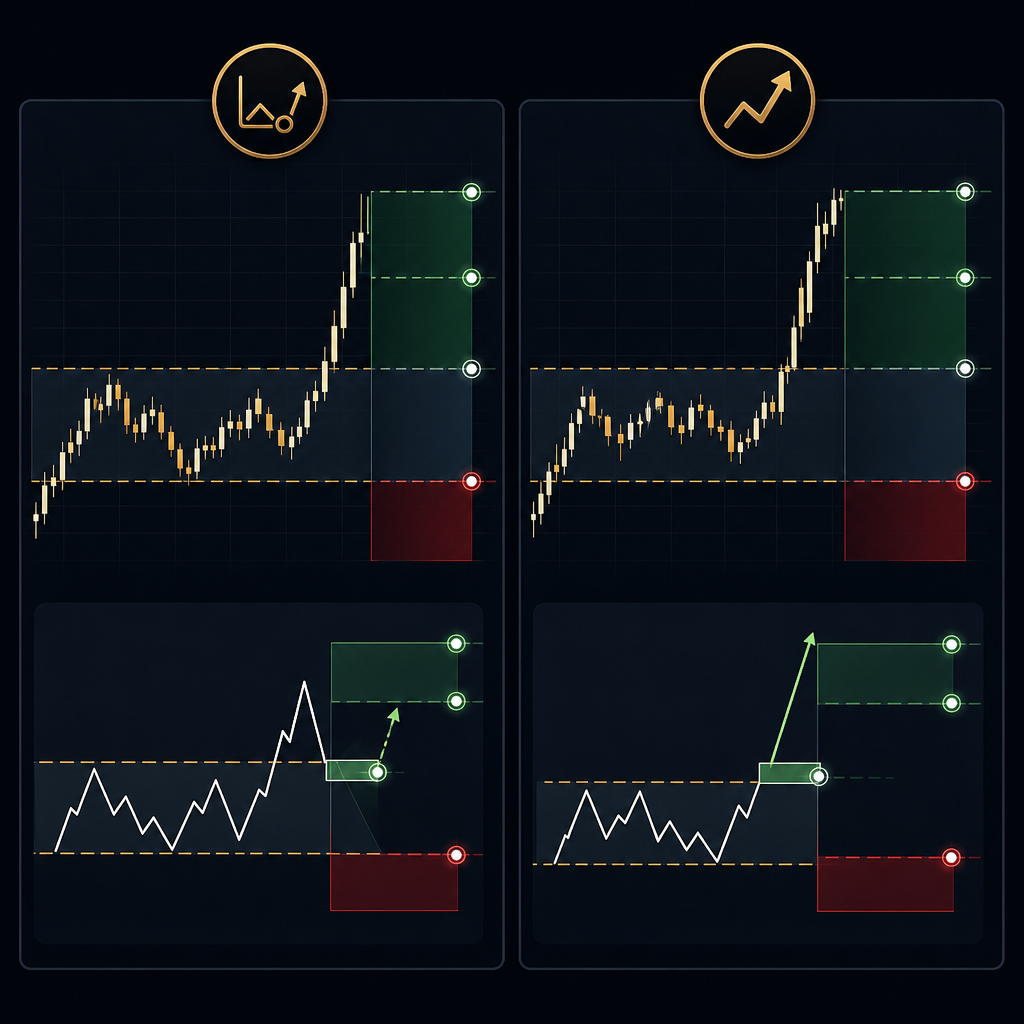
These two are often confused. They’re related, but not identical.
Asian range breakout focuses on the box formed in Asia and trades the expansion when London arrives.
London open breakout sometimes uses the first 15–30 minutes of London to form a mini-range, then trades its break. That’s a different microstructure.
When Asian range breakouts outperform
- When Asia is quiet and boxed (compression)
- When London brings real participation (expansion)
- When there’s a clear macro driver (USD move, yields shift, geopolitical headline)
When they underperform
- When Asia already trends strongly (no “spring” to release)
- When London is choppy pre-news (CPI, NFP, FOMC days)
- When spreads widen or liquidity is thin (holidays, unusual sessions)
Comparison table: entry logic and trade management
| Approach | What you trade | Best entry type | Typical stop (XAUUSD) | Typical target model | Main risk |
|---|---|---|---|---|---|
| Asian Range Breakout | Break of Asia box into early London | Break + retest (higher accuracy) | $12–$25 | Range projection + 1:2 / 1:3 | False break then reversal |
| London Open Micro-Range | Break of first 15–30 min London range | Momentum break (faster) | $8–$18 | Scalp targets + trailing | Whipsaw around open |
| NY Continuation Breakout | Break of London/NY overlap levels | Retest or pullback continuation | $10–$25 | Trend continuation to day extremes | Reversal into NY fix |
We’re focusing on the first category because it’s the most teachable, repeatable, and signal-friendly.
The Core Setup: London Expansion Out of the Asian Box (Clear Rules)
Let’s turn the concept into a strict rule set you can execute without hesitation.
Your job is to trade the first clean expansion out of the Asian range after London liquidity comes in.
Rule set (baseline)
- Step 1: Mark Asian high and low (your box).
- Step 2: Wait for London to approach (don’t pre-guess).
- Step 3: Require a breakout condition (close beyond the box, not just a wick).
- Step 4: Choose entry model: break + retest or momentum break.
- Step 5: Place invalidation stop (beyond range or beyond retest swing).
- Step 6: Scale profits systematically (1R partial + 2R/3R final).
What counts as a “break” on XAUUSD?
Gold loves wicks. If you treat every wick as a breakout, you’ll donate to the market.
Our baseline: at least one candle close outside the range on your execution timeframe (commonly M5 or M15). If you’re trading M5, you can require two closes outside for extra confirmation on choppy days.
Directional bias (optional, but powerful)
You can trade both sides mechanically. But performance often improves if you add a light bias filter:
- If DXY is pushing higher (near 106.80 and rising), gold breakouts to the downside can be cleaner.
- If risk-off hits and yields drop, upside breakouts can run hard.
This is not about predicting. It’s about aligning with the day’s dominant driver when it’s obvious.
Entry Triggers: Break + Retest vs Momentum Break (When to Use Each)
Most traders don’t lose because their strategy is “bad.” They lose because they use the right tool at the wrong time.
In a gold session range strategy, you have two professional-grade entries. Each has a purpose.
Entry Type 1: Break + Retest (higher accuracy)
This is the “signal provider friendly” entry because it’s structured and reduces chasing.
Rules:
- Wait for a candle close beyond the Asian high/low.
- Wait for price to retest the broken boundary (the top or bottom of the box).
- Enter on rejection: a strong close back in breakout direction, or a clear bullish/bearish engulfing on M5/M15.
Example (bullish): Asian high is $2652. London breaks to $2658, then pulls back to $2652–$2653. You buy at $2654 after a rejection candle.
Stop can go below the retest swing low, often $12–$20 away (e.g., SL $2642). A 1:2 target is $2678 (24 points), and a 1:3 target is $2690 (36 points) if structure allows.
Entry Type 2: Momentum Break (faster, needs filters)
This is for days when gold doesn’t retest. It just goes.
Rules:
- Break candle must be large relative to recent candles (expansion).
- Spread must remain stable (no “liquidity vacuum”).
- Enter on the close of the breakout candle or a shallow pullback (not deep into the box).
Example (bearish): Asian low is $2640. London hits and a strong M5 candle closes at $2634. You sell $2634–$2633 with SL above the box (e.g., $2650, a $16 stop). Targets: 1:2 at $2602 is too far for our guideline range, so you’d likely cap at nearby liquidity—say $2610–$2615 if it’s in play. If price is already near $2610, you skip or reduce size.
Which entry should you choose?
- Choose break + retest when the Asian box is clean and London is “normal.”
- Choose momentum when you see immediate expansion + strong continuation context (news, DXY impulse, clear trend day).
In our United Kings signals, you’ll often see both styles depending on the day’s volatility and liquidity conditions.
Stop Loss (Invalidation) Rules for XAUUSD: Where Pros Put the “Line in the Sand”
Stops are not about pain tolerance. They’re about invalidation.
If your stop is hit, the market is telling you: “the reason you entered is no longer true.” That’s it.
The three most reliable stop placements for this strategy
- Beyond the opposite side of the box (wider, but robust).
- Beyond the retest swing (tighter, best for break + retest).
- Beyond the breakout candle extreme (useful for momentum entries, but can be fragile).
Concrete examples using today’s realistic prices
Scenario A (break + retest long):
- Asian range: $2640–$2652
- Break above: price trades to $2658
- Retest: dips to $2652, then rejects
- Entry: $2654
- Stop: below retest swing low at $2642 (risk = $12)
Scenario B (momentum short):
- Asian range: $2650–$2662
- Break below: strong candle closes at $2646
- Entry: $2646
- Stop: above box mid or above box high at $2664–$2666 (risk = $18–$20)
The “too tight stop” trap in gold
Gold can wick $5–$8 even in calm periods. If your stop is $6 away during London, you may be right on direction and still lose.
As a guideline, for this specific setup we like stops in the $10–$25 band, with tighter stops reserved for very clean retests and stable spread.
Position sizing reminder (non-negotiable)
Stop size is meaningless without position sizing. If you haven’t built a sizing habit yet, start with our practical guide on risk management strategies when using forex signals. The principles apply directly to gold.
Targets & Scale-Out: Measured Moves, Liquidity Pools, and 1:2–1:3 R:R
Most traders obsess over entries. Professionals obsess over exits.
Your target plan must answer three questions:
- Where is price most likely to pause?
- How do you pay yourself early while still letting winners run?
- What’s your plan if price spikes in your favor quickly?
Target Model 1: Range projection (measured move)
Take the Asian range height and project it from the breakout point.
Example: Box is $2640–$2652 (height = $12). Break above $2652. First projection target = $2664.
That’s not necessarily your final TP. It’s your first “logical magnet.” On many days, gold hits that projection quickly, then either continues or reverses.
Target Model 2: Risk multiples (1R, 2R, 3R)
This is the most execution-friendly approach for signals.
- TP1 at 1R: take partial (e.g., 30–50%).
- TP2 at 2R: take another partial (e.g., 30–40%).
- TP3 at 3R: leave a runner if structure supports it.
Example: Buy $2654, SL $2642 (risk $12). TP1 = $2666. TP2 = $2678. TP3 = $2690 (within our guideline range and often near round-number liquidity).
Target Model 3: Liquidity + structure (the “reality check”)
Even if 3R is mathematically available, structure might block it.
Look for:
- Previous day high/low (common reaction points)
- Round numbers (e.g., $2660, $2670, $2680)
- Unfilled impulsive moves (fair value gaps) on M15/H1
We often combine models: take TP1 at 1R, then align TP2/TP3 with structure. That keeps you consistent without being blind.
Filtering False Breakouts: Spread, Volatility, and “Reclaim the Box” Rules
False breaks are not a bug. They’re part of the ecosystem.
Your job is not to eliminate them. Your job is to filter the worst ones and keep your losses small when they happen.
Filter 1: Spread and execution conditions
If spreads widen or execution becomes jumpy, breakout signals degrade fast.
Practical rule: if spread is noticeably wider than normal for your broker during the breakout moment, skip the trade or require break + retest only.
If you want to go deeper on this topic, we’ve covered the real-world problems of fills and execution in our gold trading ecosystem (especially relevant for session breakouts).
Filter 2: Volatility expansion (ATR impulse)
We want to see volatility expand at the moment of breakout.
- If the breakout candle is the same size as the last 10 candles, it’s often a trap.
- If the breakout candle is 1.5–2.5x the recent average, it’s often real participation.
You don’t need a complicated indicator. A quick visual check works. If you prefer numbers, use an ATR(14) on M5 and require the breakout candle to be at least 0.8–1.2x of ATR for momentum entries.
Filter 3: “Close back inside the box” invalidation
This is one of the simplest and strongest rules.
- If price breaks out, then closes back inside the Asian range and holds there for 1–2 candles, the breakout is likely failing.
- For break + retest entries, if the retest trades deep into the box (not just a tap), your edge drops.
Filter 4: Time-of-day cutoff
Session strategies are time-based edges. Don’t trade them outside their window.
Practical cutoff: if London has been open for a while and the breakout hasn’t happened, the “first expansion” edge fades. At that point, you’re trading a different system.
Step-by-Step Execution Checklist (The Exact Routine We Use)
This is where most traders level up: a repeatable routine.
Use this checklist daily. Print it. Put it next to your screen.
Step 1: Pre-London prep (5–10 minutes)
- Mark Asian high/low using your chosen window.
- Measure range size (in $): is it within your “tradable” band?
- Mark obvious nearby levels: round numbers and prior day high/low.
- Check macro context quickly: DXY near 106.80, USD/JPY near 149.50, and any scheduled news.
Step 2: Wait for the trigger (patience phase)
- No entries inside the box (unless you have a separate mean-reversion system).
- Watch for a close outside the box.
- Decide entry type: retest or momentum.
Step 3: Place the trade (execution phase)
- Enter only if spread is stable.
- Set SL immediately (no “mental stops”).
- Set TP1/TP2/TP3 or at least TP1 and a trailing plan.
Step 4: Manage the position (professional phase)
- At 1R, take partial or move stop to reduce risk (your choice, but be consistent).
- If price re-enters the box and closes there, consider early exit.
- If price runs quickly, don’t get greedy—follow the plan.
Step 5: Post-trade review (edge-building phase)
- Screenshot the setup.
- Log range size, entry type, stop size, outcome (R multiple).
- Tag false breaks and identify which filter would have saved you.
If you prefer having these trades delivered with clear Entry/SL/TP and ongoing education, that’s exactly what we do inside United Kings gold signals and our broader forex signals service.
Realistic Trade Examples Around $2650 (Two Full Walkthroughs)
Let’s make this tangible with two scenarios that match today’s price neighborhood.
These are examples for education, not trade recommendations.
Example 1: Break + retest long (clean London expansion)
Market context: Gold is hovering around $2650. Asia is quiet. DXY is steady near 106.80.
- Asian range (00:00–06:00 London): $2641 low, $2653 high (range = $12)
- London push: price closes above range at $2656
- Retest: pulls back to $2653, prints rejection
- Entry: Buy $2654
- Stop: $2642 (risk $12)
- TP1 (1R): $2666
- TP2 (2R): $2678
- TP3 (3R): $2690 (only if structure is clear)
Management: If price hits $2666 quickly, you can take 40% off and move SL to entry or to $2648 (reduced risk). If price then wicks back into the box and closes inside, you cut the remainder early.
Example 2: Momentum short (break and go, no retest)
Market context: USD/JPY is firm near 149.50 and DXY is pushing. Gold shows weakness.
- Asian range: $2658 high, $2648 low (range = $10)
- London break: strong M5 candle closes at $2644
- Entry: Sell $2644
- Stop: $2662 (risk $18, above the box high)
- TP1 (1R): $2626
- TP2 (2R): $2608 (near the lower bound of our guideline range; if price is unlikely to reach, reduce expectation)
Management: Momentum entries require faster decision-making. If price breaks then immediately reclaims $2648 and closes inside the box, that’s a warning. You either cut or tighten aggressively. Don’t “hope” on momentum setups.
Common Mistakes That Destroy the Asian Range Breakout Edge (and Fixes)
This strategy looks simple. That’s why it’s dangerous.
Most losses come from a handful of repeatable mistakes.
Mistake 1: Trading inside the box out of boredom
The box is a no-man’s land. If you keep taking small trades inside it, you’ll be emotionally compromised when the real move happens.
Fix: Make it a hard rule: no entries inside the Asian range for this system.
Mistake 2: Treating a wick as a breakout
Gold wicks above highs and below lows constantly. You need a close.
Fix: Require at least one candle close outside. On choppy days, require two.
Mistake 3: Stops based on money, not structure
“I’ll risk $50” is not a stop strategy. It’s a budget.
Fix: Place the stop where the setup is invalidated (beyond the box or retest swing). Then adjust lot size so the $ risk is appropriate.
Mistake 4: Ignoring spread and slippage
Breakouts are where slippage happens. If you ignore execution quality, your backtest lies to you.
Fix: Use break + retest when spreads are unstable. If you want a deeper execution framework, see our educational content on how signals behave during volatile moments: how gold signals react to unexpected news events.
Mistake 5: No scale-out plan
Gold can give you +$12 in a burst, then reverse $18. If you don’t take something off, you’ll turn winners into losers.
Fix: Take partial at 1R. Always.
How We Turn This Into Telegram-Ready XAUUSD Signals (Entry, SL, TP)
A good strategy is not automatically a good signal. A signal must be clear, timely, and executable.
Here’s the structure we use so members can act fast without confusion.
Signal format (what you should expect)
- Pair: XAUUSD
- Direction: BUY or SELL
- Entry: exact price or tight zone (e.g., 2653–2655)
- Stop Loss: exact price (e.g., 2642)
- Take Profits: TP1/TP2/TP3 levels (e.g., 2666 / 2678 / 2690)
- Notes: “Asian range break + retest,” “spread stable,” “London expansion”
Why we emphasize London and NY sessions
Liquidity is your friend. London and NY sessions tend to provide:
- Cleaner follow-through after breaks
- Tighter spreads versus off-hours
- More predictable volatility bursts
This aligns with our focus at United Kings: high-quality intraday opportunities rather than forcing trades in dead conditions.
Win rate context (responsible and transparent)
United Kings targets an 85%+ historical win rate across our signal methodology, calculated and presented transparently (see /results/ and /methodology/ on our site for how it’s measured).
That is not a guarantee of future results. Market conditions change. Execution quality differs by broker. Your discipline matters.
Where to get the signals
You can explore our full offering on the signals page, or go directly to our dedicated gold signals if XAUUSD is your main focus.
For real-time delivery, join our Telegram community at United Kings Telegram channel.
Risk Management for Session Breakouts: The “Small Loss, Big Expansion” Model
This strategy works because your losses are controlled and your winners can expand.
But only if you treat risk like a system—not a feeling.
Rule 1: Risk a fixed % per trade
Many consistent traders risk 0.25% to 1% per trade. If you’re newer, 0.25%–0.5% is plenty.
Gold can move fast. A small risk keeps you rational.
Rule 2: Daily loss limit
Session breakouts can whipsaw. If you take two losses in a row, your decision quality drops.
- Set a daily max loss like 1R–2R.
- If hit, stop trading for the day.
Rule 3: Don’t stack correlated risk blindly
If you’re long gold and also short USD pairs in the same direction (or vice versa), you may be doubling exposure to the same USD move.
Given today’s context—EUR/USD 1.0520, GBP/USD 1.2680, DXY 106.80—USD strength/weakness can drive multiple charts at once.
Rule 4: Demo first if you’re new
If you haven’t executed 30–50 trades of this exact playbook, use a demo account. Learn the rhythm of London. Learn the wicks. Learn your broker’s execution.
FAQ: XAUUSD Asian Range Breakout & London Expansion
1) What time is the Asian session range for XAUUSD?
A practical definition is 00:00–06:00 London time for the high/low box. Some traders include late US (23:00–06:00). Pick one and keep it consistent.
2) Is break + retest better than a momentum breakout on gold?
Most traders will see higher accuracy with break + retest because it avoids chasing and filters many false breaks. Momentum entries can work well on strong trend/news days, but require stricter volatility and spread filters.
3) How big should my stop loss be on XAUUSD for this strategy?
Typical stops are $10–$25 depending on range size and entry type. The stop should sit at the level that invalidates the breakout idea (often beyond the box or the retest swing).
4) What’s the best take profit method for an Asian range breakout?
A robust approach is to scale out: take partial at 1R, then target 2R and 3R if structure supports it. You can also use range projection (measured move) as a logical magnet.
5) Can I trade this strategy during major news like CPI or FOMC?
You can, but conditions change fast. Spreads can widen and false breaks increase. Many traders reduce size, wait for the first spike to settle, or skip entirely. For survival rules, study our guide on gold signals during unexpected news.
Risk Disclaimer (Read This Before You Trade)
Trading forex and gold (XAUUSD) involves significant risk and is not suitable for every investor. You can lose more than your initial deposit depending on your broker and account type. This article is for educational purposes only and does not constitute financial advice.
Past performance does not guarantee future results. Any historical win-rate references are based on defined methodology and may not reflect your personal outcomes due to execution, spreads, slippage, psychology, and risk management. If you’re a beginner, practice on a demo account first and use conservative risk.
Join United Kings: Premium XAUUSD Session Breakout Signals (With Clear Rules)
If you want this playbook delivered as ready-to-execute signals—with clean entries, invalidation stops, and structured take-profits—United Kings is built for you.
We provide premium Telegram signals for gold and forex, focused on the highest-liquidity windows in the London and NY sessions, plus educational guidance so you understand the “why,” not just the numbers.
- Explore our full service: United Kings Signals
- Dedicated XAUUSD setups: Gold Signals
- FX opportunities alongside gold: Forex Signals
- See plans and choose your tier on our pricing page (Starter 3 Months $299, Best Value 1 Year $599 with 50% savings + FREE ebook, or Lifetime $499 pay once)
- Join the Telegram channel for real-time delivery: United Kings on Telegram
Remember: we don’t promise guaranteed profits. We promise a professional process, consistent execution rules, and a community that takes risk management seriously—including a 48-hour refund window (conditions apply; see /refund-policy/).
If you’re ready to trade XAUUSD breakouts with structure instead of guesswork, join United Kings today.