
You’re one good week away from passing a prop firm challenge… until one oversized trade clips the daily loss limit.
If you’re doing prop firm trading right now, you already know the painful truth: it’s not just about being “right.”
It’s about being right without breaking rules—daily drawdown, max loss, lot caps, and sometimes news restrictions.
That’s why so many traders ask a practical question: Can you use forex signals to pass prop firm challenges?
You can—but only if you adapt the signal execution to the prop firm’s risk model.
In this guide, we’ll show you exactly how to do that with a rule-based approach you can repeat.
TL;DR — How to Use Forex Signals to Pass a Prop Firm Challenge
- Signals don’t pass challenges—risk models do. Your execution must fit daily loss and max drawdown rules.
- Convert every signal into “challenge-safe risk.” Think in % risk per trade (0.25%–0.75%), not lots.
- Prioritize high-liquidity sessions. London and New York session setups generally reduce slippage and improve fills.
- Use a “two-layer stop” system. Signal SL + a hard account-level daily stop to avoid rule breaks.
- Scale down during volatility spikes. With XAUUSD around $2650 and DXY near 106.80, intraday swings can be sharp.
- Track rule compliance like a business. A simple journal of risk, R-multiples, and drawdown keeps you funded.
Why Prop Firm Challenges Are Hard (Even With Great Signals)

Most prop firm challenges are engineered to test one thing: discipline under constraint.
In a personal account, you can “wait it out,” deposit more, or reduce size after a bad day.
In a challenge, you can be profitable overall and still fail because you violated a rule on a single trade.
The hidden trap: drawdown math
Drawdown limits are not just numbers; they’re a behavior filter.
If your challenge has a 5% daily loss limit and 10% max loss, one impulsive gold trade can end it.
Gold (XAUUSD) at around $2650 can easily move $10–$20 in minutes during London/NY overlap.
Signals are “edge,” but challenges are “process”
A quality signal provides structure: entry, stop loss, take profit, and context.
But prop firm trading adds another layer: rule compliance and risk throttling.
That’s why copying a signal with the same lot size you used in a personal account often fails.
Common ways funded traders fail with signals
- Over-risking early to “get the target fast,” then hitting daily loss on a normal losing streak.
- Ignoring session liquidity and entering during thin conditions with bigger spreads.
- Moving stops because “the signal will come back,” which turns a controlled loss into a rule breach.
- Trading every alert instead of filtering for the best setups that fit the challenge timeline.
- Not accounting for news (CPI, FOMC, NFP), where slippage can invalidate a perfect plan.
So the goal of this article is simple: turn signals into a challenge-passing system.
We’ll use realistic examples with current market context: XAUUSD near $2650 (+0.35% 24h), EUR/USD ~1.0520, GBP/USD ~1.2680, USD/JPY ~149.50, and DXY ~106.80.
Which Prop Firm Challenges Suit Signal Trading Best?
Not every challenge structure is signal-friendly.
Some are designed for high-frequency scalpers, while others reward patient swing execution.
Your job is to match the signal style to the challenge rules.
Key challenge features that matter for signal users
- Daily loss limit: The tighter it is, the more you need reduced risk per trade.
- Max drawdown: Determines how many “normal” losses you can take without failing.
- Minimum trading days: Forces you to spread risk across days instead of one big push.
- Time limit: Short time limits tempt overtrading; longer limits reward selective execution.
- News rules: Some firms restrict trading around major events; signals must adapt.
- Instrument restrictions: Some accounts limit gold or impose higher margin requirements.
Challenge types and how signals fit
In general, signals work best when the challenge allows:
- Moderate time to hit target (so you can trade high-quality setups).
- Reasonable drawdown relative to the profit target.
- Flexible holding (so you can let trades reach 1:2 or 1:3 R:R).
Comparison table: signal-friendly vs signal-hostile challenge setups
| Challenge Feature | Signal-Friendly | Signal-Hostile | What You Do |
|---|---|---|---|
| Daily Loss Limit | 4%–6% | 2%–3% | Lower risk per trade to 0.25%–0.5% if daily limit is tight |
| Max Drawdown | 8%–12% | 5%–6% | Cap losing streak damage with a weekly stop and fewer trades |
| Profit Target | 6%–10% | 12%–15% | Focus on 1:2 and 1:3 trades; avoid “revenge scaling” |
| Time Limit | 30+ days or no limit | 10–14 days | Trade only A+ setups during London/NY sessions |
| News Restrictions | Flexible | No trading ±5–15 minutes | Use pending orders earlier or skip high-impact windows |
If you’re specifically searching for FTMO signals, the bigger idea is the same: you’re not looking for “more signals.”
You’re looking for signals you can execute safely within rule constraints.
At United Kings, our approach is built around structured entries, clear SL/TP, and session timing.
You can review our signal formats on the main United Kings signals page and compare how they fit your challenge rules.
The Prop Firm Risk Model: The Only Framework That Matters
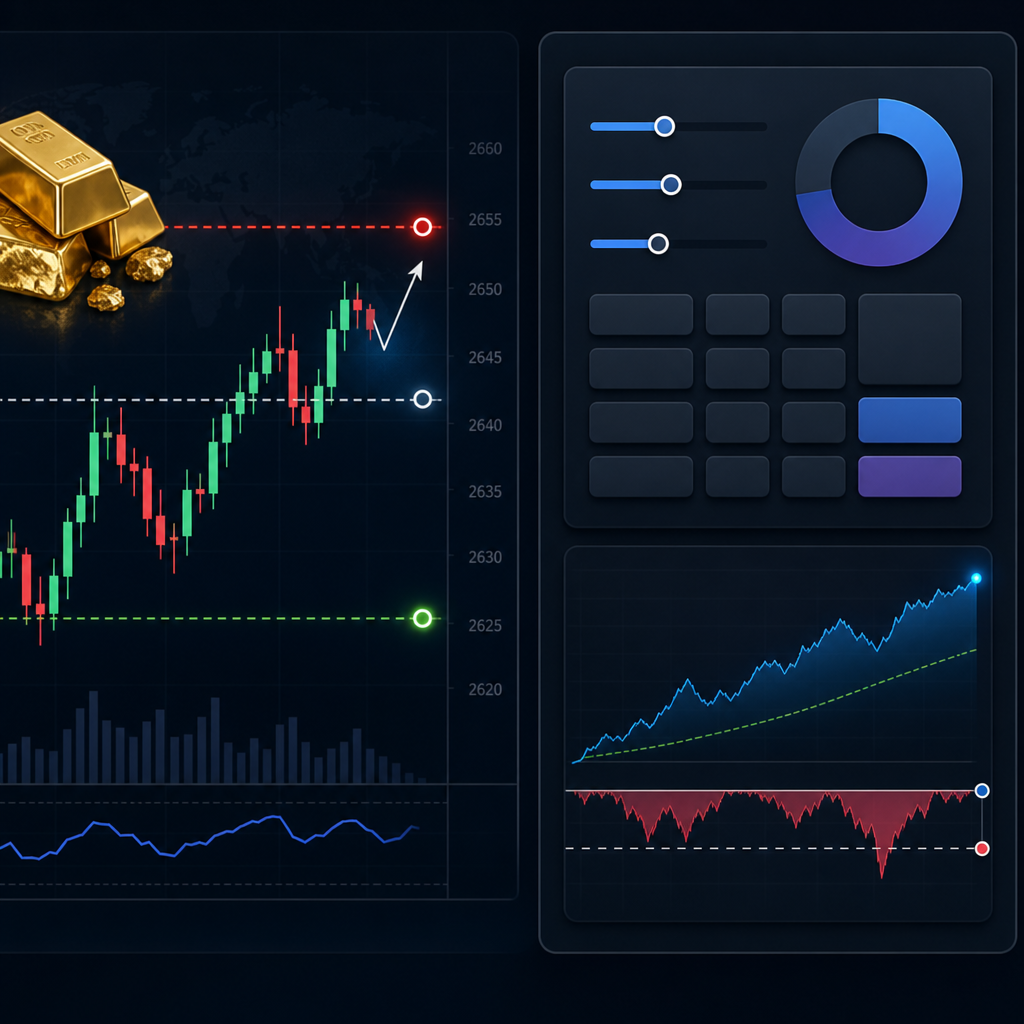
Let’s be blunt: your challenge is a risk management exam.
The “trading” part is important, but it’s secondary to survival.
So we need a simple framework that converts any signal into challenge-safe execution.
Three numbers you must define before placing any trade
- Risk per trade (%): usually 0.25%–0.75% for challenges.
- Daily risk budget (%): a self-imposed limit below the firm’s daily loss limit.
- Weekly risk budget (%): a self-imposed limit to protect max drawdown.
Example: if the prop firm daily loss limit is 5%, you might set a personal daily stop at 2%.
That means even if you have a bad day, you’re still far from disqualification.
The “2-layer stop” system (signal SL + account SL)
Layer 1 is the signal stop loss—technical invalidation.
Layer 2 is your account-level stop—rule protection.
If you hit Layer 2, you stop trading for the day, even if more signals appear.
What risk per trade looks like in real price terms
Assume XAUUSD is trading around $2650.00.
A typical signal might be:
- Buy XAUUSD: 2652.0
- SL: 2638.0 (14 dollars risk)
- TP1: 2680.0 (28 dollars = 1:2)
- TP2: 2694.0 (42 dollars = 1:3)
That’s a perfectly normal structure in the $2610–$2690 environment.
Your job is not to debate the setup; it’s to size it so a stop-out is “just a paper cut.”
A simple risk throttle for funded trader consistency
- Start at 0.5% risk per trade.
- If you lose 2 trades in a row, drop to 0.25% for the next trade.
- If you win 2 trades in a row, return to 0.5%.
- Never increase risk because you’re “close to target.”
This throttle is boring, and that’s why it works.
Most failed challenges are emotional, not technical.
If you want a deeper risk framework beyond this article, we’ve also published a dedicated guide on risk management strategies when using forex signals.
Step-by-Step: How to Convert Any Signal Into a Prop-Firm-Safe Trade
This is the execution process we recommend if you’re using signals to pass a challenge.
It’s designed to be repeatable, fast, and rule-compliant.
Print it, screenshot it, or save it in your notes.
Step 1: Check the “rule context” before the chart
- How much is left in your daily loss buffer?
- How close are you to max drawdown?
- Do you have a minimum trading day requirement to satisfy?
- Is there a high-impact release in the next 30–60 minutes?
If your buffer is thin, you don’t “try anyway.”
You either reduce risk or skip.
Step 2: Validate the signal against spread and session
Signals are easiest to execute during liquid windows.
We focus heavily on London and New York sessions because spreads are tighter and moves are cleaner.
If you’re trading EUR/USD around 1.0520 or GBP/USD around 1.2680, you want that institutional flow.
Step 3: Translate SL distance into position size
Prop firms don’t care about your lot size.
They care about your loss in dollars and percent.
So you size based on SL distance.
Example with gold:
- Entry: 2652.0
- SL: 2638.0
- Risk distance: 14.0
- Risk per trade: 0.5%
If your account is $100,000, 0.5% risk is $500.
Your position size must be set so a $14 move to SL equals about $500 loss (plus spread/commission).
Step 4: Place TP levels that match the challenge timeline
Prop challenges reward clean R-multiples.
A 1:2 trade done consistently beats a “home run” mentality.
So if your SL is $14 on XAUUSD, aim for $28 (1:2) or $42 (1:3) when the setup supports it.
Step 5: Decide the management rule before entry
- Will you move SL to breakeven at 1R?
- Will you partial at TP1?
- Will you trail above/below structure?
Decide first, then execute.
Changing management mid-trade is how traders break rules.
Step 6: Log the trade in “prop firm language”
Don’t journal only “win/loss.”
Journal: risk %, R-multiple, session, and whether you followed rules.
That’s how you become a repeatable funded trader, not a lucky one.
If you’re newer to signal execution mechanics, our beginner-friendly breakdown on how to use Forex signals on Telegram safely is a helpful companion.
Gold vs Forex for Challenges: What to Trade With Signals (and Why)
One of the biggest decisions in prop firm trading is instrument selection.
Gold can hit targets fast, but it can also hit limits fast.
Major forex pairs are slower, but often easier to control.
Current market context: why volatility matters right now
With XAUUSD around $2650 (+0.35% over 24h) and DXY around 106.80, gold is sensitive to dollar moves.
USD/JPY near 149.50 also reflects broader USD strength and rate expectations.
That combination can create sharp intraday swings in gold—especially during London/NY overlap.
When gold signals are the best choice for passing
- You have a longer time window and can wait for A+ setups.
- Your prop firm allows gold with reasonable spreads and margin.
- You can keep risk small (0.25%–0.5%) while targeting 1:2+ moves.
- You’re available during London/NY sessions to manage volatility.
A realistic gold challenge trade might look like:
- Sell XAUUSD: 2666.0
- SL: 2684.0 (18 dollars)
- TP: 2630.0 (36 dollars = 1:2)
This fits the $2610–$2690 guideline and keeps the plan clean.
When major forex pairs are the smarter “funded trader” route
EUR/USD at 1.0520 and GBP/USD at 1.2680 can be more forgiving for rule compliance.
They often trend more smoothly and have lower spread costs.
That matters when you’re trying to avoid death by a thousand fees.
What we see most often: a hybrid approach
Many challenge passers use:
- Gold for 1–2 high-conviction trades per week.
- Majors for consistent, lower-volatility opportunities.
If you want to focus specifically on gold, explore our dedicated Gold (XAUUSD) signals page.
If you prefer majors, our Forex signals coverage is built for liquid pairs and session timing.
How to Adapt FTMO-Style Rules to Signal Execution (Without Guessing)
Most traders treat prop rules like a legal document.
They read it once, then trade emotionally and hope it works out.
Professional funded traders do the opposite: they build a “rules dashboard” and trade inside it.
Create a simple rules dashboard (10 minutes)
Make a note with these lines:
- Daily loss limit: X%
- Max loss: Y%
- My daily stop: (X% × 0.4) to (X% × 0.6)
- My per-trade risk: 0.25%–0.75%
- Max trades/day: 1–3
- News restrictions: yes/no and window
That’s it.
This single note prevents most rule breaks.
Use “risk units” instead of lots
Define 1R as your chosen risk per trade.
If you risk 0.5% per trade, then:
- -1R = -0.5%
- +2R = +1.0%
- +3R = +1.5%
Now your goal becomes simple: stack R-multiples without exceeding daily loss.
How to handle scaling and partials in a challenge
Scaling in can be dangerous if it increases total risk beyond your plan.
If you add positions, keep total risk capped.
For example, two entries at 0.25% each can be safer than one entry at 0.5%.
Slippage and spread: the silent rule-breakers
Even if your stop is $14 away on gold, slippage can make it $16 in fast markets.
If your daily buffer is thin, that extra $2 can matter.
So when volatility is elevated, reduce risk by 20%–40%.
And if you trade around high-impact events, read our survival-focused guide on how gold signals react to unexpected news events.
Session Timing: Why London & New York Matter for Passing Challenges
Prop challenges punish randomness.
Session timing reduces randomness because liquidity is predictable.
That’s why our signal workflow is heavily centered on London and New York session trading.
What session timing does for signal traders
- Tighter spreads on majors and usually better gold pricing.
- Cleaner breakouts as real volume enters the market.
- Faster follow-through, which helps you reach 1:2 targets without babysitting all day.
- More reliable structure for stop placement beyond key highs/lows.
A realistic scenario: gold during London/NY overlap
Let’s say gold is at $2650 and starts pushing into $2660–$2666 during London.
As New York opens, DXY at 106.80 ticks higher and gold rejects, dropping $20 quickly.
If you’re over-leveraged, that one move can hit your daily loss limit.
If you’re correctly sized, it’s just -0.5R or -1R and you move on.
How to build a “challenge schedule” around signals
- Pre-London (15–30 min): check rules dashboard, mark key levels, watch spreads.
- London open window: take only A+ setups; avoid chasing the first spike.
- NY open window: look for continuation or reversal setups; manage existing trades.
- After NY lunch: reduce activity; liquidity drops and spreads can widen.
Why “more trades” usually hurts challenge pass rates
Every trade is another chance to violate a rule.
Every extra entry adds spread/commission and emotional fatigue.
Most challenge passers we’ve coached focus on 1–3 trades per day max, often fewer.
United Kings signals are built to be actionable in these high-liquidity windows, and shared with clear Entry/SL/TP inside our community.
If you want to see the style and cadence, start with the main signals overview and then join our Telegram community at United Kings Telegram.
Position Sizing for Funded Trader Accounts (Practical Examples)
Position sizing is where most signal users accidentally fail challenges.
They take a good setup and turn it into a rule violation by oversizing.
So let’s make sizing extremely practical.
Rule #1: size from SL distance, not from confidence
Confidence is not a variable in the market.
Stop distance is.
So your lot size should be a function of: account size × risk % ÷ SL distance.
Gold sizing example (XAUUSD around $2650)
Signal idea:
- Buy: 2648.0
- SL: 2635.0 (13 dollars)
- TP: 2674.0 (26 dollars = 1:2)
Now choose your risk:
- Conservative challenge mode: 0.25% per trade
- Standard challenge mode: 0.5% per trade
- Aggressive (not recommended): 1% per trade
In a $50,000 account, 0.5% risk is $250.
Your position size should be set so a $13 move to SL equals about $250 loss.
Forex sizing example (EUR/USD around 1.0520)
Signal idea:
- Sell EUR/USD: 1.0525
- SL: 1.0555 (30 pips)
- TP: 1.0465 (60 pips = 1:2)
If you risk 0.5% and your account is $100,000, that’s $500 risk.
You size the position so 30 pips equals $500.
How to avoid the “daily limit death spiral”
The most dangerous moment is after a loss.
Traders try to “make it back” and double size.
In a prop firm environment, that’s how you lose the account in one afternoon.
Instead, use this simple rule:
- If you lose 1 trade, keep size the same.
- If you lose 2 trades, reduce size by 50% or stop for the day.
- If you hit your personal daily stop, stop trading—no exceptions.
Why this works even with an 85%+ win-rate signal stream
Even strong signal providers have losing streaks.
Markets rotate, volatility changes, and correlations shift.
Your job is to make sure a normal losing streak does not equal disqualification.
If you’re evaluating providers, our checklist-style resource can help you filter quality: Forex trading signals provider checklist.
Trade Management Rules That Keep You Within Drawdown Limits
Entry gets all the attention.
But in prop firm trading, management is what keeps you alive.
Signals give you a plan; your management makes it challenge-compliant.
Management Model A: “Set-and-respect” (best for challenges)
This model is simple:
- Place entry, SL, TP.
- Do not widen SL.
- Take partials only if pre-planned.
It’s boring, but it avoids emotional mistakes.
Management Model B: Partial at 1R, runner to 2R/3R
This is popular for funded traders because it smooths equity curves.
Example on gold:
- Sell XAUUSD: 2662.0
- SL: 2678.0 (16 dollars)
- At 2646.0 (1R), take 50% off and move SL to entry
- Let the rest target 2630.0 (2R)
This can reduce variance while still allowing you to hit targets.
Breakeven stops: helpful, but don’t overuse
Moving to breakeven too early can cause “death by a thousand scratches.”
You’ll get stopped at 0, then watch price run to TP.
In a challenge, that can slow progress and tempt overtrading.
A practical rule:
- Only move to breakeven after price has cleared a meaningful structure level.
- Or after 1R is reached and momentum remains in your favor.
Daily stop rules: the funded trader’s “circuit breaker”
Even if the firm allows -5% daily, you might stop at -2%.
That circuit breaker prevents emotional spirals and protects max drawdown.
Correlation risk: don’t stack USD exposure accidentally
With DXY around 106.80, USD moves can ripple across pairs.
If you take:
- Sell EUR/USD
- Sell GBP/USD
- Buy USD/JPY
You’re effectively placing three versions of the same USD-strength bet.
That can triple your drawdown if the dollar reverses.
A safer approach is to treat correlated trades as one “risk bucket.”
For example, cap total USD basket risk at 0.75%–1.0% combined.
News, Slippage, and Volatility: When to Skip Signals in a Challenge
Signals are not magic shields against volatility.
In fact, high-impact news is where many challenge accounts die.
Not because the idea was wrong, but because the fill was brutal.
Why news is different in prop firm trading
In a personal account, slippage is annoying.
In a challenge, slippage can be disqualifying.
A stop that should be -0.5% becomes -0.8% because price gaps through your level.
High-risk windows to treat carefully
- US CPI / PCE inflation
- FOMC rate decision and press conference
- NFP and unemployment rate
- Unexpected geopolitical headlines (especially for gold)
Practical rules for funded traders using signals
- If your prop firm has a “no trading” window, respect it.
- If there is no restriction, reduce risk by 30%–50% during major news.
- Avoid market orders in fast conditions; use limits where possible.
- Do not widen stops to “survive the spike.”
Gold-specific volatility example near $2650
Gold can print a $12 wick and reverse in seconds.
Imagine you buy at 2654.0 with SL at 2640.0 (14 dollars).
During a surprise headline, price wicks to 2637.5 and your stop fills at 2636.8.
That’s extra slippage that can push you closer to daily loss.
The “skip rule” that saves accounts
If you’re within 1R of your personal daily stop, skip all trades for the rest of the day.
This single rule prevents desperation trading and protects your max drawdown buffer.
If you want more context on how we think about volatility and signal execution, browse the education hub on our blog and start with the resources that match your trading style.
Choosing the Right Signal Provider for Prop Firm Trading (What to Look For)
Not all signal providers are built for challenge environments.
Some are entertainment channels.
Some are martingale disguised as “confidence.”
And some are genuinely structured, risk-aware systems that can be adapted to prop rules.
Non-negotiables for prop firm signal users
- Clear Entry, SL, TP on every trade.
- Repeatable strategy logic (not random calls).
- Session awareness (London/NY focus is a strong plus).
- Risk guidance or at least consistency in stop sizing.
- Education alongside signals so you understand execution and filtering.
Red flags that blow challenges
- No stop loss, or “mental SL.”
- Constant averaging down without defined maximum risk.
- Huge stop losses with tiny take profits (bad R:R).
- Signals posted after the move already happened.
- Overtrading: 20–50 signals per day with no filtering.
Where United Kings fits (and why funded traders use us)
United Kings is a premium forex and gold signals provider built around clarity and execution.
We share signals with Entry, SL, and TP levels, and we focus on the highest-liquidity windows.
We also support traders with educational content so you can filter and manage trades properly.
Our community includes 300K+ active traders, and our signal performance targets consistency rather than hype.
We aim for an 85%+ win rate as a performance benchmark, but we also stress that past performance doesn’t guarantee future results.
If you’re evaluating providers right now, you may also want to compare our approach to industry standards in our post: best forex signals (selection criteria and what matters).
A Realistic 10-Day Challenge Plan Using Signals (No Overtrading)
Most traders fail because they don’t have a timeline.
They wake up and “trade the mood.”
Here’s a realistic plan you can adapt to your own rules and time limit.
Assumptions (adjust to your firm)
- Profit target: 8%–10%
- Daily loss limit: 5%
- Max drawdown: 10%
- Personal daily stop: 2%
- Risk per trade: 0.5%
- Average trade outcome target: 1.5R (mix of BE, 1R partials, 2R wins)
Days 1–2: survival and calibration
Take only the cleanest setups.
Your goal is not to “start fast.”
Your goal is to confirm spreads, slippage behavior, and your own execution quality.
Target: +1R to +3R total across two days (+0.5% to +1.5%).
Days 3–6: controlled growth
Now you can increase trade frequency slightly, but keep the same risk.
Focus on London/NY session signals and avoid low-liquidity hours.
Take 1–2 trades/day maximum.
Target: +6R total across four days (+3%).
Days 7–8: protect the equity curve
This is where many traders self-sabotage.
If you’re up, you get careless.
If you’re down, you get aggressive.
Do the opposite: trade fewer signals and protect your buffer.
Target: +2R to +4R (+1% to +2%).
Days 9–10: finish without forcing
If you’re close to target, reduce risk to 0.25% and look for one clean 1:2 setup.
Why reduce risk when you’re close?
Because the fastest way to fail is to break rules at the finish line.
What if you’re behind schedule?
Don’t double risk.
Instead:
- Increase selectivity: trade only A+ setups.
- Hold winners to 2R/3R when structure supports it.
- Reduce breakeven moves that cut winners early.
Challenges are not won by adrenaline.
They’re won by not doing stupid things for 10–30 days straight.
FAQ: Using Forex Signals to Pass Prop Firm Challenges
Can I copy-paste signals exactly as posted and pass a prop firm challenge?
You can follow the entry/SL/TP, but you should almost always adapt position size to your challenge rules.
The same trade can be safe at 0.5% risk and fatal at 2% risk.
Are FTMO signals different from normal forex signals?
“FTMO signals” usually means signals executed with strict drawdown discipline.
The setup itself may be similar, but the risk per trade, daily stop rules, and news handling are typically tighter.
Should I trade gold (XAUUSD) in a prop challenge?
Yes, if your firm allows it and you can control risk.
With XAUUSD near $2650, $10–$25 stops are common, so you must size carefully to avoid daily loss breaches.
How many trades per day should a funded trader take with signals?
Most consistent challenge passers take 1–3 trades per day, often fewer.
More trades increase costs, fatigue, and the chance of breaking rules.
What’s the safest risk per trade for prop firm trading?
For most challenges, 0.25%–0.75% per trade is a solid range.
If your daily loss limit is tight or volatility is high, lean toward 0.25%–0.5%.
Risk Disclaimer (Read Before You Trade)
Forex and gold trading involves significant risk and is not suitable for all investors. You can lose more than your initial deposit if trading on margin.
Signals and examples provided are for educational purposes and do not constitute financial advice. Past performance does not guarantee future results.
If you are a beginner, we strongly recommend practicing on a demo account before attempting any prop firm challenge or live trading.
Join United Kings Signals: Trade Like a Funded Trader (With Structure)
If your goal is to pass a challenge and become a consistent funded trader, you need two things: quality setups and rule-based execution.
United Kings delivers premium Telegram signals for forex and gold with clear Entry, SL, and TP levels, plus education to help you execute like a professional.
Start here:
- Explore our full coverage on the United Kings signals page.
- Choose your focus: Gold signals (XAUUSD) or Forex signals.
- Join the community on Telegram: United Kings Telegram channel.
We offer 2 plans , both with a 48-hour refund window (conditions apply—see refund policy):
- Monthly: $199/mo (cancel anytime)
- Lifetime: $499 (pay once) + FREE ebook
See the plans on our pricing section, and if you have questions about which plan fits your challenge timeline, reach out via our contact page.
Your challenge doesn’t need more trades.
It needs better execution. Join United Kings and trade with a community built for London/NY session performance and disciplined risk.


