Ever watched gold (XAUUSD) do absolutely nothing for hours… then explode 200–600 points in minutes?
That “nothing” is often the Asia session range building liquidity.
And that “explode” is frequently London or New York using that range as a launchpad.
In today’s market—gold around $2650 (+0.35% on the day), DXY near 106.80, USD/JPY around 149.50, EUR/USD 1.0520, and GBP/USD 1.2680—volatility can arrive fast.
This guide shows you how to convert that daily rhythm into XAUUSD breakout signals you can execute repeatedly.
TL;DR: The Asia Box Breakout Plan (XAUUSD)
- Mark the Asia range (high/low) during a fixed window (example: 00:00–05:00 London time) and trade the first clean breakout during London/NY.
- Breakout confirmation: require a candle close beyond the box + a minimum “push” (example: 60–120 points / $0.60–$1.20) to avoid wick traps.
- Entries: either on the breakout close (momentum) or on a retest of the box edge (higher win rate, fewer trades).
- Stops: typically $10–$25 away (e.g., $12, $15, $20), usually beyond the opposite side of the box or behind the retest swing.
- Targets: aim for 1:2 or 1:3 R:R using measured moves or nearby liquidity (recent highs/lows, round numbers like $2660/$2670).
- Filters that matter: spread threshold, time-of-day cutoff, high-impact news proximity, and false-break retest logic.
Why the XAUUSD Asia Session Range Matters (and Why It Keeps Working)
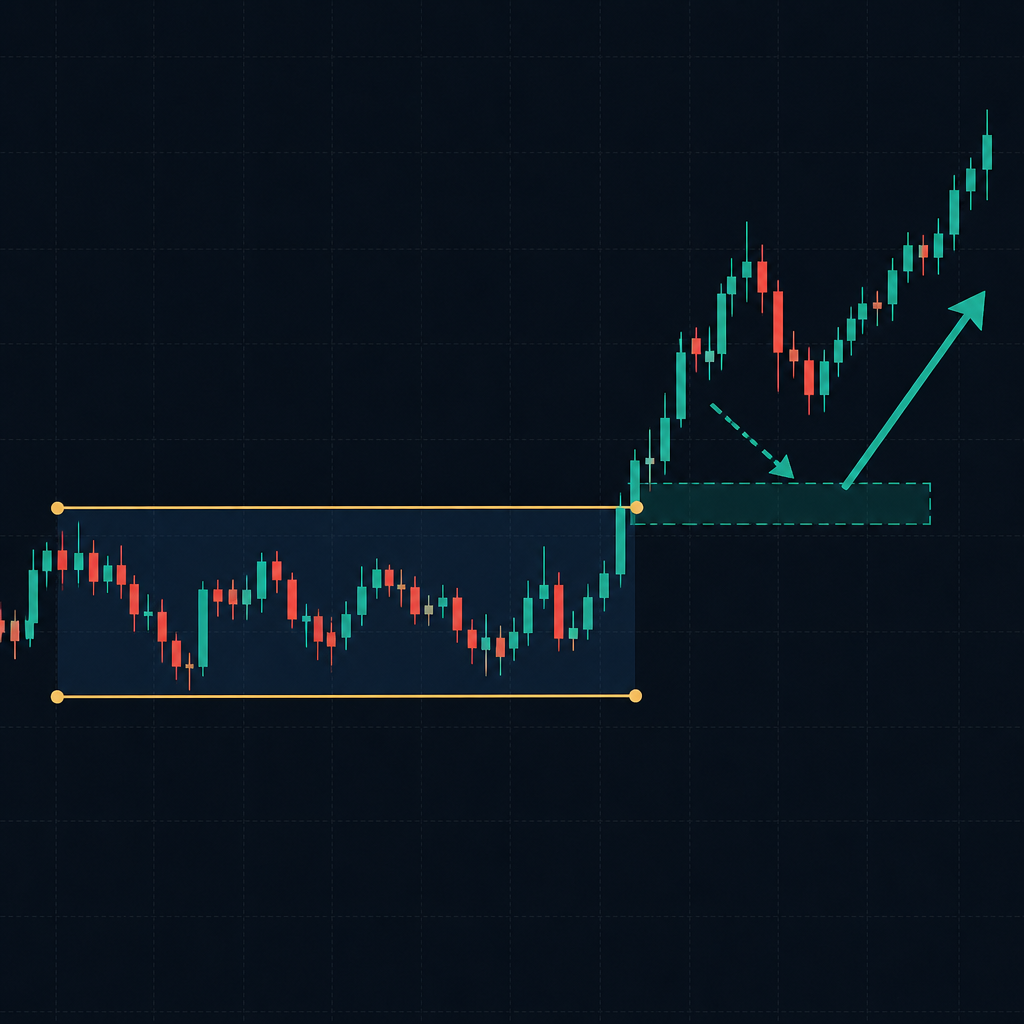
The Asia session in gold is often a “warehouse” of orders.
Liquidity is thinner than London and New York, so price tends to rotate in a contained band.
That band becomes a visible reference point for the rest of the day.
Professional flows love simple references: the Asia high, the Asia low, and the midpoint.
Those levels collect stops and pending orders from retail and systematic traders.
When London opens, volume increases, spreads tighten, and price can run those levels fast.
Here’s the core logic you’re exploiting:
- Compression → Expansion: a tight range increases the odds of a directional expansion later.
- Liquidity above/below the box: stops sit above Asia high and below Asia low.
- Session handoff: Asia sets the “box,” London/NY decides the “break.”
In the current environment, gold holding near $2650 while DXY stays elevated around 106.80 creates a tug-of-war.
That tug-of-war often shows up as a neat Asian range, then a decisive break on a catalyst: yields, risk sentiment, or a data surprise.
Even without major news, London can trigger a breakout simply because liquidity returns.
One more reason this works: it’s rule-based.
You’re not guessing “is gold bullish today?” every minute.
You’re saying: “If price breaks the Asia box with confirmation during my trade window, I have a plan.”
This is also why the Asia box approach translates well into signal alerts on Telegram.
A signal is essentially a standardized rule output: Entry, SL, TP, and conditions.
That’s exactly how we structure trades inside our United Kings Gold Signals—clear levels, session logic, and risk-defined execution.
Defining Your XAUUSD Asia Session Range (Box Rules That Don’t Drift)
The biggest mistake traders make is changing the Asia range window every day.
When your “box” starts drifting, your backtest becomes meaningless.
So we define a fixed time window and stick to it.
Choose a consistent Asia window
Pick a window that captures the bulk of Asia consolidation but ends before London volume ramps.
A common template is 00:00–05:00 London time.
Another is 23:00–04:00 London time, depending on your broker’s server time.
Your job is not to find the “perfect” window.
Your job is to find a repeatable window and trade it consistently.
Mark the Asia High and Asia Low
On a 15-minute chart (M15) or 5-minute chart (M5), draw two horizontal lines:
- Asia High: the highest wick printed during the window.
- Asia Low: the lowest wick printed during the window.
That’s your box.
Then mark the midpoint of the range (optional but useful for bias and partials).
Measure the box size (this changes your expectations)
Not all Asia boxes are equal.
A 600-point box ($6) behaves differently than a 2,000-point box ($20).
As a practical guide for XAUUSD:
- Small box: $4–$8 (400–800 points). Often leads to clean expansions.
- Medium box: $8–$14. Still tradable, needs stronger confirmation.
- Large box: $14–$22+. More chop risk; reduce size or demand retest entries.
Example near current prices:
- Asia High: $2656.20
- Asia Low: $2646.80
- Range size: $9.40 (940 points)
That’s a medium box.
It’s tradable, but you’ll want confirmation and good filters.
Session range vs. random range: why “Asia” is special
You could draw a box anywhere.
But the Asia session box is tied to time-based liquidity, which is why it repeats.
London traders see the same box you see.
Algorithms see it too.
That shared reference is what makes it signal-friendly and scalable.
Breakout Confirmation Rules (How to Stop Getting Wicked Out)
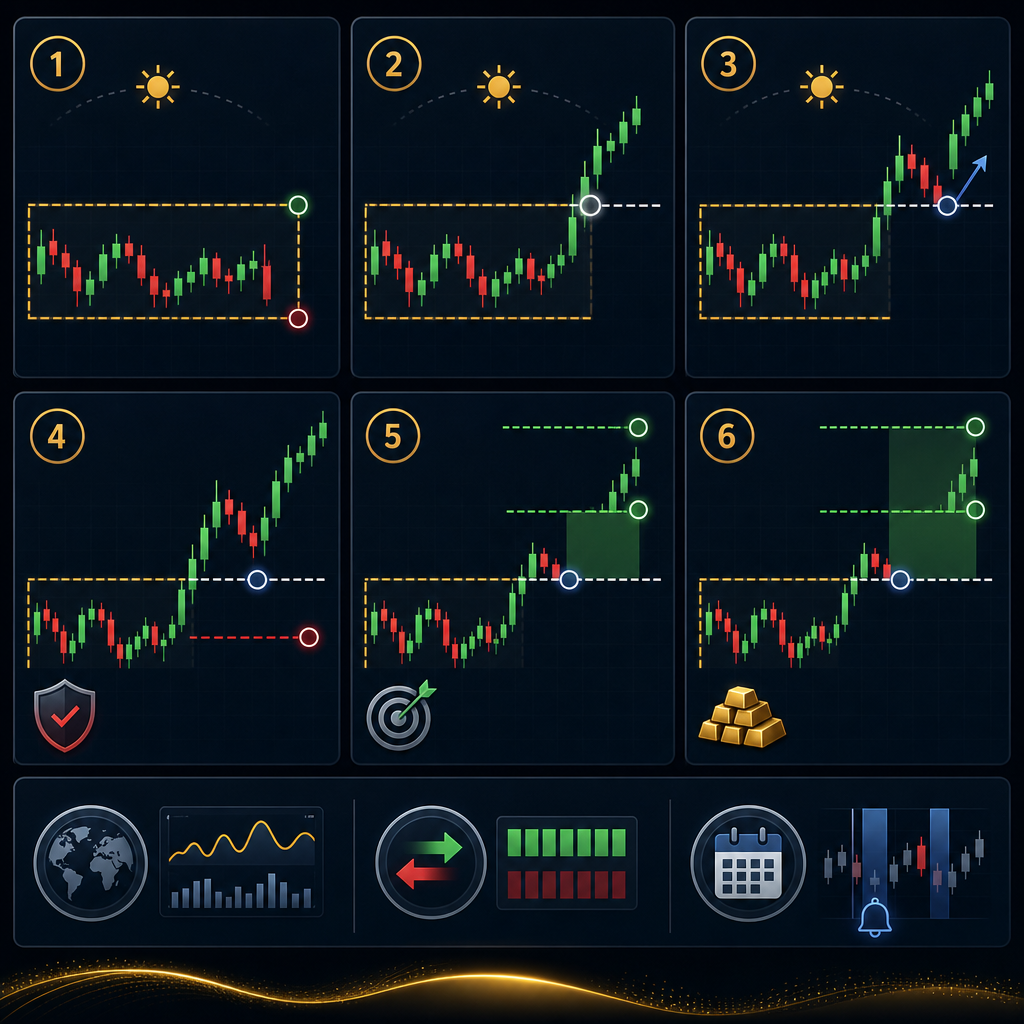
Gold loves fakeouts.
If you treat every wick above the box as a breakout, you’ll donate spreads all week.
So we define confirmation that is strict enough to filter noise but not so strict it misses the move.
Rule 1: Candle close beyond the box
We require a candle close beyond Asia High (for buys) or below Asia Low (for sells).
On XAUUSD, M5 is responsive; M15 is cleaner.
If you’re newer, start with M15 close confirmation.
Rule 2: Minimum breakout distance (“push” filter)
Not all closes are equal.
A close 10 points above the box can still be a trap.
So add a minimum push beyond the level.
Practical push filter options:
- Conservative: close at least $1.20 (120 points) beyond the box.
- Balanced: close at least $0.80 (80 points) beyond the box.
- Aggressive: close at least $0.60 (60 points) beyond the box.
Example buy breakout:
- Asia High: $2656.20
- Breakout confirmation (balanced): M15 close above $2657.00
- Preferred: close near $2657.20–$2658.00 with strong body
Rule 3: Body-to-wick quality check
This is a simple price action filter that saves trades.
For a bullish breakout candle, you want a real body, not a long top wick.
- Good breakout candle: body is at least 50% of candle range.
- Suspicious breakout: huge wick, tiny body, closes barely outside box.
Gold’s “stop-run candle” often spikes above the box and closes back inside.
Your close rule avoids that.
Rule 4: One breakout per direction (avoid revenge trading)
Decide upfront how many attempts you allow.
A clean rule: maximum 1 trade per direction from the Asia box.
If it fails, stand down until New York or wait for a new structure.
This is how we keep execution consistent in a signals environment.
It prevents the “three losses in the same chop” problem.
Entry Models: Breakout Entry vs Retest Entry (Pick Your Personality)
There are two professional ways to trade the Asia box breakout.
Both can work.
The key is matching the entry model to your risk tolerance and the day’s volatility.
Model A: Momentum (breakout-close) entry
You enter as soon as the confirmation candle closes beyond the box.
This captures fast moves that never retest.
But it can suffer from slippage during spikes.
Example (buy):
- Asia High: $2656.20
- M15 closes at $2657.60 with strong body
- Entry: Buy $2657.60
- SL: $2645.60 (below Asia Low $2646.80 with buffer) → risk $12.00
- TP1: $2681.60 (1:2) → +$24.00
- TP2: $2693.60 (1:3) → +$36.00
This fits days where gold is trending and London opens with direction.
It’s also common on days where DXY moves sharply and gold reacts instantly.
Model B: Retest entry (higher quality, fewer fills)
You wait for the breakout, then you wait again for price to retest the box edge.
For buys, you want former resistance (Asia High) to act as support.
For sells, you want former support (Asia Low) to act as resistance.
Example (buy retest):
- Asia High: $2656.20
- Breakout confirmed: M15 close at $2657.40
- Price pulls back to $2656.40–$2656.10
- Entry: Buy $2656.50 after M5 rejection candle
- SL: $2646.50 (below Asia Low or below retest swing) → risk $10.00
- TP: $2676.50 (1:2) and $2686.50 (1:3)
Retest entries often improve your win rate because you’re buying after the market proves acceptance above the box.
The trade-off is that some days price never retests and you miss the move.
Which entry model should you use?
Use a simple decision rule:
- If the Asia box is small-to-medium and London opens with strong impulse: consider momentum entry.
- If the Asia box is large or the first breakout candle has a long wick: prefer retest entry.
Inside our United Kings Signals, you’ll see both styles depending on conditions—because the market doesn’t pay you for being stubborn.
Stop-Loss Placement for XAUUSD Breakouts (Practical, Not Theoretical)
Stops are where breakout strategies live or die.
Gold can move $5 in seconds during London or NY bursts.
If your stop is too tight, the market will “breathe” you out.
If it’s too wide, your position size becomes unsafe.
Three stop models that actually work
1) Opposite side of the Asia box (classic)
This is the most robust method.
If you buy a break above Asia High, your invalidation is often below Asia Low.
But the box may be too large some days.
2) Retest swing stop (efficient)
When you enter on retest, place SL below the retest swing low (for buys) or above swing high (for sells).
This keeps risk tighter while still logical.
3) Hybrid stop (box edge + buffer)
Place SL just beyond the box edge on the other side of your entry direction, plus a buffer for spread.
Example: buy retest at $2656.50, SL at $2649.50 (below midpoint and structure), if box is large.
Gold-specific SL sizing guidelines ($10–$25)
With gold around $2650, a common intraday SL range is $10–$25.
That’s 1,000–2,500 points.
Use this practical mapping:
- Tight: $10–$12 (works best on retest entries and small boxes)
- Standard: $13–$18 (works well for most London breakouts)
- Wide: $19–$25 (use only when volatility is elevated or box is large)
Buffer your stop for spread and stop hunts
Gold spreads vary by broker and time.
During liquid hours, you might see 15–35 points (0.15–0.35).
During rollovers or news spikes, it can widen dramatically.
Add a buffer:
- Place SL $0.30–$0.80 beyond the “obvious” level, depending on spread.
- If spreads are elevated, reduce size or skip the trade.
Example: Asia Low is $2646.80.
You want SL below it, not at it.
So you place SL at $2645.60 or $2645.30, not $2646.80.
Position sizing: the silent edge
A breakout system can be profitable and still blow accounts if sizing is wrong.
Risk a fixed percentage per trade (many pros use 0.5%–1%).
If your stop is $15, your lot size must shrink compared to a $10 stop.
If you want a deeper risk framework, bookmark our guide on risk management strategies when using forex signals.
The same math applies to gold signals.
Take-Profit Rules: 1:2 and 1:3 Targets Using Liquidity (Not Hope)
Most traders obsess over entries.
Professionals obsess over exits.
Because gold can hand you +$20 quickly, then snap back and close flat if you don’t have a plan.
Base rule: set TP using R-multiples
If your SL is $12, then:
- 1:2 target = $24
- 1:3 target = $36
Example:
- Buy entry: $2657.60
- SL: $2645.60 (risk $12)
- TP1 (1:2): $2681.60
- TP2 (1:3): $2693.60 (note: slightly above our $2690 guideline; if you want to stay strict, cap at $2689.80 and trail the rest)
Because we’re working within $2610–$2690 examples, a realistic adaptation is:
- Take TP2 near $2688.50–$2689.80
- Trail the remainder under M15 higher lows if momentum continues
Liquidity-based targets (the “where will price likely go?” method)
Gold is attracted to:
- Round numbers: $2650, $2660, $2670, $2680
- Prior day high/low
- London high/low
- Unfilled impulsive legs (price inefficiency)
So if you buy a break above $2656, you might set TP1 near $2668–$2672 if that’s the next liquidity pool.
Then TP2 near $2682–$2688 if momentum persists.
Scaling out: a simple two-target model
To reduce emotional decision-making, use a fixed scale plan:
- Close 50% at 1:2.
- Move SL to breakeven (or to -$2) after TP1.
- Let the remaining 50% run to 1:3 or a liquidity target.
This keeps you in the game on trend days while paying you on normal days.
It also makes your results smoother, which matters if you’re following signals.
When to use a trailing stop
Use trailing stops only after the market proves direction.
A simple trailing method:
- Trail below the last M15 swing low (for buys) or above swing high (for sells).
- Or trail behind a short EMA like 20 EMA on M15 (only if you’ve tested it).
Don’t trail too early.
Gold will tag your trail, then continue without you.
High-Probability Filters: Spread, News, Time Cutoffs, and False-Break Logic
If you want your Asia box breakout to behave like a professional signal model, filters are non-negotiable.
Filters reduce trade frequency but increase trade quality.
That’s exactly what you want in gold, where one bad fill can erase two good trades.
Filter 1: Spread threshold (don’t pay the market to trade)
Before entry, check the spread.
Set a hard rule, for example:
- Trade only if spread is ≤ 0.35 ($0.35 / 35 points) during liquid hours.
- If spread is 0.50+, avoid momentum entries and consider retest-only—or skip.
Spread tends to widen around rollover and during high-impact news.
That’s where breakouts get messy.
Filter 2: News proximity (avoid the “random spike”)
Gold reacts violently to US data and Fed communication.
A practical rule:
- Avoid new entries 30 minutes before and 15 minutes after red-folder events.
- For CPI/NFP/FOMC, widen to 60 minutes before and 30 minutes after.
If you want a full calendar-based approach for gold, read our related resource: how gold signals react to unexpected news events.
It’s the difference between planned volatility and chaos volatility.
Filter 3: Time-of-day cutoff (don’t chase late breakouts)
The Asia box breakout works best during the liquidity transition.
Set time windows when you’re allowed to take the trade.
Example windows:
- London breakout window: 07:00–11:00 London time
- NY continuation window: 13:30–16:00 London time (around US open)
Outside these windows, breakouts can still happen, but the probability profile changes.
Late-session breakouts are more likely to reverse into the close.
Filter 4: False-break retest logic (your anti-fakeout shield)
Define what a fakeout is.
Here’s a clean rule set:
- If price breaks above Asia High but closes back inside the box on M15, treat it as a failed breakout.
- After a failure, only consider the opposite direction if price breaks the other side with confirmation.
- Do not re-enter the same direction immediately unless a new structure forms (new higher low above the box for buys).
Gold loves the “break, trap, reverse” pattern.
When you have rules for it, it stops being emotional.
Filter 5: Directional context (optional, but powerful)
You can add a bias filter using higher timeframes:
- Trade only buy breakouts if H1 structure is making higher highs/higher lows.
- Trade only sell breakouts if H1 is making lower highs/lower lows.
Don’t overcomplicate it.
The Asia box is already a strong framework.
Comparison Table: Asia Box Breakout vs Other XAUUSD Approaches
Not every gold strategy fits every trader.
This table helps you see where the Asia box sits compared to other popular intraday styles.
| Approach | Best Time | Typical Trade Frequency | Strength | Main Risk | Who It Fits |
|---|---|---|---|---|---|
| Asia Box Range Breakout | London open & NY open | Low–Medium (0–2/day) | Rule-based, great R:R, clear invalidation | Fakeouts and news spikes | Traders who want repeatable signals |
| London Open Range Breakout | First 30–60 mins London | Medium | Captures early volatility | High slippage if spread widens | Fast executors, scalpers |
| Trend Pullback (H1/H4) | All sessions | Low | High win rate in strong trends | Misses reversals and range days | Patient swing traders |
| News Spike Trading (CPI/NFP) | Major US data releases | Very low | Huge moves possible | Extreme slippage, whipsaws | Advanced traders only |
If you’re already trading London volatility, the Asia box often becomes your “map.”
You’re no longer trading random candles.
You’re trading a breakout from a known liquidity container.
Step-by-Step: Turning the Asia Box Rules Into Clean XAUUSD Breakout Signals
Let’s turn everything into a checklist you can run every day.
This is the exact kind of structure that makes Telegram signals consistent.
It also makes your own discretionary trading far less stressful.
Step 1: Pre-market prep (5 minutes)
- Check gold price area (today: around $2650).
- Check DXY (around 106.80) and risk sentiment (optional).
- Check the economic calendar for red-folder events.
- Decide your trade windows (London/NY) and your cutoff times.
Step 2: Draw the Asia box
- On M15, mark Asia High and Asia Low for your fixed window.
- Measure box size in dollars.
- Mark midpoint (optional).
Step 3: Define the breakout trigger
- Breakout requires M15 close beyond the box.
- Minimum push beyond level: $0.80 (balanced template).
- Breakout candle quality: avoid long-wick traps.
Step 4: Choose entry type (momentum vs retest)
- Momentum entry if impulse is strong and spread is tight.
- Retest entry if box is large or breakout candle is messy.
Step 5: Place SL logically
- Default: SL beyond opposite side of box with buffer.
- Retest model: SL behind retest swing.
- Keep SL typically $10–$25 from entry.
Step 6: Set TP using R:R + liquidity
- TP1 at 1:2.
- TP2 at 1:3 or next liquidity pool (round number / prior high/low).
- Consider scaling out and moving SL after TP1.
Step 7: Apply filters before sending/placing the trade
- Spread ≤ 0.35 preferred.
- No entry within 30 minutes of red-folder news (60 minutes for CPI/NFP/FOMC).
- Only trade within your session windows.
- If a breakout fails (close back inside), stand down or wait for opposite confirmation.
Step 8: Convert into a signal message format
Use a standardized template:
- Instrument: XAUUSD
- Direction: Buy/Sell
- Entry: price
- SL: price
- TP1, TP2: prices
- Setup: Asia box breakout + confirmation type
- Notes: spread/news/time filter status
This is the style you’ll see in our Forex Signals and gold-focused channels: clear levels, clear logic, and no ambiguity.
Realistic Trade Examples Around $2650 (Buy and Sell Scenarios)
Let’s ground this in realistic numbers within the $2610–$2690 zone.
We’ll build two examples: one bullish breakout and one bearish reversal day.
These are not promises—just templates you can practice and backtest.
Example 1: Bullish London breakout with retest (higher quality)
Market context: Gold is holding firm near $2650, DXY is steady at 106.80, and there’s no red-folder news for the next 2 hours.
Asia session prints a contained range.
- Asia High: $2654.90
- Asia Low: $2647.30
- Box size: $7.60
London opens and M15 closes above the high at $2656.10.
That’s a $1.20 push beyond $2654.90, so it passes the filter.
Entry plan (retest):
- Wait for price to pull back toward $2654.90–$2655.20.
- On M5, you see a rejection candle from $2655.00.
- Buy Entry: $2655.30
- SL: $2644.80 (below Asia Low with buffer) → risk $10.50
- TP1: $2676.30 (1:2) → +$21.00
- TP2: $2686.80 (approx 1:3) → +$31.50
Management:
- At +$21, close 50% and move SL to entry or to $2652.80.
- Let the rest run toward $2680–$2688 liquidity.
This trade works because the box was small, the breakout was clean, and the retest confirmed acceptance.
Example 2: Bearish breakout below Asia low after a failed upside break
Market context: Gold pushes above the Asia high early but fails; DXY firms and risk sentiment turns defensive.
- Asia High: $2658.40
- Asia Low: $2649.60
London spikes to $2659.10 but the M15 candle closes back inside at $2657.80.
That’s your first warning: failed breakout behavior.
Later, price breaks below Asia Low and closes at $2648.60 (a $1.00 push below).
Entry plan (momentum or retest):
- Sell Entry: $2648.60 (momentum close entry)
- SL: $2663.60 (above Asia High + buffer) → risk $15.00
- TP1: $2618.60 (1:2) → +$30.00
- TP2: $2610.00–$2612.00 (liquidity + near 1:2.4–1:2.5) if you want to stay inside our example band
Notice how TP2 is constrained by our $2610 guideline.
In real trading, you’d map the next daily liquidity and adjust.
Key lesson: the failed upside break increased the odds that the real move would be down.
This is why “false-break logic” is a filter, not a footnote.
Common Mistakes (and How to Fix Them Without Changing Strategies)
Most traders don’t fail because the Asia box strategy is flawed.
They fail because execution slips under pressure.
Here are the mistakes I see most often—and the fixes that keep the strategy intact.
Mistake 1: Drawing the box differently every day
If your time window changes, your statistics collapse.
Fix: pick a window and lock it for 30 trading days.
Only adjust after you have data.
Mistake 2: Trading the breakout during illiquid hours
Asia breakouts can happen, but they’re more likely to be fakeouts.
Fix: treat Asia as the “range-building” session; trade breaks during London/NY windows.
Mistake 3: Ignoring spread and getting terrible fills
On gold, spread is a tax.
If you pay too much tax, your edge disappears.
Fix: set a spread threshold and respect it.
Mistake 4: No rule for failed breakouts
Without a failure rule, you’ll re-enter repeatedly and get chopped.
Fix: if M15 closes back inside the box after a break, treat it as failure and stop trading that direction.
Mistake 5: Taking profits randomly
Random exits create random results.
Fix: use 1:2 and 1:3 targets, plus a scale-out rule.
Mistake 6: Oversizing because “the setup is perfect”
The market doesn’t care how perfect it looks.
Fix: risk a fixed % and let the math work over 50–100 trades.
If you want a process for evaluating signal quality and avoiding emotional trades, our checklist-style resource is worth reading: forex trading signals provider checklist for beginners.
Even if you trade manually, the same due diligence mindset applies.
How We Package Asia Box Breakouts Into Telegram Signals (So You Can Execute Fast)
A strategy is only useful if you can execute it quickly and consistently.
That’s why signals—when done professionally—are not “lazy trading.”
They’re a structured execution layer.
At United Kings, our focus is premium, session-based setups—especially London and New York.
That aligns perfectly with the Asia box breakout concept.
What a high-quality XAUUSD breakout signal includes
- Exact entry (or entry zone) tied to the box level.
- SL placed at a logical invalidation, not a random number.
- TP levels based on R:R and liquidity.
- Context note: “Asia box break + retest,” “spread OK,” “no red news next hour.”
- Management guidance: partial at TP1, move SL, trail options.
Signal example message (template)
- XAUUSD BUY
- Entry: 2655.30
- SL: 2644.80
- TP1: 2676.30
- TP2: 2686.80
- Setup: Asia session range breakout + retest (M15 confirm)
- Filters: spread <= 0.35, no red news 60 min
This is the difference between “buy gold now” and a real trading plan.
It’s also why communities form around professional signal providers.
United Kings has a 300K+ active trader community because clarity scales.
Where to get the signals (and what you get)
If you want these setups delivered in real time, explore our Gold Signals and the broader Signals offering.
You can also join our Telegram channel directly at United Kings Telegram signals channel for updates and trade alerts.
We publish clear Entry, SL, and TP levels and combine them with education so you learn the “why,” not just the “what.”
We target an 85%+ win rate as a performance benchmark, while always acknowledging that past performance does not guarantee future results.
Backtesting and Optimization: Make the Strategy Yours (Without Curve-Fitting)
If you want confidence in any breakout strategy, you need data.
Not opinions.
Backtesting the Asia box is straightforward because rules are time-based and level-based.
What to record (minimum viable journal)
- Date
- Asia window used
- Asia High/Low and box size
- Breakout direction and time
- Entry type (momentum vs retest)
- SL size ($)
- TP hit (TP1, TP2, BE, SL)
- Spread at entry
- News proximity (yes/no)
After 30–50 trades, patterns appear.
You’ll see which box sizes work best for you.
You’ll see whether retests outperform momentum entries in your broker environment.
Optimization knobs (keep it to 2–3)
Don’t change 10 variables at once.
That’s how traders curve-fit and then fail live.
Good variables to test:
- Asia window (two options only)
- Push filter ($0.60 vs $0.80 vs $1.20)
- Entry type (momentum vs retest)
Avoid over-optimizing SL/TP too much.
Gold volatility changes.
Instead, keep SL logical and adjust position size.
Demo first, then go small
If you’re new, trade this on demo for 2–4 weeks.
Then go live with small risk.
This is not about being cautious—it’s about building execution muscle.
If you want more education-first resources, browse the United Kings blog and build a playbook you actually understand.
FAQ: XAUUSD Asia Session Range Breakout Signals
1) What time is the Asia session for XAUUSD?
It depends on your platform time zone, but a common approach is to define a fixed window like 00:00–05:00 London time and always use that for the range box.
2) Is the Asia box strategy good for beginners?
Yes, because it’s rule-based and visual.
But beginners should start on a demo account and keep risk small when going live.
3) What’s the best timeframe for confirmation?
M15 is a strong default because it filters noise and reduces wick traps.
M5 can work for faster entries, especially on retests, but it requires more discipline.
4) How big should my stop loss be on gold breakouts?
In the $2650 area, many intraday breakout trades use $10–$25 stops depending on box size and volatility.
Always size your position so the dollar risk stays consistent.
5) What causes most Asia box breakout failures?
The top causes are news spikes, spread widening, and false breaks where price closes back inside the box.
That’s why confirmation and filters matter.
Risk Disclaimer (Read This Before You Trade)
Forex and gold trading involves significant risk and may not be suitable for all investors.
Past performance does not guarantee future results.
No strategy, signal, or method can guarantee profits, and losses can exceed expectations during volatile conditions.
If you’re new, practice on a demo account first and use strict risk management on every trade.
Join United Kings: Get Premium XAUUSD Breakout Signals (London & NY Focus)
If you want the Asia box breakout executed with discipline—clean entries, logical SL, and mapped TP levels—our team delivers that daily inside our premium community.
We share premium Telegram signals for forex and gold, built for the London and New York sessions, plus education so you can understand the setups.
Start here:
- Explore our full United Kings signals service
- Go directly to Gold (XAUUSD) signals
- Review plans on our pricing page: 3 Months ($299), 1 Year ($599 – Best Value, 50% savings + FREE ebook), and Lifetime ($999)
- Join the live channel on Telegram: United Kings on Telegram
We also offer a 48-hour money-back guarantee so you can evaluate the clarity and structure of our alerts with confidence.
When you’re ready, join United Kings and trade XAUUSD with a plan—not with hope.