
Ever opened your phone during the Asian session, saw an XAUUSD signal, and wondered: “Is this going to move… or just chop me to death until London?”
You’re not imagining it. Gold around $2650 can feel “quiet” in Asia, then suddenly violent near London open.
This guide is a complete XAUUSD Asian session strategy built for that reality. We’ll use Tokyo range compression to define the battlefield, then use ADR targets for gold trading to set take-profits that actually fit Asian volatility.
TL;DR (Save This Playbook)
- Asian session XAUUSD works best when price compresses into a tight Tokyo range (a box you can measure).
- Trade the breakout only when the break is “clean”: expanding spread + decisive candle body + no immediate snap-back.
- Stops belong beyond the range (typically $10–$25), not inside the box where noise lives.
- Use ADR to cap expectations: in Asia you often target a fraction of ADR, not the full daily move.
- Stand down before London volatility if you’re late, spreads widen, or the breakout already traveled most of its ADR allowance.
- Best results come from consistent execution—or following structured gold signals with entry/SL/TP like we post in United Kings Gold Signals.
Why the Asian Session Is Different for XAUUSD (And Why Signals Fail There)
Gold is global, but it doesn’t trade the same way every hour. In the Asian session, liquidity is often thinner than London and New York.
That matters because XAUUSD is a spread-sensitive instrument. A $0.30–$0.80 spread difference can turn a “perfect” entry into a slow bleed.
Right now, with gold around $2650 (+0.35% on the day), the broader macro backdrop still matters. DXY is around 106.80, USD/JPY near 149.50, EUR/USD around 1.0520, and GBP/USD near 1.2680.
When the dollar is firm (higher DXY), gold often needs a stronger catalyst to trend. In Asia, catalysts are less frequent.
So what happens? You get range compression, small fake pushes, and stop runs around obvious highs and lows.
Most traders lose in Asia for three reasons:
- They expect London-sized moves and hold for unrealistic targets.
- They place stops inside the range where micro-volatility hunts them.
- They chase breakouts after the best part is done, right before liquidity shifts.
Our goal is to treat Asian session trading like a different game. We’ll define a measurable range (Tokyo box), demand evidence before entry, and aim for targets that match the session.
If you’re already using signals, the same logic applies: you want to know when a signal is high-quality in Asia, and when it’s better to pass.
What “Tokyo Range Compression” Means (And How to Draw It Correctly)
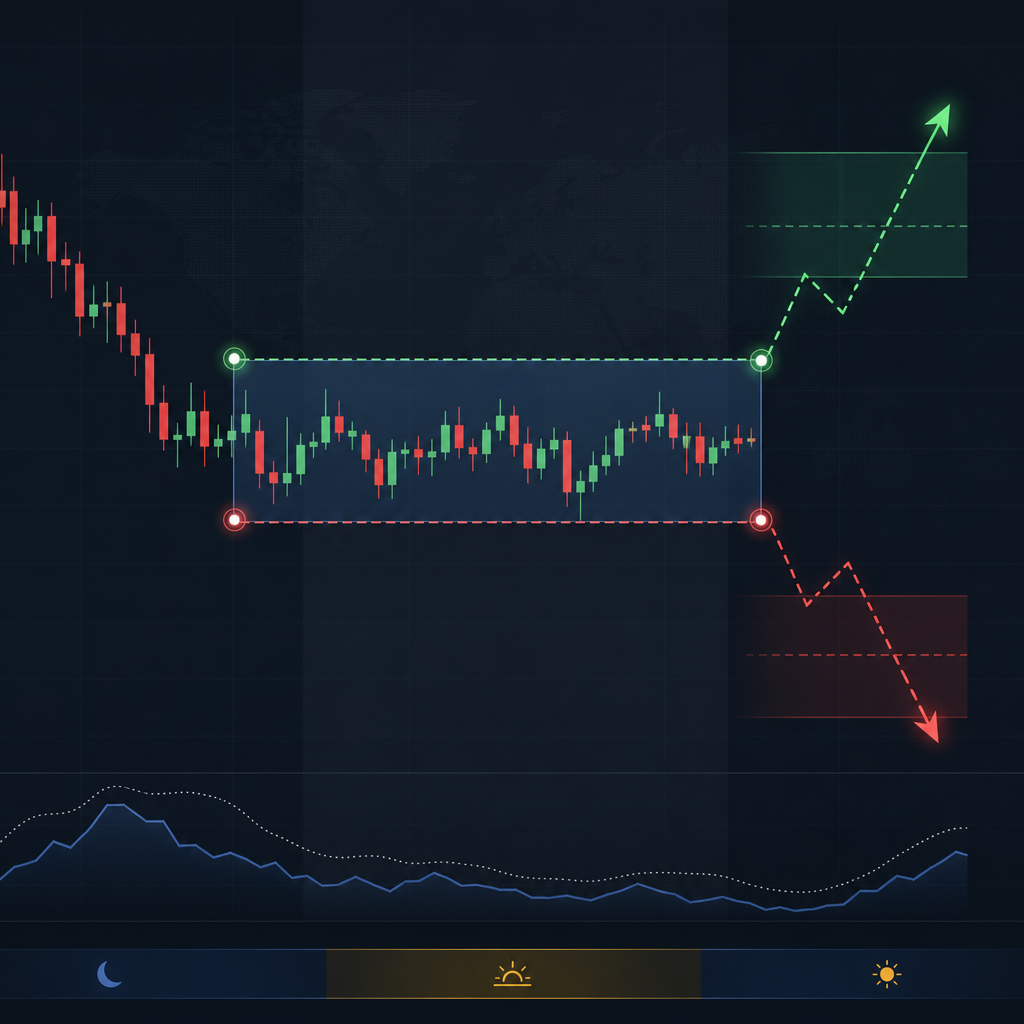
Tokyo range compression is simple: price spends hours moving sideways in a tight box during Tokyo hours, building energy.
When that box breaks, you can get a clean continuation move. Or you can get a false break that snaps back into the box.
Your edge comes from defining the box consistently. If you draw it differently every day, you’ll trade randomness.
Step 1: Define Your Tokyo Window (Pick One and Stick to It)
Different traders define “Tokyo session” differently. The key is consistency.
A practical window many signal traders use is 00:00–06:00 UTC. Another is 23:00–05:00 UTC.
Pick one window and backtest it visually on your chart. Then keep it.
Step 2: Mark the Range High and Range Low
On M15 or M30, draw a horizontal line at the highest wick and lowest wick during your Tokyo window.
That becomes your Tokyo range. The tighter it is, the more “compressed” the market is.
Example near current prices:
- Tokyo high: $2656.40
- Tokyo low: $2647.80
- Range size: $8.60 (tight for gold)
A tight $7–$12 range is often tradable. A $18–$25 range can still work, but your stop and target math changes.
Step 3: Identify Compression Quality (Not All Ranges Are Equal)
Compression is higher quality when:
- Candles overlap heavily (lots of “inside” behavior).
- Wicks poke both sides but bodies stay inside.
- The range size is below recent Asian averages.
Compression is lower quality when:
- The range is wide and trending inside the window.
- Price repeatedly closes outside and re-enters (messy).
- News spikes distort the box (unexpected headlines).
This is why we don’t blindly trade “any breakout.” We trade the breakout of a well-formed box.
Asian Session Volatility: Set Expectations With ADR (Not Hope)

If you want to stop overtrading Asia, you need a ruler. That ruler is ADR (Average Daily Range).
ADR tells you how far gold typically moves in a day. Then you can estimate how much is realistic in Asia.
In active conditions, gold might have an ADR of $28–$45. In calmer weeks, it might be $18–$25.
Let’s use a realistic example: assume XAUUSD ADR(14) is $32.
Step-by-Step: How to Use ADR Targets for Gold Trading
- Step 1: Note today’s session low/high so far. Suppose today’s low is $2638 and high is $2658.
- Step 2: ADR = $32 means a “typical” full-day range could be ~32 dollars.
- Step 3: Estimate remaining range. If today already moved $20, you may only have ~$12 of “typical” room left before the move becomes statistically stretched.
- Step 4: For Asia, target 25%–45% of ADR unless a catalyst is present.
With ADR $32, Asian targets often make sense around:
- 0.25 ADR: $8
- 0.35 ADR: $11
- 0.45 ADR: $14
Notice how that lines up with Tokyo range breakouts. If your box is $8–$12, an Asia breakout may reasonably deliver another $8–$14.
This is the core: Tokyo compression gives you structure, ADR gives you realistic take-profit boundaries.
Tokyo Range Breakout Gold: The Only 3 Breakout Types You Should Trade
In Asia, breakouts are not created equal. Most “breakouts” are just stop hunts.
We categorize Tokyo range breakout gold setups into three tradeable types. If it doesn’t match one of these, we pass.
Type 1: Clean Close-and-Go Breakout
This is the best one. Price closes beyond the range with a strong body, then continues without immediately retesting deep.
Example:
- Tokyo high: $2656.40
- Break candle closes M15 at $2659.20
- Next candle holds above $2656.40 and pushes to $2664.50
This is where you can enter either on the close (aggressive) or on a shallow retest (conservative).
Type 2: Break-Retest-Continue (The “Professional” Breakout)
Price breaks out, then comes back to test the range edge, then continues.
This is common in Asia because liquidity is thinner. The retest helps confirm the level.
Example long scenario:
- Break above $2656.40 to $2661.00
- Retest to $2656.80–$2657.20
- Continuation to $2668.00
This is often the best risk-reward entry because your stop can sit beyond the range low or beyond the retest swing.
Type 3: Liquidity Sweep Then Real Break
This is the trap that becomes an opportunity. Price first sweeps one side of the range (grabs stops), then reverses and breaks the other side.
Example:
- Tokyo low: $2647.80
- Price spikes to $2645.90 (sweep), then snaps back inside
- Later breaks above $2656.40 with a strong close
In this case, the sweep is information: it suggests stop liquidity below has been cleared, making an upside break more likely.
If you want to go deeper on stop-hunt behavior, pair this with our broader signal execution education on the United Kings blog and our risk rules in risk management strategies when using forex signals.
Filtering False Breaks in Asia: Volume/Spread Cues That Actually Help
Let’s be honest: retail traders love “volume” indicators on spot gold, even though centralized volume doesn’t exist the same way it does on futures.
Still, you can use tick volume and, more importantly, spread + candle behavior to filter bad breakouts.
In the Asian session, the market often “tests” levels with minimal commitment. Your job is to spot that lack of commitment.
Filter 1: Candle Body vs Wick at the Break
A good breakout candle usually has:
- A body that closes beyond the range (not just a wick).
- Wicks that are not longer than the body (less rejection).
- A close near the candle’s extreme (strength).
A bad breakout often looks like:
- Wick breaks the range, but the close is back inside.
- Two attempts fail at the same edge within 30–60 minutes.
- Immediate snap-back of $5–$8 in one candle.
Filter 2: Spread Expansion at the Worst Time
Spread is your hidden cost. In Asia, spreads can widen right when you need precision.
Rule of thumb: if spread suddenly jumps and the breakout candle is messy, treat it as a warning.
Example: price “breaks” above $2656.40, but spreads widen and you see price print $2659.10 then instantly back to $2656.70. That’s often a liquidity probe, not a real move.
Filter 3: Tick Volume Relative to the Prior 10–20 Candles
We don’t need perfect volume. We need relative information.
If the breakout happens on lower tick volume than the prior range candles, it’s often unreliable.
If tick volume expands and the candle closes strong, it supports the breakout.
Filter 4: Correlation Check (DXY and USD/JPY)
With DXY at 106.80 and USD/JPY around 149.50, you can use a simple confirmation:
- If gold is breaking up, but DXY is also pushing up strongly, be cautious.
- If gold is breaking down and DXY is rising, that’s more aligned.
This is not a rule. It’s a filter that keeps you out of some low-quality trades.
When we post signals in United Kings Signals, we’re watching these cross-market cues because they matter more during thin liquidity.
Stops and Entries: The Asian Session Checklist (Range-Based, Not Emotion-Based)
Asian session trading rewards mechanical rules. If you “feel” your way through it, you’ll overtrade.
Here’s the entry and stop framework you can apply to your own setups or when following our gold signals.
Step-by-Step Entry Rules (Long Example)
- Step 1: Draw Tokyo range high/low (e.g., $2656.40 / $2647.80).
- Step 2: Wait for an M15 close above the high (e.g., close at $2659.20).
- Step 3: Choose entry style:
- Aggressive: buy on close $2659.20–$2659.50.
- Conservative: buy on retest $2656.80–$2657.50.
- Step 4: Confirm no immediate snap-back into the box within the next 1–2 candles.
Stop Placement Rules (Keep It Outside the Noise)
Gold loves to revisit the breakout edge. If your stop is too tight, you’ll get clipped and watch it run.
Two practical stop models:
- Model A (Beyond the opposite side): For a long breakout, SL goes below Tokyo low. Example: entry $2659.20, SL $2646.80 (risk $12.40).
- Model B (Beyond retest swing): If you enter on retest, SL goes below the retest low. Example: entry $2657.20, retest low $2654.60, SL $2652.60 (risk $4.60). Use only if structure is clean.
In Asia, $10–$25 stops are common depending on range size and volatility. For the $2610–$2690 environment, that’s realistic.
Position Sizing (Don’t Let One Asia Trade Ruin Your Week)
Keep risk per trade small. Many disciplined traders use 0.25%–1% per position.
If your stop is $12 and you want to risk $100, your position size should be $100 / $12 ≈ 8.33 “$1-per-dollar” units (your platform will express this in lots).
If you’re not confident, demo trade first. Execution in Asia is a skill.
ADR Targets + Session Volatility: A Realistic TP Framework for Asia
Most Asian session frustration comes from take-profit mistakes. Traders either take $3 and miss the move, or hold for $30 and watch it reverse.
We solve this with a two-layer TP plan:
- Layer 1: Range-based target (measured move from the Tokyo box).
- Layer 2: ADR-based cap (don’t demand more than the day “usually” gives).
TP Method 1: Measured Move From the Tokyo Range
If the Tokyo range is $8.60, a common target is 1x to 1.5x the range after breakout.
Example long:
- Range: $8.60
- Breakout above: $2656.40
- Target 1 (1x): $2656.40 + $8.60 = $2665.00
- Target 2 (1.5x): $2656.40 + $12.90 = $2669.30
TP Method 2: Risk-Reward Anchoring (1:2 or 1:3)
Your stop defines your required reward. If you risk $12, a 1:2 target is $24.
Example:
- Entry: $2659.20
- SL: $2646.80 (risk $12.40)
- TP1 (1:2): $2659.20 + $24.80 = $2684.00
But here’s the Asian session truth: a full 1:2 may be ambitious unless the daily range allows it.
TP Method 3: ADR-Based “Permission”
Assume ADR(14) = $32 and today’s low was $2638.
A “typical” upper ADR band might be around $2638 + $32 = $2670.
If your 1:2 target is $2684 but ADR band is $2670, you’re asking for an above-average day. That’s okay sometimes, but not your default in Asia.
Practical rule:
- If your target is beyond the day’s ADR band, either reduce target, trail, or plan to hold only if London confirms.
A Simple Two-TP Model That Works in Asia
- TP1: 0.25–0.35 ADR or 1x range (bank partial).
- TP2: 0.45 ADR or 1.5x range (leave runner with trailing stop).
This keeps you paid in a quiet session while still participating if the move extends.
Stand-Down Rules: When NOT to Trade Before London Volatility Hits
A professional skill is knowing when to do nothing. In Asia, that’s half the edge.
London open changes everything: liquidity increases, spreads shift, and the market often “re-prices” the Asian move.
Here are stand-down rules we use when evaluating Asian setups and signals.
Rule 1: If the Breakout Already Traveled Most of Its Asia Allowance
If your ADR-based Asia allowance is $10–$14 and the breakout already moved $12, you’re late.
Example: breakout from $2656 to $2668 already delivered $12. Chasing at $2667.50 into London is usually poor risk.
Rule 2: If the Range Is Too Wide
If Tokyo range is $20+, your stop will likely be $20–$30 if placed correctly.
That can be valid, but it often doesn’t fit an Asian target. Risk-reward collapses.
Rule 3: If Spread Is Unstable
If spreads widen unpredictably, your stop and entry precision breaks down.
Stand down until conditions normalize.
Rule 4: If High-Impact News Is Near (Even if It’s Not “Gold News”)
Gold reacts to USD news and risk sentiment. A surprise headline can invalidate your box.
Keep an eye on the calendar and unexpected events. For survivability during sudden spikes, study our guide on how gold signals react to unexpected news events.
Rule 5: If You’re Emotionally “Chasing Back” a Loss
Asia’s chop is perfect for revenge trading. If you feel urgency, stop.
Come back for London or New York, where movement is cleaner for many traders.
Asian Session Execution: A Practical Walkthrough With Realistic Prices
Let’s put everything together using realistic levels in today’s context (gold around $2650).
Scenario: XAUUSD has been bid slightly, but DXY remains firm at 106.80. That suggests upside may be slower unless sellers fail.
Step 1: Build the Tokyo Box
- Tokyo window: 00:00–06:00 UTC
- High: $2654.90
- Low: $2646.70
- Range: $8.20
Step 2: Wait for Breakout Confirmation
At 06:30 UTC, an M15 candle closes at $2657.80 with a strong body.
Spread is stable. Tick volume is higher than the prior 10 candles. That’s a green light.
Step 3: Choose Entry Style
Conservative entry: wait for retest.
Price retests to $2655.10 and holds above the range high.
Entry: $2655.40
Step 4: Place Stop Beyond Structure
Option A: SL below range low ($2646.70) with buffer.
- SL: $2644.90 (risk $10.50)
This fits the $10–$25 stop guideline and respects the box.
Step 5: Set Targets Using Range + ADR
Assume ADR(14) = $30 today.
- TP1 (1x range): $2654.90 + $8.20 = $2663.10
- TP2 (1.5x range): $2654.90 + $12.30 = $2667.20
Risk is $10.50. TP1 gives ~0.73R, TP2 gives ~1.13R.
To align with 1:2 or 1:3, you’d need a larger extension, but Asia may not offer it. So you manage it differently:
- Take partial at TP1.
- Move stop to breakeven after TP1.
- Let TP2 run into the edge of your ADR allowance.
Step 6: Decide Whether to Hold Into London
If price reaches $2667 before London and ADR is nearly consumed, consider closing.
If London opens and holds above $2663 with momentum, you can trail for a larger move.
This is exactly how we think when managing trades around session transitions in our Telegram community at United Kings Telegram.
Comparison: Asian Session vs London/NY for XAUUSD Signals (What Changes)
Some traders force one strategy across all sessions. That’s a mistake.
Here’s a practical comparison so you can adjust expectations and execution.
| Factor | Asian Session (Tokyo) | London Session | New York Session |
|---|---|---|---|
| Liquidity | Lower, thinner order book | High, deep liquidity | High, especially with US data |
| Typical behavior | Compression, range play, small breakouts | Breakouts, reversals, trend continuation | Big extensions, news spikes, trend days |
| Spread sensitivity | Higher (spreads can widen suddenly) | Lower (usually tighter) | Medium (can widen around data) |
| Best target logic | Tokyo range + fraction of ADR | Structure + full ADR potential | Structure + full ADR / trend extension |
| Best trader profile | Patient, rule-based, selective | Active, breakout/reversal skilled | Fast decision-making, news-aware |
If you primarily trade FX alongside gold, you’ll notice similar session effects on EUR/USD (around 1.0520) and GBP/USD (around 1.2680).
For traders who want diversification signals beyond gold, we also cover majors in United Kings Forex Signals and broader coverage in our full signals hub.
How to Trade XAUUSD Signals in Asia Without Overtrading (A Daily Routine)
Most traders don’t need more indicators. They need a routine.
Here’s a simple daily routine you can follow in 20–30 minutes during Asia.
1) Pre-Session Prep (5 minutes)
- Check current price (around $2650) and note yesterday’s high/low.
- Check ADR(14) and estimate today’s “room.”
- Note DXY (106.80) and USD/JPY (149.50) direction for context.
2) Build the Tokyo Box (2 minutes)
- Mark the range high/low for your chosen Tokyo window.
- Write down the range size in dollars.
3) Set “Permission Rules” (2 minutes)
- I only trade if range is under $12–$15 (or if structure is very clean).
- I only trade if breakout candle closes outside the box.
- I only trade if spreads are stable.
4) Execute One High-Quality Attempt (Not Five)
Asia often gives one clean move. Trying to farm every wiggle is how accounts die slowly.
Take one A+ setup, then stop.
5) Manage With Partial Profits
Because targets are smaller in Asia, partials matter.
Banking partial at TP1 and protecting the rest keeps you consistent.
6) Cut Off Before London (Your “Hard Stop” Time)
Set a time where you stop initiating new positions, like 60–90 minutes before London open.
This prevents the classic mistake: entering late in Asia and getting whipsawed by London re-pricing.
If you want a framework for evaluating providers and avoiding random channels, use our signals provider checklist.
How United Kings Structures XAUUSD Signals for Session-Based Trading
Signals are only as good as the structure behind them. The Asian session is where “lazy signals” get exposed.
At United Kings, we focus on clarity and risk control:
- Clear Entry, SL, TP levels so you’re not guessing.
- 85%+ win rate reported by our community tracking, with the reminder that past performance doesn’t guarantee future results.
- London and NY session focus for bigger moves, but we also teach how to handle Asia when it’s tradable.
- Education alongside signals so you improve, not just copy.
- 300K+ active traders sharing execution feedback and broker/spread conditions.
Asian session signals require extra discipline. Sometimes the best signal is “wait.”
That’s why we emphasize rules like Tokyo compression and ADR caps, so you don’t turn a quiet session into a death-by-a-thousand-cuts experience.
If you’re exploring our ecosystem, you can start from UnitedKings.net and choose your focus: dedicated gold signals, broader forex signals, or all markets via the full signals page.
FAQ: XAUUSD Asian Session Strategy (Tokyo Range + ADR)
1) What is the best timeframe for Tokyo range breakout gold trades?
M15 and M30 are the sweet spot for most traders. M5 can be too noisy in Asia, and H1 can be too slow for precise stops.
2) How tight should the Tokyo range be to trade it?
As a guideline, $7–$12 is attractive. $12–$18 can still work with clean structure. Above $20, be selective because stops and targets may not fit Asian volatility.
3) Do ADR targets for gold trading work on trend days?
ADR is a guide, not a ceiling. On strong trend days, gold can exceed ADR. In Asia, we still use ADR to avoid unrealistic expectations, then reassess after London confirms direction.
4) What stop loss is typical for XAUUSD in the Asian session?
Most clean Asian setups use $10–$25 stops, placed beyond the Tokyo range edge or beyond the retest swing. Stops inside the range are more likely to get hit by noise.
5) Should beginners trade XAUUSD in the Asian session?
Beginners should start on a demo and trade fewer setups. Asia can be deceptively tricky because moves are smaller and fakeouts are common.
Risk Disclaimer: Forex and gold trading involves significant risk and may not be suitable for all investors. You can lose more than your initial deposit. Past performance and historical win rates do not guarantee future results. Signals and educational content are for informational purposes only and are not financial advice. Consider practicing on a demo account and using strict risk management.
Ready to Trade XAUUSD Signals With a Clear Session Plan?
If you’re tired of guessing in the Asian session, the fix is structure: Tokyo range compression for entries, range-based stops, and ADR-based targets to keep expectations realistic.
When you want that structure delivered to you daily—with clear Entry, SL, and TP—join our premium community.
- Start with United Kings Gold Signals for XAUUSD-focused setups.
- Or get full access via United Kings Signals across gold and forex.
- Choose a plan on our pricing page: Starter (3 Months $299), Best Value (1 Year $599 with 50% savings + FREE ebook), or Unlimited (Lifetime $999 pay once).
- Join the live community on Telegram: United Kings official Telegram.
We also offer a 48-hour money-back guarantee so you can evaluate the quality and clarity of our signals without pressure.
Your next step: pick one routine, follow one checklist, and trade fewer but better setups. We’ll help you do it with discipline.