If you’ve ever watched XAUUSD jump $20 in seconds during US CPI… and then reverse $30 like nothing happened, you already know the truth: inflation news can pay you fast—or punish you faster.
Right now, gold (XAUUSD) is trading near $2650 (+0.35% in the last 24h), with the dollar still firm (DXY 106.80) and USD/JPY hovering near 149.50. That mix is exactly why CPI and Core PCE days can turn into “spread-and-slippage traps.”
This guide is a practical XAUUSD CPI strategy focused on safety first: how to trade gold during CPI and PCE with controlled risk, how to filter bad spreads, how to manage slippage, and how to avoid the classic mistakes that wipe out good traders.
TL;DR — The XAUUSD News-Trading Safety Playbook
- Decide upfront: you’re either trading a defined plan or you’re skipping the release—no improvising during the spike.
- Use spread & slippage filters: if spreads blow out (example: from $0.20–$0.40 to $1.50+), you stand down.
- Pick one entry style: (1) post-spike pullback, (2) breakout confirmation, or (3) no-trade safety mode.
- Stops must respect news volatility: typical CPI-day gold stops are $10–$25 from entry, sized smaller, not tighter.
- Manage the first 5 minutes like a pro: reduce risk, avoid moving SL emotionally, and consider partials at 1R.
- Signal followers win by executing cleanly: the edge is discipline + execution, not prediction.
1) Why CPI & Core PCE Turn XAUUSD Into a Different Market
CPI and Core PCE aren’t “just another news event.” They’re direct inputs into the interest-rate narrative, and gold is a rate-sensitive asset.
When inflation prints hotter than expected, markets often price in higher-for-longer rates. That tends to support the dollar (DXY) and yields, which can pressure gold. When inflation cools, the opposite can happen: yields soften, the dollar eases, and gold can rip higher.
But the real danger is not the direction. The danger is the microstructure during release minute: spreads widen, liquidity disappears, and execution quality drops. That’s why a good XAUUSD slippage spread control plan matters more than a “bullish or bearish” bias.
What usually happens to gold during CPI/PCE (realistic behavior)
- Pre-news compression: price often tightens into a range 15–60 minutes before the release.
- Release spike: a fast impulse move of $8–$25 can happen in seconds.
- Whipsaw / second leg: the first move can fake out, then reverse and run harder.
- Trend day: sometimes the first move holds and you get a clean continuation for $20–$60 intraday.
In today’s context, with XAUUSD around $2650, it’s completely normal to see CPI produce a spike from $2650 → $2668 and then a reversal to $2642, all within minutes. If you’re trading the same way you trade a calm London session, you’re trading the wrong game.
Why signal followers struggle most on news
Signals are only half the equation. News releases punish poor execution: late entries, market orders during spread blowouts, moving stops, and over-leverage.
Our goal in this playbook is to make you execution-proof. If you follow premium levels with discipline, you give yourself a real chance to survive volatility and capture the clean move after the chaos.
2) The “Should I Trade This?” Filter (Your First Risk Control)
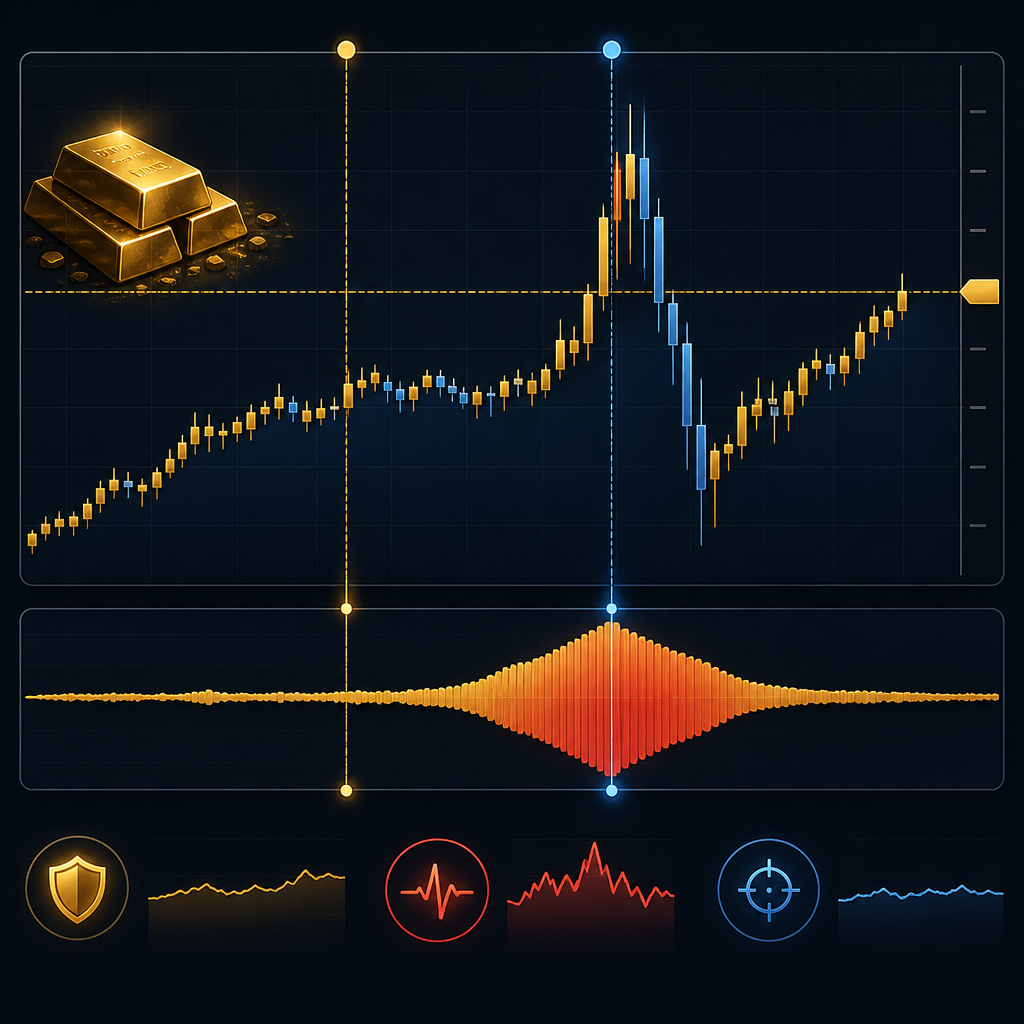
The safest CPI trade is often the one you don’t take. That’s not motivational fluff—it’s professional risk management.
Before every CPI or Core PCE, you need a binary decision: trade or stand down. If you’re unsure, you stand down. The market will still be here tomorrow.
Step-by-step: the pre-news decision checklist
- Account health: Are you down this week? If yes, skip. Don’t “make it back” on CPI.
- Broker conditions: Does your broker widen XAUUSD spreads aggressively? If yes, skip or trade smaller.
- Platform reliability: If your internet is unstable, skip. CPI punishes latency.
- Emotional state: If you’re anxious, revenge-trading, or distracted, skip.
- Time window: Can you monitor the first 10 minutes post-release? If not, skip.
Professionals don’t trade every CPI. They trade the CPI setups that fit their execution conditions.
Market context filter (use what’s on the screen)
Use the broader context to set expectations for volatility:
- DXY 106.80 suggests USD is already firm. That can amplify gold downside on hot CPI.
- USD/JPY 149.50 often signals higher yield pressure and risk of sharp cross-asset moves.
- EUR/USD 1.0520 and GBP/USD 1.2680 being relatively subdued can still explode on CPI, feeding into gold volatility.
If the dollar is already trending strongly into CPI, the post-release move can be more violent because positioning is crowded. That’s when spreads and slippage become the main enemy.
Three “stand down” rules (non-negotiable)
- Rule 1: If your XAUUSD spread is already elevated pre-news (example: $0.80+), don’t trade the release.
- Rule 2: If you can’t define a stop that makes sense ($10–$25) without oversizing, don’t trade.
- Rule 3: If you need to use a market order during the release minute, you’re not trading—you’re gambling.
3) Spreads & Slippage: The Real CPI Tax (And How to Control It)
On normal conditions, many traders see XAUUSD spreads around $0.20–$0.40 (varies by broker and account type). On CPI minute, it can jump to $1.00–$3.00+. That’s not a small difference—it can invalidate your entire setup.
Slippage is the second tax. You might place a buy at $2652.00 and get filled at $2654.20. Now your stop and risk are wrong, and your psychology is already stressed.
What spread widening does to your trade math
Let’s say you plan a clean 1:2 trade:
- Entry: $2650.00
- Stop: $2638.00 (risk $12)
- TP: $2674.00 (reward $24, 1:2)
If spread widens by $2 and you get slipped $2, your effective entry might be $2654.00. Now your stop is $16 away and your TP is only $20 away. Your 1:2 becomes nearly 1:1.25 without you noticing.
Step-by-step: your spread & slippage filters
- Filter A (spread ceiling): define a max spread you will accept. Example: $0.80. Above that, you don’t enter.
- Filter B (slippage ceiling): if your last two fills slipped more than $1.00 each, you reduce size or stop trading.
- Filter C (no market orders on release minute): use limit orders on pullbacks or wait for confirmation candles.
These rules feel “boring,” but boring is profitable. CPI punishes excitement.
Broker reality: why two traders see different CPI outcomes
One trader uses a broker with stable execution and gets a $0.50 spread and $0.40 slippage. Another gets $2.50 spread and $3 slippage. Same chart, same idea, completely different P&L.
That’s why we teach execution discipline alongside our premium Telegram signals. If you want a structured approach to signal execution, pair this article with our risk framework at risk management strategies when using forex signals.
4) The Three CPI Entry Models (Pick One and Master It)
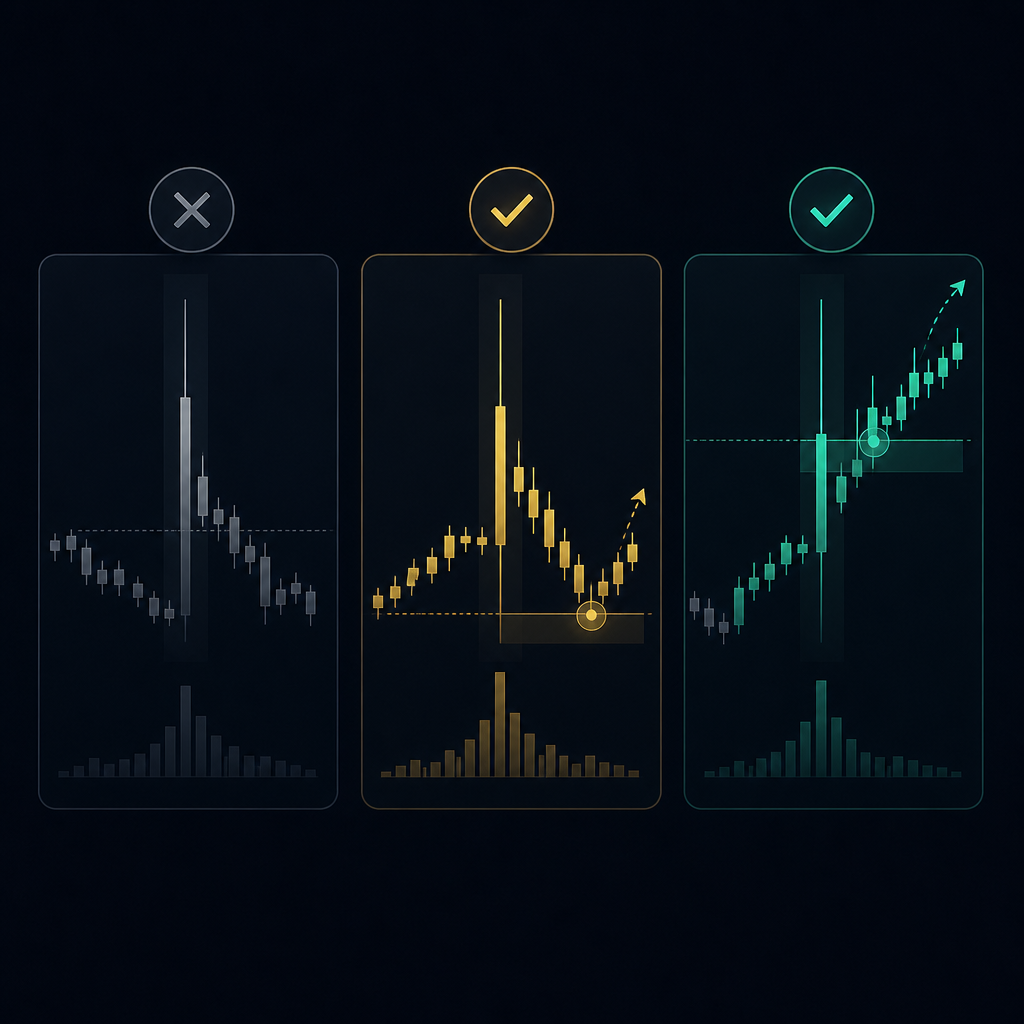
Most traders lose because they mix entry styles mid-spike. They start as breakout traders, then become pullback traders, then panic-close like scalpers.
You need one model per event. Here are three that work for CPI/PCE when executed with discipline.
| Entry Model | When to Use | Pros | Cons | Best For |
|---|---|---|---|---|
| No-Trade Safety Mode | Unstable spreads, uncertain bias, tired or emotional | Zero CPI blow-up risk | You may miss the move | Beginners, recovery weeks |
| Post-Spike Pullback | After first impulse + clear structure forms | Better entries, less slippage | May not retrace enough | Signal followers, disciplined traders |
| Breakout Confirmation | When range breaks and closes beyond key level | Catches trend days | Higher chance of whipsaw | Advanced execution, fast platforms |
Model 1: No-Trade Safety Mode (yes, it’s a strategy)
This is what pros do when conditions are bad. You wait 15–30 minutes after CPI, then trade a cleaner setup in the London/NY overlap or NY continuation.
If you’re following signals, you can still participate later in the session with better spreads. Our community focuses heavily on London and NY session structure—see our gold signals approach for how we frame intraday levels.
Model 2: Post-Spike Pullback (the highest-quality CPI execution)
Rule: you do not trade the first candle. You let the spike happen, then you trade the reaction.
Example scenario (realistic around current price):
- Pre-news: XAUUSD ranges between $2646 and $2654.
- CPI hits: spike to $2666 then snaps back to $2652.
- You wait for a pullback and structure: enter long near $2653 with SL $2641 (risk $12).
- TP1 at 1R: $2665, TP2 at 2R: $2677.
The key is you’re trading after spreads normalize and structure returns.
Model 3: Breakout Confirmation (only with strict rules)
You define a pre-news range. You wait for a candle close beyond it (not a wick). Then you enter on a retest or continuation.
Example:
- Range high: $2654
- Range low: $2646
- After CPI: a 1-minute close above $2656, then you enter on a retest at $2655–$2656
- SL: $2643 (risk $12–$13)
- TP: $2680 (reward $24–$25, ~1:2)
This model can work, but it requires strict spread filters and calm execution.
5) Pre-News Preparation: Levels, Scenarios, and the “Do Not Touch” Window
Preparation is where CPI traders make their money. Not by predicting the number, but by building a map of what you’ll do if price goes up or down.
You want to enter CPI with two scenarios: bullish and bearish. You also want a “no-trade window” where you do nothing, even if the chart looks tempting.
Step-by-step: build your CPI map in 10 minutes
- Step 1: Mark current price and nearby structure. With gold near $2650, note key intraday levels like $2640, $2665, and $2685.
- Step 2: Identify the last 1–2 hour range. Example: $2646–$2654.
- Step 3: Mark liquidity zones (recent highs/lows). CPI loves to sweep them.
- Step 4: Define your entry model (pullback or breakout confirmation).
- Step 5: Pre-define SL distance and position size.
The “Do Not Touch” window
A simple rule that saves accounts: Do not open new positions from 60 seconds before the release until 60–180 seconds after. That’s the worst liquidity pocket.
If you must trade, you trade after the first impulse and you demand spreads normalize.
Scenario planning example (bullish vs bearish)
Bullish gold scenario: CPI comes in softer, DXY drops, gold breaks above $2665. You look for pullbacks to $2656–$2660 with targets toward $2680–$2690.
Bearish gold scenario: CPI comes in hot, DXY spikes, gold flushes below $2640. You look for a retest of $2640–$2644 as resistance, targeting $2620–$2610.
Notice we’re not predicting. We’re preparing. That’s what keeps you consistent.
6) Stop Loss Placement on CPI Days (Why “Tight Stops” Fail)
On CPI/PCE, the market can move $10–$20 in a blink. If you use your usual $4 stop because it “improves risk-reward,” you’re basically donating.
The correct approach is the opposite: use a volatility-appropriate stop and reduce position size. Your risk in dollars stays the same, but your stop distance increases.
Practical stop placement rules for XAUUSD CPI strategy
- Rule 1: Place stops beyond the level that invalidates your idea, not where it “feels safe.”
- Rule 2: Avoid placing SL exactly on round numbers like $2650 or $2640. CPI loves to sweep those.
- Rule 3: Use typical CPI-day SL ranges of $10–$25, depending on your entry model.
Stop examples (realistic around $2650)
Pullback long example:
- Entry: $2653
- Invalidation: below the spike-base and pre-news range low
- SL: $2641 (risk $12)
- TP: $2677 (reward $24, 1:2)
Breakout confirmation long example:
- Entry: $2662 after a close above resistance
- SL: $2647 (risk $15)
- TP: $2692 (reward $30, 1:2)
Position sizing: the part most traders skip
If your normal stop is $8 and you trade 1 lot, moving to a $16 stop means you should cut size roughly in half to keep risk constant.
This is exactly why we emphasize process over hype in our community of 300K+ traders. If you’re building your execution system around signals, also read our forex trading signals provider checklist to make sure your setup is realistic for news conditions.
7) Trade Management: The First 5 Minutes After the CPI Spike
The first five minutes after CPI are where good trades become bad trades—mostly due to emotions.
You’ll see profit quickly. Then you’ll see it disappear. Then you’ll want to move your stop. This is where rules save you.
Step-by-step: a simple CPI trade management protocol
- Step 1 (0–1 min): Do nothing. Let spreads normalize and candles print.
- Step 2 (1–3 min): If you’re in a trade and price hits +1R, consider taking partial profit (25–50%).
- Step 3 (3–5 min): Move stop to break-even only if structure supports it (not just because you’re scared).
- Step 4 (5+ min): Trail behind structure (higher lows/lower highs), not behind every candle.
Example: managing a pullback long
You buy $2653, SL $2641 (risk $12). Price pops to $2665 (+$12, 1R).
- You take 30% off at $2665.
- You keep SL at $2641 until a higher low forms.
- Once price holds above $2656, you can reduce risk by moving SL to $2650 (still gives room).
- Final TP at $2677 (2R).
This avoids the classic mistake: moving SL to break-even instantly, getting tagged, then watching price run to your target without you.
How to handle the “second spike”
Sometimes CPI produces a second impulse 3–10 minutes later. If you’re already in profit, you can let it work. If you’re not in, don’t chase the second spike with a market order.
Chasing is how slippage becomes a strategy—and it’s a losing one.
8) Common CPI/PCE Traps (And the Exact Rules That Prevent Them)
Most losses on CPI are not “bad analysis.” They’re predictable behavioral mistakes.
Let’s make them explicit and install rules that block them.
Trap 1: Trading the release candle
You see a big candle and hit buy/sell. You get the worst spread and worst fill of the day.
Rule: No new trades during the 60 seconds before and at least 60–180 seconds after the release.
Trap 2: Tightening stops to “improve RR”
You place a $5 stop because you want a 1:4 screenshot. CPI wicks you out instantly.
Rule: CPI stops are volatility-based: typically $10–$25. Reduce size instead of tightening SL.
Trap 3: Overtrading the whipsaw
You take 3–5 trades in 10 minutes trying to “catch it.” Spreads and emotions compound.
Rule: Maximum one CPI attempt per direction, two attempts total. If stopped twice, you’re done.
Trap 4: Moving SL emotionally
You widen your stop because “it will come back.” On CPI, it often doesn’t.
Rule: No widening stops. Ever. If SL is hit, reassess after 10–15 minutes.
Trap 5: Confusing “volatility” with “opportunity”
Volatility is not automatically edge. It’s just speed. If your execution isn’t built for speed, volatility is a disadvantage.
Rule: Trade only if spreads and fills are within your predefined limits.
If you want more context on how signals behave during chaotic events, pair this with how gold signals react to unexpected news events.
9) A Signal-Follower’s CPI Execution Plan (So You Don’t “Ruin” a Good Signal)
High-quality signals can still lose if execution is poor. CPI days amplify that.
If you follow premium Telegram signals, your job is not to predict CPI. Your job is to execute the plan cleanly.
Step-by-step: how to execute a CPI signal safely
- Step 1: Confirm the time of CPI/PCE and decide if you’re trading the event or waiting.
- Step 2: If a signal is posted near the release, check your broker spread in real time.
- Step 3: Only enter if spread is under your ceiling (example: $0.80).
- Step 4: Use the provided Entry/SL/TP exactly. Don’t “optimize” mid-news.
- Step 5: If you miss entry by more than $2–$3 due to slippage, skip. Don’t chase.
- Step 6: Manage the trade using 1R partials and structure-based trailing.
Example: what “missing the entry” looks like
Signal entry is $2652. CPI hits and you get filled at $2656.
If the planned SL was $2640, your risk jumped from $12 to $16. That’s a 33% risk increase without permission.
Rule: If slippage increases your planned risk by more than 20%, you pass the trade.
Where United Kings helps on CPI days
We focus on clear levels, session timing, and structured trade management. Our premium Telegram signals include Entry, SL, and TP, and we aim for disciplined execution rather than hype.
If you’re still building your signal execution workflow, start with this beginner guide to forex signals on Telegram and then explore our full signals hub.
10) CPI vs Core PCE: What Changes for XAUUSD News-Trading?
CPI is usually the bigger instant volatility event. Core PCE is the Fed’s preferred inflation gauge, and it can still move gold sharply—sometimes with a more “trend-like” follow-through if it shifts rate expectations.
Your safety plan stays the same: spread filters, no-trade window, defined entry model, and volatility-appropriate stops.
Key differences you’ll notice in practice
- CPI: more violent first minute, more whipsaw risk, bigger spread spikes.
- Core PCE: can be cleaner after the first reaction, especially if it aligns with prior CPI trend.
- Revisions and components: markets sometimes react to underlying details, not just headline.
How to adjust your plan (small but important)
- On CPI: lean toward post-spike pullback entries and stricter spread ceilings.
- On Core PCE: breakout confirmation can work better if the pre-news range is tight and spreads are stable.
- On both: reduce size compared to normal session trades.
Example: PCE trend continuation setup
Gold is at $2650 pre-release. PCE prints softer, gold spikes to $2662, then consolidates between $2658–$2664.
- Entry: $2664 after a clean close and retest
- SL: $2650 (risk $14)
- TP: $2692 (reward $28, 1:2)
This is not about speed. It’s about structure.
11) A Complete Step-by-Step CPI Day Routine (Before, During, After)
If you want consistency, you need a routine that runs even when your emotions don’t.
Here’s a full routine you can copy-paste for every CPI and Core PCE. Keep it simple. Keep it repeatable.
60–30 minutes before the release
- Check your calendar and confirm release time.
- Mark key levels around current price ($2650): recent highs/lows, range boundaries, and major intraday pivots.
- Decide your entry model: pullback, breakout confirmation, or no-trade.
- Set your spread ceiling (example: $0.80).
30–5 minutes before the release
- Watch spread behavior. If it’s already unstable, shift to no-trade mode.
- Reduce open risk. If you’re already in a trade, consider closing or tightening exposure before CPI.
- Prepare orders only if your broker execution is reliable. Otherwise, wait.
Release minute (and why doing nothing is a skill)
- No new positions in the “do not touch” window.
- Observe: impulse direction, wick behavior, and whether price respects pre-marked levels.
2–15 minutes after the release
- Wait for spreads to normalize under your ceiling.
- Let a structure form: higher low for longs, lower high for shorts.
- Enter using your chosen model with a volatility-appropriate stop.
- Take partials at 1R if price moves fast.
15–90 minutes after the release
- Manage the trade like a normal session trade. Don’t keep “CPI emotions.”
- Look for the secondary, cleaner setup if you skipped the first.
- Journal: spread at entry, slippage, and whether rules were followed.
Where this fits inside a bigger trading plan
CPI is one day. Your edge is a year of disciplined execution.
If you want to build a consistent routine around signals beyond CPI, browse our blog and consider following structured session-based ideas via our forex signals and gold signals.
12) Putting It All Together With United Kings: Safer CPI Execution With Premium Signals
News trading doesn’t reward the loudest trader. It rewards the most prepared.
At United Kings, we combine premium Telegram signals with education and execution rules so you’re not left guessing during high-impact releases. We focus on London and NY session trading, and we emphasize clarity: Entry, SL, TP, plus the discipline to follow them.
How to use this playbook with our signals
- Use the spread/slippage filters to decide if you’ll execute a CPI signal or wait.
- Choose one entry model and stick to it.
- Size down on CPI days, keep stops realistic, and aim for 1:2 to 1:3 when structure allows.
- Journal every CPI trade: spreads, slippage, and rule adherence.
Where to start (links)
- Explore all services in our United Kings signals hub.
- If you mainly trade XAUUSD, start with our premium gold signals.
- For major FX pairs (EUR/USD 1.0520, GBP/USD 1.2680, USD/JPY 149.50), see our forex signals.
- Want diversification beyond FX and metals? Check our crypto signals.
- Review our 3 plans on the pricing page (Starter 3 Months $299, Best Value 1 Year $599 with 50% savings + FREE ebook, Lifetime $999 pay once).
- Join our Telegram community directly: United Kings Telegram channel.
FAQ — XAUUSD CPI Strategy & News-Trading Safety
1) Is it better to trade gold during CPI or avoid it?
If you’re new or your broker has unstable spreads, avoiding the release minute is usually smarter. Many profitable traders only trade the post-spike structure, not the initial impulse.
2) What spread is “too high” for XAUUSD CPI trading?
It depends on your broker and stop size, but a practical ceiling many traders use is around $0.80. If your spread is $1.50–$3.00, your risk-reward can collapse quickly.
3) What stop loss size is reasonable for CPI on XAUUSD?
Typical CPI-day stops are often $10–$25 from entry, depending on structure. The key is to reduce position size so your dollar risk stays controlled.
4) Should I use market orders during CPI?
Generally no. Market orders during the release minute are most exposed to slippage and spread widening. Limit orders on pullbacks or confirmation entries are usually safer.
5) How do I avoid chasing after I miss a CPI entry?
Use a rule: if you miss by more than $2–$3 or slippage increases planned risk by more than 20%, skip. There will be another setup after structure forms.
Risk Disclaimer (Read Before Trading)
Risk warning: Forex and gold trading involves significant risk and can result in the loss of your entire capital. News events like CPI and Core PCE can cause extreme volatility, spread widening, and slippage. Past performance does not guarantee future results. Nothing in this article is financial advice. If you’re a beginner, practice on a demo account first and use strict risk limits.
Call to Action: Trade CPI Smarter With United Kings
If you want a disciplined way to trade XAUUSD around CPI and PCE—without guessing—join the United Kings community. You’ll get premium Telegram signals with clear Entry/SL/TP, an education-first approach, and a process built for London and NY sessions.
Choose your plan: Starter 3 Months ($299), Best Value 1 Year ($599) with 50% savings + FREE ebook, or Lifetime ($999) pay once for unlimited access. Review options on our pricing page, then join us on Telegram: https://t.me/unitedkings1.
We also offer a 48-hour money-back guarantee—so you can test the service with confidence while still trading responsibly.