Ever had a perfect XAUUSD signal… and FOMC turned it into instant whiplash?
You’re not alone. On FOMC days, gold (XAUUSD) can look “easy” for five minutes, then rip $25 the other way, then come right back to your entry like nothing happened.
Right now gold is trading around $2650 (+0.35% in the last 24h), while DXY sits near 106.80, EUR/USD ~1.0520, GBP/USD ~1.2680, and USD/JPY ~149.50. That mix matters because FOMC is fundamentally a USD-volatility event first—and gold volatility second.
This guide is your XAUUSD FOMC strategy playbook: what to do 30 minutes before, during the decision spike, and after the press conference, so you can trade gold signals rate decision days with structure—not hope.
TL;DR: The 60-minute XAUUSD FOMC playbook
- Pre-FOMC (T-30 to T-5): Reduce risk, define “no-trade” rules, and prepare conditional orders only if spreads behave.
- Decision minute (T to T+5): Avoid market orders. Let the first spike print, then trade confirmation or stand down.
- Press conference (T+30 to T+60): Watch for the second move. Many clean trends start after Powell’s Q&A.
- Use ATR-based stops: On FOMC, fixed $10 stops often fail. Use a volatility rule (e.g., 1.2–1.8× M5 ATR) with a hard max.
- Spreads & slippage are the hidden enemy: If spreads blow out beyond your threshold, you skip—even if the signal is “right.”
- Best edge = selective execution: The best FOMC trade is often the one you don’t take. Capital protection is a strategy.
Why FOMC is different for XAUUSD (and why signals need a special plan)
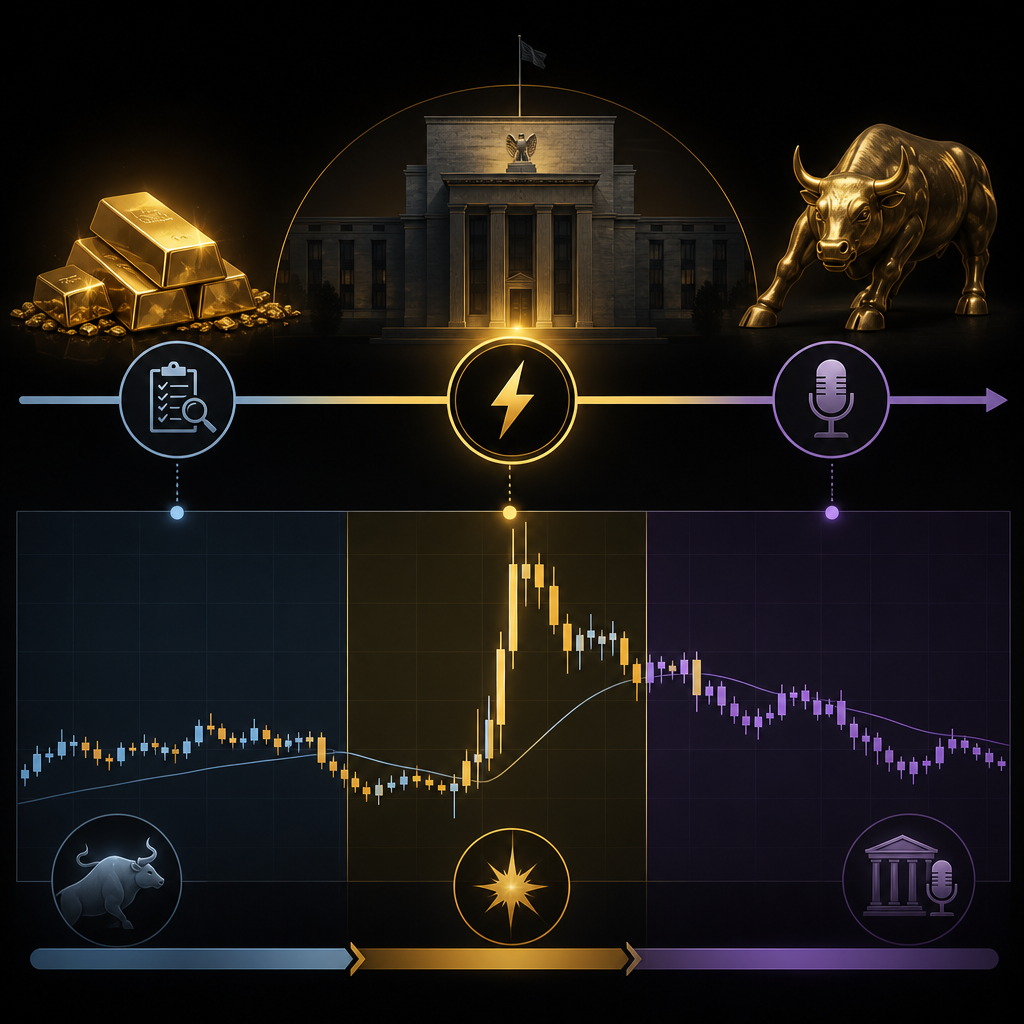
FOMC days are not “normal volatility.” They’re a liquidity re-pricing event. Dealers widen spreads, algorithms hunt stops, and price can travel $15–$35 in minutes—especially when positioning is crowded.
Gold reacts to the Fed through multiple channels. The obvious one is real yields: if the market reprices the path of rates higher, real yields typically rise and gold can drop. But it’s rarely that clean in the first 60 minutes.
Here’s what makes FOMC uniquely dangerous for traders following gold signals rate decision alerts:
- Spread expansion: XAUUSD spreads can widen from “normal” (e.g., $0.20–$0.60) to $1.50–$4.00+ depending on broker and liquidity conditions.
- Slippage: A stop loss at $2638 can fill at $2635 or $2633 in a fast drop, changing your risk from $12 to $15–$17 instantly.
- Two-stage volatility: The first move comes at the statement. The second (often more directional) comes during the press conference and Q&A.
- Headline algo whipsaws: One line about inflation progress can spike gold up; one line about “higher for longer” can reverse it within 30 seconds.
That’s why a generic “buy/sell with SL/TP” approach needs context. At United Kings, we focus heavily on London and New York session execution, and FOMC is a New York volatility monster.
If you’re new to signals, it’s worth bookmarking our broader education hub on the United Kings blog, and reviewing how to evaluate a provider using our forex signal provider checklist. On FOMC, details matter more than opinions.
The “FOMC triangle” that moves gold
In the first hour, gold is driven by three interacting forces:
- USD direction (DXY): With DXY around 106.80, even a 0.3–0.6 move can flip gold sentiment fast.
- Rate path expectations: The statement and dots can shift pricing for the next 2–4 meetings.
- Risk sentiment: Equities can rally or dump, and gold can react as a risk hedge—or as a liquidity source.
Your job isn’t to predict each headline. Your job is to execute a plan that survives the noise and catches the clean move when it appears.
Pre-FOMC (T-30 to T-5): Build the trade map and define “skip rules”
The biggest mistake traders make is waiting for the signal, then improvising execution. On FOMC, improvisation is expensive.
At T-30 minutes, you want a simple map: key levels, volatility expectations, and the exact conditions under which you will not trade.
Step-by-step: your pre-FOMC checklist (10 minutes)
- Mark the “decision range”: Identify the last 60–90 minutes high/low on M5 or M15. Example: gold ranges between $2642 and $2658 into the event.
- Find the liquidity magnets: Round numbers (2650/2660), prior day high/low, and obvious swing points. Example: prior day high at $2666, prior day low at $2620.
- Check DXY and USD/JPY: If DXY is already trending hard pre-event, expect more violent mean reversion. With USD/JPY ~149.50, a sudden yen move can amplify risk sentiment.
- Measure current ATR: Pull M5 ATR(14). If it’s normally $1.8 and now it’s $3.2, you’re already in a “hot” tape.
- Set your spread threshold: Decide a hard rule (e.g., do not enter if spread > $1.20). Write it down.
- Reduce size: Many pros cut risk to 0.25R–0.5R on FOMC. If you normally risk 1%, risk 0.25–0.5%.
This is where most traders protect their month. Not by predicting Powell—by refusing to donate to the spread and slippage machine.
When to skip before the decision (capital protection rules)
Skipping is a skill. Here are clean, objective skip rules you can use:
- Spread is unstable: If it’s jumping from $0.40 to $1.80 every few seconds, execution becomes random.
- Price is already at a major level: If gold is sitting at $2666 (prior day high) 2 minutes before the decision, you’re likely to get wicked both ways.
- You’re emotionally “attached”: If you missed a move earlier and want revenge, FOMC will punish you.
- Your broker’s news execution is poor: If you’ve seen $8–$12 slippage historically, the best play is post-event only.
If you want a deeper framework for sizing and risk limits when following signals, review risk management strategies when using forex signals. FOMC is where those rules become non-negotiable.
Order types on FOMC: market vs limit vs stop (and what we actually use)

On normal days, market execution can be fine. On FOMC, market orders are often a hidden tax: you pay the spread, then you pay slippage, then you pay the whipsaw.
This is why your XAUUSD FOMC strategy should be built around conditional orders and confirmation entries rather than “hit buy/sell now.”
Comparison table: order types for trading gold during FOMC
| Order Type | Best Use on FOMC | Main Risk | Our Practical Rule |
|---|---|---|---|
| Market | Only after volatility cools (post-spike confirmation) | Slippage + spread blowout | Avoid at T to T+2 minutes |
| Buy Stop / Sell Stop | Breakout entries above/below a defined range | Triggered by wick (false breakout) | Use with a confirmation filter or delayed activation |
| Buy Limit / Sell Limit | Fade extremes after a spike (mean reversion setups) | “Catching a falling knife” in trend continuation | Only at pre-defined liquidity levels with strict max loss |
| Stop-Limit | Controlled breakout entry with price cap | Missed fills during fast moves | Best for brokers that support it reliably |
The practical approach: two play modes
We generally think in two modes for gold signals rate decision days:
- Mode A: Breakout-with-confirmation (safer for trend days). You wait for the initial spike, then enter on a retest or a close above/below a level.
- Mode B: Exhaustion fade (advanced). You fade the second push into a liquidity level (like $2685–$2690) with tight rules.
If you’re newer, Mode A is the better default. It prevents you from selling the low of the first dump or buying the top of the first rip.
Conditional orders in the 30 minutes before
Here’s a realistic pre-FOMC setup using current levels:
- Pre-event range: $2642 (low) to $2658 (high)
- Buy stop idea: Buy stop at $2661 (above range), but only activate at T-2 minutes if spread < $1.00
- Sell stop idea: Sell stop at $2639 (below range), same spread rule
Notice we’re not placing orders right on the range edge. We give it room to avoid being triggered by a single wick.
And we’re not committing blindly. We’re making the order conditional on execution quality, not just direction.
Volatility-based stop rules (ATR) for XAUUSD on FOMC days
Fixed stops are simple, but FOMC isn’t. A $10 stop can be perfectly reasonable on a quiet day—and completely meaningless when M5 candles are $6–$10 tall.
That’s where ATR-based stops shine. ATR doesn’t predict direction. It tells you what “normal movement” looks like right now, so you don’t place your stop where everyone else’s stop is sitting.
Step-by-step: ATR stop method for FOMC execution
- Use M5 ATR(14): This captures the immediate volatility regime.
- Set a multiplier: On FOMC, consider 1.2× to 1.8× ATR for your stop distance.
- Apply a hard max stop: Even if ATR explodes, cap your stop (often $25 for many intraday traders).
- Adjust position size: Wider stop means smaller size. Risk stays constant.
Example with realistic numbers (around $2650)
Let’s say gold is at $2650 and M5 ATR(14) is $4.50 pre-event.
- ATR stop at 1.5× = $6.75 (too tight for FOMC spikes)
Now imagine right after the statement, ATR expands to $9.00.
- ATR stop at 1.5× = $13.50 (more realistic)
A practical FOMC rule we like for retail execution is:
- Minimum stop: $12
- Typical stop: $15–$20
- Hard max: $25
So if you buy at $2652 with a $18 stop, your SL is $2634. A 1:2 target is $2688. A 1:3 target is $2706 (often ambitious in the first hour, but possible on big surprise days).
Why ATR stops reduce “random stop-outs”
On FOMC, price often does a stop sweep before the real move. If your stop is placed at a “nice” number like $10 away, you’re likely sitting in the crowd.
ATR-based placement shifts you away from the obvious cluster. It doesn’t guarantee safety, but it improves survival odds.
For a deeper understanding of how signals should be structured with SL/TP logic, you can also explore our signals ecosystem at United Kings gold signals, where we share clear entry, stop, and take-profit levels designed for real execution.
During the decision (T to T+5): how to avoid whipsaws and trade only the “tradeable” move
This is where most accounts get damaged: the first 60–120 seconds after the statement. The chart will print huge candles, and your brain will scream, “I’m missing it.”
Your edge comes from doing the opposite: you let the first move show itself, then you decide if it’s tradeable.
The “first spike rule” (simple, effective)
In our experience, the first spike is often a liquidity probe. Sometimes it trends. Often it’s a head-fake.
So we use a rule:
- No new market entries for the first 60–120 seconds after the statement.
That one rule alone can eliminate the worst fills and the most emotional trades.
Tradeable vs non-tradeable spikes (your filter)
Here’s a practical filter for XAUUSD FOMC strategy execution:
- Tradeable spike: Breaks a key level (like $2658), closes beyond it on M1/M5, and spreads normalize within 2–3 minutes.
- Non-tradeable spike: Wicks $12–$20 both ways, closes back inside the pre-FOMC range, and spreads stay wide.
Example: gold spikes from $2650 to $2668 in 30 seconds, then dumps to $2646, then returns to $2656. That’s classic non-tradeable behavior. You wait.
Example: gold spikes to $2668, pulls back to $2660, holds, then pushes to $2674. That’s more tradeable. You can plan an entry on the hold/retest.
Execution technique: confirmation entry (2 options)
Option 1: Close-and-retest
- Wait for an M1 close above $2660–$2662.
- Enter on a pullback to $2661–$2662 (limit) or on a bullish continuation candle (market).
- Stop based on ATR, often $15–$20.
Option 2: Two-candle rule
- Wait for two consecutive M1 candles closing in the same direction beyond the range.
- Enter with smaller size, add only if spreads normalize.
This is not about being late. It’s about avoiding the “fake first move” that wipes out impatient traders.
Post-statement, pre-press conference (T+5 to T+30): the “structure rebuild” window
After the initial chaos, the market starts to rebuild structure. This is where you can often trade with more logic: levels start to hold, pullbacks become readable, and spreads normalize.
Many traders ignore this window because it’s not as exciting as the spike. But it’s frequently where the best risk-adjusted trades appear.
What you’re looking for: acceptance vs rejection
In this window, you want to know if price is being accepted above/below a key level, or rejected back into the old range.
- Acceptance: price holds above $2660 and uses it as support.
- Rejection: price spikes above $2660 but closes back below $2658 repeatedly.
Example scenario: bullish acceptance after a dovish surprise
Let’s say the statement is interpreted dovish. Gold jumps from $2650 to $2668, then settles around $2662–$2666.
A clean plan could look like this:
- Entry: Buy $2663 after a retest holds
- Stop: $2647 (16 dollars risk)
- TP1 (1:2): $2695 (32 dollars)
- TP2 (runner): trail below higher lows, aiming for $2700+ only if volatility supports it
Notice the target sits near a psychological area (2690–2700). That’s realistic within the guideline range and consistent with FOMC volatility.
What to do with United Kings signals in this window
If you’re following signals, your job is to translate the signal into an execution plan that respects FOMC conditions.
- If a signal triggers during the spike, you may wait for confirmation before entering.
- If spreads are wide, you skip or reduce size.
- If you’re already in profit, you can scale partials and reduce exposure before the press conference.
Our premium alerts in United Kings signals are designed with clear Entry/SL/TP levels. But on FOMC days, execution discretion is part of professional trading.
If you want to see how we think about volatility events beyond FOMC, our article on how gold signals react to unexpected news events is a helpful companion.
During the press conference (T+30 to T+60): the second move is often the real move
Traders underestimate the press conference. The statement sets the stage, but the Q&A often defines the trend.
It’s common to see gold spike one way at the statement, then reverse and trend the other way once Powell clarifies the Fed’s reaction function.
Why the second move can be cleaner
- Positions are partially cleared: the first spike stops people out and reduces crowding.
- Liquidity improves: spreads often tighten compared to T+0.
- Narrative becomes clearer: “data dependent” vs “higher for longer” starts to settle.
This is where you can often trade with a more “normal” process: break, retest, continuation—just with bigger candles.
Step-by-step: press conference continuation setup
- Identify the post-statement high/low: Example: high $2676, low $2644.
- Wait for a break: Price breaks above $2676 with an M5 close.
- Demand a retest: Price pulls back to $2672–$2676 and holds.
- Enter with ATR stop: Example buy $2675, SL $2657 (18 risk).
- Target logical liquidity: TP1 $2711 (1:2). If that’s too far, use partials at $2690–$2695 and trail.
Yes, $2711 is beyond today’s guideline range. That’s why you should be flexible with partial profit-taking. A more conservative structure could be:
- TP1: $2692 (17 dollars)
- TP2: $2705+ only if the trend accelerates
The goal is not to force a perfect 1:3 every time. The goal is to keep your trade management aligned with volatility and liquidity.
When to stop trading after the press conference
A professional rule: if you take one clean trade in the post-conference trend, you don’t need a second revenge trade.
- If you hit TP1 and price becomes choppy, stop.
- If you take a loss, stop and reassess. Don’t “win it back” in the same hour.
FOMC days can offer big opportunity. They also offer big temptation.
Spread, slippage, and broker reality: how to protect your edge on FOMC
Most FOMC losses aren’t because your direction was wrong. They’re because your execution was wrong.
Let’s talk about the three execution killers: spread, slippage, and stop execution quality.
1) Spread thresholds (practical numbers)
On XAUUSD, spreads vary widely by broker and account type. You need your own baseline. But here’s a practical framework:
- Normal conditions: $0.20–$0.80 spread
- FOMC acceptable: up to ~$1.00–$1.20 if volatility is tradeable
- No-trade zone: $1.50+ (for most retail accounts)
If your stop is $15 and the spread is $2.50, you’re donating a large chunk of your risk budget to transaction cost.
2) Slippage planning (assume it will happen)
Instead of pretending slippage doesn’t exist, build it into your plan:
- Reduce risk (0.25R–0.5R).
- Avoid market orders at T+0.
- Use stop-limit if your platform supports it.
Also, consider splitting entries. For example, enter half size on confirmation, then add only if the retest holds and spreads normalize.
3) Stop placement vs stop execution
Even with a perfect ATR stop, execution can differ. That’s why you should:
- Keep a hard daily loss limit (example: 1% or 2%).
- Avoid holding oversized positions into the statement.
- Consider closing partials before the press conference if you’re already up.
If you want a structured approach to session-based execution (which matters because FOMC is a NY event), you’ll like our session timing resources across the blog at UnitedKings.net/blog.
Signal execution framework: how to follow XAUUSD signals on FOMC without overtrading
Signals can be powerful on FOMC days—if you treat them as a decision framework, not a dopamine button.
At United Kings, we share premium Telegram signals for forex and gold with clear Entry, SL, and TP levels, and we publish performance context (historical win rate 85%+; see /results/ and /methodology/ on our site for how it’s calculated). But we also emphasize execution discipline.
The 3-layer filter for FOMC signal execution
Before you take any trade gold during FOMC signal, run it through three filters:
- Filter 1: Timing — Is this signal triggered during the “no market orders” window (T to T+2)? If yes, wait for confirmation or skip.
- Filter 2: Spread — Is spread within your threshold? If not, skip. No exceptions.
- Filter 3: Structure — Is price outside the pre-FOMC range and being accepted? Or is it whipsawing inside?
This framework keeps you from taking every alert. On FOMC, fewer trades is usually more money.
How we manage partials on FOMC (realistic approach)
Because volatility is higher, partial profit-taking becomes more valuable.
Example buy scenario:
- Entry: $2654
- SL: $2638 (16 risk)
- TP1: $2686 (32 reward, 1:2)
On FOMC, you might take 50–70% off at TP1, then trail the rest below M5 higher lows. That way, if the press conference reverses, you still banked a strong R-multiple.
Where to get the signals (and how to align them with your style)
- For gold-only focus, use United Kings gold signals.
- For multi-asset coverage, see all United Kings signals.
- If you also trade majors like EUR/USD (1.0520) or GBP/USD (1.2680), explore our forex signals.
And if you want live delivery via Telegram, join our official channel: United Kings Telegram signals channel.
Advanced setups: breakout, retest, and the “whipsaw trap” (with examples)
Let’s turn the theory into practical setups you can recognize in real time. These are not guaranteed patterns. They’re repeatable behaviors we see on FOMC days.
Setup A: Range breakout with acceptance (best for most traders)
Context: Pre-FOMC range $2642–$2658. Statement spikes above $2658 and holds.
Rules:
- Wait for an M5 close above $2658.
- Wait for a retest that holds above $2658–$2660.
- Enter on continuation with ATR stop.
Example:
- Entry: buy $2662
- SL: $2646 (16 risk)
- TP: $2694 (32 reward, 1:2)
This is clean, simple, and fits the $2610–$2690 example range. It also naturally avoids the first spike madness.
Setup B: The whipsaw trap (and how to not be the liquidity)
What it looks like: Price breaks above the range, triggers breakout buyers, then immediately dumps below the range, triggers sellers, then returns to the middle.
How to avoid it:
- Don’t enter on the first break.
- Demand a close beyond the level and a retest hold.
- Keep your spread rule strict.
Example whipsaw: $2658 breaks to $2667, dumps to $2645, then returns to $2655. If you traded both breaks, you likely lost twice.
Setup C: Exhaustion fade into liquidity (advanced, high-skill)
Context: Gold spikes hard into a known liquidity pocket like $2685–$2690, then prints rejection wicks and fails to make new highs.
Rules:
- Fade only at a pre-defined level (not “somewhere up there”).
- Use smaller size than breakout trades.
- Accept you may be early; define a hard invalidation.
Example:
- Entry: sell $2687
- SL: $2705 (18 risk)
- TP: $2651 (36 reward, 1:2)
This can work beautifully when the first move is overextended. It can also fail hard if the Fed surprise creates a genuine trend day. That’s why it’s “advanced.”
When not to trade: the FOMC “capital preservation protocol”
If you take nothing else from this article, take this: your FOMC strategy must include a no-trade plan.
Professional traders don’t trade every event. They trade the events that offer clean risk-to-reward, with acceptable execution conditions.
No-trade conditions (clear and actionable)
- Spreads exceed your threshold for more than 2–3 minutes.
- Price is trapped in a 3–4 candle M1 whipsaw with long wicks both sides.
- Your broker freezes or requotes during the first spike.
- You already hit daily loss limit (example: -1% or -2%).
- You’re emotionally compromised (missed entry, angry, trying to “make it back”).
The “one good trade” rule
On FOMC days, aim for one high-quality trade. Two at most.
Why? Because the event creates a lot of movement, but not all movement is tradable. Overtrading turns volatility into churn.
Use demo trading if you’re new
If you haven’t traded at least 3–5 FOMC cycles, do your first few with a demo. Learn how your platform behaves, how spreads widen, and how your emotions react.
Signals are a tool. Your execution is the weapon. FOMC is not the day to discover your weapon jams.
Putting it all together: a 60-minute timeline you can follow every FOMC
Let’s consolidate everything into a simple timeline. You can screenshot this and use it as your checklist.
T-30 to T-15: preparation
- Mark pre-event range (last 60–90 minutes).
- Mark prior day high/low and round numbers (2650/2660/2670).
- Check ATR and define stop range ($12–$25).
- Set spread threshold (example: $1.20 max).
T-15 to T-5: positioning and risk control
- Reduce risk to 0.25R–0.5R.
- Decide your “no-trade” conditions.
- Prepare conditional orders only if your broker execution is stable.
T to T+2: the protection window
- No market orders.
- Watch the first spike. Let it print.
- Observe spread behavior; if it’s chaotic, stand down.
T+2 to T+10: confirmation phase
- Look for acceptance outside the range.
- Enter on close-and-retest or two-candle confirmation.
- Use ATR stop with hard max.
T+10 to T+30: structure rebuild
- Trade continuation setups with clearer levels.
- Take partials at 1:2 where possible.
- Avoid adding to losers.
T+30 to T+60: press conference second move
- Watch for reversal or acceleration.
- Trade break-and-retest with tighter spreads.
- Stop after one clean trade or after hitting daily target/loss limit.
FAQ: Trading XAUUSD signals around FOMC
1) Can I trade gold during FOMC with tight stops like $8–$10?
Sometimes, but it’s usually a low-probability approach during FOMC. With gold around $2650, 1-minute noise can easily be $6–$12. Many traders shift to $15–$20 stops (or ATR-based) and reduce position size to keep risk constant.
2) Should I hold a gold trade through the FOMC statement?
Only if it’s part of a planned strategy and your risk is reduced. Many traders close or partially close before the statement because slippage can exceed normal assumptions. If you do hold, accept that your stop may not fill exactly where you place it.
3) What’s the best timeframe for FOMC execution on XAUUSD?
Use M15 to map levels, M5 to manage structure, and M1 for entry timing. Avoid making big decisions purely on M1 because it exaggerates noise during the spike.
4) How do I handle United Kings gold signals on FOMC days?
Follow the signal levels, but apply the three-layer filter: timing (avoid T to T+2 market entries), spread threshold, and structure (acceptance vs whipsaw). If conditions are not tradeable, skipping is a valid professional decision.
5) Is it better to trade the statement or the press conference?
For most traders, the press conference window (T+30 to T+60) can offer cleaner moves with better spreads. The statement can be profitable, but it’s also where execution risk is highest.
Risk disclaimer (read before trading)
Trading forex and gold (XAUUSD) involves significant risk and may not be suitable for all investors. Prices can move rapidly around news events like FOMC, and you may experience slippage, widened spreads, and losses exceeding your expectations. Past performance does not guarantee future results. Signals and educational content are provided for informational purposes and are not financial advice. If you are a beginner, consider practicing on a demo account before risking real capital, and never trade money you cannot afford to lose.
Join United Kings: Get premium XAUUSD signals built for real execution
If you want to trade FOMC days with more structure, you don’t need more hype—you need clear levels, disciplined execution, and risk-first thinking.
United Kings provides premium Telegram signals for forex and gold with clear Entry, SL, and TP levels, plus education to help you execute like a professional. Explore our gold signals or view all signals to match your trading style.
Ready to join? See our three plans on United Kings pricing:
- Starter (3 Months): $299 (~$100/mo)
- Best Value (1 Year): $599 ($50/mo) + FREE ebook (50% savings)
- Unlimited (Lifetime): $499 (pay once, access forever)
For live delivery and community updates, join our official Telegram now: https://t.me/unitedkings1.
Pro tip: If you have questions before subscribing, reach out via our contact page—we’ll point you to the best plan for your goals. A 48-hour refund window is available under our policy terms (see /refund-policy/).
Trade the event with a plan. Protect your capital. Let the market show its hand—then execute.