
Ever watched gold (XAUUSD) spike $8–$15 in one direction right at the London open… only to reverse hard and run the other way?
If you’ve traded around 08:00 London time, you’ve probably felt that frustration. You enter the breakout, get stopped, and then price “magically” moves to where you expected—without you.
That pattern is often a liquidity sweep (a stop-hunt): price briefly takes out a prior session high/low to trigger stops and pending orders, then reverses once liquidity is collected. In this guide we’ll build a complete XAUUSD liquidity sweep strategy with clear entry, stop loss, and take profit rules—specifically for the London open gold stop hunt—and show you how to execute it with real-time signals.
TL;DR (Key Takeaways)
- London open (around 08:00 London) is a prime time for XAUUSD stop-hunts because liquidity jumps and spreads tighten.
- A valid sweep usually has displacement + rejection: a wick through a key high/low and a close back inside the range.
- Entries are best taken on a retest of the swept level or a clear break of structure on M5–M15.
- Stops belong beyond the sweep extreme (typically $10–$25 depending on volatility), not inside the noise.
- Targets should be realistic: 1:2 to 1:3 R:R using Asia range, prior day levels, and London session range expansion.
- Signals work best when you filter for news risk, session timing, and clean liquidity levels—then execute with discipline.
1) Why London Open Creates XAUUSD Liquidity Sweeps (and Why You Care)
Gold is a global market, but liquidity is not evenly distributed across the day. The London session is where a lot of institutional flow shows up, and it often sets the tone for the next several hours.
Right now, we’re trading around XAUUSD $2650 (+0.35% on the day). At the same time, the DXY is ~106.80, EUR/USD ~1.0520, GBP/USD ~1.2680, and USD/JPY ~149.50. That mix matters because gold is sensitive to USD strength, real yields, and risk sentiment.
When London opens, several things happen at once:
- Liquidity increases: more participants, deeper order books, more stop orders to harvest.
- Volatility expands: gold can print $10–$25 moves quickly, especially if Asia was tight.
- Price seeks liquidity: the market often runs toward obvious highs/lows where stops sit.
Retail traders tend to anchor to simple lines: “Asia high,” “Asia low,” “yesterday’s high,” “yesterday’s low,” and “round numbers” like $2650 or $2660. Institutions know this. If price is sitting just below Asia high at 07:55 London, the path of least resistance can be a quick push above that high to trigger buy stops and breakout entries—then a reversal once enough liquidity is filled.
Think of liquidity as fuel. A big move needs counterparties. If smart money wants to sell, they need buyers. Where do buyers cluster? Above highs (breakouts) and below lows (breakdowns). That’s why the “breakout that fails” is so common at London open.
This is also why a liquidity sweep strategy is not “predicting.” It’s reacting to a very specific event: price taking a known level and then showing evidence that the move was a grab—not a genuine trend continuation.
When you understand this, your mindset changes. Instead of chasing the first spike, you wait for the market to show its hand. That patience is what separates traders who get stopped from traders who get paid.
2) The Liquidity Sweep Concept on Gold: What Counts (and What Doesn’t)
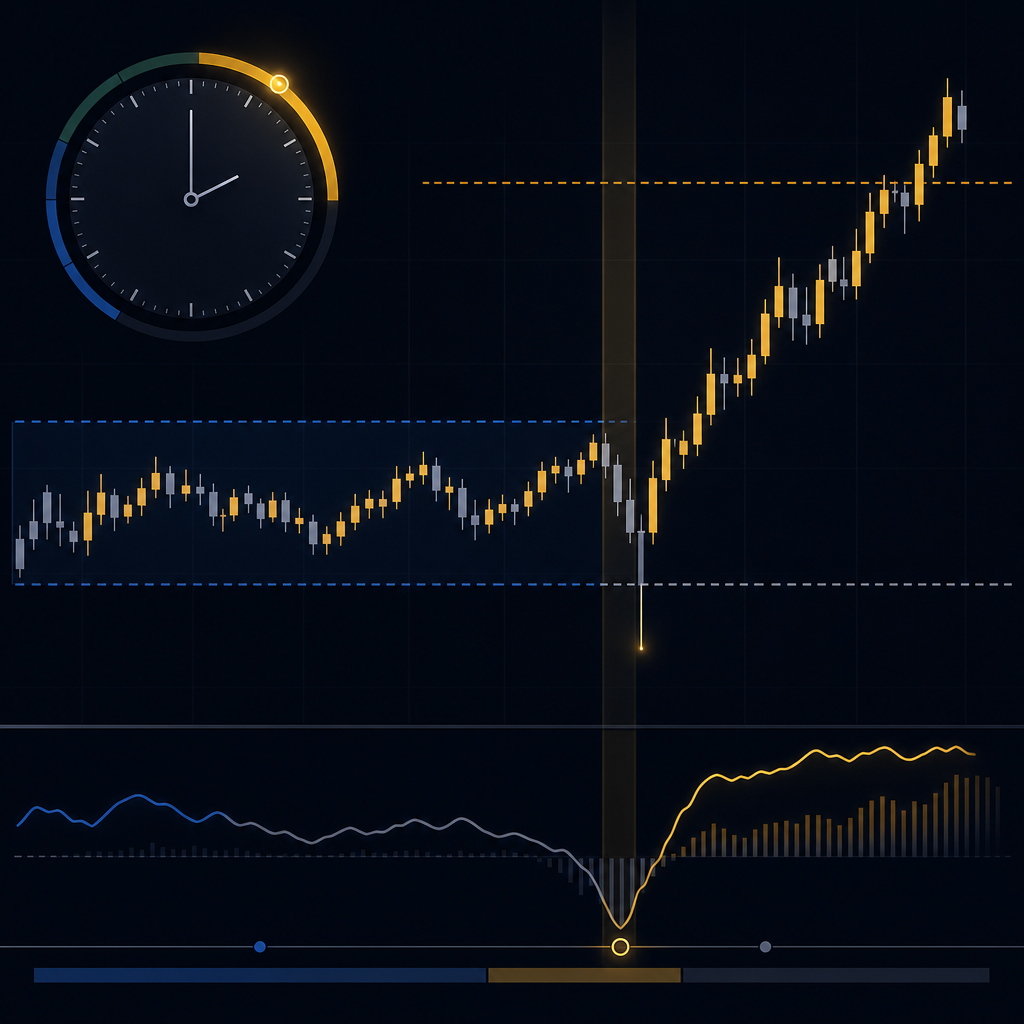
Not every wick is a liquidity sweep. Gold can be noisy, especially around session opens, and you need a definition tight enough to be tradable.
In this playbook, a liquidity sweep is a three-part event:
- 1) A known liquidity pool exists: prior session high/low, prior day high/low, or a clear swing point.
- 2) Price trades through it: a wick or body breaks the level by a meaningful amount (not just 10 cents).
- 3) Price rejects and returns: closes back inside the range or prints a structure shift (e.g., lower high after sweeping a high).
On XAUUSD around $2650, a “meaningful” sweep might be $1.50–$4.00 beyond the level on M5–M15, depending on the day’s ATR. If Asia range is only $6 wide, even a $2 sweep can be significant. If Asia range is $18 wide, you may need more confirmation.
Common liquidity pools for the London open
- Asia session high/low (often the cleanest for London plays).
- Previous day high/low (bigger targets and stronger magnets).
- Previous New York high/low (frequently swept before London establishes direction).
- Equal highs/equal lows (two or more similar swing points—obvious stop clusters).
- Round numbers (e.g., $2650, $2660, $2675) when aligned with structure.
What does NOT count (avoid these traps)
- Random wicks in the middle of nowhere with no clear prior high/low being taken.
- One-tick breaks that barely touch the level and immediately chop (often spread/quote noise).
- Sweeps during major red news (CPI, NFP, FOMC) where the move is driven by information, not liquidity engineering.
A practical way to filter: ask, “If I were a breakout trader, would I place my stop there?” If the answer is yes, it’s likely a real liquidity pool. If the answer is no, you’re probably forcing a narrative.
One more nuance: gold can sweep both sides. You’ll sometimes see London take Asia low, reverse to Asia high, then trend. That’s why we don’t marry bias. We follow the sweep + confirmation rules.
3) Market Context Checklist: When the London Open Stop-Hunt Works Best
Liquidity sweeps are a setup, but not every day is equal. The best traders treat context like a gatekeeper: if context is wrong, you either size down or skip.
Use this checklist before you even look for entries:
A) Volatility and range conditions
The London open sweep works best when Asia is relatively contained. If Asia range is tight (say $6–$12 on XAUUSD), London often expands it. If Asia already moved $20+, London may trend without giving a clean sweep/reversal.
With gold around $2650, imagine Asia printed a range from $2642 to $2650. London is likely to probe above $2650 or below $2642 first.
B) Dollar and majors alignment (quick read)
Gold’s intraday moves often correlate inversely with the USD. With DXY ~106.80, if DXY is pushing higher into London, gold rallies are more likely to be sold (sweep highs → short). If DXY is dropping, gold dips are more likely to be bought (sweep lows → long).
Also watch EUR/USD at 1.0520 and USD/JPY at 149.50. A risk-off burst (JPY strength) can lift gold. A USD bid across the board can pressure gold.
C) News filter (non-negotiable)
Major scheduled releases can invalidate the “engineered sweep” logic. You can still trade them, but it becomes a different strategy.
- Avoid initiating a sweep trade within 15–30 minutes of high-impact USD news.
- If the day includes Fed speakers, CPI, NFP, or FOMC, expect wider stops and more fakeouts.
If you want a dedicated framework for news volatility, pair this playbook with our guide on how gold signals react to unexpected news events.
D) Session timing (where most traders mess up)
The highest-probability window is typically:
- 07:45–09:15 London time for the sweep and confirmation.
- 09:00–11:00 London time for continuation toward targets.
If you’re taking “London open” trades at 10:30 London, you’re often late. The sweep has already happened, and you’re buying the middle.
This is exactly why we focus our execution and alerts around London and NY sessions inside our premium gold signals. Timing is edge.
4) The XAUUSD Liquidity Sweep Playbook (Exact Rules and Definitions)
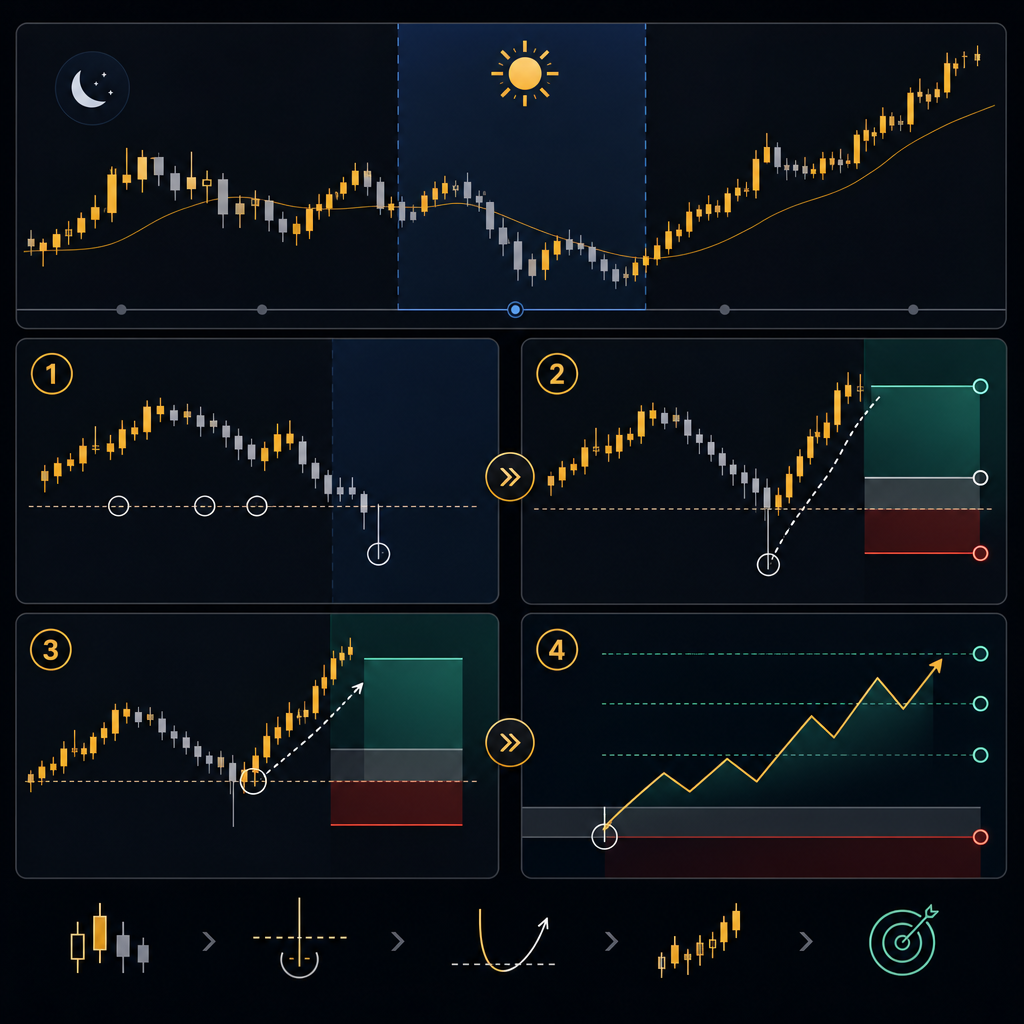
Let’s turn the concept into rules you can execute. The goal is to remove ambiguity so that when a signal arrives—or when you spot the setup yourself—you know exactly what to do.
Step 1: Mark the liquidity levels (5 minutes)
- Draw Asia high and Asia low (from the session that led into London).
- Mark previous day high/low.
- Mark any equal highs/equal lows near current price.
Example with current context: price is trading around $2650. Asia high is $2652 and Asia low is $2641. Yesterday’s high is $2668 and yesterday’s low is $2622.
Step 2: Wait for the sweep (the “stop-hunt”)
A sweep is valid when:
- Price trades through Asia high/low (or another key level).
- The sweep prints a clear wick or impulse, often $2–$6 beyond the level.
Example: At 08:05 London, XAUUSD spikes from $2650 to $2657, taking Asia high $2652.
Step 3: Demand confirmation (no confirmation = no trade)
Use one of these confirmation models on M5 or M15:
- Rejection close: a candle closes back below the swept high (for shorts) or above the swept low (for longs).
- Break of structure (BOS): after sweeping highs, price forms a lower high and breaks the last higher low on M5.
- Displacement candle: a strong opposite-direction candle that engulfs or closes decisively back inside the prior range.
Continuing the example: after spiking to $2657, a 5-minute candle closes at $2650.80 (back below Asia high). That’s your first “yes.”
Step 4: Choose your entry trigger (2 options)
Entry A (Aggressive): enter on the confirmation close (market entry) if the candle is clean and spreads are normal.
Entry B (Conservative): wait for a retest of the swept level (limit/stop entry) and enter after it holds as resistance/support.
Example short: enter at $2651.50 on a retest of the Asia high zone after the sweep.
Step 5: Place the stop loss beyond the sweep extreme
This is where most traders sabotage the setup. If you put your stop inside the wick zone, you’re placing it exactly where the market just proved it can trade.
- For a short after sweeping highs: stop goes above the sweep high.
- For a long after sweeping lows: stop goes below the sweep low.
Example: sweep high is $2657. Place SL at $2669 (a $17.5 stop from $2651.5) if volatility is elevated, or $2664 (a $12.5 stop) if the day is calmer and structure supports it.
Step 6: Set take profits using session range logic
Targets should come from where liquidity is likely next:
- TP1: midpoint of Asia range or first internal swing (often 1R).
- TP2: opposite side of Asia range (common 2R).
- TP3: prior day level or London range extension (3R if conditions allow).
Example: short from $2651.50 with SL $2664.00 (risk $12.50). A 1:2 target is $2626.50 (25 points), but that might be too far for a typical London morning. More realistic within our guideline range: aim for $2630–$2635 if structure supports it, and trail for more if momentum is strong.
The key is consistency: define your R:R before entry, not after the trade goes against you.
5) Candle Structure Confirmation: The 3 Patterns That Validate the Reversal
Gold can sweep a level and keep going. Your confirmation is what keeps you from fading a real breakout. Here are the three cleanest confirmation patterns I’ve used for years on XAUUSD around session opens.
Pattern 1: Sweep + Rejection Close (the “classic”)
This is the simplest and often the most reliable on M15. Price takes a high/low, then the candle closes back inside the prior range with a clear wick.
- Short setup: wick above Asia high, close back below Asia high.
- Long setup: wick below Asia low, close back above Asia low.
Example: Asia high is $2652. London prints a 15-minute candle that spikes to $2659 but closes at $2651. That’s a statement: buyers tried, but sellers absorbed.
Execution tip: if the rejection candle is huge (say $15+), don’t chase the close. Wait for a retrace to improve R:R.
Pattern 2: Sweep + Displacement (the “impulse flip”)
Displacement is a strong opposite-direction candle that shows urgency. It’s common when stops trigger a final push and then institutions flip the order flow.
- Look for a candle that closes decisively back into the range and breaks a minor swing.
- Ideally, the displacement candle body is larger than the prior 3–5 candles.
Example: price sweeps Asia low at $2641 down to $2636. Then a 5-minute candle rips up and closes at $2646. That’s not “random.” That’s demand showing up.
Pattern 3: Sweep + Break of Structure (BOS) on M5
This is the most “mechanical” confirmation, and it’s excellent for traders who want objective rules.
After a sweep of highs:
- Identify the last higher low on M5 during the push up.
- Wait for price to break below it and close.
- Enter on a retest of that broken level (now resistance).
Example: gold runs to $2657 and forms a higher low at $2650. When price breaks and closes below $2650, you have a structure shift. A retest to $2650–$2652 becomes a high-quality short entry zone.
Why this matters: you’re no longer guessing a top. You’re trading a confirmed change in market structure.
When we publish entries in our United Kings signals, we prefer this kind of clarity: Entry, SL, TP anchored to a structure event, not vibes.
6) Entry, Stop Loss, Take Profit Rules (with Realistic $2610–$2690 Examples)
This section is the “do this, then this” part. You can screenshot it and keep it next to your charts.
Rule set for a SHORT (sweep highs at London open)
Scenario: XAUUSD is hovering at $2650 pre-London. Asia high is $2652. London spikes above.
- Sweep: price trades to $2658, clearly above $2652.
- Confirmation: M5 closes back below $2652 OR breaks the last higher low.
- Entry trigger:
- Conservative: sell retest at $2651.80–$2653.00.
- Aggressive: sell market on the confirmation close near $2651.
- Stop loss: place SL $10–$25 beyond the sweep high.
- If sweep high is $2658, a practical SL is $2669–$2683 depending on volatility.
- Take profit:
- TP1 (1R): if risk is $12, TP1 is $12 in profit (e.g., entry $2652 → TP1 $2640).
- TP2 (2R): opposite side of Asia range (e.g., Asia low $2641).
- TP3 (3R): extend to a bigger magnet like $2625–$2630 if momentum and DXY support it.
Concrete example: Sell $2652.00, SL $2666.00 (risk $14). TP1 $2638.00 (1R). TP2 $2624.00 (2R). TP3 $2610.00 (3R) only if the day is trending and structure breaks cleanly.
Notice how all prices stay within the realistic band and use a stop distance that matches gold’s behavior around London.
Rule set for a LONG (sweep lows at London open)
Scenario: Asia low is $2642. London dips below it first.
- Sweep: price trades to $2637, taking stops under $2642.
- Confirmation: M5 closes back above $2642 OR breaks the last lower high.
- Entry: buy retest at $2641.50–$2643.00.
- Stop loss: below the sweep low by $10–$25.
- If sweep low is $2637, SL could be $2625–$2620 depending on volatility.
- Take profit:
- TP1 at 1R (e.g., entry $2642, SL $2629 risk $13 → TP1 $2655).
- TP2 at Asia high or an intraday swing (often $2658–$2665).
- TP3 into prior day high if aligned (e.g., $2668).
Concrete example: Buy $2642.00, SL $2628.00 (risk $14). TP1 $2656.00 (1R). TP2 $2670.00 (2R). TP3 $2684.00 (3R) if London–NY momentum continues.
One rule that improves results immediately: “No trade without space”
If your first logical target is only $6 away but your stop needs to be $14 away, skip. Liquidity sweep trades need room to run, otherwise you’re forcing a low R:R trade in a high-noise window.
7) Comparison Table: Liquidity Sweep vs Breakout vs Mean Reversion (Gold at London)
Many traders lose money at the London open because they’re using the wrong playbook for the conditions. Here’s a clear comparison so you know what you’re actually trading.
| Approach | What You’re Betting On | Best Market Condition | Typical Entry | Stop Placement | Common Mistake |
|---|---|---|---|---|---|
| Liquidity Sweep Reversal | Stops get hunted, then price reverses | Tight Asia range, clear highs/lows, no major news | After rejection close or BOS + retest | Beyond sweep extreme ($10–$25) | Entering before confirmation |
| Breakout Continuation | Price breaks a level and trends | Strong trend day, high momentum, supportive fundamentals | Break + retest with volume/impulse | Below/above breakout structure | Buying the first spike at London open |
| Mean Reversion (Range Fade) | Price returns to VWAP/midpoint | Choppy days, low directional conviction | At range extremes with divergence | Outside range by small buffer | Fading a real trend day |
The liquidity sweep playbook is powerful because it’s designed for the exact behavior we see at session opens: a quick raid of obvious levels, followed by a move to the “real” destination.
But remember: if the day is a genuine trend day (for example, a major USD catalyst pushing DXY hard), the sweep might happen and then continue. That’s why confirmation is king.
8) Signal Execution in Real Time: How to Filter and Trade London Sweep Alerts
Signals can be a cheat code—or a trap—depending on how you execute them. The London open is fast. If you’re slow, you’ll get slipped into poor entries and blame the signal instead of the process.
Inside United Kings, we focus on clear Entry, SL, TP levels and a high-quality execution routine. Here’s how you should approach a London sweep signal in real time.
Step-by-step execution checklist (fast but disciplined)
- Confirm timing: Is it within the London sweep window (roughly 07:45–09:15 London)? If it’s later, treat it as a different setup.
- Check the level: Does the entry align with Asia high/low or a prior day level? If the signal is “mid-range,” be cautious.
- Scan news: Any high-impact USD event in the next 30 minutes? If yes, reduce risk or skip.
- Validate spread: If your broker spread widens at open, don’t market-enter into a spike. Use the conservative retest model.
- Place orders correctly: Entry, SL, TP all set before you press confirm. No “I’ll add the stop later.”
- Manage partials: Consider taking partial profit at 1R and moving SL to breakeven only after structure supports it.
How to read a sweep signal message (what matters most)
- Entry zone: ideally a tight band (e.g., $2651.8–$2653.0), not a $12-wide range.
- SL logic: should be beyond the sweep extreme, not inside the wick.
- TPs: should map to liquidity targets (Asia low/high, prior day levels) and respect 1:2 or 1:3 where feasible.
If you’re new to executing alerts, you’ll also benefit from our execution-focused education on the blog. Start with how to follow Telegram signals as a beginner and then review risk management strategies when using trading signals. The mechanics are universal, even if this playbook is gold-specific.
Where traders lose money with good signals
- Late entries: entering $6–$10 away from the planned entry because you hesitated.
- Moving stops: widening SL because “London is volatile.” Volatility is why SL was placed properly in the first place.
- Overtrading: taking 3–5 London trades in the first hour. One clean setup is enough.
Signals are a tool. Execution is the edge. If you want a structured place to start, explore our full signals service and the dedicated XAUUSD gold signals page to see how we frame trades.
9) Risk Management for London Open Gold Stop-Hunts (Position Sizing + Trade Management)
Liquidity sweep trades can be extremely rewarding, but they can also be emotionally intense. Your risk plan is what keeps a single bad sweep from ruining your week.
A) Decide your risk per trade (keep it boring)
For most traders, a sensible range is 0.5% to 1% per trade. If you’re trading the London open for the first time, start at 0.25% until you prove consistency.
Gold can move $10 in a minute during the open. If you risk 3% and take two losses, you’ll start revenge trading. That’s how accounts die.
B) Size your position based on stop distance (not feelings)
Your stop on XAUUSD will often be $10–$25 away. That means your lot size must adjust day by day.
- Smaller stop = larger size (within reason).
- Larger stop = smaller size (always).
If you want a deeper breakdown of sizing logic, combine this playbook with the risk framework in our risk management guide.
C) Trade management: partials and breakeven rules
Here’s a practical management model for London sweeps:
- At 1R: take 30–50% off. This pays you for being right.
- Move SL to BE: only after price breaks a structure level in your favor (not immediately at +$2).
- Trail the rest: behind new M5 swing highs/lows or toward the opposite side of Asia range.
Example: You short from $2652 with SL $2666 (risk $14). When price hits $2638 (1R), you bank partials. If price then breaks below $2635 and retests, you can safely protect the remainder.
D) Daily loss limit (your circuit breaker)
Set a daily max loss, like 2R or 2%. If you hit it, stop trading. London open is a narrow window—missing one day is cheaper than forcing trades.
This is especially important if you’re following signals. The best signal in the world can’t save you from breaking your own risk rules.
10) Common Mistakes (and the Fixes) When Trading XAUUSD Sweeps at London Open
Most traders don’t fail because the strategy is bad. They fail because they execute a good strategy poorly. Here are the mistakes I see repeatedly with London open gold stop-hunts—and how to correct them.
Mistake 1: Trading the sweep itself instead of the reversal
Many traders see price break Asia high and instantly buy. That’s literally buying into the liquidity grab.
Fix: Your first action is not “enter.” Your first action is “wait for confirmation.” If confirmation never comes, you don’t trade.
Mistake 2: Stops too tight (death by noise)
Gold can wick $3–$6 even after confirmation. If your stop is $6 away when it needs to be $14, you’ll get tagged and then watch price run.
Fix: Put SL beyond the sweep extreme with a buffer. Use $10–$25 as a realistic framework depending on the day.
Mistake 3: Targets too ambitious for the session
A 3R target is great, but not every day will deliver it before NY. If you refuse to take profit at logical targets, you’ll turn winners into breakeven trades.
Fix: Use TP1/TP2/TP3. Pay yourself at 1R and let the market fund the rest.
Mistake 4: Ignoring DXY and macro tone
With DXY around 106.80, if the dollar is trending strongly into London, fading gold rallies can be higher probability. If USD is dumping, buying dips may be cleaner.
Fix: Take 60 seconds to check DXY direction and whether EUR/USD and USD/JPY confirm the tone.
Mistake 5: Overtrading the London open
London open can print multiple “almost” setups. Traders take them all and end up in drawdown even if one was a winner.
Fix: Limit yourself to one A+ setup in the London sweep window. Two max if both are extremely clean and independent.
If you want more structured execution habits, browse our United Kings blog and consider how you’ll integrate signals and education into one routine.
11) A Practical London Open Routine (15 Minutes) for Liquidity Sweep Traders
Consistency comes from routines, not motivation. Here’s a simple pre-London process you can repeat daily.
15 minutes before London open
- Open charts: XAUUSD M15 and M5.
- Mark levels: Asia high/low, prior day high/low, any equal highs/lows near price.
- Check context: DXY direction, gold location (near highs/lows), and whether Asia was tight.
- Check calendar: any high-impact USD news soon.
At the open (first 15–30 minutes)
- Do nothing for 3–5 minutes if spreads are unstable.
- Wait for price to sweep a marked level.
- Demand confirmation (rejection close, displacement, or BOS).
- Execute using your chosen entry model (retest preferred).
After entry (next 30–90 minutes)
- Manage to TP1 at 1R if reached.
- Protect the trade only after structure breaks in your favor.
- Don’t micromanage every tick. Let the setup breathe.
This routine pairs perfectly with signal execution. When an alert comes in via Telegram, you’re not scrambling—you already have levels marked and context understood.
If you want to receive sweep-style trade ideas and clean intraday setups around London and NY, join our community on Telegram: United Kings signals channel on Telegram.
12) How United Kings Signals Fit This Playbook (What to Expect, How to Use Them)
A good signal provider doesn’t just throw entries at you. We aim to give you a repeatable framework: clear pricing, clear levels, and education that makes you better over time.
Here’s how our approach aligns with the XAUUSD liquidity sweep strategy:
- Premium Telegram signals focused on forex and gold, optimized for London and NY sessions.
- 85%+ win rate target through selective setups and disciplined risk parameters (remember: past performance doesn’t guarantee future results).
- Entry, SL, TP clarity so you can execute quickly during fast windows like London open.
- Education alongside signals so you understand why a trade exists, not just where to click.
- 300K+ active traders in the wider community—useful for staying engaged and consistent.
To explore all markets we cover, visit our forex signals and gold signals pages. If you also trade digital assets, we have crypto signals as well.
Pricing (3 plans) and who they’re for
- Starter (3 Months): $299 (~$100/mo) if you want to test execution and build routine.
- Best Value (1 Year): $599 (~$50/mo) with 50% savings + FREE ebook for serious traders.
- Unlimited (Lifetime): $999 pay once for long-term access.
You can review the options on our pricing page. We also offer a 48-hour money-back guarantee so you can evaluate fit without feeling trapped.
If you’re the type who wants to understand the team behind the work, visit about United Kings. And if you have questions about setup compatibility with your broker or timezone, reach out via our contact page.
FAQ: XAUUSD Liquidity Sweep Strategy at London Open
1) What timeframe is best for trading London open stop-hunts on XAUUSD?
Use M15 to mark structure and see clean rejection candles, then use M5 for confirmation (BOS) and entry precision. M1 can be too noisy at the open unless you’re very experienced.
2) How far should my stop loss be on gold for sweep trades?
A common range is $10–$25 beyond the sweep extreme, depending on volatility and how wide the Asia range is. If your stop is consistently under $8 at London open, you’ll likely get wicked out.
3) Can I trade the liquidity sweep strategy without signals?
Yes. Signals simply speed up decision-making and help with consistency. The core edge comes from your ability to identify clean liquidity levels and wait for confirmation before entering.
4) What’s the best take profit method for London sweep reversals?
Use a staged approach: TP1 at 1R, TP2 near the opposite side of Asia range, and TP3 at prior day levels if momentum supports it. This balances consistency with upside.
5) Does this strategy work during CPI, NFP, or FOMC?
It can, but the behavior changes. Those moves are often information-driven, spreads can widen, and sweeps can extend much further. Beginners should avoid trading sweep reversals during major news and practice on demo first.
Risk Disclaimer (Read This Before You Trade)
Forex and gold trading involves significant risk and may not be suitable for all investors. You can lose more than your initial deposit. Signals and educational content are provided for informational purposes only and do not constitute investment advice. Past performance is not indicative of future results. If you’re new, start on a demo account and use strict risk management before trading live.
Join United Kings: Trade London Open Sweeps with Clear Entry, SL, TP
If you want to trade the London open without guessing, you need two things: a proven playbook and consistent execution. That’s exactly what we build at United Kings.
Get access to premium XAUUSD and forex signals with clear Entry, Stop Loss, and Take Profit levels, plus education that helps you understand the “why” behind the trade. Choose from three plans—3 Months ($299), 1 Year ($599), or Lifetime ($999)—on our pricing page.
Ready to see real-time London and NY session setups? Join our Telegram now: United Kings Telegram signals channel. Or explore the full service on UnitedKings.net.