Ever feel like gold waits for you to enter… then instantly spikes your stop and runs the real move without you?
If you trade XAUUSD, you’ve seen it: a clean breakout above a prior high, a fast rejection, and then a 20–40 point move in the opposite direction. That’s not “bad luck.” It’s often a liquidity sweep (stop hunt) followed by displacement and a Fair Value Gap (FVG) that offers the higher-probability entry.
In today’s market context, gold is trading around $2650 (+0.35% in 24h), with the Dollar Index near 106.80, USD/JPY around 149.50, EUR/USD 1.0520, and GBP/USD 1.2680. That mix typically supports fast intraday rotations in XAUUSD, especially during the London and New York “kill zones.”
TL;DR (Save This Before You Trade)
- Liquidity sweep first, FVG second: we want a stop run (above a high / below a low) and then a clear displacement candle that creates an FVG.
- Trade the kill zones: focus execution in London and New York windows when liquidity is highest and setups complete faster.
- Mark obvious highs/lows (Asian range, prior day high/low, session highs/lows). The more obvious the level, the better the sweep.
- Entry model: wait for retrace into the FVG (preferably 50%–100% fill), then execute with a tight invalidation beyond the sweep.
- Simple filter: skip trades when spread is elevated or when the last 5-minute candles are abnormally large (volatility spike) unless it’s news-planned.
- Risk plan: use $10–$25 stops on gold (depending on structure), target 1:2 to 1:3, and reduce size if volatility expands.
Why This XAUUSD Liquidity Sweep Strategy Works (And Why Most Traders Miss It)
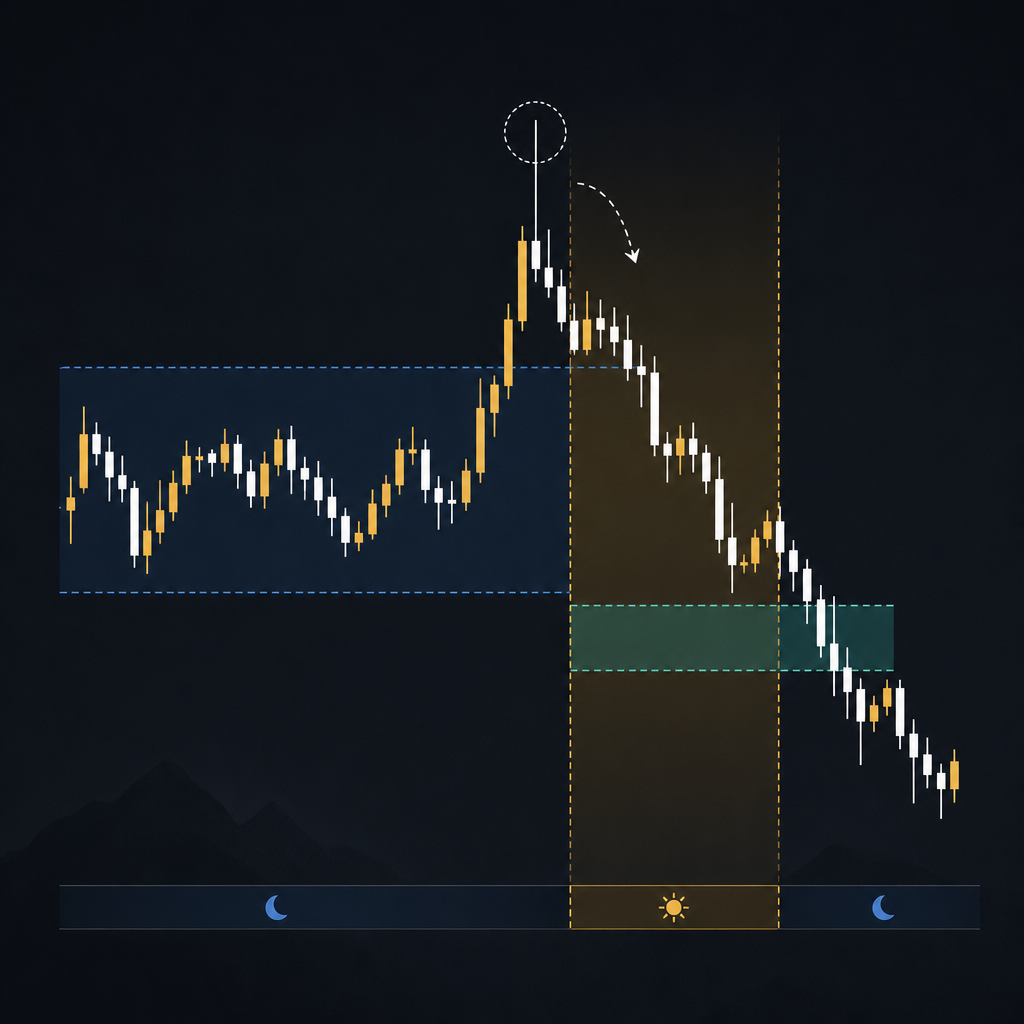
The hard truth: most retail traders are taught to buy breakouts and sell breakdowns. That’s not always wrong, but in XAUUSD it’s often the worst timing, especially around session opens.
Gold is a liquidity-hungry instrument. It’s heavily traded by institutions, hedgers, and fast money. When price approaches a well-known high—say the Asian session high—there are usually clusters of buy stops above it and sell limits around it.
A “liquidity sweep” is simply price reaching into that pool of orders. The market doesn’t do it to “hunt you” personally. It does it because that liquidity is useful: it allows larger players to enter/exit with less slippage.
Here’s the key difference between a random wick and a meaningful sweep:
- Location: it happens at an obvious level (Asian high/low, prior day high/low, equal highs/lows, round numbers like $2650, $2660, $2675).
- Timing: it often triggers during London open or NY open, when liquidity and volume surge.
- Follow-through: after the sweep, you see displacement—a strong impulsive move away that breaks structure and leaves imbalance.
This is where fair value gap gold trading becomes practical. An FVG is a three-candle imbalance that forms when price moves too quickly, leaving inefficient trading behind. Markets often come back to “rebalance” that inefficiency.
So instead of chasing the breakout, we let the sweep happen, confirm displacement, and then use the FVG as the entry mechanism with defined risk.
That’s the core of a repeatable London NY kill zone XAUUSD execution plan: liquidity → displacement → FVG retrace → continuation.
If you want the shortest path to applying this with real-time trade ideas, United Kings publishes structured XAUUSD setups with Entry/SL/TP on our Gold Signals page and inside our Telegram community.
Liquidity Sweeps in Gold: What to Mark Before London and NY
If you skip the marking process, you’ll “see” sweeps everywhere. That’s how traders overtrade. The goal is to mark only the levels that are most likely to contain resting stops and pending orders.
Start with a clean chart. Use a 15-minute and 5-minute for execution, and a 1-hour for context. In the current environment (XAUUSD near $2650), intraday swings of $15–$35 are common during active sessions.
Step 1: Mark the Asian Range (Your Primary Liquidity Map)
Define the Asian range roughly from 00:00–06:00 London time (adjust to your broker time). Mark the Asian high and Asian low with horizontal lines.
Why it matters: the Asian range is often “contained,” then London comes in and raids one side before choosing direction. Those raids are your liquidity sweeps.
Step 2: Mark Prior Day High/Low and the Daily Open
Gold respects prior day extremes because they’re widely watched. If yesterday’s high was $2668 and today we’re at $2650, you already have a potential magnet above.
Add the daily open as a reference. Many intraday moves rotate around it, especially on mean-reversion days.
Step 3: Mark “Equal Highs/Lows” and Clean Swing Points
Equal highs (two similar peaks) are classic stop pools. The market loves to run them by $1–$4, then reverse. The same applies to equal lows.
Only mark what’s obvious. If you have to squint, it’s not liquidity—at least not the kind we want.
Step 4: Add One Higher-Timeframe Bias Filter (Optional)
You don’t need a complicated model. A simple filter is enough:
- If price is above the 1H 20 EMA and making higher highs/higher lows, prioritize buy-side sweeps (sweep lows then go up).
- If price is below it and making lower highs/lower lows, prioritize sell-side sweeps (sweep highs then go down).
In mixed conditions (common when DXY is firm near 106.80 but gold is still supported), treat your bias as intraday only and let the sweep + displacement confirm direction.
For traders who prefer guided execution, our Signals approach is built around session timing and clean invalidation levels—so you’re not guessing which highs/lows matter.
Fair Value Gaps (FVG) in XAUUSD: The Only Definition You Need
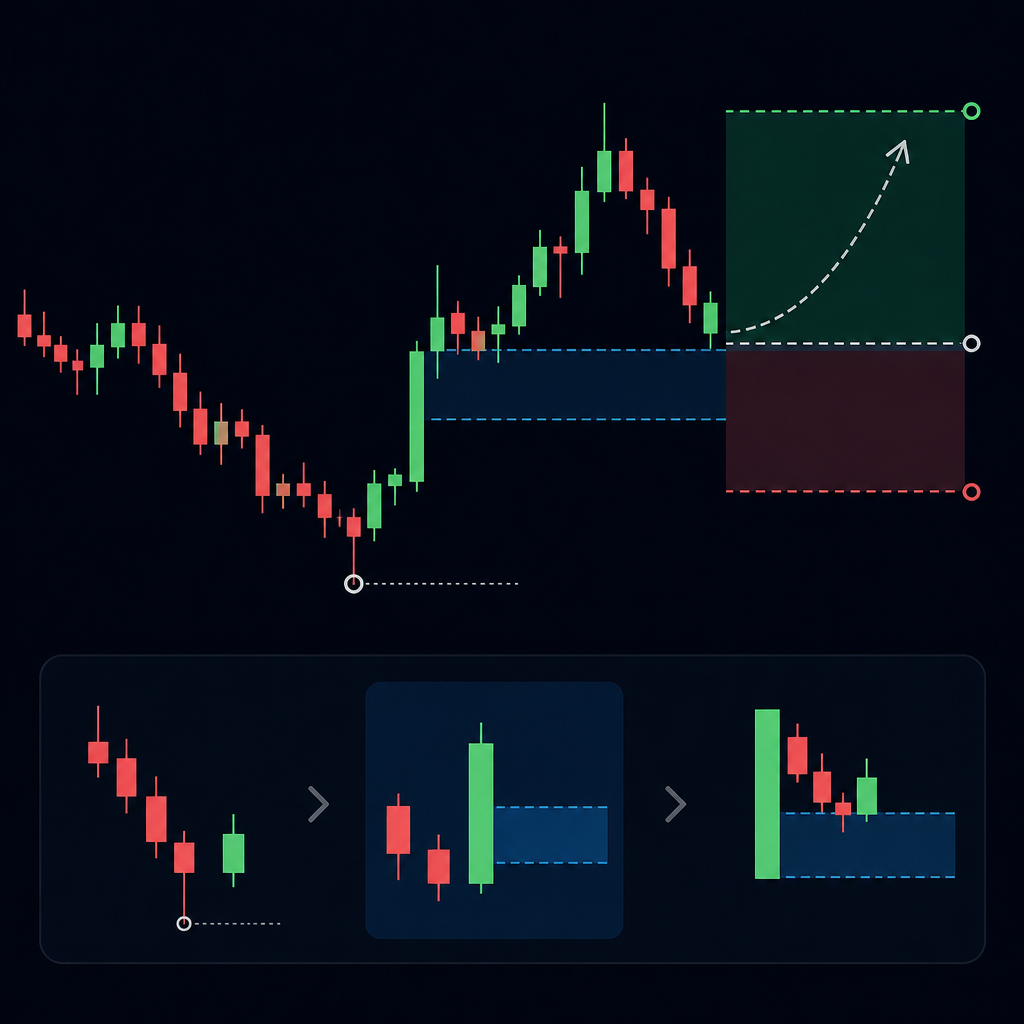
Let’s make FVGs simple and tradable. A fair value gap is an imbalance created by a fast move. In candlestick terms, it’s typically identified using a three-candle sequence.
Bullish FVG: the low of the third candle is above the high of the first candle. The “gap” between those two prices is the bullish FVG zone.
Bearish FVG: the high of the third candle is below the low of the first candle. The “gap” between those two prices is the bearish FVG zone.
Why FVGs Matter More in Gold Than in Many FX Pairs
XAUUSD often moves in sharp bursts—especially during London/NY transitions. Those bursts create imbalances that price frequently revisits within the same session.
That revisit is your “discount entry” after the market reveals direction. You’re not predicting. You’re reacting to displacement.
What “Good” Displacement Looks Like (Your Confirmation)
Not every FVG is worth trading. We want displacement that proves smart money actually pushed price:
- Large body candle(s) relative to recent candles (e.g., a 5-minute candle of $6–$12 body when recent bodies were $2–$4).
- Break of structure: price closes beyond a recent swing high/low, not just wicks it.
- Minimal overlap: the impulsive move should “cleanly” leave the zone, not chop.
How to Draw the FVG Zone Correctly (Common Mistake)
Traders often draw FVGs too wide or too tight. Keep it mechanical:
- For a bullish FVG: draw from high of candle 1 to low of candle 3.
- For a bearish FVG: draw from low of candle 1 to high of candle 3.
Then treat the zone like a “retest area.” Your entry is not the first touch every time—your entry is the touch that gives you a clean trigger (more on that below).
If you’re still building confidence with these concepts, pair this article with our beginner-friendly guide on Telegram execution and expectations: Forex signals Telegram guide for beginners.
London & New York Kill Zones for XAUUSD (Timing That Actually Matters)
Time is a filter. The same pattern that fails at 2 a.m. can work beautifully at 8:15 a.m. London time. That’s because the market’s ability to move depends on participation.
What We Mean by “Kill Zone” (Practical Definition)
A kill zone is a time window where liquidity and volatility are consistently high enough for setups to complete with follow-through.
For XAUUSD, focus on two windows:
- London Kill Zone: roughly 07:00–10:00 London time (first 2–3 hours of London).
- New York Kill Zone: roughly 12:30–15:30 New York time (overlap and early NY).
Depending on daylight savings, you may adjust by an hour. The concept stays the same: trade when the big players are active.
Why Sweeps Cluster Around These Windows
During session opens, price often “cleans up” resting liquidity from the prior session. If Asia ranged between $2638 and $2652, London frequently raids one side first.
That raid triggers stops and breakout orders. Then, with liquidity collected, the market can move efficiently in the real direction.
How Current Macro Context Affects the Kill Zones
Right now, DXY around 106.80 and USD/JPY near 149.50 suggest the dollar is not weak. Yet gold is holding around $2650, implying either safe-haven support, yield dynamics, or positioning that keeps buyers engaged.
In these “tug-of-war” regimes, gold often whipsaws around key levels before trending intraday. That’s exactly when liquidity sweeps + FVG retraces shine, because you’re trading the resolution after the fake move.
What to Avoid During Kill Zones
- Chasing the first candle of the session open without a sweep or displacement confirmation.
- Trading through major news blindly (CPI, PCE, FOMC). If you do, it must be planned with wider risk or reduced size.
- Ignoring spreads: if your broker widens spreads during volatility, your “perfect” entry becomes a worse trade.
United Kings focuses heavily on London and NY execution in our gold signals and forex signals, because that’s where clean moves and consistent liquidity live.
The Step-by-Step XAUUSD Liquidity Sweep + FVG Execution Plan
This is the repeatable model you can use daily. Print it, save it, or turn it into a checklist. The edge comes from doing the same thing the same way—especially when emotions kick in.
Step 1: Build the Liquidity Map (10 minutes before the kill zone)
- Mark Asian high/low.
- Mark prior day high/low.
- Mark any equal highs/lows formed in the last 24 hours.
- Mark the current session high/low as it develops.
Keep it to 5–8 lines max. Too many levels = analysis paralysis.
Step 2: Wait for the Sweep (The “Stop Run”)
A sweep is not a touch. It’s a clear raid. For example:
- Asian high at $2652.
- London opens and spikes to $2657.
- Then price quickly returns below $2652.
That $5 push above the high is the sweep. It grabbed buy stops and breakout buys.
Step 3: Demand Displacement (Structure Break + Momentum)
After the sweep, we want a decisive move away. In the example above, you’d want a strong bearish move that closes below a recent 5-minute swing low—say from $2650 down to $2642 with clean candles.
No displacement = no trade. This rule alone saves you from most false signals.
Step 4: Identify the FVG Created by Displacement
As price drops from $2650 to $2642, you’ll often see a bearish FVG on the 5-minute chart. Let’s say the FVG is between $2648.50 and $2646.80.
Step 5: Plan the Entry on the Retrace
Your entry is typically:
- A limit entry at 50% of the FVG (more conservative), or
- A limit entry at the top of the bearish FVG (more aggressive), or
- A confirmation entry on a lower-timeframe trigger (1-minute rejection) once price taps the zone.
Example: Sell limit at $2647.70 (mid-FVG).
Step 6: Place the Stop Loss Where the Idea Is Invalid
For a bearish setup after a buy-side sweep, your invalidation is usually above the sweep high.
Example:
- Entry: $2647.70
- Sweep high: $2657.00
- Stop: $2660.00 (about $12.30 risk)
This fits the guideline of $10–$25 stops, depending on volatility.
Step 7: Set Take Profits with 1:2 to 1:3 R:R
If risk is ~$12.30, then:
- TP1 (1:2): about $24.60 below entry → $2623.10
- TP2 (1:3): about $36.90 below entry → $2610.80
Notice those targets land inside the realistic range ($2610–$2690) and often align with liquidity (prior lows, Asian low, etc.).
Step 8: Manage the Trade Like a Professional (Not a Hope Trader)
- When price hits 1R, consider moving stop to breakeven only if structure supports it.
- Scale partials at TP1, let the rest run to TP2/TP3 if momentum remains.
- If price re-enters the FVG and holds there too long, be cautious. Strong trades usually reject quickly.
This is the same logic we use to structure signal execution in United Kings: clear entry, clear invalidation, and realistic targets. If you want those levels delivered daily, start with United Kings premium signals.
Two Realistic Trade Scenarios Around $2650 (London & NY Examples)
Let’s make this concrete with two scenarios using today’s approximate pricing. These are examples for education, not trade recommendations.
Scenario A: London Kill Zone Sell After a Buy-Side Sweep
Context: Gold is ranging pre-London between $2641 and $2652. DXY is firm near 106.80, suggesting gold may struggle to sustain upside without clearing liquidity first.
Setup:
- Asian high: $2652
- London spike: $2658 (sweep)
- Displacement: drop to $2643 with a 5-minute close below a swing low at $2646
- Bearish FVG forms: $2649.20–$2647.10
Execution plan:
- Sell limit: $2648.20 (mid-FVG)
- Stop loss: $2661.00 (above sweep + buffer; ~$12.80 risk)
- TP1 (1:2): $2622.60
- TP2 (1:3): $2609.80 (if volatility expands, you may aim closer to $2611–$2613)
What would invalidate the idea early? If price taps the FVG and then makes higher highs on the 1-minute without rejecting, you likely don’t have real sell pressure. Also, if spread widens and you get slipped into a worse fill, skip it.
Scenario B: New York Kill Zone Buy After a Sell-Side Sweep
Context: After London, gold sells off to $2628. New York comes in and runs stops below a clean intraday low at $2626, prints $2622, then snaps back above $2626 with strong candles.
Setup:
- Intraday low liquidity: $2626
- NY sweep: $2622
- Displacement: rally to $2636 with a break above a swing high at $2632
- Bullish FVG forms: $2629.40–$2631.80
Execution plan:
- Buy limit: $2630.60 (mid-FVG)
- Stop loss: $2618.50 (below sweep low + buffer; ~$12.10 risk)
- TP1 (1:2): $2654.80
- TP2 (1:3): $2666.90
Why these targets? They align with common magnets: the daily open, prior session highs, and round numbers around $2650–$2665. In practice, you’d also watch reaction at $2650 because it’s a psychological level.
If you want to see how real traders structure these levels in a community environment, read our breakdown of what to look for in Telegram channels: best Telegram channels for gold trading signals.
Liquidity Sweep vs Breakout vs Reversal: A Quick Comparison
Many traders confuse a liquidity sweep setup with a breakout trade or a generic reversal. Here’s a practical comparison so you can classify what you’re seeing in seconds.
| Approach | What You’re Trading | Best Time | Typical Entry | Common Mistake |
|---|---|---|---|---|
| Liquidity Sweep + FVG | Stop run + displacement + retrace into imbalance | London/NY kill zones | Limit on FVG (50%–100%) with invalidation beyond sweep | Entering before displacement confirms direction |
| Breakout | Continuation through a level | Strong trend days / news expansion | Buy above high / sell below low | Buying right into liquidity where stops are clustered |
| Generic Reversal | Mean reversion without liquidity logic | Range days | Fade extremes with indicator confirmation | Fading a trend day and getting steamrolled |
The reason the XAUUSD liquidity sweep strategy is so powerful is that it explains why price moved beyond the level and gives you a structured way to enter after the market shows its hand.
The Checklist: Marking Levels, Validating Displacement, Executing the FVG
If you only take one thing from this guide, take this checklist. Most traders don’t need more indicators. They need fewer decisions.
Pre-Kill Zone Checklist (Before You Place Any Order)
- Market context: XAUUSD around $2650; note DXY (106.80), USD/JPY (149.50) for risk tone.
- Key levels marked: Asian high/low, prior day high/low, clean equal highs/lows.
- News check: any high-impact releases in the next 60 minutes?
- Spread check: is spread normal for your broker? If it’s elevated, reduce size or skip.
Sweep Validation Checklist (Is It a Real Stop Hunt?)
- Did price run an obvious high/low by at least $1–$4 in normal conditions (more in high volatility)?
- Did it reject quickly back inside the range/level?
- Did the sweep occur during London/NY kill zones (or just before)?
Displacement Checklist (Your “Go/No-Go”)
- Was there a strong impulsive move away with large bodies?
- Did price break structure (close beyond a swing)?
- Did the move create a clean FVG on 5m (or 1m for refined entries)?
FVG Entry Checklist (Execution Rules)
- Entry planned at 50% of FVG (default) or at edge (aggressive).
- Stop placed beyond sweep with $10–$25 risk typical.
- Targets mapped to liquidity: opposing session range, prior highs/lows, round numbers.
- Minimum R:R: 1:2. Prefer 1:3 when structure supports.
Trade Management Checklist (After You’re In)
- If price reacts immediately and breaks structure in your favor, you can trail behind new swings.
- If price stalls inside the FVG too long, consider reducing exposure.
- Don’t widen the stop. If invalidated, exit and reassess.
For a broader framework on selecting and using signal services responsibly, bookmark our signals provider checklist and our guide to risk management when using forex signals.
The Volatility & Spread Rule: How to Filter False XAUUSD Signals
Gold can be brutally efficient at punishing “almost correct” trades. Many losses aren’t because your idea was wrong—they’re because conditions were wrong.
So we use a simple filter that improves decision quality without adding complexity.
Rule Part 1: Spread Filter (The Hidden Cost)
Before you execute during kill zones, check your current spread. If your broker’s spread is noticeably higher than normal, your entry becomes worse and your stop becomes easier to hit.
Practical guideline: if spread is more than 1.5x your usual during normal conditions, skip or reduce size. If you normally see $0.20–$0.40 spread and it’s suddenly $0.80+, be cautious.
Rule Part 2: Volatility Filter (Avoid the “Knife Candles”)
We want displacement, but we don’t want chaos. There’s a difference.
Simple volatility rule: look at the last 6 candles on the 5-minute chart (30 minutes). If 3+ candles have ranges above your normal by a large margin, stand down unless you are trading a planned news setup.
In today’s conditions around $2650, a typical 5-minute candle might be $2–$6. If you suddenly see repeated $10–$15 candles, that’s often a “stop cascade” environment. Your FVG may still work, but your stop needs to be wider or your position size smaller.
How to Adjust When Volatility Expands
- Widen stop modestly (within your rules) and reduce lot size so $ risk stays constant.
- Use partial entries: 50% at mid-FVG, 50% at deeper fill (if your plan allows).
- Take profits faster at 1:2 if price is spiking and reversing quickly.
This is also why a professional signal provider matters. When volatility changes, the “same” setup needs different execution. United Kings signals include clear levels and session timing, and we actively focus on London/NY windows where spreads are usually tighter and fills are cleaner. Learn more on our About United Kings page.
Risk Management for Gold FVG Setups: Stops, Position Size, and Realistic Targets
You can have a great strategy and still lose money if your risk is random. XAUUSD moves fast. A $12 stop can be hit in minutes if you enter at the wrong time.
So we treat risk as part of the setup, not an afterthought.
Stop Placement: Structure First, Then Distance
Your stop should sit where your idea is invalid. In this model, that usually means beyond the sweep high/low plus a buffer.
In the $2610–$2690 environment, typical intraday stops for this approach are $10–$25. If your stop is $35–$50, you’re likely entering too late or trading the wrong timeframe for the day.
Position Sizing: Keep $ Risk Fixed (Not Lot Size)
Pick a fixed % risk per trade (many disciplined traders use 0.5%–1%). Then calculate lot size based on stop distance.
Example: If your account is $10,000 and you risk 1% ($100):
- Stop is $12 → you size so that a $12 move equals $100 loss.
- If next trade requires a $20 stop due to volatility, you reduce size so $20 move still equals $100.
This keeps your psychology stable and prevents a single volatile session from doing outsized damage.
Profit Targets: Liquidity-Based, Not Wish-Based
Targets should align with where price is likely to go next. In this model, that’s usually the next liquidity pool:
- Opposite side of the Asian range
- Prior day high/low
- Session high/low
- Round numbers ($2650, $2660, $2675)
Combine that with 1:2 or 1:3 R:R. If the next liquidity pool only offers 1:1.3, skip the trade. You’re forcing it.
One Rule That Saves Accounts: Max Trades per Session
Set a cap: for example, 1–2 trades per kill zone. If you miss the move, you miss it. Revenge trading is how good strategies get ruined.
If you want a structured way to implement this with daily guidance, United Kings provides signal formatting that includes entry, stop, and multiple take-profit levels. Explore our Gold Signals and choose a plan on pricing (Starter 3 Months $299, Best Value 1 Year $599 with 50% savings + free ebook, or Lifetime $999).
Common Mistakes Traders Make With Liquidity Sweeps & FVGs (And Fixes)
This strategy is simple, but it’s not “easy.” Most mistakes happen because traders rush the sequence or trade it outside the right context.
Mistake 1: Calling Every Wick a Sweep
A wick is not automatically a stop hunt. A sweep should raid a clear liquidity level and then show rejection.
Fix: only trade sweeps of Asian high/low, prior day high/low, equal highs/lows, or very clean swing points.
Mistake 2: Entering the FVG Without Displacement
Traders see an FVG and assume it must fill and reverse. But without displacement, the “FVG” can be meaningless chop.
Fix: require a structure break and strong candle bodies before you even draw the FVG.
Mistake 3: Stops Too Tight for Gold
Gold breathes. A $4 stop on a 5-minute FVG trade is often just donating money—unless volatility is extremely low and the structure is perfect.
Fix: keep stops in the $10–$25 range as a baseline and size down to maintain constant $ risk.
Mistake 4: Trading Outside London/NY and Expecting the Same Results
Setups can appear in any session, but the highest-quality completion rate is usually during kill zones.
Fix: if you trade outside kill zones, demand higher confirmation (e.g., multiple structure breaks) or reduce frequency.
Mistake 5: Ignoring News and Getting Randomly Stopped
High-impact news can blow through levels and invalidate technical structure temporarily.
Fix: either stand aside or trade only if you have a news plan. For survival guidance, read how gold signals react to unexpected news events.
When you remove these mistakes, the strategy becomes what it should be: a clean framework for trading gold with defined risk and repeatable execution.
How United Kings Turns This Into Tradable Signals (What You Should Expect)
Many traders understand the concept but still struggle in real time. That’s normal. Execution speed, discipline, and session timing are hard—especially if you have a job, school, or family responsibilities.
United Kings exists to bridge that gap with a premium signal experience that’s practical, not hype.
What a “Good” Signal Looks Like
In our community, signals are structured so you can execute quickly:
- Instrument: XAUUSD (or major FX pairs)
- Direction: Buy/Sell
- Entry: exact price or entry zone
- Stop Loss: clear invalidation level
- Take Profits: TP1/TP2/TP3 levels based on structure and liquidity
- Context: session timing (London/NY) and brief rationale
Our Value Props (And How They Fit This Strategy)
- Premium Telegram signals for forex and gold delivered with clarity and speed.
- 85%+ historical win rate communicated transparently as past performance, not a promise.
- 300K+ active traders in the broader community—useful for shared learning and accountability.
- London and NY session focus where liquidity sweep + FVG setups complete best.
- Education alongside signals so you learn the “why,” not just the “what.”
- 48-hour money-back guarantee so you can evaluate fit with less friction.
Where to Start
If XAUUSD is your main instrument, start with United Kings Gold Signals. If you want diversification with majors like EUR/USD (1.0520), GBP/USD (1.2680), and USD/JPY (149.50), add Forex Signals.
If you also trade crypto, we have a separate track for that on Crypto Signals, but keep your gold model separate so you don’t mix volatility profiles.
To join the live feed and see how we call levels during kill zones, connect via Telegram: United Kings official Telegram channel.
FAQ: XAUUSD Liquidity Sweeps, FVGs, and Kill Zone Execution
1) What timeframe is best for fair value gap gold trading?
For most intraday traders, the 5-minute chart is the sweet spot for identifying displacement and FVGs. Use 15m/1H for context and 1m for refined entries if you’re experienced.
2) Do FVGs always fill in XAUUSD?
No. Many FVGs partially fill or never return. That’s why we require displacement and structure break first, and why we prefer kill zone timing where rebalancing is more common.
3) How far should a liquidity sweep run beyond the high/low?
In normal conditions, $1–$4 beyond an obvious level can be enough. In higher volatility, sweeps can extend $6–$12 or more. The key is rejection plus displacement afterward, not the exact distance.
4) Can I use this XAUUSD liquidity sweep strategy during major news?
You can, but it requires adjustments: smaller size, wider stops, and acceptance of slippage. Beginners should demo trade news periods first and avoid “impulse entries” during releases.
5) What’s the biggest reason traders fail with London NY kill zone XAUUSD setups?
They enter too early—before displacement confirms direction—or they overtrade multiple sweeps in the same session. One clean setup is enough; forcing five trades usually ends badly.
Risk Disclaimer (Read Before You Trade)
Forex and gold trading involves significant risk and may not be suitable for all investors. You can lose some or all of your capital. Past performance, including any stated win rates, does not guarantee future results.
All examples in this article are for educational purposes only and are not financial advice. If you’re new, practice on a demo account before risking real money, and always use proper risk management.
Join United Kings: Get London & NY XAUUSD Setups With Clear Levels
If you’re serious about trading XAUUSD with structure—liquidity sweeps, displacement, and FVG execution—don’t do it alone in real time.
Join United Kings for premium Telegram signals with clear Entry, Stop Loss, and Take Profit levels, built around the sessions that matter most.
- Start here: United Kings Gold Signals
- Explore all services: Signals overview
- Pick a plan: Starter (3 Months $299), Best Value (1 Year $599 + free ebook), Lifetime ($999)
- Join the community on Telegram: https://t.me/unitedkings1
If you have questions before joining, visit Contact Us and we’ll point you to the best plan for your trading style.