Ever held an XAUUSD trade that was perfectly fine… then “mysteriously” dipped, your stop got tagged, and five minutes later price went right back your way?
If you trade gold signals, that pain often has a name: rollover. The daily reset can combine XAUUSD swap fees, a gold rollover spread spike, and a burst of thin liquidity that turns a normal stop into a magnet.
Right now gold (XAUUSD) is trading around $2650 (+0.35% in the last 24h). DXY is elevated near 106.80, USD/JPY is around 149.50, EUR/USD near 1.0520, and GBP/USD around 1.2680. That backdrop matters because higher USD volatility often shows up as sharper micro-moves in gold—especially when liquidity thins.
This guide is your overnight survival plan: how swaps really work, when spreads typically widen, and the exact checklist we use to decide whether to hold or close gold signals before rollover.
TL;DR: XAUUSD rollover survival in 60 seconds
- Rollover is a liquidity event: spreads widen and slippage risk increases even if your analysis is correct.
- Swap is the “rent” you pay to hold overnight; it’s broker- and direction-dependent and can flip with rates and liquidity conditions.
- Wednesday often has triple swap (broker convention), making hold-vs-close decisions more important midweek.
- Don’t judge stops by “normal” spreads: build a rollover buffer (or reduce size) if you must hold through the reset.
- Use a checklist based on trend strength, distance to SL, expected spread spike, and event risk (data/geopolitics).
- Professional routine wins: a 2-minute daily calendar + cost check saves more than “better entries” do.
Why rollover turns good XAUUSD trades into bad outcomes

Most traders think rollover is only about swap. In practice, rollover is a three-part cost event: swap + spread + slippage.
Gold is already a fast market. A normal, liquid moment might show a tight spread and clean fills. But around rollover, liquidity providers reprice risk, some books reset, and quotes can get jumpy.
Here’s the typical “rollover trap” story. You’re long XAUUSD at $2648 with a $2636 stop (12 dollars risk). Price is stable at $2650 before rollover. Then spread widens, a thin print taps $2636, you’re out, and within minutes price is back at $2652.
Was your analysis wrong? Often, no. You were simply positioned where microstructure could hurt you.
Rollover also changes how your stop behaves. A stop order becomes a market order when triggered. If the spread expands and the market gaps a few ticks, your fill can be worse than expected. On XAUUSD, that can mean an extra $0.30–$1.50 of adverse fill in ugly conditions, sometimes more depending on broker execution and account type.
Now stack that with swap. If you’re holding multiple lots, swap can become a meaningful drag over time—especially if you’re swinging positions for days. The result is that rollover can quietly eat your edge.
The goal of this article isn’t to make you afraid of holding trades overnight. It’s to teach you when holding is worth it and when closing and re-entering is the professional move.
How XAUUSD swap fees are calculated (and why yours differs)
XAUUSD swap fees are the overnight financing cost (or credit) applied when you hold a position past your broker’s daily cutoff. Think of it as the cost of carrying exposure.
In simple terms, swap depends on:
- Position direction (buy vs sell): long and short swaps can be very different.
- Broker’s liquidity and markup: two brokers can quote different swap rates on the same day.
- Contract specification: your broker’s lot size definition for gold (commonly 100 oz per 1.00 lot, but not always).
- Interest rate differentials + funding conditions: the USD leg matters and can change with Fed expectations.
- Day-of-week convention: often triple swap midweek to account for weekend settlement.
Most platforms show swap in the contract specs. In MT4/MT5, it’s typically listed as Swap long and Swap short (in points or account currency). Your actual charge is then computed based on your lot size and the broker’s formula.
Here’s the practical way to think about it without getting lost in formulas: swap is usually small per day compared to a $15–$30 move in gold, but it becomes big when:
- You hold for many nights (3–10 days).
- You trade larger size (multiple lots).
- You hold across triple swap.
Example scenario. You’re long XAUUSD from $2622 targeting $2668 (46 dollars). Your stop is $2607 (15 dollars risk). If your swap is the equivalent of, say, $6 per 1.00 lot per night, holding 2 lots for 4 nights is about $48. That doesn’t kill a strong swing, but it’s not “free.”
The key is that swap is predictable (you can check it), while rollover spread and slippage are probabilistic (you manage them with rules).
If you want a deeper foundation on professional signal execution and cost control, pair this guide with our execution framework: United Kings trading guides and our practical onboarding for new signal followers.
Gold rollover spread: when it widens and what “normal” looks like
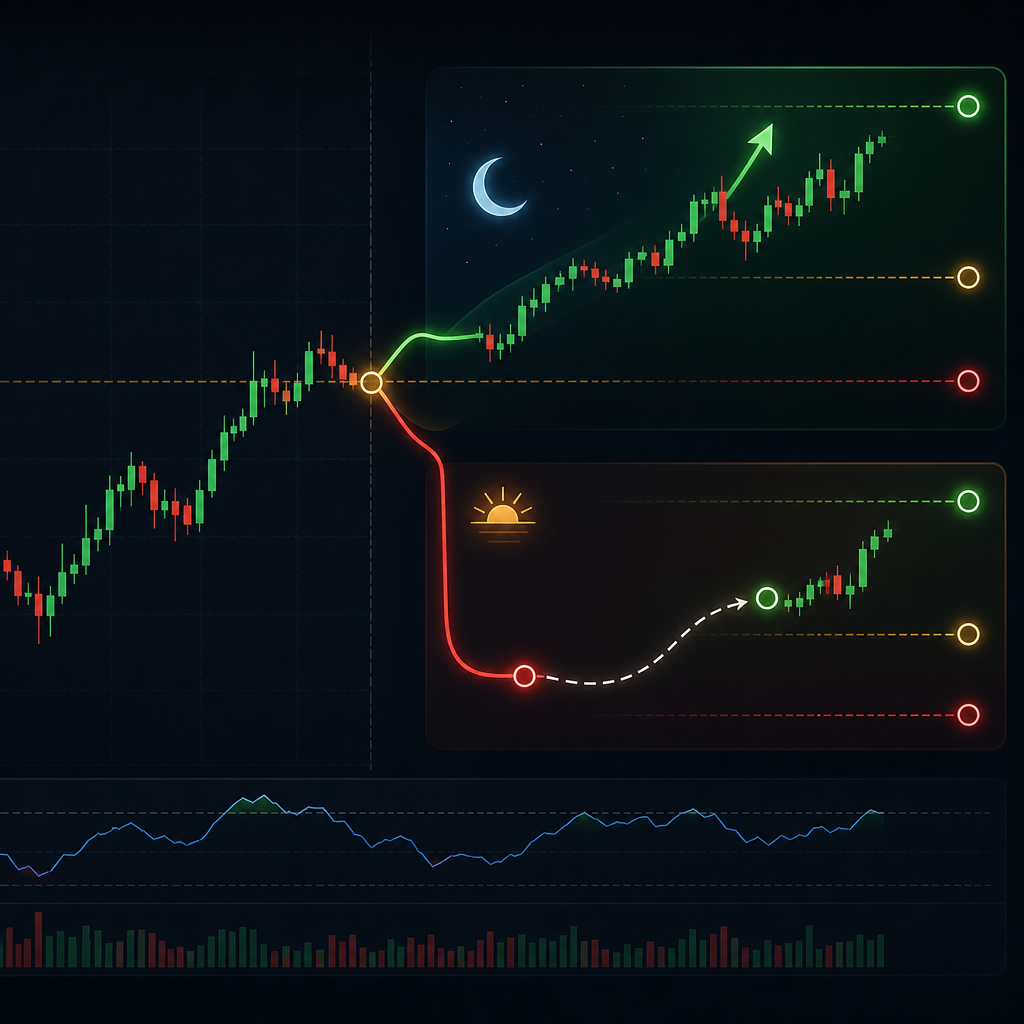
Gold rollover spread behavior is not random. It follows liquidity patterns.
During the most liquid windows—typically London and New York sessions—XAUUSD spreads are usually more stable. But around the daily rollover, liquidity can thin, and spreads can widen quickly.
What does “widen” mean in real terms? It depends on your broker and account type, but the pattern is consistent:
- Before rollover: spreads may start creeping wider 10–30 minutes ahead.
- At rollover: spreads can spike dramatically for seconds to minutes.
- After rollover: spreads normalize, but fills can remain jumpy briefly.
If you normally see, for example, a tight spread during active hours, you might see it become 2x–5x wider in the rollover window. That’s enough to tag tight stops and distort risk-reward.
This is why “I only risk $12 on gold” can be misleading. If your stop is $12 away but rollover spread expansion temporarily adds the equivalent of $2–$6 in effective distance (via bid/ask distortion plus slippage), your real risk is larger than your plan.
Rollover spread also interacts with stop placement. Stops placed right under obvious lows (or right above obvious highs) are already vulnerable. Add rollover spread spikes, and they become high-probability targets even without intentional stop hunting.
Practical rule: if you must hold through rollover, avoid having your stop within the “noise band” of recent structure. On gold near $2650, that often means you don’t place a stop just $6–$8 away in a choppy market. You either widen the stop to a more structural level (often $10–$25 depending on volatility) and reduce lot size, or you close before rollover.
We’ll convert that into a checklist soon. But first, you need the calendar reality: not all rollover days are equal.
Rollover calendar routine: the day-by-day plan (including triple swap)
Your best edge isn’t a secret indicator. It’s a repeatable routine that reduces hidden costs.
Most brokers apply the “weekend” financing via a triple swap on one weekday (commonly Wednesday). That means holding through that rollover can cost about 3x the usual daily swap. Sometimes it’s credited if your direction earns positive swap, but in gold it’s often a cost depending on broker conditions.
Here’s a simple weekly routine you can run in under 2 minutes daily:
Step 1: Identify the rollover cutoff in your platform time
Don’t assume your local time. Confirm the broker’s server time and the daily cutoff. Put a reminder 20 minutes before.
Step 2: Mark “high-cost” days
- Triple swap day: usually Wednesday rollover.
- Major data days: CPI, PCE, NFP, Fed decision days. Volatility can stay elevated into the close.
- Geopolitical headline risk: gold can gap on unexpected news.
Step 3: Decide your overnight posture
Ask: are we swing trading or intraday trading today? If you’re following London/NY session signals, your default posture should be intraday-first unless the setup is explicitly a swing.
At United Kings, our focus is heavily on London and NY session trading because liquidity is better and costs are more predictable. That’s why our premium Telegram alerts include clear Entry, SL, and TP levels designed for real execution.
Step 4: Check swap and spread conditions before committing
Look at your platform’s contract specs and your broker’s typical rollover spread behavior. If your broker is notorious for massive spikes, your “hold” threshold should be stricter.
Step 5: Use a “rollover buffer” rule
If your stop is too close and you’re in profit, either tighten and exit (bank it) or widen and reduce size. Don’t keep the same size with a wider stop. That’s how accounts bleed.
This routine is boring. It’s also exactly what separates consistent signal followers from those who feel like their broker is “out to get them.”
Hold vs close gold signals: the exact rollover decision checklist
This is the core of the article: a practical, repeatable checklist to decide whether to hold a gold signal overnight or close before rollover and re-enter later.
We’ll use realistic current levels: XAUUSD around $2650, with volatility that can push $10–$25 intraday swings without warning.
The 7-question checklist (score it honestly)
- 1) Is the trade a swing thesis or an intraday scalp?
If the signal was designed for London/NY momentum, holding overnight often reduces edge. - 2) How far is price from your stop right now?
If your stop is within ~$10 and rollover is near, you’re in the danger zone unless structure supports it. - 3) Are you holding through triple swap?
If yes, you need a stronger reason to hold. “Hope” is not a reason. - 4) Where is price relative to key structure?
If you’re long near $2650 but the nearest real support is $2632, a stop at $2642 is structurally weak. - 5) What is the expected spread spike for your broker?
If your broker widens aggressively, treat rollover like a mini-news event. - 6) Is there scheduled or unscheduled event risk?
Gold reacts to surprise headlines. If the world is tense, overnight gaps are more likely. - 7) Is the trade already “paid” (partial TP hit)?
If you’ve taken partial profit, holding a small runner can be rational even with swap costs.
If you answer “bad” to 3 or more of these, your default should be: close before rollover and look to re-enter during liquid hours.
Two concrete examples (hold vs close)
Example A: Close before rollover. You’re long from $2646, stop $2634 (12 risk), TP $2670 (24 reward, 1:2). It’s 15 minutes to rollover, price is at $2651 (+$5). Your stop is still only $17 away, and your broker’s spread spikes are nasty. This is a classic “close and re-enter” situation. You can bank +$5 and re-enter on a clean pullback in London.
Example B: Hold through rollover (with rules). You’re long from $2620, stop $2605 (15 risk), TP1 $2650 hit, TP2 $2668 (48 reward from entry). You’ve already taken partial profit, and your remaining position is small. Price is above structure, and you can afford the swap. Holding a reduced runner is reasonable—if you widen your “mental tolerance” for rollover noise and avoid moving your stop into the danger band.
The point isn’t to always close. The point is to stop treating rollover like a normal minute of the day.
Comparison table: holding overnight vs closing and re-entering
Use this table as a quick reference when deciding how to manage gold signals around rollover.
| Approach | Best for | Main costs/risks | When it fails | Practical rule |
|---|---|---|---|---|
| Hold through rollover | Swing trades, strong trend days, post-breakout runners | Swap fees, spread spikes, slippage on stops | Tight stops near noise; triple swap; headline risk nights | Only hold if stop is structural and size is reduced |
| Close before rollover | Intraday signals, mean-reversion trades, choppy conditions | Opportunity cost if price runs without you | Strong continuation trend that never pulls back | Close if stop is within ~$10–$12 and rollover is near |
| Partial close (bank + runner) | Trades already in profit with clear structure support | Still exposed to rollover spikes, but reduced | Runner too large; stop moved too tight | Keep runner small (e.g., 20–40% of original) |
| Hedge (advanced) | Advanced traders managing portfolio exposure | Complexity, extra spread, execution errors | Over-hedging in widening spreads | Only if you understand net exposure and costs |
Step-by-step: the “Rollover-Proof” trade management process
Here’s the exact step-by-step process you can apply to any gold signal you’re following—especially if you receive entries from a Telegram channel and you want to execute like a pro.
Step 1: Define your trade type before you enter
Write one sentence: “This is an intraday momentum trade” or “This is a swing continuation trade.” That sentence decides whether overnight holding is even on the table.
If you’re following professional alerts, the signal should make this clear. Our premium alerts in United Kings Gold Signals are structured with clean SL/TP logic designed for session liquidity.
Step 2: Set SL and TP with rollover in mind
On XAUUSD near $2650, a common professional stop band for active trading is $10–$25 depending on volatility and structure. If your stop is tighter than the market’s “breathing room,” rollover will expose it.
Example: If you buy $2652, a tighter but sometimes viable stop could be $2642 (10 risk) only if structure supports it and rollover is not imminent. If rollover is near, consider either:
- Widen stop to $2637 (15 risk) and reduce lot size, or
- Don’t take the trade if it requires holding through rollover.
Step 3: Reduce size if you must hold
Rollover is a volatility multiplier. A simple rule: if you hold through rollover, consider cutting risk by 25–50% versus your normal intraday risk.
So if you normally risk 1% per trade, holding overnight might mean risking 0.5–0.75% or scaling out partial profit before rollover.
Step 4: Set a “decision alarm”
Set an alert 20 minutes before rollover. When it triggers, you do the checklist. No exceptions.
Step 5: Choose one of three actions
- Close fully (best for intraday trades near rollover).
- Partial close (bank profit, keep a small runner).
- Hold with protection (structural stop, reduced size, accept swap).
Step 6: Plan the re-entry (if you close)
Closing isn’t “giving up.” It’s switching from a low-liquidity environment to a high-liquidity one. Plan your re-entry around London or NY when spreads normalize and price action is cleaner.
If you want a broader framework for executing signals with discipline, you’ll also like: risk management strategies when using forex signals.
Stop placement rules that survive rollover (without oversized risk)
Stops are where rollover damage shows up first. So we need stop rules that respect structure and microstructure.
We’ll keep this practical and aligned with the price band you’re seeing now (gold between roughly $2610–$2690).
Rule 1: Stops must be beyond structure, not inside it
If the last clean swing low is $2634 and you’re long, a stop at $2636 is not “safe.” It’s inside the noise. A more structural stop might be $2629 or $2626 depending on the setup, but that increases risk distance.
That’s where position sizing matters: you widen the stop and reduce lots so your account risk stays constant.
Rule 2: Add a rollover buffer if holding overnight
Think of a rollover buffer as extra room to survive spread spikes. If your “daytime” structural stop would be $2640, your “overnight” stop might need to be $2637. That’s not always required, but it’s a useful concept.
Important: you don’t add buffer and keep the same lot size. You add buffer and reduce size.
Rule 3: Avoid obvious “round-number” stops near rollover
Gold loves round levels like $2650, $2640, $2630. If you place stops exactly on those levels, you increase the chance of being clipped by a spread spike or a quick sweep.
Rule 4: Use 1:2 or 1:3 R:R targets that justify the hold
Overnight holding should be paid for. If your target is too close, you’re taking overnight costs for little reward.
Example long: Entry $2644, SL $2629 (15 risk). A 1:2 TP is $2674. A 1:3 TP is $2689. Those targets sit inside the current $2610–$2690 guideline and justify the hold more than a tiny TP would.
Rule 5: If you can’t place a structural stop, don’t hold
This is the hard truth. If the market structure doesn’t give you a logical stop, the trade is not a rollover hold. Close it, or don’t take it late.
For more on execution and platform behavior (spreads, slippage, order types), browse our education in the United Kings blog. It’s designed to make signal-following feel professional, not chaotic.
Position sizing adjustments: how to keep swap and spread from eating your edge
Most traders try to solve rollover problems with “better entries.” Professionals solve it with position sizing.
Here’s the logic: rollover increases uncertainty about fills and effective stop distance. That means your real risk is higher than your planned risk. The solution is to reduce size when holding overnight or when rollover is close.
A simple sizing framework for rollover holds
- Intraday trade (no rollover exposure): risk your normal amount (example: 1%).
- Holding overnight: reduce risk to 0.5–0.75%.
- Holding through triple swap: reduce risk further or require stronger trend confirmation.
Let’s make it real with numbers. Suppose your account is $10,000 and you normally risk 1% ($100). You take a gold long at $2650 with SL at $2635 (15 dollars risk).
If 1.00 lot equals 100 oz, then a $1 move is $100 per lot. A $15 stop is $1,500 per lot. To risk $100, you’d trade about 0.07 lots (because 0.07 x $1,500 ≈ $105).
Now if you’re holding overnight and you reduce risk to 0.6% ($60), your size becomes roughly 0.04 lots. That size reduction is what makes rollover noise survivable.
Swap then becomes less emotionally significant too. If swap is, say, $6 per lot per night, at 0.04 lots that’s about $0.24 per night. You can hold when it’s rational, not because you’re afraid of fees.
When to scale out before rollover
Scaling out is a clean compromise. If you’re up +$8 on a long from $2642 (price at $2650) and rollover is near, you can:
- Close 60–80% of the position.
- Move stop to a structural level (not too tight).
- Let the runner target $2670–$2685.
This is how you keep upside exposure without donating profits to rollover conditions.
If you want to follow gold alerts where these decisions are simplified into clear instructions, our premium trading signals are built around clean risk definitions and session timing.
Rollover slippage: why stops fill worse and how to defend
Slippage is the silent partner of rollover spread. Spread is what you see. Slippage is what you feel after the fill.
During rollover, the market can move quickly while liquidity is thin. When your stop triggers, your broker fills you at the best available price—sometimes worse than your stop level.
Common rollover slippage scenarios on XAUUSD
- Stop triggered by spread expansion: price didn’t really trade there in a meaningful way, but the bid/ask did.
- Micro-gap: price jumps a few ticks, skipping your stop level.
- Thin-book sweep: a quick push clears nearby liquidity and snaps back.
Example. You’re short from $2660, SL $2674 (14 risk). At rollover, spread widens and a sudden print pushes to $2675.20. Your stop fills at $2675.10 instead of $2674. That extra $1.10 on 0.10 lots is about $11. On bigger size, it’s real money.
Defenses that actually work
- Don’t place stops too tight near rollover (obvious, but it’s the #1 fix).
- Close or reduce exposure before rollover if you’re in a fragile zone.
- Use limit re-entries during liquid sessions instead of chasing post-rollover spikes.
- Pick execution-friendly conditions: London/NY sessions, avoid late-day entries unless swing thesis is strong.
And if you’re evaluating any signal service, make sure they teach execution—not just entries. Our community focuses on that, with educational posts and live guidance alongside signals.
You can also review our due-diligence framework here: forex signals provider checklist for beginners. The same logic applies to gold.
Market context: how DXY, yields, and geopolitics change overnight risk
When gold is around $2650 and the Dollar Index is strong near 106.80, gold often becomes more sensitive to shifts in rate expectations and risk sentiment.
That matters because overnight is when headlines hit. Asia session can react to geopolitical developments, central bank commentary, or unexpected data. Gold can move fast when liquidity is thinner than London/NY.
What to watch in the current backdrop
- DXY at 106.80: a firm dollar can cap gold rallies intraday, but also sets up sharp squeezes if USD weakens.
- USD/JPY near 149.50: if JPY volatility spikes (intervention fears), risk sentiment can spill into gold quickly.
- EUR/USD 1.0520 and GBP/USD 1.2680: risk-on/risk-off shifts often show up across majors and gold simultaneously.
Overnight holding is most dangerous when:
- You’re positioned against the dominant macro flow (e.g., long gold while USD is ripping higher).
- A major risk event is scheduled within Asia hours.
- Geopolitical tension is elevated and headlines can gap price.
Overnight holding can be most rewarding when:
- You’re aligned with a strong trend and holding a runner from a great location (e.g., long from $2620 with structure support).
- You already reduced risk (partial close) and your stop is protected by structure.
- Your target is far enough (1:2 to 1:3) to justify the carry.
If you want to see how gold signals behave during surprise volatility, study: how gold signals react to unexpected news events. It pairs perfectly with rollover planning.
The “re-entry” playbook: how to close before rollover without missing the move
The biggest objection to closing before rollover is emotional: “What if price runs without me?”
That can happen. But in professional trading, we don’t optimize for catching every tick. We optimize for repeatable execution with controlled costs.
Re-entry principle: don’t chase, replace
If you close a long at $2651 before rollover, your goal isn’t to buy back at $2656 in panic. Your goal is to re-enter using a plan that offers:
- A defined trigger (pullback, breakout, or retest).
- A structural stop.
- A clean spread environment (London/NY).
Three re-entry patterns that work well on XAUUSD
1) Pullback to prior support. If gold broke above $2648 and you closed at $2651, you can wait for a pullback toward $2648–$2645 during London and re-enter with SL below $2635–$2632 depending on structure.
2) Break-and-retest continuation. If price consolidates between $2652 and $2658 after rollover and then breaks $2658 in London, you can enter on the retest with a defined stop under the range.
3) Session open momentum. Gold often shows clean direction during London and NY opens. If your bias remains intact, you can use session momentum to re-enter with better liquidity.
How to avoid “death by overtrading”
Closing and re-entering can become a bad habit if you do it impulsively. The rule is: you only re-enter if the new entry offers equal or better R:R than the original.
Example: you closed a long and now price is $2662. If the nearest structural stop is $2648 (14 risk) and your realistic TP is $2676 (14 reward), that’s 1:1. Not good enough. You wait.
If you want signals that already align entries with the best liquidity windows, explore our gold signals and the broader forex signals coverage for correlation context.
Putting it all together: a daily rollover checklist you can copy
Print this mentally. Use it every day. Consistency is the edge.
20 minutes before rollover
- Check how close price is to your SL and to obvious swing levels.
- Check whether tonight is triple swap (your broker’s convention).
- Scan for scheduled news/events in the next 8–12 hours.
- Look at current spread vs your normal spread (is it already creeping wider?).
Decision rules (choose one)
- Close fully if: trade is intraday + stop is within ~$10–$12 + spread is widening.
- Partial close if: you’re in profit + structure supports a runner + you can reduce exposure meaningfully.
- Hold if: swing thesis + structural stop + reduced risk + target justifies carry (1:2 or 1:3).
If holding: protection rules
- Do not move stop into the noise band just to “lock in” a tiny profit.
- Accept that rollover can print weird candles. Manage the trade on structure, not emotions.
- Consider reducing size before triple swap unless trend is exceptionally clean.
If closing: re-entry rules
- Plan the re-entry trigger (pullback, retest, session momentum).
- Only re-enter if R:R is still at least 1:2.
- Prefer London/NY windows for better spreads and fills.
This checklist is what we mean when we say we provide more than entries. We provide a system around the signal so your execution doesn’t leak money.
FAQ: XAUUSD swap, rollover spreads, and holding gold overnight
1) What time is rollover for XAUUSD?
It depends on your broker’s server time, but it typically aligns with the daily trading day reset (often around New York close). Confirm inside your platform and set an alert 20 minutes before.
2) Is swap always negative on gold?
No. Swap can be negative or positive depending on broker pricing and market conditions. Long and short swaps can differ significantly. Always check your contract specs for Swap long and Swap short.
3) Why did my stop get hit when price “never reached it”?
During rollover, spreads can widen sharply. Your stop can trigger based on bid/ask movement even if the mid price didn’t trade there meaningfully. Slippage can also worsen the fill.
4) Should I always close gold trades before rollover?
No. If you’re in a swing trade with strong structure, reduced size, and a target that justifies holding (1:2 or 1:3), holding can be reasonable. Intraday trades with tight stops are usually better closed.
5) How can I reduce rollover losses without changing strategy?
Use a rollover routine: reduce size for overnight holds, avoid tight stops near rollover, scale out in profit, and re-enter during liquid London/NY windows when spreads normalize.
Risk disclaimer (read before trading)
Forex and gold trading involves significant risk and may not be suitable for all investors. Spreads, swaps, and slippage can increase around rollover and during volatile market conditions. Past performance does not guarantee future results. Signals and educational content are not financial advice. If you are new, practice on a demo account before risking real money, and never trade with funds you cannot afford to lose.
Join United Kings: trade gold signals with a real execution edge
If you’re serious about trading XAUUSD, you need more than “buy/sell” messages. You need entries, SL, TP, timing, and rules that account for real costs like swap and rollover spread.
United Kings delivers premium Telegram signals for forex and gold with an 85%+ win rate target approach, clear levels, and a community of 300K+ active traders. We focus on London and NY sessions where execution is cleaner, and we share education alongside alerts.
- Explore our full signal hub: United Kings Signals
- Gold-specific coverage: Gold Signals (XAUUSD)
- Forex opportunities across majors: Forex Signals
- See all 3 plans and choose your tier: Starter (3 Months $299), Best Value (1 Year $599 with 50% savings + FREE ebook), Unlimited (Lifetime $999)
- Join our Telegram now and watch how we manage sessions and rollover: United Kings Telegram trading community
Bonus: We also offer a 48-hour money-back guarantee so you can evaluate the quality and structure with confidence.
If rollover has been quietly draining your results, fix it this week. Use the checklist, control your sizing, and trade gold like a professional—one decision at a time.