You followed the XAUUSD signal perfectly… except you entered 90 seconds late.
Gold (XAUUSD) was trading near $2650, the move was clean, and your analysis matched the signal.
But your fill was higher, your stop had to be wider, and the “easy” 1:3 trade turned into a stressful scratch.
This is exactly why xauusd signal execution matters as much as the signal itself.
In fast conditions—especially around London and New York session bursts—execution errors create the same outcome as bad analysis: inconsistent results.
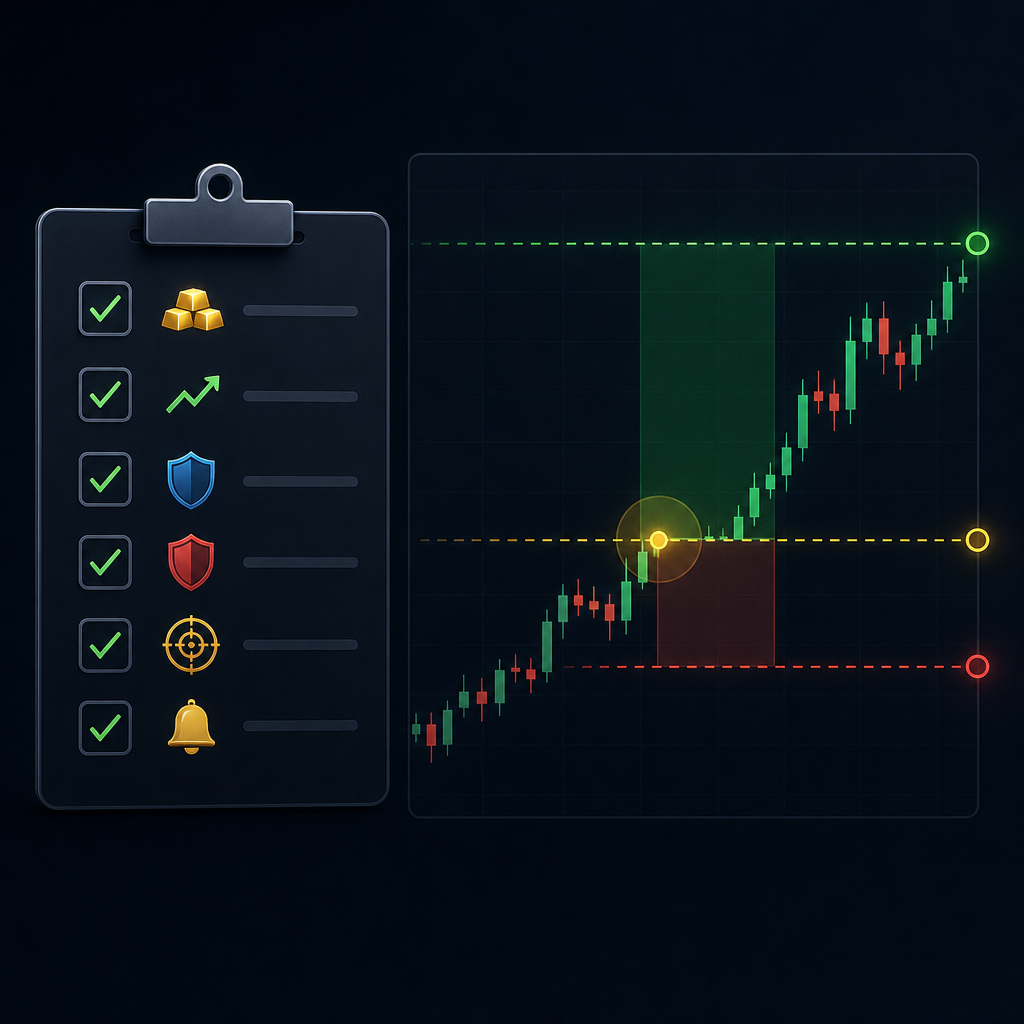
TL;DR — The XAUUSD Signal Execution Checklist (Save This)
- Decide the order type first: market orders for immediate continuation, gold pending orders (limit/stop) for pullbacks or breakouts.
- Pre-build the trade: entry, SL, TP1/TP2, and alerts should be set before price reaches the level.
- Use invalidation levels: if price breaks the structure that justified the signal, cancel the pending order—no “hope fills.”
- Control slippage: avoid market orders during spreads/volatility spikes; use stop-limit (if available) or wait for a retest.
- Automate alerts: set a “heads-up” alert 1–2 dollars before entry and a “decision” alert at the level.
- Standardize risk: for gold, typical SL examples are $10–$25; size positions so the dollar risk stays constant.
Why XAUUSD Execution Is Different (and Why Late Entries Hurt More)
Gold is not EUR/USD.
Even when EUR/USD sits around 1.0520 and looks calm, XAUUSD can move $5–$15 in minutes on a modest impulse.
Right now, with gold around $2650 (+0.35% on the day), the tape can feel “orderly.”
But gold’s micro-volatility still punishes hesitation, especially when the Dollar Index is elevated around 106.80 and USD/JPY is near 149.50.
The hidden cost of a late entry (real numbers)
Let’s say a signal calls for a buy limit at $2642 with a stop at $2627 (risk: $15).
Your intended TP at 1:3 would be $2687 (reward: $45).
Now imagine you miss the limit fill and chase with a market buy at $2648.
If you keep the same SL ($2627), your risk becomes $21—a 40% larger risk—without increasing your edge.
If you instead “tighten” the SL to keep risk $15, you might place it at $2633.
But that new stop could sit inside normal noise and get tagged before the move.
Execution is a strategy multiplier
The best signal providers focus on entries, but the best traders focus on fills.
At United Kings, we publish clear Entry/SL/TP levels and focus heavily on London and NY sessions because that’s where liquidity and follow-through are most reliable.
If you want the broader framework behind how a premium service structures trades, visit our Gold Signals page and the main Signals overview.
This guide is your execution playbook: how to turn any XAUUSD signal into a precise, repeatable order workflow—without changing the strategy.
Market vs Pending: The Order-Type Decision (Limit, Stop, Stop-Limit)
Before you think about SL/TP, answer one question:
Is the signal expecting a pullback fill, or a momentum continuation?
That single decision determines whether you should use a market order, a limit order, or a stop order.
Most late entries happen because traders default to “market buy/sell” even when the signal was designed for a pending fill.
Quick definitions (in gold terms)
- Market order: you buy/sell now. Best when the signal is a continuation and the level is already broken with momentum.
- Limit order: you buy lower or sell higher. Best for pullbacks into support/resistance, order blocks, or retracement zones.
- Stop order: you buy higher or sell lower. Best for breakouts when you want confirmation (price must reach the level).
- Stop-limit: a stop triggers, then a limit attempts to fill within a range. Useful to reduce slippage during spikes (broker dependent).
Comparison table: which order fits which XAUUSD signal?
| Signal scenario | Best order type | Why it helps | Main risk |
|---|---|---|---|
| Pullback to support (e.g., buy at $2642) | Buy Limit | Pre-planned fill; avoids chasing; better R:R | May miss if price doesn’t retrace |
| Breakout above resistance (e.g., buy if $2660 breaks) | Buy Stop | Confirms momentum before entry | Slippage/whipsaw on false breaks |
| Immediate continuation after news settles | Market Order | Fast participation when move is already underway | Worst fills during spread spikes |
| High-volatility spike expected (London open, CPI) | Stop-Limit (if available) | Caps slippage by controlling max fill price | No fill if price gaps through limit |
A practical rule we use
If the signal’s edge comes from price returning to a level, use a limit order.
If the signal’s edge comes from price proving itself beyond a level, use a stop order.
When traders ignore this and chase with market orders, they often “pay the spread twice”: once in worse entry, then again in a tighter stop that gets clipped.
The Core XAUUSD Signal Execution Checklist (Before You Place Any Order)
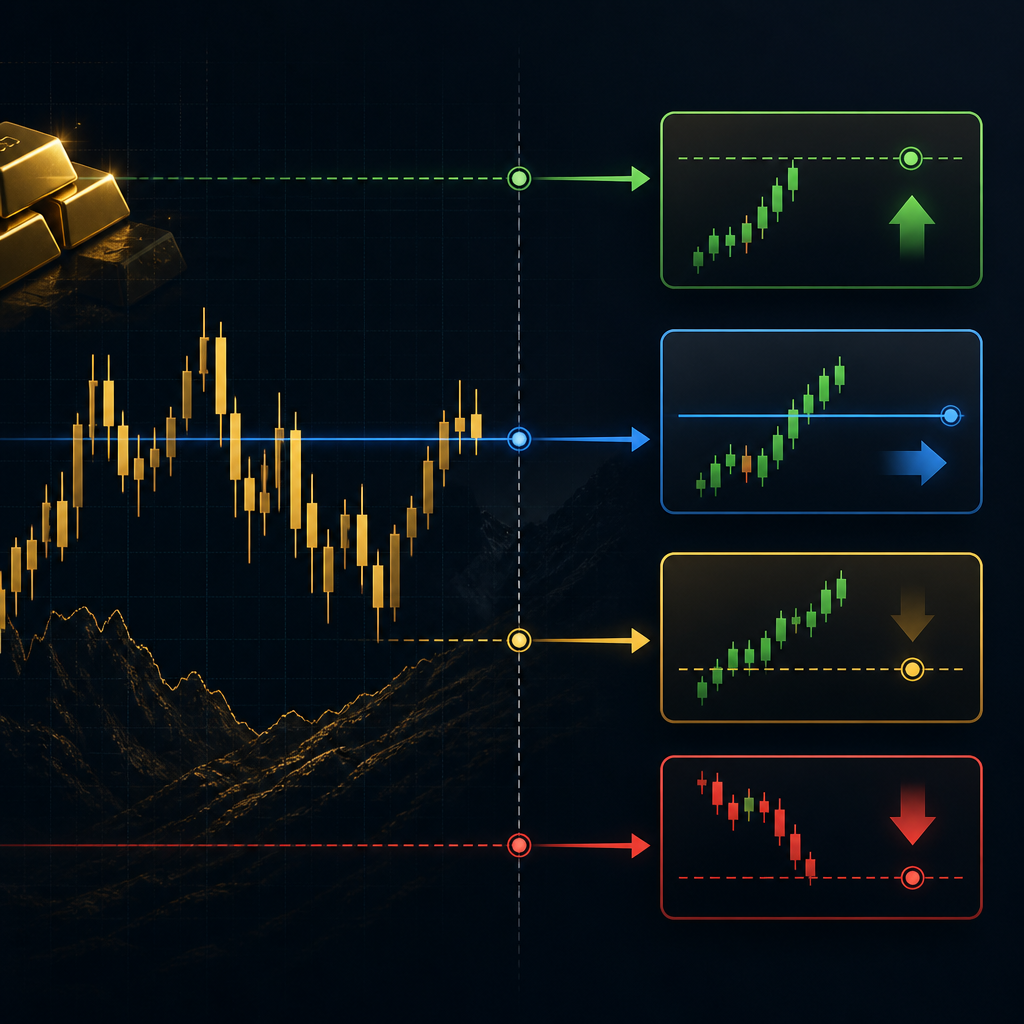
If you want consistency, you need a repeatable pre-trade process.
Not a long one—just a checklist you run every time, especially when gold is moving fast around $2650.
Step 1: Confirm the signal type and timeframe
Is it an intraday scalp, a session trade, or a swing idea?
A $12 stop might be fine for a London push, but too tight for a multi-session hold.
Step 2: Identify the “execution window”
We prefer London and NY because liquidity is deeper and spreads are typically more stable.
If you’re trading outside those windows, consider reducing size or demanding cleaner confirmation.
Step 3: Check current conditions (30-second macro filter)
- DXY at 106.80: a firm dollar can cap gold rallies or create sharper pullbacks.
- USD/JPY near 149.50: risk sentiment and yield dynamics can spill into gold quickly.
- EUR/USD 1.0520 and GBP/USD 1.2680: if majors are stagnant, gold may be the day’s volatility leader.
You’re not doing deep fundamentals here.
You’re simply asking: “Is today likely to be smooth or spiky?”
Step 4: Define your invalidation level (the ‘cancel’ point)
This is where most traders lose discipline.
They place a buy limit, price breaks structure, and they leave the order sitting there like a landmine.
Example:
- Buy limit planned at $2642
- Structure low at $2630
- If price closes below $2630 (on your chosen timeframe), the long idea is invalidated
- Your pending order should be canceled, not “left just in case”
Step 5: Pre-calculate SL/TP and position size
Gold moves too fast to calculate lot size while price is hitting your level.
Set your SL first (typically $10–$25 away), then compute size so your account risk is fixed.
If you want a full risk framework for signal trading, pair this guide with our risk article: risk management strategies when using forex signals.
Step 6: Place alerts before the order triggers
Alerts are not optional if you want to avoid late entries.
They are the bridge between “I saw the signal” and “I executed it on time.”
How to Place XAUUSD Limit Orders (Pullback Entries) Without Missing Fills
A strong limit order strategy XAUUSD traders use is simple: let price come to you.
But you need to structure the limit properly, or you’ll either miss the fill by $0.50 or get filled in the wrong market state.
When buy limits and sell limits work best
- Buy limit: bullish context, you want a dip into support (e.g., $2642–$2645 zone).
- Sell limit: bearish context, you want a pop into resistance (e.g., $2668–$2672 zone).
Limit orders are ideal when gold is ranging around a key level and you expect a “tap and go.”
They’re also ideal when spreads are stable and you don’t want to chase a candle.
Step-by-step: a clean buy limit build (with realistic numbers)
- Choose the entry: Buy Limit $2642.0.
- Place the stop: SL $2627.0 (risk = $15).
- Set TP1 (1:2): $2672.0 (reward = $30).
- Set TP2 (1:3): $2687.0 (reward = $45).
- Decide management: at TP1, either take partial (e.g., 50%) or move SL to breakeven if conditions are calm.
- Add alerts: alert at $2644 (heads-up) and $2642 (entry touch).
How to avoid the #1 limit-order mistake: “set-and-forget” in changing structure
Limit orders are not “fire and forget.”
They’re “fire and monitor the context.”
If price breaks below $2630 with momentum and DXY is pushing higher, your long thesis may be invalid.
In that case, leaving a buy limit at $2642 is not patience—it’s negligence.
Zone entries vs single-price entries
Gold often front-runs levels by $0.50–$2.00.
If your broker allows multiple pending orders, consider splitting entries:
- Buy Limit 1: $2644 (30% size)
- Buy Limit 2: $2642 (40% size)
- Buy Limit 3: $2640 (30% size)
Your SL stays the same, but your average fill improves and you reduce the “missed by a whisker” problem.
This is one of the simplest ways to reduce late entries without changing the strategy.
How to Execute Breakout Signals with Stop Orders (Without Slippage Traps)
Breakout execution is where traders lose the most money through slippage and false breaks.
Gold can spike $6–$12 through a level, trigger your stop order at the worst price, then snap back.
When to use buy stop / sell stop on XAUUSD
- Buy stop: above resistance when you want confirmation. Example: buy if $2660 breaks and holds.
- Sell stop: below support when you want confirmation. Example: sell if $2638 breaks with momentum.
Step-by-step: a disciplined buy stop breakout plan
Assume gold is consolidating between $2646 and $2658, and the signal is a breakout long.
- Entry: Buy Stop at $2660.0 (above the range high).
- Stop: SL at $2646.0 (risk = $14).
- TP1 (1:2): $2688.0 (reward = $28).
- TP2 (1:3): $2702.0 (reward = $42) — note: this is slightly above the guideline range, so you can cap TP2 at $2698–$2690 depending on nearby resistance.
- Alert: $2658 (heads-up), $2660 (trigger), $2664 (slippage check / momentum confirmation).
Use “confirmation logic” to avoid false breaks
You don’t need extra indicators.
You need rules that prevent you from buying a one-tick spike.
- Rule A (candle close): only keep the trade if a 5M candle closes above $2660 after triggering.
- Rule B (retest): if price triggers and immediately returns below $2660, consider exiting quickly or tightening risk.
- Rule C (time stop): if after 15–30 minutes price hasn’t moved at least $4–$6 in your direction, momentum may be failing.
Stop-limit as a slippage control (when available)
If your platform supports stop-limit, you can set:
- Buy Stop: $2660
- Buy Limit: $2661.5 (max acceptable slippage)
If gold gaps to $2665, you won’t get filled at a terrible price.
You may miss the trade—but missing is often cheaper than a bad fill with a wide stop.
Stop-Loss and Take-Profit Rules for Gold Signals (SL/TP That Survive Volatility)
Most traders don’t “lose on analysis.”
They lose because their SL is placed where gold naturally breathes, or their TP is set without respecting nearby liquidity.
Gold SL placement: structure first, dollars second
The $10–$25 guideline is useful, but it’s not the reason for the stop.
The reason is invalidation: the market proved your idea wrong.
Practical examples around current levels:
- Long from $2642: if the swing low is $2630, an SL at $2627 gives room beyond structure (risk $15).
- Short from $2672: if the swing high is $2683, an SL at $2688 gives room beyond structure (risk $16).
TP selection: use R:R plus “where price will react”
1:2 and 1:3 are solid benchmarks.
But gold respects obvious levels, and your TP should consider them.
Example short:
- Sell Limit: $2672
- SL: $2688 (risk $16)
- TP1 (1:2): $2640 (reward $32)
- TP2 (1:3): $2624 (reward $48) — still within the $2610–$2690 context
Partial profits vs single TP: a simple model
If you’re trading signals and want consistency, a two-target approach is practical:
- TP1: 1:2, take 40–60% off.
- TP2: 1:3 (or next major level), trail or hold remaining size.
This reduces the emotional pressure to “be perfect.”
It also aligns with how gold often moves: impulse, pause, second impulse.
Breakeven rules (when to move SL to entry)
Breakeven is a tool, not a religion.
Move to breakeven too early and you’ll get stopped out on a normal retest.
A balanced rule for XAUUSD:
- Only move SL to breakeven after price has moved at least 1R in your favor (e.g., $15 if your SL is $15).
- Prefer moving SL to a structure-based level (higher low / lower high) instead of exact entry.
If you want to deepen this, we also cover execution and volatility behavior in our news-survival guide: how gold signals react to unexpected news events.
Alert Automation: The Fastest Way to Stop Late Entries (Phone + Platform)
If you only implement one thing from this article, make it alerts.
Alerts fix the real-world problem: you’re not staring at XAUUSD all day.
The 3-alert system (simple and effective)
For any pending entry, set three alerts:
- Heads-up alert: 1–2 dollars before entry (gets you ready).
- Trigger alert: at the exact entry level (decision moment).
- Failure alert: near invalidation (warns you to cancel or reduce risk).
Example for buy limit $2642 / invalidation $2630:
- Heads-up: $2644
- Trigger: $2642
- Failure: $2631
Why alerts beat “watching the chart”
Watching the chart creates fatigue.
Fatigue creates impulsive clicks.
Alerts create a “punctuated workflow.”
You act when the market is at your level, not when your emotions are at their limit.
Telegram + platform alerts: how to combine them
Most traders already receive signals via Telegram.
The missing step is converting the Telegram message into platform-native alerts and pending orders immediately.
At United Kings, our premium Telegram signals include clear Entry, SL, and TP levels, which makes this conversion fast.
If you want to see how our community receives and executes trades, join our Telegram here: United Kings Telegram trading room.
A practical routine that takes under 2 minutes
- Read the signal once (don’t interpret it yet).
- Place the pending order with SL/TP.
- Add the heads-up alert and invalidation alert.
- Only then go back and review context (spread, session, nearby news).
This routine is how you avoid the classic mistake: analyzing so long that price reaches the level without you.
Slippage, Spread, and Volatility: How to Reduce Execution Costs on XAUUSD
In gold, your “fee” is not just commission.
Your real cost is the combination of spread + slippage + poor fills.
Where slippage spikes (common times)
- London open volatility burst
- New York open and the London-NY overlap
- High-impact US data releases
- Unscheduled geopolitical headlines
Even on a normal day with gold around $2650, a quick $8 candle can turn your planned entry into a worse fill.
Execution tactics that actually work
- Prefer pending orders for planned levels: limits for pullbacks, stops for breakouts.
- Avoid market orders during the first spike: wait for the second candle or a retest if the setup allows.
- Use maximum deviation settings (platform dependent) to avoid fills far from your price.
- Don’t widen SL to “make it work” after a bad fill—reduce size or skip the trade.
Spread awareness without obsessing
You don’t need to stare at spread all day.
You need one rule: if spread is abnormally wide, don’t execute aggressively.
For example, if your normal spread is tight and suddenly expands, a breakout buy stop at $2660 can trigger and fill poorly.
That turns a $14 risk plan into a $20 risk reality.
Use “execution buffers” for breakouts
Instead of placing a buy stop exactly at resistance, place it slightly above to reduce false triggers.
Example:
- Resistance: $2658
- Buy stop: $2660 (buffer $2)
- SL: below the range at $2646
This buffer is not random.
It’s a recognition that gold loves to wick obvious levels before choosing direction.
If you want more on the mechanics behind gold execution costs, our spread deep-dive pairs well with this checklist: United Kings blog (search “spread explained”).
Signal-Type Checklists: Market Entry vs Pending Entry (Copy-Paste Ready)
Different signal formats require different execution behavior.
Use the right checklist and you’ll stop improvising under pressure.
Checklist A: Market-entry XAUUSD signals (when speed matters)
- Confirm it’s truly a market signal: not a limit that already ran.
- Check spread: if it’s unusually wide, wait 30–60 seconds or demand a retest.
- Place SL immediately: do not “enter first, decide later.”
- Use 1:2 baseline TP: then decide if you’ll extend to 1:3 based on structure.
- Set a time-stop: if no follow-through after 15–30 minutes, reduce risk.
- No revenge re-entries: if stopped, wait for a new signal or a clear re-setup.
Checklist B: Pending-entry XAUUSD signals (limits/stops)
- Place the pending order immediately after reading the signal.
- Set invalidation rules: if structure breaks, cancel the order.
- Use alerts: heads-up, trigger, and failure alerts.
- Consider split entries: 2–3 limits to reduce missed fills.
- Don’t “chase” if missed: if price never touched your level, wait for the next setup.
Checklist C: Breakout stop orders (the slippage-safe version)
- Buffer the trigger: place buy stop $1–$2 beyond the obvious level.
- Know your max acceptable slippage: consider stop-limit if available.
- Require confirmation: candle close beyond level or retest hold.
- Keep SL logical: below the breakout base, not “somewhere small.”
- Reduce size during news windows: execution risk is higher.
These checklists are execution-only.
They don’t change the strategy—just the consistency of how you deploy it.
Position Sizing for XAUUSD Signals: Keep Risk Constant, Not Lot Size
If you keep the same lot size on every gold trade, your risk is not consistent.
And inconsistent risk is one of the fastest ways to turn a good signal stream into a rollercoaster.
The only sizing goal that matters
Risk a fixed dollar amount (or fixed %), not a fixed lot.
Because your stop distance changes from trade to trade.
Example: two trades, same lot size, completely different risk
Trade A uses a $12 stop (tight intraday).
Trade B uses a $24 stop (wider swing).
If you use the same lot size for both, Trade B risks roughly double.
That means one loss can erase two wins, even if your win rate is strong.
A simple sizing workflow (platform-agnostic)
- Decide your maximum risk per trade (example: 1% of account).
- Measure SL distance in dollars (example: $15).
- Calculate position size so that if SL hits, you lose exactly your chosen risk.
- Round down to the nearest size your broker supports.
If you’re newer, test this on demo first.
Execution skills are best built without real-money pressure.
Why this matters for signal services specifically
Signal providers can deliver excellent entries.
But if you oversize one trade and undersize the next, you won’t experience the same performance curve.
At United Kings, we focus on clarity—Entry, SL, TP—so you can size correctly.
We also publish results and methodology for how performance is calculated (see /results/ and /methodology/), because transparency matters.
If you’re also trading currencies, the same sizing logic applies—see our Forex Signals page for how we structure majors alongside gold.
Real Execution Scenarios Around $2650: Two Trades, Two Outcomes
Let’s make this practical with two realistic scenarios in the $2610–$2690 range.
Same signal idea, different execution quality, different outcome.
Scenario 1: Pullback long executed with a limit (clean)
Context: Gold is bullish intraday, but pulling back from $2662 toward support.
- Buy Limit: $2643
- SL: $2629 (risk $14)
- TP1: $2671 (1:2)
- TP2: $2685 (near 1:3)
You place the pending order and alerts.
Price taps $2643 during a quick dip, fills you, then runs to $2671 during NY momentum.
Result: you hit TP1, reduce risk, and let the remainder attempt TP2.
Even if TP2 doesn’t hit, your execution made the trade easy.
Scenario 2: Same idea, but you chase (late entry)
You didn’t place the limit.
You watch gold dip to $2643, then bounce to $2649, and you buy market at $2649.
Now your original SL at $2629 is a $20 risk.
To maintain your original dollar risk, you either reduce size (good) or tighten SL (dangerous).
Many traders tighten SL to $2635, get stopped on a routine wick, then watch price rally to TP.
They conclude the signal “didn’t work.”
But the signal did work.
The execution didn’t.
The execution lesson
Your job is not to predict every tick.
Your job is to ensure that when price reaches the level, you’re already prepared—with orders, SL/TP, and alerts.
This is why premium signal trading is as much about process as it is about entries.
If you want a broader framework for evaluating services, this pairs nicely with our checklist: forex trading signals provider checklist.
Execution Mistakes That Kill Good XAUUSD Signals (and the Fix for Each)
Most execution problems repeat.
Fix the patterns once, and your results improve permanently.
Mistake 1: Entering after the move (FOMO entry)
What it looks like: you see gold already $6 above the planned entry and you “don’t want to miss it.”
Fix: if your limit didn’t fill, either wait for the next retracement or wait for a new setup.
Mistake 2: Moving SL wider after entry
What it looks like: you buy at $2650, SL was $2635, then price dips and you move SL to $2625.
Fix: if the planned SL is hit, accept it. If you want a wider SL, decide that before entry and size down.
Mistake 3: Placing SL at “round numbers”
What it looks like: everyone puts SL at $2640 or $2630 because it’s clean.
Fix: place SL beyond structure and likely liquidity pools (e.g., $2629 instead of $2630).
Mistake 4: No invalidation rule for pending orders
What it looks like: you leave a buy limit active even after a bearish break.
Fix: set a “cancel condition” based on structure (close below/above key level) and enforce it.
Mistake 5: Alerts only at the entry price
What it looks like: you get an alert at $2642, but you’re busy, and by the time you look it’s $2648.
Fix: use the 3-alert system: heads-up, trigger, failure.
Mistake 6: Treating all sessions the same
What it looks like: you execute aggressively during low liquidity hours and get chopped.
Fix: prioritize London and NY sessions, and be more selective elsewhere.
These fixes don’t require a new indicator.
They require a professional execution routine.
FAQ: XAUUSD Signal Execution, Pending Orders, and Alerts
1) Should I use market orders or pending orders for gold signals?
Use pending orders when the signal is designed around a level (pullback or breakout trigger).
Use market orders only when the signal explicitly expects immediate continuation and spreads are stable.
2) How far should my stop loss be on XAUUSD?
In many intraday gold setups, SLs often fall in the $10–$25 range.
But the correct SL is where your idea is invalidated (beyond structure), then you size your position to keep risk constant.
3) What’s the best way to avoid late entries on Telegram signals?
Convert the signal into a pending order immediately, then set alerts (heads-up + trigger + failure).
If you rely on “I’ll enter when I see it,” you’ll be late on the fastest moves.
4) If my limit order didn’t fill, should I chase the trade?
Usually no.
If the edge was the pullback fill, chasing changes the trade’s risk/reward and often places your entry into resistance or late momentum.
5) How do I reduce slippage on XAUUSD breakout trades?
Use a trigger buffer ($1–$2 beyond the level), consider stop-limit if available, avoid entering on the first spike, and demand confirmation (close/retest).
Risk Disclaimer (Read Before You Trade)
Forex and gold trading involves significant risk and may not be suitable for all investors.
Past performance (including any historical win-rate figures) does not guarantee future results, and no signal can promise profits.
Always use stop-loss orders, manage position size responsibly, and consider practicing on a demo account before trading live.
Ready to Execute Gold Signals Like a Pro? Join United Kings
If you want to stop missing entries and start executing with confidence, you need two things: clear signals and a repeatable execution system.
United Kings provides premium Telegram forex and gold signals with clear Entry, SL, and TP levels, plus educational guidance to help you execute—not just watch.
Start here:
- Explore our full service: United Kings trading signals
- Focus specifically on XAUUSD: premium gold signals
- Compare our plans on the pricing section: Starter (3 Months $299), Best Value (1 Year $599), Unlimited (Lifetime $499)
Want the fastest access?
Join our Telegram now and see how we structure trades in real time: https://t.me/unitedkings1.
Reminder: we offer a 48-hour refund window (conditions apply—see refund policy).
Execute the next XAUUSD move with a checklist—not with hope.