If you’ve ever tried to trade gold (XAUUSD) during U.S. CPI or an FOMC decision, you know the feeling: price jumps $8 in a blink, your spread doubles, your entry fills late, and the next candle reverses $15 like nothing happened.
That’s not “bad luck.” That’s news microstructure. And if you’re executing a gold signal without a plan for volatility, spread spikes, and slippage, you’re basically donating to the market.
In this execution guide, we’ll focus on one practical goal: how to trade XAUUSD during CPI and FOMC using volatility filters, spread limits, and OCO orders so you can follow signals without getting wrecked by the first two minutes of chaos.
TL;DR: The CPI & FOMC XAUUSD Execution Rules (Save This)
- Don’t market-enter into the first spike. Use OCO (one-cancels-the-other) stop orders or wait for a post-news confirmation candle.
- Use a volatility filter. If 1-minute ATR or the last 5-minute range is already “too hot,” skip the entry and wait for structure.
- Set a maximum spread rule. Example: if XAUUSD spread is > $0.50–$0.80 during the event (broker-dependent), you don’t execute.
- Pre-define slippage tolerance. If your platform supports it, cap deviation; otherwise, use stop orders with buffers.
- Trade smaller during news. Same stop size ($10–$25), but smaller lots to keep risk constant when fills are messy.
- After CPI/FOMC, trade the “second move.” Confirmation + retest setups often outperform the first impulse.
Why CPI & FOMC Are Different for XAUUSD (And Why Signals Fail Here)
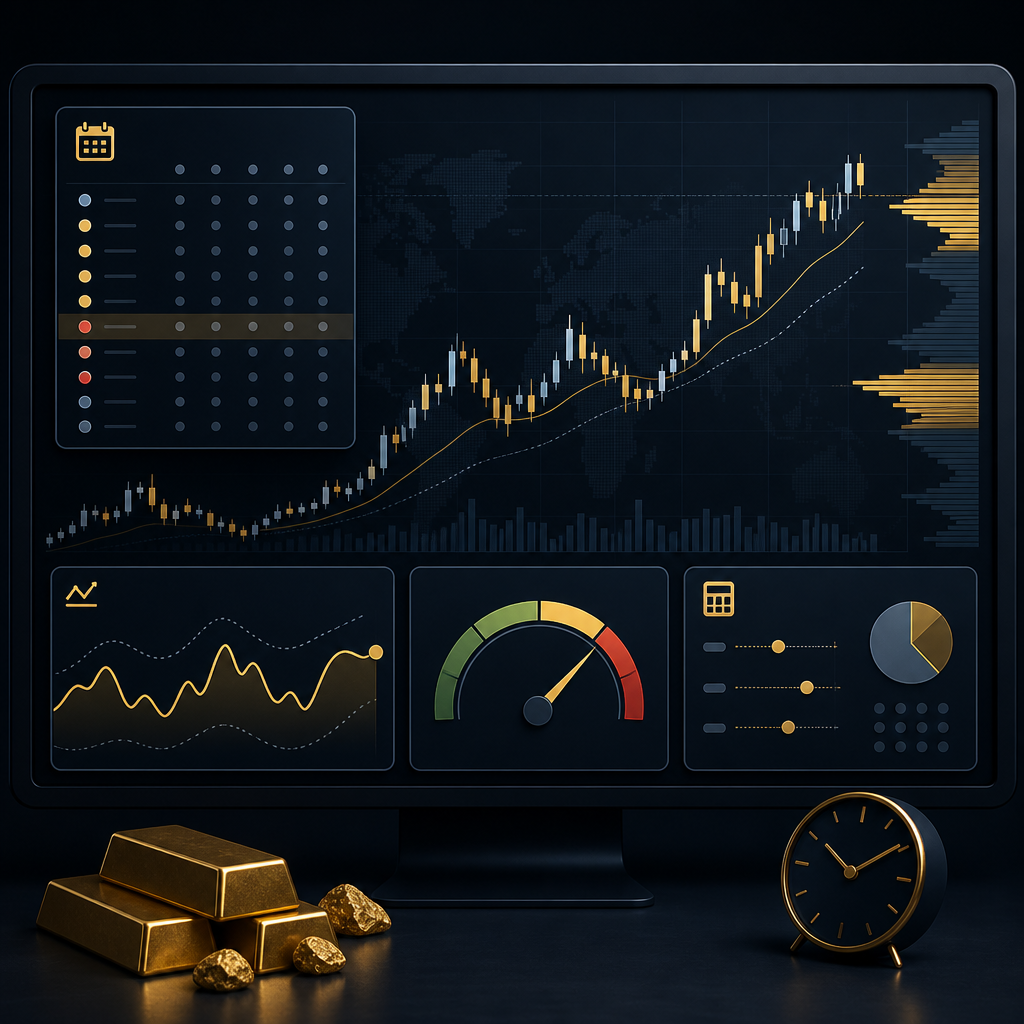
Gold at $2650 is not “just another chart.” It’s a macro asset that reacts instantly to U.S. inflation surprises, Fed rate expectations, and real yields.
Right now, the broader context matters: DXY around 106.80, USD/JPY near 149.50, EUR/USD around 1.0520, and gold holding firm near $2650 (+0.35% on the day). That’s a classic environment where a single CPI print can reprice the whole curve.
Here’s the execution problem: during CPI and FOMC, XAUUSD liquidity thins at the exact moment everyone tries to transact.
That creates three “signal killers”:
- Spread expansion: your broker widens pricing to protect themselves, and you pay the hidden cost.
- Slippage: your order gets filled at a worse price than expected, turning a clean 1:2 RR into a messy 1:1.
- Whipsaw: the first move often gets faded, especially when algos hunt stops above/below obvious levels.
So when traders say, “Signals don’t work during news,” what they usually mean is: execution rules were missing.
At United Kings, we treat CPI and FOMC as a separate playbook.
We still trade London and NY sessions, but we adjust the how: order types, volatility filters, and strict spread limits.
If you’re already following signals from United Kings Gold Signals, this article helps you execute them like a pro during the most dangerous 30 minutes of the month.
Pre-News Checklist: What You Must Confirm 60–15 Minutes Before CPI/FOMC
Most blowups happen because traders “show up” to CPI or FOMC like it’s a normal Tuesday.
Instead, run a checklist. This is the difference between controlled risk and chaos.
Step 1: Know the exact event and the “second event”
CPI has the release, then the revision narrative, then the bond market reaction.
FOMC has the rate decision, then the statement, then Powell’s press conference Q&A.
So you’re not trading one candle.
You’re trading a sequence of liquidity shocks.
Step 2: Mark your key XAUUSD levels (simple, not fancy)
On a 15M or 1H chart, mark the nearest obvious:
- Previous day high/low
- Asia range high/low
- London high/low (if CPI is NY morning)
- Nearest round numbers: $2640, $2650, $2660, $2670
Example with gold at $2650:
- Asia range: $2638–$2652
- London high: $2661
- Prior day high: $2674
These levels become your OCO anchors and your “do not chase” boundaries.
Step 3: Check your broker’s typical spread behavior
News spreads are broker-specific.
On calm conditions, XAUUSD might be $0.15–$0.35 spread.
During CPI, it can jump to $0.80–$2.50 for a few seconds.
Your job is to define a rule like:
- Max spread allowed for entry: $0.60
- Max spread allowed for stop modification: $1.00 (only if already in trade)
If you don’t define these numbers, you’ll rationalize bad fills in real time.
Step 4: Decide your “news mode” risk
News mode usually means smaller size, not wider stops.
For example, if you normally risk 1% per trade, drop to 0.25%–0.50% during CPI/FOMC.
Keep stops realistic for gold: $10–$25 depending on the setup.
That way, even if slippage adds $2–$4, you don’t blow the plan.
For deeper risk frameworks, pair this guide with our execution and risk articles on the United Kings blog and especially our dedicated guide on risk management when using signals.
Volatility Filters That Keep You Out of the Worst Whipsaws (ATR + Range Rules)
Volatility is not the enemy.
Unfiltered volatility is.
A volatility filter is a rule that tells you when conditions are too unstable to execute a signal as written.
This matters because CPI/FOMC can push gold from $2650 to $2668 and back to $2646 within minutes.
If you enter during that phase, your stop placement becomes meaningless.
Filter #1: 1-minute ATR threshold (practical version)
Use ATR(14) on the 1-minute chart.
Create a “red zone” threshold based on your broker’s typical behavior.
Example rule:
- If 1M ATR(14) is > $1.20 before the news, you don’t place new orders.
- If 1M ATR(14) spikes to > $2.50 right after release, you wait for it to fall back below $1.50 before executing.
This prevents you from trading during the “air pocket” phase.
Filter #2: 5-minute range cap (the simplest filter)
If you don’t like indicators, use a pure price filter:
- Measure the last 5-minute candle range (high-low).
- If it’s > $10, you don’t market-enter.
- If it’s > $15, you avoid stop orders too and wait for structure.
Why these numbers?
Because many retail gold strategies use $10–$25 stops.
If a single 5-minute candle is already $15 wide, your stop is likely inside the noise.
Filter #3: “Two-candle stabilization” rule
After CPI/FOMC, wait for:
- Two consecutive 1-minute candles with smaller bodies, and
- Wicks that stop expanding in both directions.
This is a simple way to let the initial stop-hunt finish.
Then you trade the next clean break or retest.
How to combine filters without overthinking
Use one indicator filter and one price-action filter.
For example:
- 1M ATR must be below $1.50, and
- Last 5M range must be below $12
If both are true, you’re allowed to execute.
If either is false, you wait.
This is how professional execution desks think: permissioning conditions, not predictions.
Maximum Spread Rules: Your Non-Negotiable “No Trade” Line
Spread is the cost you pay to enter and exit.
During CPI and FOMC, spread becomes a risk variable, not just a cost.
If you ignore it, you’ll see trades that “should have worked” fail because your entry was effectively worse by $0.80–$1.50.
Define your spread limits in dollars (not feelings)
Gold spreads are quoted in dollars (or points depending on broker).
Make your rule explicit:
- Normal conditions: acceptable spread $0.15–$0.40
- News conditions: acceptable spread $0.40–$0.80
- No-trade zone: spread > $0.80 (or your broker’s equivalent)
If your broker regularly hits $1.50+ on CPI, you must either avoid trading that minute or consider a better execution venue.
Why spread limits protect your stop-loss
Let’s say you buy XAUUSD at $2652.0 with a $12 stop at $2640.0 and a 1:2 TP at $2676.0.
If spread is $0.30, fine.
If spread expands to $1.20 and you get slipped $1.00, your real entry might be closer to $2653.0–$2654.0.
Now your stop is effectively $1–$2 closer.
That changes the probability of survival dramatically in the first 60 seconds.
Spread-aware execution tactics
- Don’t modify orders during the spike. Adjusting SL/TP while spread is wide can cause accidental closes.
- Use alerts: if spread exceeds your limit, your platform should alert you and you pause execution.
- Prioritize limit entries post-news: once structure forms, limits reduce slippage risk.
Quick comparison: Entry methods under spread stress
| Execution Method | Best For | Main Risk During CPI/FOMC | When We Use It |
|---|---|---|---|
| Market order | Fast fills in calm markets | High slippage + worst spread | Rarely; only after stabilization filters pass |
| Stop order (Buy Stop/Sell Stop) | Breakout capture | Stop runs + fill at peak volatility | Pre-news with OCO + buffers |
| Limit order (Buy Limit/Sell Limit) | Retest entries | Missed fills if move doesn’t retest | Post-news confirmation + pullback |
| OCO bracket (Buy Stop + Sell Stop) | Direction-agnostic news trading | Both sides triggered if broker doesn’t truly OCO | When platform supports true OCO or manual cancel plan |
Spread limits are boring.
They’re also the single most important “adult supervision” rule in news trading.
If you want a deeper breakdown of how spreads behave in gold, pair this with our related explainer on XAUUSD execution costs inside the United Kings ecosystem, and keep your signal workflow aligned with our signals execution standards.
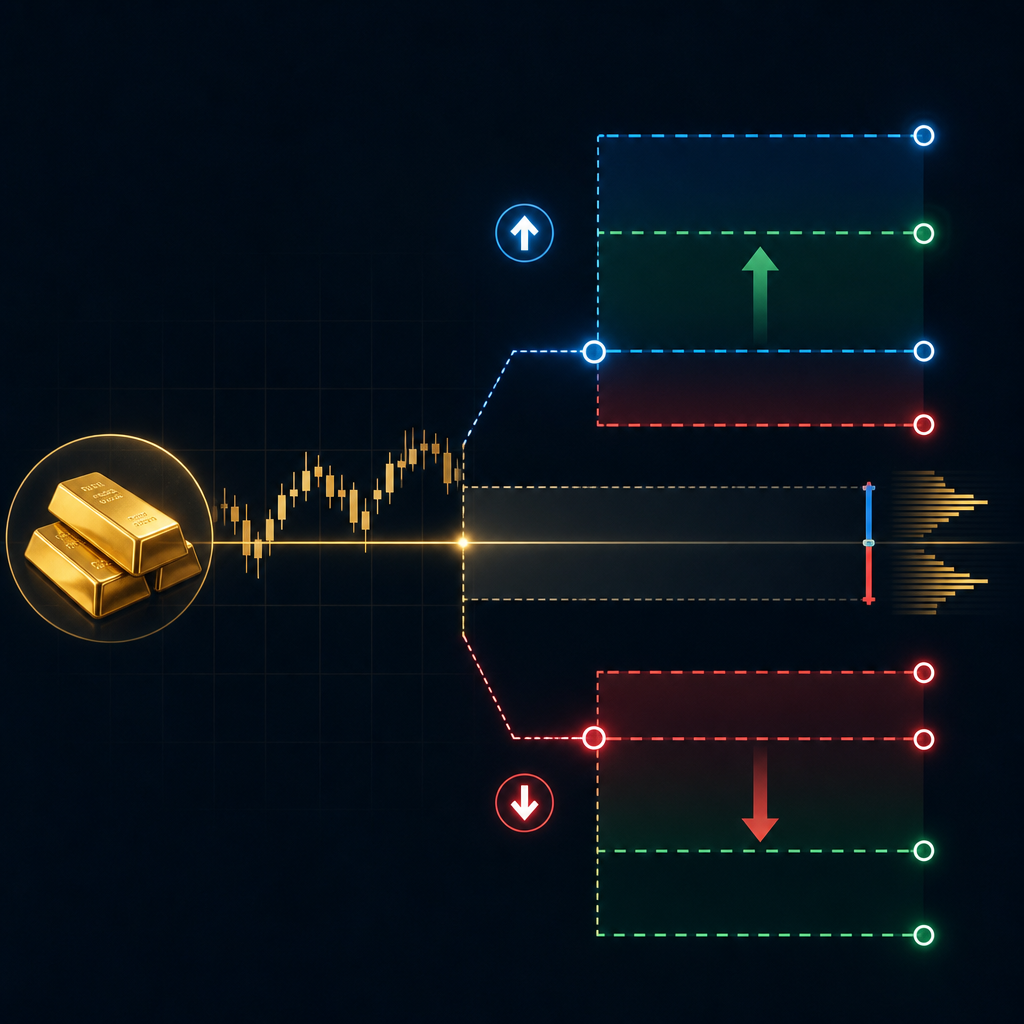
OCO Orders for CPI & FOMC: The Cleanest Way to Catch the Move Without Guessing
OCO stands for One Cancels the Other.
You place two pending orders: one above price, one below.
If one triggers, the other is cancelled automatically.
This is ideal for CPI and FOMC because you don’t need to predict direction.
You just need a plan to manage volatility and avoid the fake first break.
Step-by-step: A practical OCO setup on XAUUSD near $2650
Let’s assume gold is hovering at $2650.0 5 minutes before CPI.
You mark a tight pre-news range: $2646.5–$2653.5.
Now you build an OCO bracket with buffers:
- Buy Stop: $2656.0 (above the range + buffer)
- Sell Stop: $2644.0 (below the range + buffer)
- Stop Loss: $12–$18 away (news mode). Example: $2644.0 entry SL at $2660.0 is wrong side; instead SL should be above structure if sell triggers—e.g., Sell Stop $2644.0, SL $2658.0 ($14).
- Take Profit: 1:2 or 1:3. Example: risk $14, TP1 $2616.0 (1:2) and TP2 $2602.0 (1:3) if momentum is strong. (If you prefer staying within the day’s likely range, you can scale: TP1 $2630.0, TP2 $2620.0 depending on volatility.)
The key is the buffer.
If you place stops right at $2653.5 and $2646.5, you’re begging to be triggered by a wick.
How big should the buffer be?
A simple rule:
- Buffer = 0.5 × 1M ATR (just before news)
If 1M ATR is $1.20, buffer is $0.60.
In practice, many traders use $1.0–$2.5 buffers on gold around CPI.
It depends on your broker and the current volatility regime.
OCO mistake that blows accounts: “Both sides filled”
Some platforms label orders as OCO but don’t truly cancel instantly.
During a spike, price can trigger both orders before cancellation executes.
To protect yourself:
- Use a platform that supports true OCO (or a bracket order feature).
- If not, use a manual OCO protocol: the moment one triggers, immediately cancel the other.
- Reduce size so even a double-fill doesn’t break your daily risk limit.
When we prefer OCO vs post-news entries
We prefer OCO when:
- Pre-news range is tight and clean
- Spread is stable under your max limit
- You can monitor the release live
We prefer post-news confirmation when:
- Spread is already widening before release
- Gold is sitting at a major weekly level (fakeouts common)
- FOMC press conference is coming (two-stage volatility)
OCO is not a magic trick.
It’s a structure that forces discipline when your emotions want to click “Buy” on the first green candle.
Stop Orders vs Limit Orders: Choosing the Right Tool for News Volatility
During CPI/FOMC, your edge often comes from order selection, not indicator settings.
Two traders can see the same signal and get opposite results purely based on execution.
Stop orders: best for momentum, worst for slippage
A stop order is designed to enter when price breaks a level.
That’s perfect if CPI triggers a genuine repricing and gold runs from $2650 to $2675.
But it’s dangerous if the first move is a liquidity sweep.
Example scenario:
- CPI comes hotter than expected.
- DXY spikes above 106.80 and gold dumps from $2650 to $2638.
- Then gold snaps back to $2655 in 90 seconds as yields cool.
If you used a Sell Stop at $2646 with no filter, you might get filled at $2644.5 and stopped at $2658 on the snapback.
The move “worked” later, but you were gone.
Limit orders: best for retests, worst for missed fills
A limit order enters on a pullback.
This is often the cleaner way to trade the “second move.”
Example:
- Gold spikes up from $2650 to $2668 on CPI.
- Then it retraces to $2658–$2660.
- You place a Buy Limit at $2660 with SL $2648 ($12 risk) and TP $2684 (1:2).
This avoids buying the very top.
The trade-off is that sometimes gold doesn’t retest and you miss the run.
That’s fine.
Missing a trade is a cost.
Getting slipped into a bad fill is a compounding loss.
A simple decision framework you can use every time
- If volatility filter is red: no stops, no markets. Wait.
- If volatility filter is yellow: consider OCO stops with larger buffers and smaller size.
- If volatility filter is green after release: use limits on retests with defined structure.
Where most signal followers go wrong
They treat a signal like a command: “Buy now.”
Professional execution treats a signal like a setup: “Buy if conditions allow.”
This is exactly how our community learns to trade around high-impact events inside United Kings Gold Signals—you get clear Entry, SL, and TP, but you also learn the execution context so you don’t force trades during the worst spreads.
Slippage Control: How to Reduce Bad Fills When Gold Moves $10 in Seconds
Slippage is the gap between the price you wanted and the price you got.
During CPI and FOMC, slippage is normal.
The goal is not “zero slippage.”
The goal is bounded slippage that doesn’t destroy your risk-reward.
Rule 1: Never size positions assuming perfect fills
If your stop is $15 and you risk $150 per trade, you might normally trade 0.10 lots (example only; depends on contract specs).
During news, assume you could lose an extra $2–$5 from slippage and spread.
So you reduce size until your worst-case still fits your risk.
Rule 2: Use “entry zones,” not single-price entries
Instead of “Buy at $2652.0,” define:
- Entry zone: $2651.5–$2653.0
- Invalidation: closes below $2646 on 1M (example)
This is more realistic around CPI.
It also prevents emotional revenge trading when you miss an exact price by $0.40.
Rule 3: Avoid moving stops to break-even too early
During news, break-even stops are magnets.
If you move to BE after +$4, a normal retrace tags you and then the real move happens without you.
Instead, use a structured approach:
- Move to BE only after price achieves at least 1R (equal to your stop distance).
- Or trail behind a 5M swing level, not a random number.
Rule 4: Don’t “close and re-open” rapidly
During CPI/FOMC, rapid re-entry is how traders rack up spread costs.
Each round-trip might cost $1–$3 in spread and slippage.
Do that five times and you’ve paid $10–$15 just to participate.
Instead, commit to one of these:
- OCO breakout plan
- Post-news confirmation plan
- No-trade plan
Reality check: when slippage is telling you to stop trading
If you see:
- Multiple fills worse than $2.0 from expected, or
- Stops triggered on spread spikes without real price movement
That’s your broker/environment saying: “Not now.”
Protect your monthly P&L by skipping the worst 5 minutes.
There will be another trade in London or NY session later.
Post-News Confirmation Entries: The “Second Move” Strategy for Safer Gold Trades
If you want the cleanest approach to trade XAUUSD during CPI without the heart attack, trade the confirmation.
This means you let the first impulse happen, then you trade the structure that forms after.
It’s less exciting.
It’s also where many consistent traders make their money.
Step-by-step: Confirmation entry after CPI on XAUUSD
Assume gold is $2650 pre-CPI.
CPI prints softer than expected.
Gold spikes to $2669, then pulls back to $2660.
Now you wait for three things:
- Impulse: a clear break above the pre-news range (done: $2669)
- Pullback: price returns toward the breakout area (done: $2660)
- Confirmation: a bullish close back above $2663–$2665 (example trigger)
Your trade could look like:
- Entry: Buy $2665.0 after confirmation close
- SL: $2652.0 (risk $13)
- TP1 (1:2): $2691.0 (risk $13 → reward $26)
- TP2 (1:3): $2704.0 (only if momentum stays; otherwise trail)
Notice how the stop is placed under a structural level, not in the middle of the spike zone.
Confirmation tools that work well (keep it simple)
- 5M market structure: higher high + higher low after the release
- VWAP reclaim (optional): price reclaims VWAP after the spike
- 1H close direction: if the 1H closes in the direction of the move, continuation odds improve
Why this works especially well on FOMC days
FOMC is often a two-act play.
The decision headline creates the first move.
Then Powell’s tone creates the second move.
If you trade confirmation, you avoid being chopped by the first algorithmic reaction.
You also avoid getting trapped when the market reverses after listening to the press conference.
How to combine confirmation entries with signal following
If you receive a signal and it’s within 5–10 minutes of CPI/FOMC:
- Don’t blindly enter.
- Convert it into a conditional plan: “I’ll enter after confirmation if spread < $0.70 and ATR stabilizes.”
This is how you stay aligned with the idea of the signal while respecting the reality of news execution.
If you’re new to Telegram-based execution, our guide on how to use Forex signals on Telegram helps you build the habit of reading signals as structured setups, not impulsive commands.
Complete CPI/FOMC Execution Playbook (Minute-by-Minute)
Let’s turn this into a repeatable routine you can run every CPI and every FOMC.
Keep it boring.
Consistency beats adrenaline.
T-60 to T-30 minutes: Environment check
- Check current price: XAUUSD ~$2650, DXY ~106.80.
- Mark key levels: prior day high/low, Asia high/low, London high/low.
- Decide your mode: OCO breakout vs post-news confirmation.
- Set max spread rule: example “no entries above $0.80 spread.”
T-30 to T-10 minutes: Build the plan
- Measure 1M ATR and last 5M range.
- If volatility is already elevated, commit to post-news only.
- If using OCO, place stops with buffers and pre-defined SL/TP.
- Reduce lot size to news risk (0.25%–0.50% risk).
T-10 to T-0 minutes: Hands off
- No new analysis.
- No moving orders closer “to get filled.”
- Cancel plan if spread starts exploding early.
T+0 to T+2 minutes: The chaos window
- Do not market-enter.
- If OCO triggers, manage calmly: ensure the opposite order is cancelled.
- Do not adjust SL/TP until spreads normalize.
T+2 to T+10 minutes: Stabilization window
- Apply your volatility filters: ATR and range must cool.
- Look for confirmation structure: break, pullback, reclaim.
- Prefer limit entries on retests.
T+10 to T+60 minutes: Trade the real trend
- Now you can trade like a normal session again.
- Targets and stops become more reliable.
- Trail behind structure, not behind emotions.
This routine is compatible with signal-based trading because it tells you when you’re allowed to execute a signal.
And if your goal is to follow a professional team, that’s exactly what we build at United Kings: signals plus the execution framework to survive the high-volatility days.
Real Trade Examples (XAUUSD $2610–$2690): Good vs Bad Execution
Let’s make this concrete with realistic gold prices and risk parameters.
We’ll use stops in the $10–$25 range and 1:2 to 1:3 RR.
Example A: “Bad execution” market buy into CPI spike
Context: XAUUSD is $2650.0 pre-CPI.
CPI prints softer, gold spikes instantly.
- Trader hits Market Buy at “$2658.0”
- Actual fill due to slippage/spread: $2661.2
- Stop set at $2648.0 (risk $13.2)
Price whips to $2668, then dumps to $2649.0 and stops them out.
Then gold trends to $2688 later.
The idea was right.
The execution was wrong.
Example B: “Good execution” confirmation buy after CPI
Context: XAUUSD spikes to $2668, pulls back to $2658.
- Entry: Buy $2662.0 after 5M reclaim
- SL: $2649.0 (risk $13)
- TP1: $2688.0 (1:2)
- TP2: $2701.0 (1:3) if momentum holds
Even if there’s a second pullback, your stop is under structure, not under noise.
Example C: OCO breakout during FOMC (direction-agnostic)
Context: Gold compresses pre-FOMC between $2646 and $2654.
- Buy Stop: $2657.0
- Sell Stop: $2643.0
- SL: $15
- TP: $30 (1:2) and optional runner to $45 (1:3)
FOMC triggers a hawkish surprise, gold breaks down.
Sell triggers, buy cancels, and you ride the move toward $2615–$2620 if momentum persists.
Example D: “No trade” is a valid trade
Context: 1M ATR is $2.80, spread is $1.40, and candles are $12–$18 wide.
Your filter says no.
You skip.
This is how pros protect equity curves.
Remember: you don’t get paid for activity.
You get paid for quality decisions.
How CPI and FOMC Change Gold’s Relationship With DXY and USD/JPY
During normal sessions, gold often trades inversely to the dollar.
But during CPI/FOMC, correlations can flip briefly because multiple markets reprice at once.
Right now, with DXY at 106.80 and USD/JPY at 149.50, the market is sensitive to anything that shifts rate expectations.
What to watch in the first 5 minutes
- DXY spike + gold spike: can happen if the move is driven by risk-off flows or liquidity dislocations.
- USD/JPY whips: a violent JPY move can signal rate vol; gold may follow with a lag.
- Bond yields (if you track them): real yields drive gold more cleanly than nominal yields over time.
A practical “macro filter” for signal execution
If you’re about to take a gold buy after CPI:
- If DXY is making new highs aggressively, be cautious on gold longs.
- If DXY fades after the initial spike and gold holds above the breakout level, that supports continuation.
You don’t need to become a macro economist.
You just need one cross-check so you’re not buying gold while the dollar is ripping higher on a hawkish repricing.
We cover these cross-market filters in more depth across our education, and you’ll see them referenced alongside our alerts in United Kings Signals when the day calls for extra caution.
Position Sizing for News: Keep the Same Stop, Reduce the Lot
Most retail traders respond to CPI/FOMC by widening stops.
That’s usually backwards.
Gold can move $20–$40 on big surprises, yes.
But if you widen stops to “survive,” you often end up risking 2–3× your normal amount without noticing.
The news sizing principle
Keep your stop logical ($10–$25) and reduce position size to keep risk fixed.
Example:
- Normal day: risk $200 with a $10 stop.
- News day: still use a $10–$15 stop, but risk $75–$100.
This protects you from:
- Slippage
- Spread spikes
- Double-fill OCO accidents
- Emotional revenge trades
Daily loss limit (the rule that saves careers)
Set a hard daily loss limit for CPI/FOMC days.
For many traders, that’s 1R or 2R.
If you hit it, you stop.
Because news days can trigger “tilt” faster than any other environment.
Scaling out: how to lock profits without choking the trade
Gold trends after CPI/FOMC can be powerful.
But they can also snap back violently.
A practical approach:
- Take partial at 1:1 or 1:1.5 (depending on plan).
- Move stop only after 1R is reached.
- Leave a runner for 1:2 or 1:3 if structure supports it.
This is especially useful when gold is trading in the $2610–$2690 band and you’re aiming for the edges of the range.
If you want a structured way to evaluate signal providers and their risk frameworks, our checklist at forex signal provider checklist for beginners translates perfectly to gold signal quality too.
Common CPI/FOMC Mistakes Signal Traders Make (And the Fix for Each)
Let’s call out the mistakes that repeatedly destroy otherwise good strategies.
These are painful because they’re avoidable.
Mistake 1: Entering because “the signal says so”
Fix: Add execution conditions: spread limit + volatility filter + timing rule.
A signal is not a guarantee.
It’s a plan that needs proper market conditions.
Mistake 2: Placing stops at obvious sweep levels
During news, obvious levels get hunted.
Fix: Place SL beyond structure, not beyond your comfort.
If the structure is too wide, reduce size or skip.
Mistake 3: Overtrading the first 3 minutes
Fix: One attempt only in the chaos window.
If it fails, switch to confirmation mode.
Mistake 4: Ignoring platform limitations (no true OCO)
Fix: Test your platform on demo during a high-impact event.
If it can’t handle bracket orders properly, don’t rely on it for OCO.
Mistake 5: Trading FOMC like CPI
CPI is a single release shock.
FOMC is multiple shocks.
Fix: If you trade FOMC, plan for two volatility waves and avoid overcommitting before Powell speaks.
If you want to understand how gold signals behave when the unexpected hits (geopolitics, surprise comments, emergency headlines), read how gold signals react to unexpected news events and integrate those survival rules into your CPI/FOMC routine.
United Kings Execution Standards: How We Help You Trade News Without Guessing
Gold news trading is where “free signals” usually fall apart.
Not because the idea is always wrong.
Because execution details are missing.
At United Kings, our approach is built for real traders:
- Premium Telegram signals with clear Entry, SL, and TP levels
- 85%+ historical win rate (past performance is not a guarantee)
- 300K+ active traders in the community learning together
- London and NY session focus, where liquidity and follow-through are strongest
- Education alongside signals, so you can execute like a professional
- 48-hour money-back guarantee so you can test the service with confidence
If you want to follow both gold and FX around U.S. events, you can explore:
- United Kings Gold Signals for XAUUSD-focused setups
- United Kings Forex Signals for majors like EUR/USD (1.0520), GBP/USD (1.2680), and USD/JPY (149.50)
And if you want the full bundle and execution guidance, start at our main signals page.
We also keep our community active on Telegram, where execution notes matter most during CPI/FOMC: United Kings official Telegram channel.
FAQ: Trading XAUUSD Signals During CPI & FOMC
1) What is the safest way to trade XAUUSD during CPI?
The safest approach is usually post-news confirmation: wait for the first impulse, then trade a pullback + reclaim with spread and ATR filters. This reduces slippage and whipsaw exposure.
2) What spread is “too high” for gold during news?
It depends on your broker, but many traders set a maximum spread rule around $0.60–$0.80 for new entries. If your spread is above that, your execution quality is likely compromised.
3) Are OCO orders good for FOMC gold trading strategy?
Yes—if your platform supports true OCO and you use buffers plus smaller size. FOMC can whipsaw twice (headline + press conference), so OCO should be paired with strict volatility filters.
4) What stop loss size is realistic for XAUUSD around CPI/FOMC?
Many setups use $10–$25 stops depending on structure. The key is to keep risk fixed by adjusting lot size, and to avoid placing stops inside the event’s normal noise band.
5) Should beginners trade gold during CPI and FOMC?
Beginners should start on a demo account and practice the checklist, spread rules, and order types first. Live trading during CPI/FOMC can be emotionally and technically demanding.
Risk Disclaimer (Read Before You Trade)
Trading forex and gold (XAUUSD) involves significant risk and is not suitable for all investors. High-impact news events like CPI and FOMC can cause extreme volatility, spread widening, and slippage. You can lose more than you expect if you trade without risk controls. Past performance is not indicative of future results, and no signal provider can guarantee profits. If you’re new, practice on a demo account and use strict position sizing and daily loss limits.
Final CTA: Want CPI/FOMC-Ready XAUUSD Signals With Clear Execution?
If you’re serious about trading gold around CPI and FOMC, you need two things: high-quality setups and professional execution rules.
Join United Kings and get premium gold and forex signals with clear Entry, SL, and TP levels, plus the execution guidance that helps you handle volatility days without panic.
- Explore our full service: United Kings Signals
- Focus on gold: XAUUSD Gold Signals
- Choose your plan on our pricing page: Starter (3 Months $299), Best Value (1 Year $599 + FREE ebook), or Unlimited (Lifetime $999)
- Join the community on Telegram: United Kings official Telegram
Trade smarter, not louder. Let’s execute CPI and FOMC the way disciplined gold traders do.