You’re following gold analysis or signals and you notice something confusing: the XAUUSD price on your MT4/MT5 broker doesn’t always match the COMEX gold futures (GC) price you see on TradingView or a futures platform. Sometimes the difference is small. Around big news or near contract rollover, it can look “off” enough to make you doubt your entry, stop loss, or take-profit.
This guide answers the practical retail question: XAUUSD vs gold futures—what’s actually different, why quotes can diverge, and what that means for spreads, rollover behavior, and news volatility when you execute trades.
Key takeaways
- XAUUSD is spot (OTC) pricing quoted by brokers/liquidity providers; GC is an exchange-traded futures contract with centralized order flow.
- Spot and futures are linked by cost-of-carry (rates, storage, time), but they can differ because they are different instruments with different market microstructure.
- Futures “roll” via contract months; spot brokers often apply swap/financing daily. These are not the same thing and can affect holding costs and chart continuity.
- Spreads and slippage behave differently: XAUUSD spread is broker-dependent; GC spread is typically tight but you pay commissions and exchange fees.
- During CPI/FOMC/NFP, both can spike, but your fill quality depends on where liquidity is deepest at that moment and how your platform routes orders.
- A simple checklist at the end helps you choose the instrument that fits your signal-following execution needs.
XAUUSD vs Gold Futures (GC): what you’re actually trading
What XAUUSD is (spot gold in CFD/OTC form)
XAUUSD is the symbol most retail traders use for spot gold priced in USD. In practice, many retail accounts trade XAUUSD as a CFD (contract for difference) offered by a broker. That means:
- There’s no single centralized exchange for your XAUUSD trade.
- Your broker streams a quote from one or more liquidity providers and adds a spread (and sometimes a markup).
- Your holding cost is usually expressed as swap/financing (often charged daily, with a triple-swap day).
If you’re new to the symbol itself, see what XAUUSD is and how brokers quote it.
What GC futures are (standardized COMEX contracts)
GC is the ticker for COMEX gold futures (CME Group). A futures contract is standardized: contract size, tick size, delivery month, trading hours, and rules are defined by the exchange. Key implications:
- Price discovery happens on a central limit order book (you can see bids/asks and volume).
- You typically pay commissions and exchange fees instead of a broker “spread markup” (though there is still a bid/ask spread).
- You trade a specific contract month (e.g., April, June, December), and you must roll to a later month if you want to maintain exposure.
Why this matters for signal followers
Most retail gold signals are written for XAUUSD because it’s widely available on MT4/MT5 and CFD brokers. But you might execute on futures (GC) for tighter spreads, different margining, or because your country/provider setup makes futures easier.
The problem: the same “gold idea” will not always have the same entry price, stop distance, or exact wick behavior between XAUUSD and GC. You need a translation layer.
How spot gold and futures prices are linked (and why they still differ)
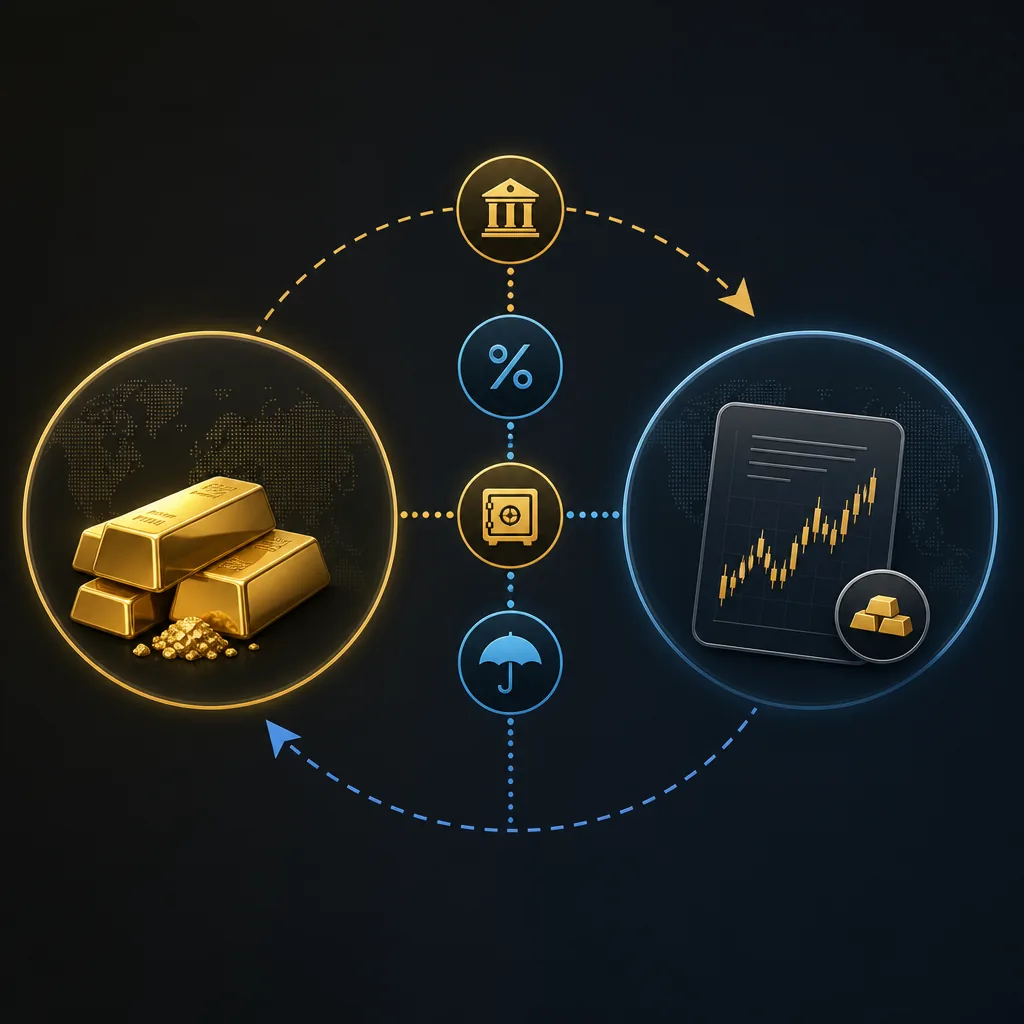
The relationship: cost-of-carry (in plain English)
Spot and futures are connected by arbitrage. If futures are “too expensive” versus spot (after accounting for carry costs), traders can buy spot and sell futures (or equivalent hedges). If futures are “too cheap,” they can do the opposite.
The key idea is time: a futures contract expires in the future, so its fair value reflects the cost/benefit of holding gold until that time.
In simplified terms, the difference between futures and spot tends to reflect:
- Interest rates (cost of funding capital)
- Storage/insurance (for physical hold, relevant in institutional pricing)
- Convenience yield (benefit of holding the physical asset, can vary)
- Time to expiry (more time, more carry effect)
You don’t need to calculate this daily as a retail trader. You just need to accept a practical rule: GC and XAUUSD are highly correlated but not identical, and the basis (the difference) can widen or shrink.
Three common reasons quotes differ on your screen
- Different instrument: GC is a specific contract month; XAUUSD is spot. A June futures contract can trade at a premium/discount to spot depending on carry.
- Different liquidity venues: XAUUSD is OTC liquidity; GC is centralized exchange liquidity. Microstructure differs, especially during fast markets.
- Different data and chart settings: many charting platforms show “continuous” futures (rolled/adjusted). Your broker shows spot. If you compare the wrong futures series, you’ll think something is broken.
Hypothetical example: why your entry doesn’t match
Example (hypothetical numbers): Suppose spot XAUUSD is trading at 2,400.0. The active GC contract you’re watching is at 2,403.0. That 3.0 difference is not automatically “manipulation” or a bad broker. It can simply be the futures contract pricing in carry until expiry.
If a signal says “Buy XAUUSD 2,400.0,” and you execute on GC without adjustment, you might enter at 2,403.0—effectively paying 3.0 more. That changes your stop distance and your risk per contract unless you compensate.
Spreads and trading costs: what changes between XAUUSD and GC
XAUUSD costs: spread + swap (and sometimes commission)
With XAUUSD on a typical retail broker, your direct visible cost is the spread. Some accounts also charge commission, but many bake their revenue into the spread.
Your main “hidden” cost is financing/swap if you hold positions overnight. Swap can be positive or negative depending on broker and market conditions, but for many traders it’s effectively a cost of holding.
If you’re actively following gold signals, it’s worth also reading a focused guide on execution frictions—see XAUUSD trading strategy for practical context on how setups and execution interact.
GC futures costs: tight spread + commissions/fees
GC futures often trade with very tight bid/ask spreads in liquid hours. But you pay:
- Commission (your broker/FCM)
- Exchange fees (CME/COMEX)
- Data fees (depending on platform and subscription)
So “tight spread” doesn’t automatically mean “cheaper.” It depends on your trade frequency and size.
Comparison table: retail-relevant differences
| Feature | XAUUSD (spot/CFD) | GC (COMEX futures) | What it means for you |
|---|---|---|---|
| Market type | OTC quote via broker | Exchange-traded order book | Futures has centralized prints/volume; XAUUSD depends on broker feed. |
| Pricing reference | Spot gold in USD | Specific contract month | Expect a basis difference (premium/discount), especially near expiry. |
| Trading costs | Spread + swap (maybe commission) | Spread + commissions/fees | Choose based on your holding time and trade frequency. |
| Overnight holding | Daily swap/financing | No swap; exposure embedded in futures price + roll | Holding costs show up differently; don’t compare them 1:1. |
| Rollover behavior | No contract expiry; broker may adjust swap conditions | Contracts expire; you must roll to maintain position | Futures traders must plan roll dates; spot traders must plan swap impact. |
| News volatility | Can widen spreads sharply (broker-dependent) | Can gap/whip with fast order flow | Both are volatile; your fill quality depends on liquidity and order type. |
Rollover vs swap: the biggest “hidden” difference

How rollover works in futures (GC)
Futures contracts have expiration months. Most retail futures traders don’t hold into delivery; they roll—close the current contract and open the next active one.
When you roll, you’re switching to a different contract price. That price can be higher or lower than the contract you’re leaving. This creates an apparent “jump” on continuous charts, depending on how your platform builds the continuous series (back-adjusted, forward-adjusted, or unadjusted).
Practical impact: if you place stops/targets based on a chart that is adjusted differently than your execution contract, your levels can be off by a few dollars.
How swap works in XAUUSD
Spot/CFD positions don’t expire, so brokers charge/credit swap for holding beyond a cutoff time. This is the broker’s way of reflecting financing costs. Many brokers apply a larger swap on a specific weekday to account for weekend settlement conventions.
Practical impact: two traders can take the same XAUUSD signal and get different net outcomes if one holds for several nights and the other closes intraday—purely due to swap and spread conditions.
Hypothetical example: same idea, different holding cost mechanics
Example (hypothetical): You buy XAUUSD at 2,400.0 and hold 5 nights. Your broker charges a small overnight financing amount each night. On futures, you buy the active GC contract and hold the same calendar period; you don’t see a daily swap debit, but the futures price already reflects carry, and if you cross a roll window you may need to roll to keep exposure.
Bottom line: “No swap” on futures doesn’t mean “no cost.” It means the cost is expressed differently (in the futures curve and the roll).
Why news volatility can look different on XAUUSD vs GC
Liquidity and spread behavior around events
During major releases (CPI, FOMC, NFP), gold can move fast. Both instruments can show sharp spikes, but the trading experience differs:
- XAUUSD: spreads can widen significantly because your broker widens quotes when liquidity thins or risk increases. You may see more “spread spikes” and stop-outs if your stop is tight.
- GC futures: spreads can remain relatively tight in normal conditions, but price can move through levels quickly. Slippage can happen if you use market orders or if your stop becomes a market order in a fast move.
If your main concern is trading during volatile windows, it helps to plan sessions and expected liquidity. See best time to trade XAUUSD for a session-by-session perspective you can adapt to futures as well.
Order types and how they fill
Execution details matter more than most traders admit. For signal followers, the big differences are:
- Stop orders: on many platforms, a stop triggers a market order. In fast markets, the fill can be worse than expected on both XAUUSD and GC.
- Limit orders: reduce slippage risk but increase “missed trade” risk. If a signal assumes a limit entry, you should keep it as a limit where possible.
- Partial fills: common on exchange-traded futures when liquidity at your price is limited. Less common on retail CFD fills (though you can still get requotes or worse fills depending on broker model).
How to translate a signal between XAUUSD and GC (step-by-step)
If you follow signals written for XAUUSD but you execute on GC (or vice versa), use this practical process. It won’t make prices identical, but it will keep your risk controlled and reduce “why did my stop get hit?” surprises.
Step 1: Confirm you’re comparing the right futures series
- Check whether your chart is showing the active contract month or a continuous contract.
- If it’s continuous, find out whether it’s back-adjusted or unadjusted. Back-adjusted charts smooth the roll gap but shift historical prices.
- For execution, always reference the actual tradable contract (the one you will place orders on).
Step 2: Measure the current basis (GC price minus XAUUSD price)
At the moment you plan to enter, note both quotes and compute a simple difference:
- Basis ≈ GC (active contract) − XAUUSD (spot)
Example (hypothetical): XAUUSD 2,400.0 and GC 2,403.0 → basis is +3.0.
This basis is not constant. Measure it close to the time you execute, not hours earlier.
Step 3: Translate the signal’s entry, stop, and target by distance, not by exact price
Signal followers often make a costly mistake: they try to copy the exact XAUUSD prices onto GC. Instead, translate using distance.
Example (hypothetical):
- XAUUSD signal: Buy 2,400.0, SL 2,385.0 (risk 15.0), TP 2,430.0 (reward 30.0)
- You execute on GC. If GC is 3.0 higher at that moment, you can approximate:
- GC entry near 2,403.0, SL near 2,388.0, TP near 2,433.0 (keeping the same 15/30 distances)
That keeps your structure consistent, even if the basis shifts slightly.
Step 4: Recalculate position size using your instrument’s tick value
A 15-dollar stop on XAUUSD in a CFD account does not automatically equal the same money risk as a 15-dollar move on a futures contract. You must size by your account risk and the instrument’s value per move.
- Decide your risk per trade (e.g., 1% of account).
- Convert stop distance into money risk per lot/contract.
- Size down if the contract is too large for your stop.
If you want a straightforward tool-based workflow for sizing, use a lot size calculator and double-check move value with a pip calculator where applicable (brokers define “pip” conventions differently for metals).
Step 5: Choose order types that match the signal’s intent
- If the signal is a limit entry (pullback), keep it a limit on your platform if possible.
- If it’s a breakout entry, expect slippage in fast markets; consider a stop-limit (where available) to cap worst-case fills.
- During major news, consider reducing size or skipping if your broker routinely widens spreads aggressively.
Step 6: Document the basis and your adjustments
Keep a simple note in your journal: “Signal written for XAUUSD; executed on GC; basis at entry +3.0; translated SL/TP by distance.” After 20–30 trades, you’ll see patterns in when the basis widens (roll windows, certain sessions, extreme volatility).
Common mistakes traders make when comparing XAUUSD and GC
Mistake 1: Comparing spot to the wrong futures contract
If you compare XAUUSD to a far-month GC contract, the difference can look “too big” simply because there’s more time to expiry (more carry). Always compare to the most relevant active contract you would actually trade.
Mistake 2: Using a back-adjusted futures chart for exact price levels
Back-adjusted continuous charts are great for indicators and long-term structure. But the historical prices have been shifted to remove roll gaps. If you copy exact prices from that chart into live orders, your levels may not align with the tradable contract.
Mistake 3: Ignoring spread widening on XAUUSD during news
Many traders place tight stops because the chart “looks clean.” Then CPI hits, spread widens, and the stop triggers even if the mid-price didn’t truly break the level. If you trade XAUUSD around news, you must plan for spread behavior (or avoid those minutes).
Mistake 4: Not recalculating risk when switching instruments
Switching from XAUUSD micro-lots to a full GC contract can silently multiply your risk. Even if your stop distance is the same in dollars, the money per dollar move can be very different.
If you need a refresher on building risk rules around signals, see forex risk management (the same principles apply to gold).
Which is better for retail traders: XAUUSD or GC?
There isn’t a universal winner. The better choice depends on how you trade, what platform you use, and how you follow signals.
XAUUSD tends to fit you if…
- You follow signals designed for MT4/MT5 pricing and want minimal translation.
- You want flexible position sizing (micro lots) and easy access with many brokers.
- You mostly trade intraday and can avoid holding through multiple swap charges (or you’ve tested your broker’s swap impact).
- You value simplicity: one symbol, no contract months, no roll operations.
GC futures tends to fit you if…
- You want centralized exchange pricing and visible volume/order flow.
- You prefer the futures cost model (commissions/fees) and you trade during liquid futures hours.
- You’re comfortable managing contract months and rolling when needed.
- Your strategy benefits from tight spreads and consistent market structure on an exchange.
Simple checklist: decide what fits a signal follower’s execution needs
Use this checklist before you commit to one instrument (or before you switch). It’s designed specifically for traders executing signals.
Execution fit checklist
- 1) Where are the signals written? If your provider posts XAUUSD entries/SL/TP, can you execute XAUUSD directly without translation?
- 2) Can you size properly? Can you trade small enough (lots/contracts) so your stop distance matches your risk plan?
- 3) What happens during news? Does your broker widen XAUUSD spreads aggressively? Does your futures platform handle volatility with acceptable slippage?
- 4) Do you hold overnight? If yes, compare XAUUSD swap impact vs futures roll/curve effects. Don’t assume one is automatically cheaper.
- 5) Are you comparing the right chart? For futures, are you using the tradable contract for execution and understanding continuous chart adjustments?
- 6) Is your workflow fast enough? Signals require speed. If your futures platform is slower for you than MT5 (or vice versa), that matters more than theory.
A practical “hybrid” approach many retail traders use
Some traders analyze gold using GC futures (for volume and clean exchange prints) but execute on XAUUSD because their signal service and account are built around MT4/MT5. Others do the opposite: follow XAUUSD signals but execute on GC after translating distances and sizing carefully.
If you do this, be consistent: always note the basis at entry and always translate by distance.
FAQ: XAUUSD vs gold futures (GC)
Is XAUUSD the same as COMEX gold futures?
No. XAUUSD is spot gold priced in USD (often traded as a CFD via a broker). GC is a futures contract with a specific expiry month traded on COMEX. They’re strongly linked, but they are different instruments.
Why is GC sometimes higher (or lower) than XAUUSD?
Because futures pricing reflects time to expiry and carry factors (like interest rates and storage economics). Also, spot is OTC broker pricing while futures is exchange pricing. The difference (basis) changes over time.
Do gold futures have swap fees like XAUUSD?
Futures don’t charge a daily swap in the same way CFDs do. Instead, the cost/benefit of carry is reflected in the futures price and in the roll process between contract months. The economic effect can still matter—just expressed differently.
Which is better for trading gold during CPI/FOMC?
Either can work, but the risk is different. XAUUSD may show spread widening (broker-dependent). GC can move extremely fast with slippage risk. If you trade news, consider practicing on a demo first and use order types that match your plan.
Can I follow XAUUSD signals if I trade GC futures?
Yes, but you should translate levels by distance, measure the basis near entry, and recalculate position size for futures tick value and contract size. Don’t copy/paste exact prices without adjustment.
Risk warning: Trading forex and gold involves a significant risk of loss and is not suitable for all investors. You can lose more than you deposit with leveraged products. Past performance does not guarantee future results. This article is for education only and is not personal financial advice. If you’re unsure, practice on a demo account before trading live.
If you want trade alerts you can execute quickly, United Kings sends forex and gold (XAUUSD) signals on Telegram with an entry, stop loss, and take-profit levels. You can view a selection of signals on the free channel at https://t.me/unitedkings1. If you’re comparing providers, start with our guides to the best gold signals and best forex signals, and review how our results are reported and how they are calculated. VIP plan details are on the pricing page.