
Ever watched XAUUSD jump $20–$40 in minutes during FOMC, only to reverse so fast you feel like the chart is “hunting” your stop?
If you’ve traded gold around a Fed rate decision, you already know the truth: the move isn’t random, but your execution often is.
This guide is a practical FOMC gold strategy built for real conditions—spreads widening, slippage, fake breakouts, and that second move that comes after the headline spike.
TL;DR: The Two-Scenario FOMC Plan (Pre-News → Spike → Reversal)
- Prepare two scenarios (bullish and bearish) with clear invalidation levels before the release—no improvising at 2:00 PM ET.
- Pre-news trades are optional: only take them if you have a tight structure and reduced size; otherwise, wait for the first spike to finish.
- Don’t chase the first candle: the safest money is often in the second move after the whipsaw.
- Use volatility-adjusted stops: on FOMC, a $10 stop is often noise; plan $15–$25 with smaller lot sizes.
- Filter false breakouts with “close + retest” logic and wick analysis; long wicks at key levels often signal reversal setups.
- Trade like a signal pro: entry + SL + TP + time window + “no trade” rules—exactly how premium Telegram signals are structured.
Current Market Context: Why This FOMC Setup Matters Right Now

Let’s ground this playbook in today’s tape.
Gold (XAUUSD) is trading around $2650.00, up roughly +0.35% on the day.
That’s not a huge daily change, but it’s enough to remind us gold is still sensitive to rate expectations and dollar swings.
Here’s the broader snapshot we’ll reference in examples:
- EUR/USD: 1.0520
- GBP/USD: 1.2680
- USD/JPY: 149.50
- DXY: 106.80
When DXY holds firm near 106.80, gold often needs a stronger catalyst to rally cleanly.
On FOMC days, that catalyst is rarely the rate decision alone.
It’s usually a mix of:
- Rate decision (hold, hike, cut)
- Statement language (hawkish vs dovish nuance)
- Dot plot (future path expectations)
- Press conference (Powell Q&A can reverse the first move)
That’s why a single-direction bias can be dangerous.
Instead, we build a two-scenario signal plan that tells you what to do if gold breaks up—and what to do if it breaks down.
If you want to see how we structure these decisions across multiple markets (not just gold), explore our premium hub at United Kings trading signals.
Why FOMC Moves Gold So Violently (And Why the First Move Often Lies)
Gold is priced in USD, and the Fed is the most powerful driver of USD liquidity expectations.
So when the Fed speaks, gold reacts—sometimes instantly.
The mechanics behind the FOMC spike
At the release second, algorithms read the headline and fire orders.
Liquidity thins, spreads widen, and market orders can slip several dollars on XAUUSD.
That’s why you’ll often see:
- A $10–$25 one-minute candle in either direction
- Long wicks (stop runs) above and below key levels
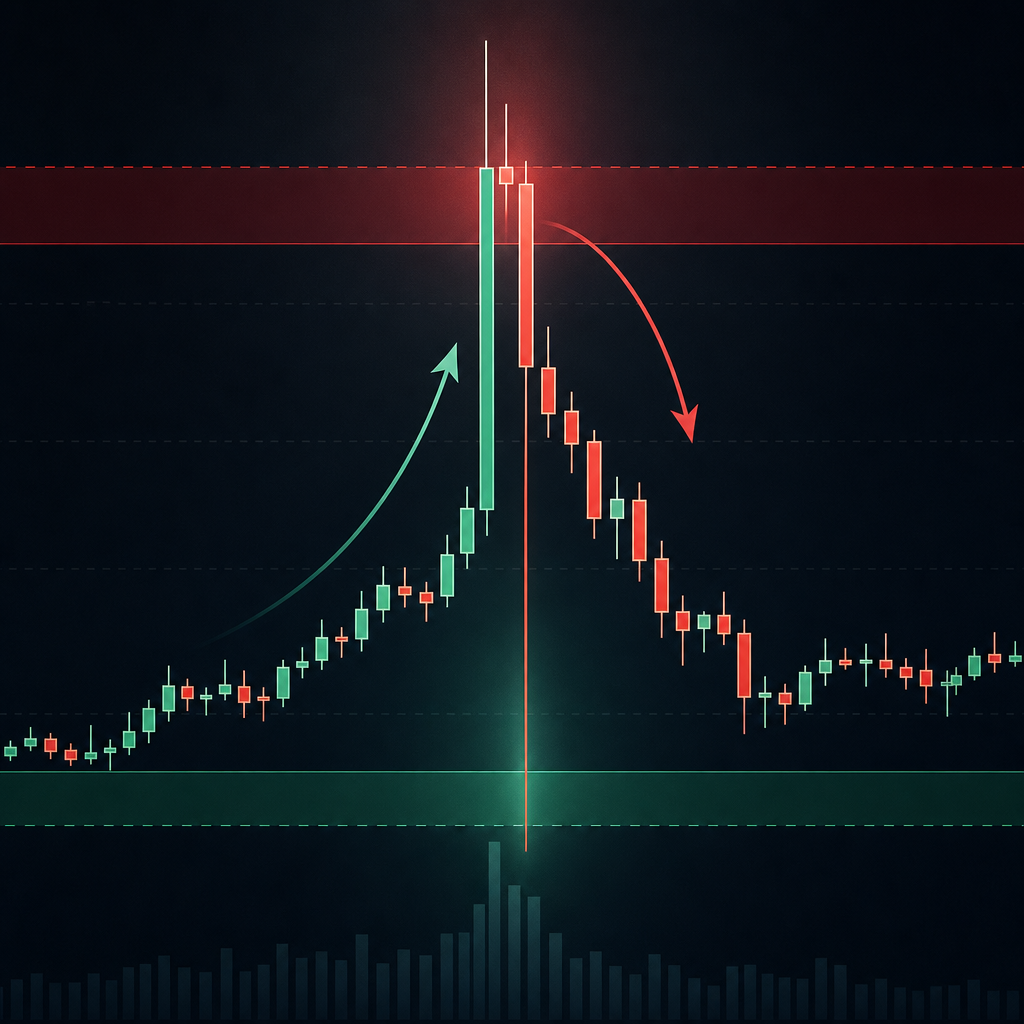
- A fast reversal as the market digests the statement details
Why the “first move” can be a trap
The first move often prices the headline.
The second move often prices the implications.
Example scenario around $2650:
- Headline reads “rates unchanged” (market expected hold).
- Gold spikes from $2650 → $2666 in 60 seconds.
- Then dot plot signals fewer cuts; yields pop; DXY jumps.
- Gold reverses $2666 → $2642 within minutes.
If you chased the breakout at $2664 with a $10 stop, you likely got clipped.
If you waited for the reversal confirmation, you had a structured trade with room.
What professional signal plans do differently
Pros don’t “predict” the candle.
They define levels, define invalidation, and execute only when the market shows its hand.
This is exactly how our gold signals are built: clear entries, SL, TP, and conditions—especially during London and New York session volatility.
The Two-Scenario Signal Blueprint (Bullish vs Bearish) You Prepare Before FOMC
Your edge on FOMC is not speed.
Your edge is preparation.
We build two scenarios around a “decision zone” using realistic levels inside today’s range.
With XAUUSD around $2650, a clean planning map could look like this:
Step 1: Mark the pre-news structure
- Resistance zone: $2668–$2675
- Mid pivot: $2650–$2653
- Support zone: $2632–$2638
- Lower flush level: $2618–$2622
- Upper extension: $2685–$2690
These are not magic numbers.
They’re simply areas where liquidity tends to sit: prior highs/lows, session opens, and obvious consolidation edges.
Step 2: Define the bullish scenario (A)
Scenario A: Gold holds above $2650 and breaks $2675 with acceptance.
- Trigger: 5m close above $2675 and a retest that holds $2670+
- Entry idea: Buy $2672–$2676 on retest
- Stop loss: $2656 (about $16–$20 risk depending on fill)
- TP1: $2705 (1:2-ish)
- TP2: $2725 (1:3-ish, only if volatility stays elevated)
- Invalidation: 5m close back below $2668 after breakout
Step 3: Define the bearish scenario (B)
Scenario B: Gold loses $2632–$2638 support and accepts below it.
- Trigger: 5m close below $2632 and a retest that fails under $2638
- Entry idea: Sell $2630–$2636 on retest
- Stop loss: $2650–$2655 (about $15–$25 depending on structure)
- TP1: $2595–$2600 (if the flush accelerates; otherwise scale earlier)
- TP2: $2575 (only if the post-statement trend persists)
- Invalidation: reclaim and hold above $2642 after breakdown
Notice what we did: we didn’t say “gold will go up” or “gold will go down.”
We said: if A happens, we do A; if B happens, we do B.
This is the same logic you’ll see in high-quality forex signals too—scenario-based execution beats prediction on high-impact news.
Pre-News Phase (30–90 Minutes Before): How to Trade Without Getting Chopped
The pre-news phase is where traders lose money quietly.
Not on the spike—before it, when the market is thin and indecisive.
What typically happens before FOMC
In the 30–90 minutes before the decision, gold often compresses.
You’ll see smaller candles, tighter ranges, and “fake” pushes into liquidity.
With XAUUSD near $2650, a common pre-FOMC behavior is:
- Price rotates between $2644 and $2658.
- Stops build above $2660–$2665 and below $2640–$2638.
- Market makers probe both sides to see where orders sit.
Pre-news trading rule: only trade if you can define “cheap invalidation”
If your stop has to be $25 away in a dead range, skip it.
Pre-news trades should be small, clean, and quick.
Two pre-news setups that can work:
- Range fade at extremes (only if the range is stable and spreads normal).
- Break-and-hold of a tight box with immediate follow-through.
Example: Pre-news range fade (lower-risk version)
Assume gold is ranging $2644–$2658.
- Buy idea: $2646
- SL: $2636 (risk $10)
- TP: $2656 (reward $10) and exit—no hero trades pre-FOMC
This is not a “big win” setup.
It’s a controlled attempt to capture rotation while keeping risk tight.
Pre-news position sizing: cut it in half
If your normal risk is 1% per trade, consider 0.25%–0.50% pre-news.
Save your risk budget for the post-release structure where probability is clearer.
For a deeper framework on sizing and exposure, keep our risk guide bookmarked: risk management strategies when using signals.
And if you’re unsure whether you should trade pre-news at all, a simple rule works: if you feel rushed, you’re not prepared—don’t trade.
The Spike Phase (0–5 Minutes After): Rules to Avoid Slippage and Fake Breakouts
This is where most traders do the most damage.
The first 1–5 minutes after the release can be pure chaos.
What changes during the spike
- Spreads widen (especially on some brokers and prop feeds).
- Market orders slip several dollars.
- Stops get swept above/below obvious levels.
- Limit orders can miss if price gaps.
So our first rule is simple: don’t market buy the first breakout candle.
If you do, you’re paying the worst price in the worst conditions.
The “No-Trade Window” rule (highly recommended)
For many traders, the best decision is to wait.
A practical rule is: no new trades in the first 60–120 seconds.
That short pause does three things:
- Lets spreads normalize.
- Lets the first stop-run show itself.
- Gives you a clearer invalidation level.
How to filter false breakouts with price action
Here are three filters we use in FOMC gold strategy execution:
- Close filter: don’t trust a wick; trust a close (5m close is stronger than 1m).
- Retest filter: breakout should retest the level and hold (acceptance).
- Wick logic: a long upper wick into $2675–$2685 often signals buy-side liquidity grab.
Example of a classic trap:
- Gold spikes from $2650 → $2684.
- The 1m candle closes at $2668 with a massive upper wick.
- Next candles fail to reclaim $2675.
- Price dumps to $2648 and then $2636.
That’s not “random.”
That’s the market grabbing breakout buyers and triggering sell liquidity.
Spike-phase order types: what’s safest?
During the first minutes, limit orders can be safer than market orders.
But limits can also miss if price doesn’t retest.
Your best compromise is often: wait for a retest, then enter with a limit inside the zone.
This is how structured XAUUSD news trading signals are designed—planned execution, not panic clicks.
If you want more on surviving surprise volatility beyond FOMC, read: how gold signals react to unexpected news events.
The Reversal Phase (5–60 Minutes After): How to Catch the “Second Move”
Now we’re in the phase where professionals make their money.
The reversal phase is where the market decides whether the spike was real—or just a liquidity sweep.
Why the second move is often higher probability
By 5–15 minutes after the release, spreads usually tighten.
More participants return, and the market starts respecting levels again.
This is where you can apply classic tools:
- Break + retest
- Failure swing
- Support/resistance flips
- Trend continuation after consolidation
Reversal setup #1: Spike-and-fail (fade the wick)
Assume gold spikes to $2686 (inside our $2685–$2690 extension zone).
Then it fails to hold above $2675 and prints lower highs.
A clean execution plan:
- Trigger: 5m close below $2670 after the spike high
- Entry: Sell $2668–$2672 on retest
- SL: $2688 (risk ~$16–$20)
- TP1: $2632–$2638 support zone (reward ~$30–$40)
- TP2: $2622 if momentum accelerates
This is a textbook 1:2+ idea without needing to “predict” the initial spike direction.
Reversal setup #2: Drop-and-reclaim (bear trap → long)
Sometimes the first move is down.
Gold might flush from $2650 to $2622, then reclaim $2638 and hold.
Execution plan:
- Trigger: reclaim $2638 and 5m close above it
- Entry: Buy $2638–$2642 on retest
- SL: $2620 (risk ~$18–$22)
- TP1: $2675 (reward ~$33)
- TP2: $2688–$2690 (reward ~$46–$50)
The key is patience.
You’re letting the market show that the breakdown failed.
The “one clean trade” rule
FOMC can tempt you into overtrading.
A rule we like: one A+ setup only; if it’s not there, you stand down.
That discipline is also why serious traders prefer curated channels over noisy groups.
If you want a benchmark for what “good” looks like, see our guide: Forex signals on Telegram for beginners.
Volatility-Adjusted Stops and Targets for FOMC (So You Don’t Get Wicked Out)
The fastest way to blow up on FOMC is to use normal-day stops.
Gold’s noise expands, and your $8–$10 stop becomes a magnet.
Rule of thumb: widen stops, reduce size
During FOMC, a practical stop range for XAUUSD is often $15–$25.
But your account risk should stay the same—or even decrease.
That means you adjust position size, not just the stop distance.
Example: Same risk, different stop
Let’s say you normally risk $100 per trade.
- Normal day: $10 stop → $10 per $1 move means you can size bigger.
- FOMC day: $20 stop → you cut size in half to keep risk $100.
Many traders do the opposite: they keep the same lot size and widen the stop.
That doubles risk without realizing it.
Targeting on FOMC: be realistic with liquidity zones
FOMC can deliver huge moves, but it can also stall hard after the first hour.
So we like structured scaling:
- TP1 at the nearest major zone (e.g., $2675 or $2638).
- Move SL to breakeven only after structure confirms (not instantly).
- TP2 at extension zones (e.g., $2688–$2690 or $2622).
Trailing stops: use structure, not emotion
On gold, a trailing stop that’s too tight will get hit by normal pullbacks.
Instead, trail behind:
- The last 5m swing high/low
- Or a key reclaimed level (support/resistance flip)
When to stop trading the event
If you miss the clean entry and price is mid-range, don’t force it.
FOMC is a one-hour opportunity window, not an all-day casino.
If you want a more complete framework for risk across multiple trades and signals, revisit: risk management strategies when using signals.
Comparison Table: Three Ways to Trade FOMC on XAUUSD (And Who Each Fits)
Not everyone should trade FOMC the same way.
Your style, broker execution, and psychology matter.
| Approach | When You Enter | Pros | Cons | Best For |
|---|---|---|---|---|
| Pre-News Range Trade | 30–90 min before FOMC inside a tight range | Clear structure, smaller candles, defined invalidation | Chop risk, can get stuck before spike, needs discipline to exit | Experienced scalpers with strict risk limits |
| Spike Chase (Not Recommended) | 0–60 seconds after release on the breakout candle | Can catch a huge move fast if lucky | High slippage, wide spreads, false breakouts, emotional errors | Rarely anyone; requires pro execution + rules |
| Post-Spike Retest (Preferred) | 5–30 minutes after, on break + retest or reversal confirmation | Better fills, clearer invalidation, higher probability “second move” | Sometimes you miss the full move; requires patience | Most traders, including signal followers |
If you’re following signals, the post-spike retest approach is usually the safest match.
It aligns with how premium channels can provide clear entries, SL, and TP without forcing you into the first-minute chaos.
That’s also why United Kings focuses heavily on London and New York session execution—liquidity and follow-through matter.
Step-by-Step: A Full Two-Scenario Signal Plan You Can Copy for the Next FOMC
Let’s put everything together into a repeatable checklist.
This is the exact “signal plan” format we recommend saving in your notes.
Step 1: 2–4 hours before — build your level map
- Mark Asia high/low and London high/low.
- Identify the nearest clean zones around current price (now ~$2650).
- Write down 2–3 “decision levels” (e.g., $2638 and $2675).
Step 2: 60 minutes before — decide your mode
- Mode A: No-trade until 2–5 minutes after release.
- Mode B: Small pre-news range trade only if structure is clean.
If you’re newer, Mode A is your default.
Demo trade Mode B until you can execute it without emotion.
Step 3: Define Scenario A (bullish) and Scenario B (bearish)
Scenario A (Bull):
- Condition: 5m close above $2675
- Entry: buy retest $2672–$2676
- SL: $2656
- TP1: $2705
- TP2: $2725 (optional)
Scenario B (Bear):
- Condition: 5m close below $2632
- Entry: sell retest $2630–$2636
- SL: $2652
- TP1: $2600
- TP2: $2575 (optional)
Step 4: During release — enforce the no-chase rule
- No market entries in the first 60–120 seconds.
- Watch where the wick forms relative to $2675 and $2638.
- Wait for a close + retest.
Step 5: After entry — manage like a pro
- Take partials at TP1 if volatility is extreme.
- Move SL only after structure confirms (not after the first green candle).
- Stop trading after one clean win or one clean loss.
This is exactly how a reliable trade XAUUSD during Fed decision plan should read: conditions first, execution second.
If you want these plans delivered in real time with clear Entry/SL/TP, our community follows them daily via United Kings gold signals.
Common FOMC Mistakes on Gold (And the Fix for Each)
Most FOMC losses come from a small set of repeatable mistakes.
Fixing them is often more profitable than learning a new indicator.
Mistake #1: Trading without invalidation
If you can’t answer “what price proves me wrong,” you’re gambling.
Fix: every trade must have a level-based invalidation (close back inside range, reclaim of broken support, etc.).
Mistake #2: Using normal-day stops
On FOMC, a $10 stop is often just market breathing.
Fix: widen to $15–$25 and reduce size to keep risk constant.
Mistake #3: Moving to breakeven too early
FOMC pullbacks are sharp.
If you move to BE after a $6 move, you’ll get tagged and watch it run $30.
Fix: only move to BE after a structure event, like a higher low holding above $2670 on a long.
Mistake #4: Overtrading the press conference
The press conference can reverse the statement move.
But it can also chop violently in a $10–$15 band.
Fix: treat the Q&A as a separate event with its own setup.
If you already took a trade, protect profit and reduce frequency.
Mistake #5: Ignoring the dollar and yields
Gold doesn’t move in isolation.
If DXY is ripping above 106.80 and yields are rising, gold rallies may fail faster.
Fix: keep a simple dashboard: XAUUSD + DXY + USD/JPY (now ~149.50) during FOMC.
If you want more on building discipline when volatility spikes, we’ve covered the psychology side in depth on our United Kings blog.
How United Kings Structures FOMC-Ready XAUUSD News Trading Signals
Signal quality matters most on days like FOMC.
A vague “Buy gold now” message is useless when spreads widen and price whips $20.
What a high-quality FOMC signal should include
- Exact entry zone (not one price, but a workable range)
- Stop loss in dollars (e.g., $18 risk), placed beyond structure
- Take profits with scaling logic (TP1/TP2)
- Scenario conditions (close + retest, acceptance, reclaim)
- Time context (London/NY session, post-release window)
- “No trade” rules when price is mid-range or spreads are abnormal
At United Kings, we focus on premium Telegram signals for forex and gold with a community of 300K+ active traders.
Our approach is built around clarity: Entry, SL, TP—and the conditions that make the trade valid.
How the two-scenario plan fits signal delivery
On FOMC days, we typically prepare both sides.
That way, if gold breaks $2675 and holds, you already know the buy plan.
If it flushes below $2632 and fails the retest, you already know the sell plan.
You’re not reacting emotionally—you’re executing.
Where to get the signals (and how to follow safely)
You can explore our full signal offering here: signals dashboard.
And if gold is your main market, start here: XAUUSD gold signals.
We also provide educational guidance alongside signals so you understand the “why,” not just the “what.”
For live delivery and updates, join our official Telegram: United Kings Telegram channel.
Pricing, Plans, and the Best Way to Use Signals on FOMC Weeks
If you only trade gold during major events, consistency is hard.
FOMC comes eight times a year, but the skill is built in the weeks between.
Why traders use a plan-based signal service
On FOMC weeks, you want:
- Daily key levels leading into the event
- Session-based execution (London/NY)
- Clear risk parameters
- Less noise, more structure
That’s exactly what our premium service is designed for.
United Kings plans (3 options)
- Starter (3 Months): $299 (~$100/month)
- Best Value (1 Year): $599 (~$50/month) with 50% savings + FREE ebook
- Unlimited (Lifetime): $999 pay once, access forever
You can review all options on our pricing section: United Kings pricing plans.
How to use signals safely during FOMC
- Reduce risk per trade on event day (many traders cut to 0.5% or less).
- Follow the condition, not just the direction (wait for the close + retest if specified).
- Avoid late entries if price already traveled most of the distance to TP1.
- Journal the event: screenshot entry, note spread/slippage, record emotions.
We also offer a 48-hour money-back guarantee, so you can evaluate the signal quality and communication with real market conditions.
If you have questions about which plan fits your trading frequency, reach out via contact United Kings support.
FAQ: Trading XAUUSD Around FOMC Rate Decisions
1) What is the safest way to trade gold during FOMC?
The safest approach for most traders is the post-spike retest.
Wait 5–15 minutes, then trade a break-and-hold or a reversal confirmation with defined invalidation.
2) How wide should my stop loss be on XAUUSD during FOMC?
It depends on volatility and structure, but many FOMC trades need $15–$25 stops to avoid noise.
Reduce lot size so your account risk stays controlled.
3) Should I trade the first minute candle after the Fed decision?
Most traders shouldn’t.
Spreads and slippage are worst in the first 60 seconds, and false breakouts are common.
4) What levels matter most for a two-scenario FOMC gold strategy?
The best levels are the ones the market already respects: prior session highs/lows, consolidation edges, and obvious liquidity pools.
In our examples around $2650, key zones were $2632–$2638 (support) and $2668–$2675 (resistance).
5) Can I follow FOMC gold trading signals as a beginner?
Yes, but start on a demo account and keep risk small.
Focus on understanding the conditions (close + retest, invalidation) rather than rushing execution.
Risk Disclaimer (Read This Before You Trade FOMC)
Forex and gold trading involves significant risk and is not suitable for all investors.
FOMC events can cause extreme volatility, widened spreads, slippage, and rapid losses.
Past performance does not guarantee future results, and no signal service can guarantee profits.
If you’re a beginner, we strongly recommend practicing on a demo account before trading live, and never risk money you cannot afford to lose.
Final CTA: Get FOMC-Ready XAUUSD Signals With Clear Scenarios
If you want to trade FOMC like a pro, you need more than a bias.
You need a two-scenario plan, clean levels, volatility-adjusted risk, and the patience to wait for the second move.
That’s exactly what we deliver at United Kings: premium Telegram signals for forex and gold, built for London and New York session execution, with a community of 300K+ active traders.
Start here to access our full service: United Kings premium signals.
If gold is your focus, go straight to: United Kings XAUUSD gold signals.
To join the live channel now: United Kings Telegram.
Ready to choose a plan?
Compare Starter (3 Months $299), Best Value (1 Year $599), or Unlimited (Lifetime $999) on our pricing page: United Kings pricing.