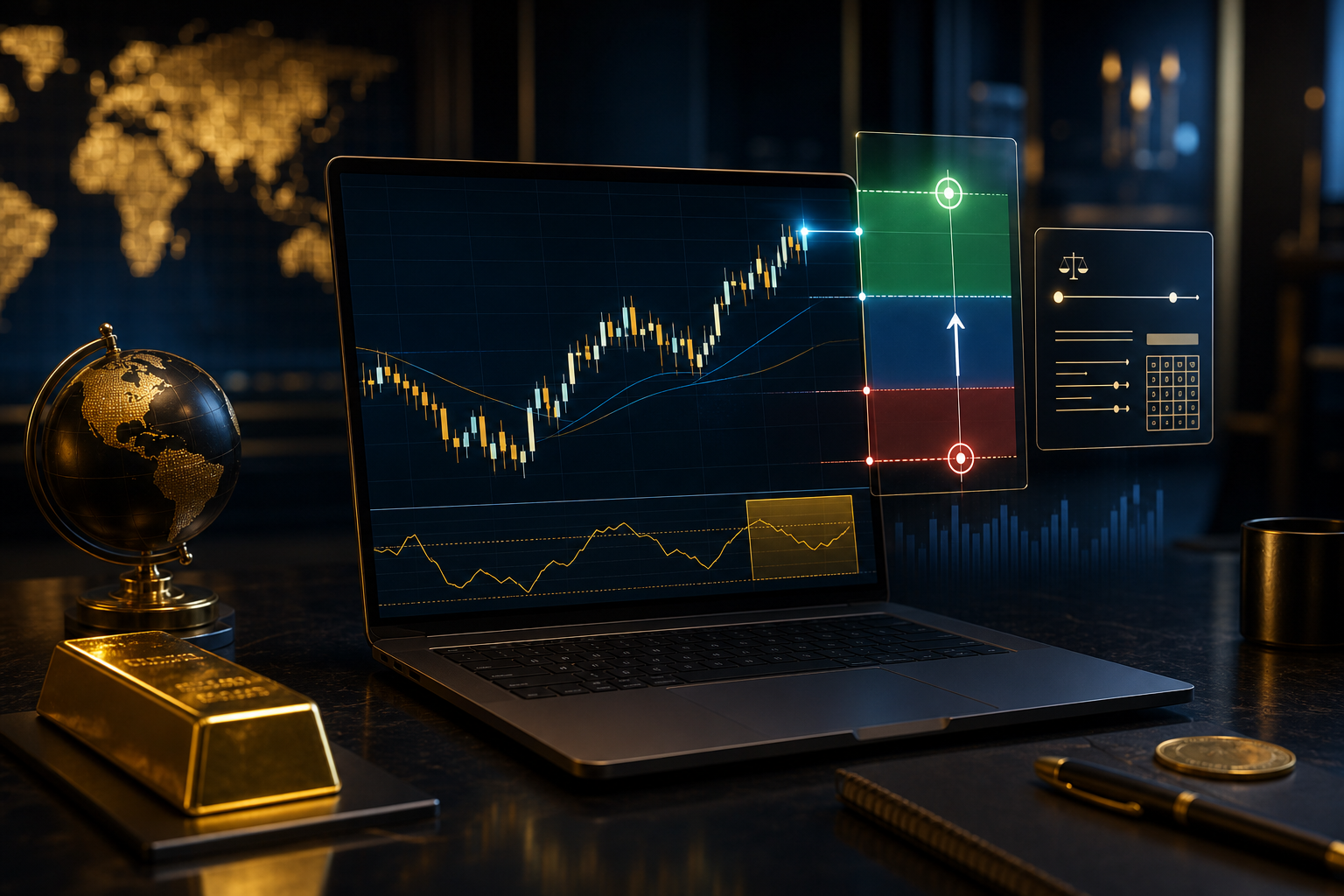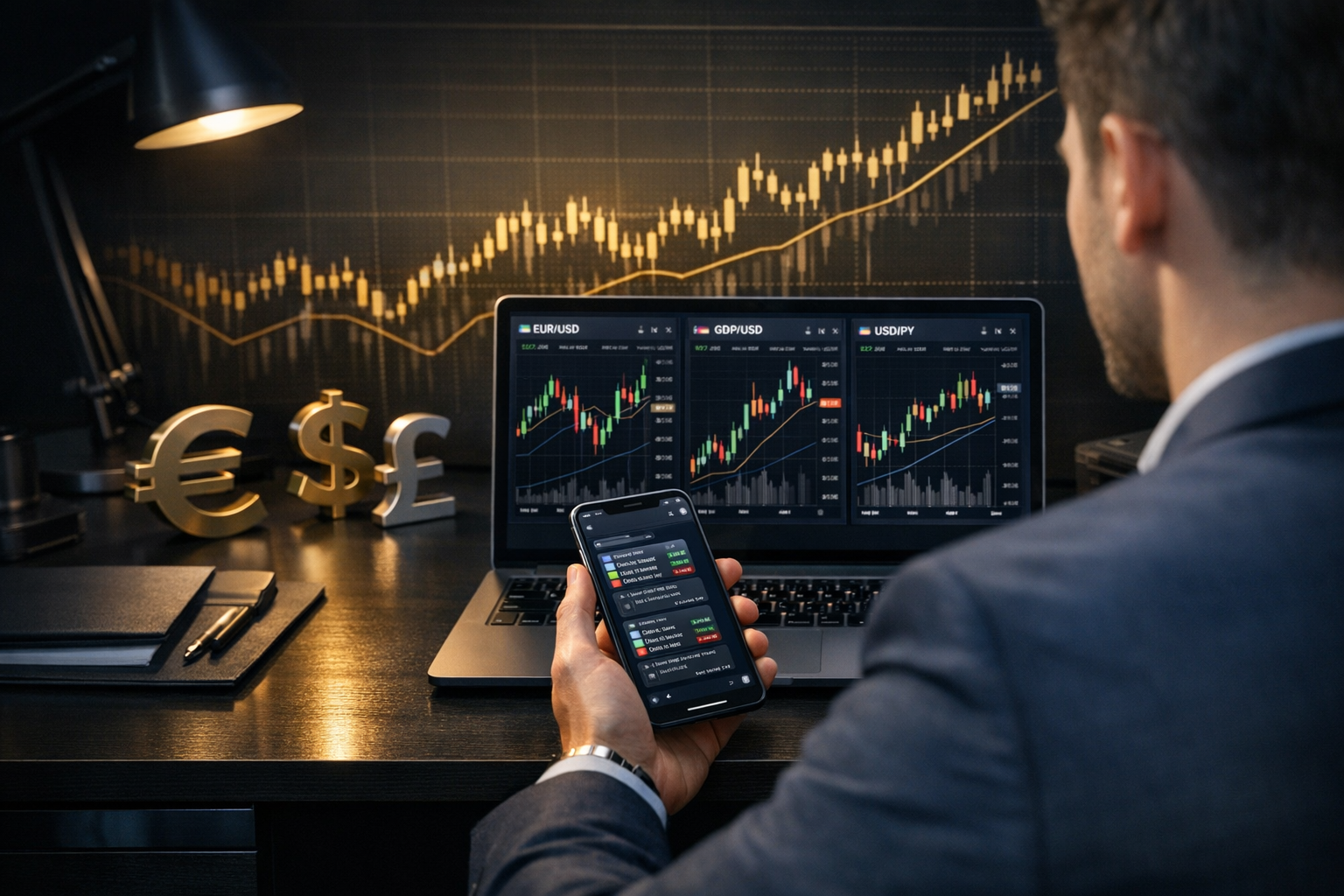
Forex signals are trade recommendations sent by professional analysts or automated systems that tell you exactly which currency pair to buy or sell, at what price to enter, where to place your stop loss, and where to take profit. For beginners, they represent one of the fastest ways to start participating in the foreign exchange market without years of study.
This guide covers everything you need to know to go from complete beginner to confidently executing forex signals. We will walk through what signals are, how they are generated, how to evaluate providers, and how to build a sustainable trading routine around them.
What Are Forex Signals and How Do They Work?
A forex signal is a structured trade idea that typically includes five core components: the currency pair (such as EUR/USD or GBP/JPY), the direction (buy or sell), the entry price, the stop loss level, and one or more take profit targets. Some providers also include the reasoning behind the trade, the risk-to-reward ratio, and the lot size recommendation.
Signals are delivered through various channels. The most popular delivery method in 2026 is Telegram, which allows instant push notifications on your phone. Other methods include email, SMS, dedicated mobile apps, and direct integration with trading platforms like MetaTrader 4 or MetaTrader 5.
Types of Forex Signals
There are several categories of forex signals that beginners should understand:
- Manual signals: Generated by human analysts who study charts, economic calendars, and market sentiment. These tend to offer more context and adapt well to unusual market conditions.
- Automated signals: Produced by algorithms and trading bots that scan markets for predefined technical setups. They can cover more pairs simultaneously but may struggle during unexpected events.
- Copy trading signals: Rather than receiving instructions to execute manually, your account automatically mirrors the trades of a master trader. This removes execution delay but also removes your ability to filter trades.
- Hybrid signals: A combination of algorithmic scanning with human oversight and final approval. This approach aims to balance speed with judgment.
How to Choose a Forex Signal Provider
The signal provider you choose will have more impact on your trading results than almost any other decision. Here is what to evaluate:
Track Record Transparency
A legitimate provider publishes verified results. Look for providers who share their full trade history, not just cherry-picked winners. The best providers use third-party verification services like Myfxbook or FX Blue that connect directly to live trading accounts.
Be skeptical of providers who only show screenshots of winning trades or who claim impossibly high win rates. A realistic win rate for a solid signal service is typically between 65% and 80%, depending on the strategy and risk-to-reward ratio.
Risk Management Standards
Quality providers always include a stop loss with every signal. If a provider sends signals without stop losses, that is a serious red flag. The stop loss protects your account from catastrophic losses on any single trade.
Look for providers who recommend risking no more than 1-2% of your account per trade. This ensures that even a string of losing trades will not destroy your capital. At United Kings, every signal includes clear stop loss and take profit levels with defined risk parameters.
Delivery Speed and Timing
Signals are time-sensitive. A signal that arrives even a few minutes late can mean the difference between a profitable entry and a poor one. Telegram is the gold standard for delivery because notifications are near-instant. Test the provider with a free trial or demo account to verify that signals arrive promptly and that entry prices are realistic by the time you can act.
Communication and Support
Good signal providers do more than just send trade alerts. They explain their reasoning, provide market commentary, and are available to answer questions. This educational component helps you grow as a trader rather than becoming permanently dependent on signals.
How to Execute Forex Signals Step by Step
Once you have chosen a provider, here is the process for executing each signal:
Step 1: Receive and Read the Signal
When a signal arrives, read it completely before doing anything. Note the pair, direction, entry price, stop loss, and take profit. Check if the entry price is still available on your platform. If the market has already moved significantly past the recommended entry, it may be better to skip the trade.
Step 2: Calculate Your Position Size
Before entering any trade, calculate the correct lot size based on your account balance and the distance between entry and stop loss. The formula is straightforward:
Position Size = (Account Balance x Risk Percentage) / (Stop Loss Distance in Pips x Pip Value)
For example, with a $5,000 account risking 1% per trade ($50) and a 30-pip stop loss on EUR/USD (where a standard lot pip value is $10), you would trade 0.17 lots. Most trading platforms have built-in calculators, and there are free online tools to help with this calculation.
Step 3: Place Your Order
Open your trading platform (MetaTrader 4, MetaTrader 5, or your broker's proprietary platform) and place the order. If the current price matches the signal's entry price, use a market order. If the signal specifies a price that has not yet been reached, use a pending order (buy limit, sell limit, buy stop, or sell stop as appropriate).
Always enter the stop loss and take profit at the same time as the entry. Never plan to add them later because you might forget, and an unexpected market move could devastate your account.
Step 4: Monitor and Manage
Once the trade is live, avoid the temptation to constantly watch it. If you have followed proper risk management, each trade risks only a small percentage of your account. Some providers send updates when they move stop losses to breakeven or adjust targets. Follow these management updates.
Step 5: Record and Review
Keep a trading journal. For each signal you execute, record the pair, entry, exit, result, and any notes about how the trade played out. After 30 to 50 trades, review your journal to identify patterns. Are you missing signals due to timing? Are you modifying signals and getting worse results? This data drives improvement.
Risk Management Fundamentals for Signal Traders
Risk management is not optional. It is the single most important skill that separates traders who survive from those who blow their accounts. Here are the non-negotiable rules:
The 1-2% Rule
Never risk more than 1-2% of your account on a single trade. With a $2,000 account, that means your maximum loss per trade should be $20 to $40. This might feel conservative, but it ensures you can weather losing streaks. Even with a 60% win rate, you will inevitably face stretches of five or more consecutive losses. The 1-2% rule keeps you in the game.
Correlation Awareness
If you receive signals on EUR/USD, GBP/USD, and AUD/USD at the same time, all going in the same direction, recognize that these are correlated trades. If the US dollar strengthens against all of them, you could lose on all three simultaneously. Treat correlated trades as a single risk event and reduce position sizes accordingly.
Drawdown Limits
Set a maximum daily and weekly drawdown limit. If you lose 3% in a single day, stop trading for the rest of that day. If you lose 6% in a week, step back and review what is happening. These circuit breakers prevent emotional trading and spiraling losses.
Common Mistakes Beginners Make with Forex Signals
Understanding these pitfalls will save you money and frustration:
- Overriding the stop loss: Moving your stop loss further away because you believe the trade will come back is the most expensive mistake in signal trading. The stop loss exists for a reason. Respect it.
- Taking partial signals: Some beginners enter only the trades they personally agree with, skipping others. This defeats the purpose of following a signal system. If you trust the provider enough to subscribe, execute all their signals consistently, or find a different provider.
- Overleveraging: Using too large a position size to make more money faster is the fastest route to account destruction. Stick to 1-2% risk per trade without exception.
- Chasing entries: If a signal was sent at 1.0850 and the market has already moved to 1.0880, do not chase it. The risk-to-reward ratio has changed, and entering late often leads to getting stopped out at a loss that was not part of the original plan.
- Provider hopping: Switching providers after every losing trade is counterproductive. Every system has losing periods. Give a provider at least two to three months and at least 50 trades before making a judgment. Short-term results are dominated by randomness.
Setting Up Your Trading Environment
To trade signals effectively, you need the right infrastructure:
Choose a Regulated Broker
Open an account with a broker regulated by a reputable authority such as the FCA (UK), ASIC (Australia), CySEC (Cyprus), or NFA (US). Regulation protects your funds and ensures fair execution. Avoid unregulated offshore brokers regardless of how attractive their spreads or bonuses seem.
Install MetaTrader 4 or MetaTrader 5
Most signal providers design their signals for MetaTrader platforms. Download the platform from your broker's website, log in with your account credentials, and familiarize yourself with placing orders, setting stop losses, and viewing your trade history.
Configure Telegram Notifications
If your provider uses Telegram, make sure notifications are enabled and that your phone is not silencing them during market hours. Consider keeping Telegram open on your desktop as well for redundancy. Speed matters when executing signals.
Start with a Demo Account
Before risking real money, practice executing signals on a demo account for at least two weeks. This helps you become comfortable with the mechanics of order placement, position sizing, and trade management without any financial risk.
Building a Sustainable Trading Routine
Consistency is the foundation of profitable signal trading. Here is a daily routine that works:
- Morning review (10 minutes): Check the economic calendar for high-impact events. Note any signals that were sent overnight and whether they are still valid.
- Active trading window (market hours): Keep your phone and platform ready. When a signal arrives, execute it promptly following the steps above. Log each trade in your journal.
- End-of-day review (10 minutes): Record the results of closed trades. Note any ongoing positions and their current status. Review whether you followed your rules.
- Weekly review (30 minutes): Analyze your journal for the week. Calculate your win rate, average profit, average loss, and overall return. Identify any execution errors and plan to correct them.
When to Move Beyond Signals
Signals are an excellent entry point, but many traders eventually want to develop their own analysis skills. As you follow signals over months, you will start to recognize patterns in the types of setups that win. This is natural and valuable learning.
Consider transitioning gradually: continue following signals while also paper-trading your own ideas alongside them. Compare your results over time. When your own analysis consistently matches or exceeds the signal provider's performance, you may be ready to trade independently, or you might choose to keep using signals as a secondary confirmation tool.
Getting Started Today
The path from complete beginner to competent signal trader is straightforward: choose a reputable provider with a verified track record, start with a demo account, follow proper risk management, execute consistently, and review your results regularly.
At United Kings, we provide professionally analyzed forex and gold signals delivered instantly via Telegram with clear entry, stop loss, and take profit levels on every trade. Our transparent track record and educational approach make us ideal for traders who are serious about building real skills while generating returns from day one.
Ready to start? View our signal packages and join thousands of traders who use professional signals to navigate the forex market with confidence.