
You can have the best gold entry in the world—and still blow the trade by sizing it wrong.
It happens in real time: XAUUSD is hovering near $2650 (up roughly +0.35% on the day), volatility is alive, and you get a clean setup during London or New York. You place a stop that “feels” reasonable… then the position is either so big a $12 pullback hurts your account, or so small the win barely matters.
This guide fixes that. We’re going to build a repeatable XAUUSD position sizing method that converts ATR-based stop-loss into an exact lot size on MT4/MT5—with real numbers, broker contract-size differences, and a checklist you can apply to any gold signal before you execute.
TL;DR: XAUUSD position sizing in 60 seconds
- Risk per trade = Account Equity × Risk % (example: $5,000 × 1% = $50).
- Stop distance in dollars = Entry − SL (example: $2650 → $2635 = $15).
- Know your contract size: many brokers use 1.00 lot = 100 oz on XAUUSD; some use 1 oz or 10 oz equivalents.
- Dollar loss per $1 move = Lots × Contract Size (oz) × $1 (example: 0.03 lots × 100 oz = $3 per $1 move).
- Lot size formula: Lots = Risk $ ÷ (Stop $ × Contract Size).
- Always validate with MT4/MT5 tick value / symbol specs and include spread + slippage buffers in fast markets.
Quick comparison: the 3 most common XAUUSD contract-size models
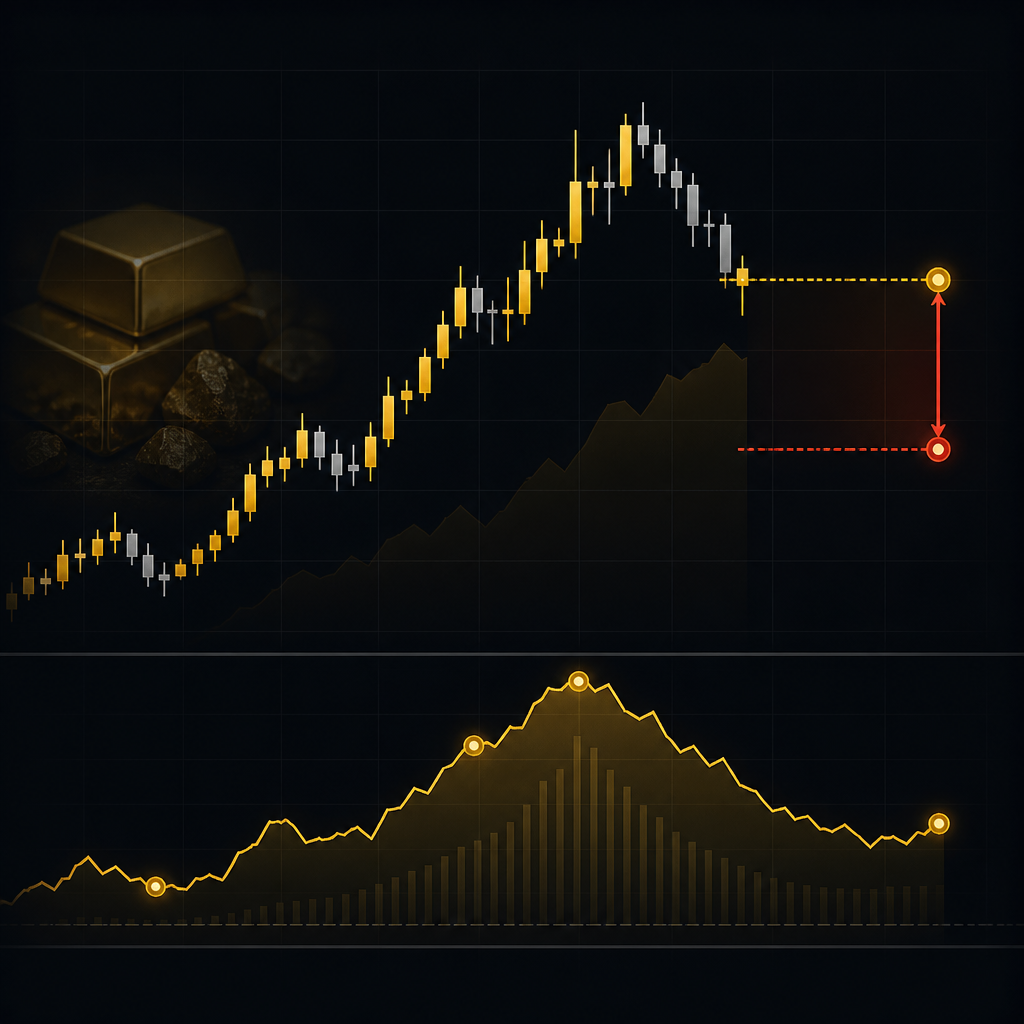
Your “gold lot size calculator” will be wrong if you assume the wrong contract size. That’s why two traders can place the same 0.10 lot and get wildly different P/L per $1 move.
| Broker model (typical) | 1.00 lot equals | P/L per $1 move at 1.00 lot | Best for | Where to confirm |
|---|---|---|---|---|
| Standard XAUUSD (most common) | 100 oz | $100 | Most MT4/MT5 brokers, prop-style sizing | MT5: Symbol → Specification |
| Mini gold / fractional | 10 oz | $10 | Small accounts, tighter scaling | Contract size field |
| Micro gold / 1 oz model | 1 oz | $1 | Beginners, testing, very small risk | Tick value + contract size |
In this article we’ll use the most common model—1.00 lot = 100 oz—and show you how to adapt instantly if your broker uses 10 oz or 1 oz.
1) Why XAUUSD position sizing is different (and why most traders miscalculate)
Gold is not EUR/USD. On EUR/USD, most traders get used to “pips,” standard lot values, and relatively stable point mechanics. On XAUUSD, the confusion comes from three places: price increments, contract size, and volatility regime.
First, XAUUSD moves in dollars and cents. Many MT4/MT5 symbols quote gold to 2 decimals (e.g., 2650.25). Some brokers show 1 decimal. That changes what a “point” means inside the platform, even though your real-world risk is still the same: dollars from entry to stop.
Second, the contract size is not universal. A “lot” on gold is not automatically the same across brokers. If your broker defines 1 lot as 100 oz, then a $1 move at 1 lot is $100. If your broker defines 1 lot as 10 oz, then a $1 move at 1 lot is $10. If you assume the wrong model, your risk can be off by 10× or 100×.
Third, gold’s volatility clusters. With DXY around 106.80 and USD/JPY near 149.50, you can get sudden risk-on/risk-off bursts where XAUUSD moves $8–$20 quickly. If you size too large, a normal ATR swing feels like a crisis. If you size correctly, it’s just noise.
Here’s a common real scenario. You see a United Kings gold signal during New York: Buy XAUUSD around $2652, stop below structure at $2639 (a $13 stop), take profit at $2678 (a $26 target, ~1:2 RR). You choose 0.30 lots because it “looks small.”
If your broker is 100 oz per lot, your $1 move at 0.30 lots is $30. A $13 stop becomes $390 risk. On a $3,000 account, that’s 13% in one trade—before spread and slippage. That’s not trading; that’s gambling with extra steps.
Correct sizing makes your strategy measurable. It also makes signals usable. If you’re following premium entries from United Kings gold signals, you want every trade to represent the same planned risk, regardless of whether gold is calm at Asian range or ripping during NY.
2) The core formula: convert stop-loss dollars into exact XAUUSD lot size
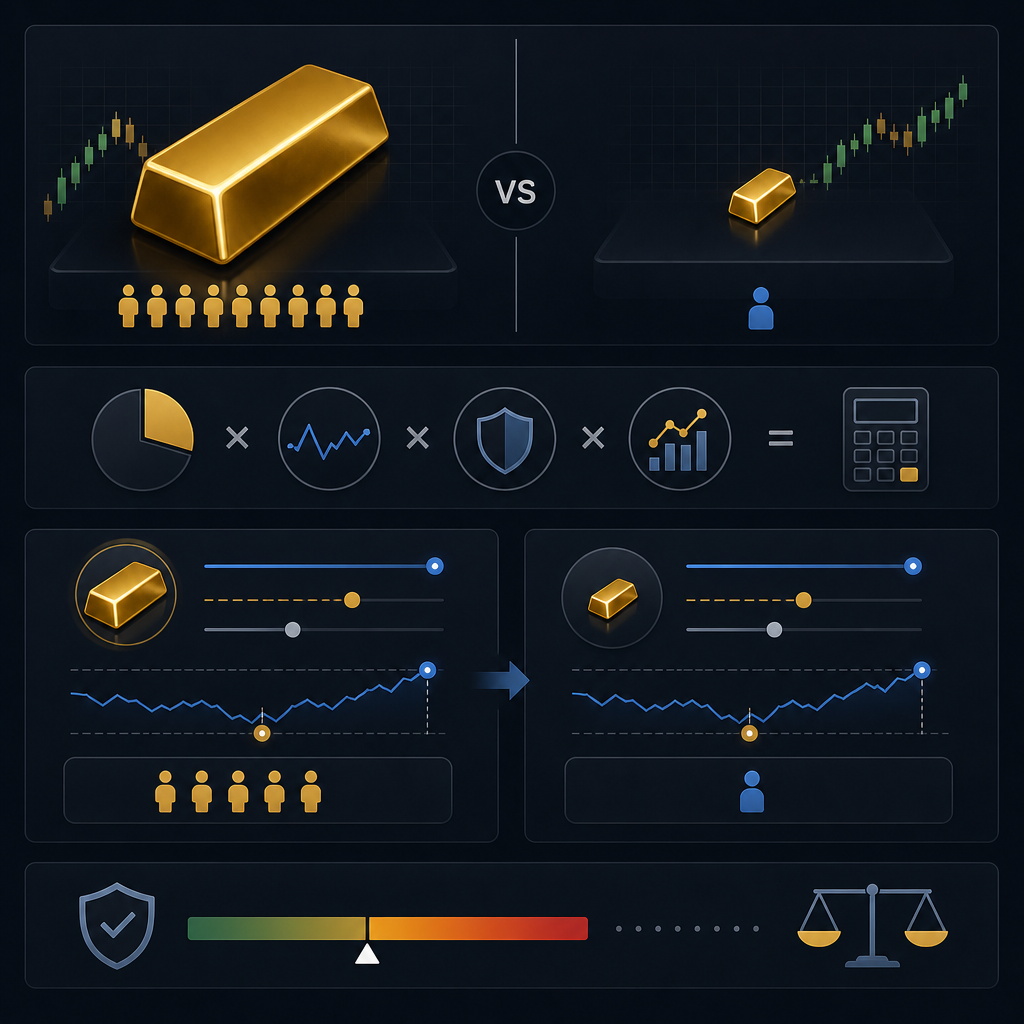
Let’s build the calculator logic in plain English. You only need three inputs:
- Account equity (or balance—equity is better if you have floating P/L).
- Risk percentage per trade (commonly 0.25%–2%).
- Stop-loss distance in dollars (Entry − SL).
Then you need one broker-specific value:
- Contract size (oz per 1.00 lot) for XAUUSD.
Step 1: calculate risk in dollars
Risk $ = Equity × Risk %
Example: Equity = $10,000 and risk = 1%.
Risk $ = 10,000 × 0.01 = $100
Step 2: measure your stop in dollars
If entry is $2650 and SL is $2635, then stop distance is:
Stop $ = 2650 − 2635 = $15
Notice we’re not talking pips yet. For gold, dollars are the cleanest way to think.
Step 3: compute loss per $1 move for 1.00 lot
If contract size is 100 oz, then a $1 move at 1.00 lot is:
$1 move P/L = 100 oz × $1 = $100 per $1
Step 4: compute the lot size
Lots = Risk $ ÷ (Stop $ × Contract Size)
Using Risk $100, Stop $15, Contract Size 100 oz:
Lots = 100 ÷ (15 × 100) = 100 ÷ 1500 = 0.0666
Rounded to broker step size (often 0.01), you’d place 0.06 or 0.07 lots. If you round up, you risk slightly more than planned. If you round down, slightly less.
Sanity check (always do this)
At 0.07 lots, your $1 move is $7 (because 0.07 × 100 = 7 oz exposure equivalent). With a $15 stop, risk is $105. That’s close enough if your target was $100 and you accept small rounding differences.
This is the entire “gold lot size calculator” in one line. Everything else in this guide is about making it robust: ATR stops, spread buffers, broker differences, and execution reality on MT4/MT5.
3) ATR stop loss on XAUUSD: turning volatility into a consistent stop distance
Using a fixed $10 stop on gold is like using the same umbrella for drizzle and a thunderstorm. Sometimes it’s too tight and you get chopped. Sometimes it’s too wide and you underperform your best setups.
ATR (Average True Range) solves this by sizing your stop based on current volatility. In today’s environment—gold around $2650, DXY elevated near 106.80, and major FX pairs like EUR/USD at 1.0520—gold can shift quickly on USD flows and yields. ATR helps you avoid placing stops inside the “normal” daily noise.
Which ATR settings work for gold?
There’s no single magic number, but here are practical defaults we see work for signal execution and discretionary trading:
- ATR(14) on H1: great for intraday trades during London/NY.
- ATR(14) on H4: better for swing trades and wider targets.
- ATR(20) on M15: useful for scalps, but can be noisy.
If you trade with a signals provider that focuses on London and New York sessions (like we do at United Kings), ATR(14) on H1 is a strong baseline because it adapts to session volatility.
How to convert ATR into a stop distance
Most traders use a multiplier, like 1.0×, 1.5×, or 2.0× ATR. The idea is simple: the more volatile the market, the more space you give the trade.
Example: Suppose ATR(14) on H1 for XAUUSD reads $8.20. Here are three stop options:
- 1.0× ATR stop = $8.20 (tight, higher chance of stop-outs)
- 1.5× ATR stop = $12.30 (balanced for intraday)
- 2.0× ATR stop = $16.40 (wider, lower size, more breathing room)
Now you match that to structure. ATR should not replace technical logic; it should support it. If the nearest invalidation level is $14 away and 1.5× ATR is $12.30, you usually choose the larger of the two. That keeps your stop beyond both volatility noise and structure.
ATR-based stop with a real price scenario (current levels)
Let’s say gold is trading at $2650. Price breaks above an intraday range and you buy at $2652. The most recent swing low is $2640 (a $12 distance). ATR(14) H1 is $8.20, so 1.5× ATR is $12.30.
Your stop becomes $2639.70 (entry $2652 − $12.30), which is effectively $2640 when rounded and aligned with structure. That’s a clean, volatility-aware stop.
Now we turn that stop into lot size—exactly—so the risk is consistent every time, regardless of whether ATR is $6 or $12.
4) The “XAUUSD position sizing calculator” workflow (step-by-step with numbers)
Here’s the repeatable workflow you can use before every gold trade. It’s the same process we recommend to traders following United Kings premium signals—because the only way signals scale across different account sizes is through correct sizing.
Step 1: choose a fixed risk percentage
For most traders, 0.5% to 1% per trade is a professional sweet spot. If you’re newer, 0.25%–0.5% is safer while you build execution discipline.
Example: Account equity = $7,500. Risk = 0.75%.
Risk $ = 7,500 × 0.0075 = $56.25
Step 2: set stop-loss using ATR + structure
Assume entry is $2650.50. ATR(14) H1 = $9.00. You choose 1.5× ATR = $13.50. Structure suggests invalidation at $2638.80, which is $11.70 away, so ATR is wider. Use the wider stop.
Stop $ = $13.50
SL price = 2650.50 − 13.50 = $2637.00
Step 3: confirm contract size (do not assume)
We’ll use 100 oz per 1.00 lot (common). If yours differs, we’ll adjust later.
Step 4: calculate lot size
Lots = Risk $ ÷ (Stop $ × Contract Size)
Lots = 56.25 ÷ (13.50 × 100) = 56.25 ÷ 1350 = 0.0416 lots
Rounded to 0.01 steps: 0.04 lots (risk slightly under) or 0.05 lots (risk slightly over).
Step 5: map take-profit to RR (1:2 or 1:3)
With a $13.50 stop:
- 1:2 TP distance = $27.00 → TP = 2650.50 + 27.00 = $2677.50
- 1:3 TP distance = $40.50 → TP = 2650.50 + 40.50 = $2691.00 (this is slightly above our guideline range, so you’d likely cap it near $2688–$2690 or trail)
Given our market context guideline ($2610–$2690), a realistic 1:3 might be partials: take some profit near $2677.50 and trail the rest toward $2688–$2690 if momentum supports it.
Step 6: do the final “platform reality” check
- Is spread currently wide (news, rollover, low liquidity)?
- Is your SL placed beyond structure after accounting for spread?
- Does your broker allow that lot size and step (0.01, 0.10, etc.)?
This workflow takes under two minutes once you’ve done it a few times. And it removes the emotional sizing decisions that sabotage otherwise good trades.
5) MT4/MT5 specifics: points, ticks, tick value, and why traders get confused
MT4/MT5 can make gold sizing feel harder than it is because the platform speaks in points and ticks, while traders think in dollars. The bridge between the two is symbol specification.
What are points on XAUUSD?
On many brokers, XAUUSD is quoted to 2 decimals (e.g., 2650.25). In that case:
- 0.01 is often 1 “point” (broker-dependent naming).
- $1.00 equals 100 points.
So a $15 stop could be shown as 1500 points in the platform. That’s where traders panic and oversize (“1500 points sounds huge”). It’s not huge—it’s just $15.
Tick size and tick value (the MT5 truth source)
In MT5, right-click the symbol in Market Watch → Specification. You’ll see:
- Contract size (e.g., 100)
- Tick size (e.g., 0.01)
- Tick value (money per tick per lot)
If contract size is 100 and tick size is 0.01, then a 0.01 move is $1 per lot? Not exactly—because tick value is computed by the platform based on contract size, quote currency, and sometimes conversion rates.
For a USD-quoted gold symbol, the mental model is usually safe:
- 1 lot (100 oz) → $1 move ≈ $100
- 0.10 lot → $1 move ≈ $10
- 0.01 lot → $1 move ≈ $1
But you still verify with tick value because some brokers use different contract definitions or suffixes (XAUUSD., XAUUSDm, GOLD, etc.).
MT4 limitation: less transparent specs
MT4 shows fewer details. You can still check contract size by right-clicking the symbol → Specification, but tick value can behave oddly depending on broker settings.
The practical approach: do one controlled test. Place a demo trade with 0.01 lots on XAUUSD, let price move $1, and observe P/L. If P/L moves about $1, you’re on the 100 oz model. If it moves about $0.10 or $10, you’re on a different model.
This is also why we recommend beginners start on demo while learning execution. If you want a structured transition plan, our guide on building discipline around signals pairs well with this sizing method—browse the United Kings blog when you’re ready to go deeper.
6) Broker contract size differences: how to adjust your gold lot size calculator instantly
Let’s make this simple. Your position sizing formula stays the same. Only the contract size changes.
Lots = Risk $ ÷ (Stop $ × Contract Size)
Assume the same trade:
- Equity: $10,000
- Risk: 1% → Risk $100
- Stop: $15
Case A: 100 oz per lot (most common)
Lots = 100 ÷ (15 × 100) = 0.0666 → 0.06–0.07 lots.
Case B: 10 oz per lot (mini)
Lots = 100 ÷ (15 × 10) = 100 ÷ 150 = 0.666 → 0.66–0.67 lots.
Notice: you need more lots because each lot represents less gold exposure.
Case C: 1 oz per lot (micro)
Lots = 100 ÷ (15 × 1) = 6.66 lots.
This looks crazy if you’re used to FX lots, but in a 1 oz model it’s normal because 1 lot is tiny exposure. Again, the formula keeps you honest.
How to confirm contract size in 30 seconds
- MT5: Market Watch → right-click XAUUSD → Specification → Contract size.
- MT4: Market Watch → right-click XAUUSD → Specification → Contract size.
- If the broker uses suffixes (XAUUSDm), check the exact symbol you trade.
Why this matters for copying signals
When you follow a signal, the entry/SL/TP are universal, but the lot size is not. That’s why professional signal execution is always “risk-based.”
At United Kings, our signals are built with clear Entry, SL, and TP levels. Your job is to translate that into your personal lot size using a fixed risk rule. That’s how traders in a 300K+ community can trade the same idea responsibly, whether they’re on a $500 account or a $50,000 account.
7) Spread, slippage, and news volatility: the hidden math that changes your real risk
Most “position sizing” tutorials assume perfect fills and zero spread. Gold doesn’t trade like that—especially when markets are reacting to USD strength (DXY near 106.80) or sudden risk headlines.
If you size purely off the chart stop distance, your real risk can be larger because:
- Spread: you enter at ask on buys and exit at bid on stops.
- Slippage: in fast moves, your stop can fill worse than your SL price.
- Stop hunting vs liquidity: it’s not always manipulation; sometimes it’s just thin liquidity spikes.
Practical buffer method (simple and effective)
Add a small buffer to your stop distance when calculating lot size. For example:
- Normal conditions: add $0.50–$1.50
- High-impact news windows: add $2–$5 (or reduce risk %)
Example: Your chart stop is $15. Spread is $0.40–$0.70. You choose a $1 buffer.
Adjusted Stop $ = 15 + 1 = $16
Now position size with $16 instead of $15. You’ll trade slightly smaller, but your realized risk becomes closer to your plan.
News reality check for gold traders
Gold can jump $10+ in seconds around CPI, NFP, FOMC, or surprise geopolitical headlines. If you’re trading those windows, you must expect slippage.
If you want to understand how signals behave in those moments, pair this sizing guide with our volatility survival resource: how gold signals react to unexpected news events.
Session-based volatility: London and NY are not equal
We focus heavily on London and New York sessions because that’s where gold typically offers the cleanest liquidity and follow-through. But it also means your ATR can expand quickly.
Rule of thumb: if ATR expands, your lot size should shrink automatically to keep risk constant. That’s the entire point of combining ATR stop loss XAUUSD with fixed % risk.
8) Applying the method to real signal-style trades (2 complete examples)
Let’s run two full examples using realistic prices in the $2610–$2690 range. We’ll include entry, stop, take profit, and the exact lot size.
Example 1: Intraday long from $2648 with a $12.50 ATR stop
Market context: XAUUSD is holding firm near $2650 with mild bullish drift. EUR/USD is soft near 1.0520 and DXY is elevated, so gold is not in a straight-line rally—moves can be choppy.
- Account equity: $4,000
- Risk %: 1% → Risk $40
- Entry: $2648.00
- ATR-based stop distance: $12.50
- SL: 2648.00 − 12.50 = $2635.50
- Contract size: 100 oz/lot
Lot size: Lots = 40 ÷ (12.5 × 100) = 40 ÷ 1250 = 0.032 → round to 0.03 lots.
TP planning:
- 1:2 target distance = $25.00 → TP = 2648 + 25 = $2673.00
- 1:3 target distance = $37.50 → TP = 2648 + 37.5 = $2685.50
If the chart shows resistance around $2672–$2675, you can take partial at 1:2 and trail toward $2685.
Example 2: Short from $2662 with structure + ATR, and a spread buffer
Market context: Gold spikes into $2660–$2665, prints rejection wicks, and USD/JPY at 149.50 suggests USD strength pockets can pressure gold intraday.
- Account equity: $12,500
- Risk %: 0.5% → Risk $62.50
- Entry: $2662.00
- Structure stop: above swing high at $2678.00 → $16.00 stop
- ATR(14) H1: $9.20 → 1.5× = $13.80 (structure is wider, so use $16)
- Spread/slippage buffer: add $1.00 → Adjusted stop = $17.00
- SL: 2662 + 16 = $2678 (price SL), but sizing uses $17 adjusted
Lot size: Lots = 62.5 ÷ (17 × 100) = 62.5 ÷ 1700 = 0.0367 → 0.03–0.04 lots (choose 0.03 if you want to stay under risk).
TP planning:
- 1:2 distance = $34 → TP = 2662 − 34 = $2628.00
- 1:3 distance = $51 → TP = 2662 − 51 = $2611.00
Both targets fall within our guideline range. If price reaches $2628 quickly, consider moving SL to reduce exposure, but only if your strategy supports it.
9) A repeatable pre-trade checklist for sizing any gold signal (print this)
Most traders don’t fail because they can’t calculate. They fail because they skip steps when they’re excited, rushed, or emotional. This checklist is designed to be used right before you place a trade—especially when you’re copying signals from Telegram.
The United Kings “Gold Sizing Checklist”
- 1) Confirm account equity (not yesterday’s balance). Write it down.
- 2) Confirm your risk % for today (0.5%? 1%?). No improvising.
- 3) Identify entry and SL from the signal or your chart. Convert to stop distance in $.
- 4) Check ATR (H1 or H4). If ATR-based stop is wider than structure, use ATR. If structure is wider, use structure.
- 5) Add buffer for spread/slippage if conditions are fast (news, session open, thin liquidity).
- 6) Confirm contract size in MT4/MT5 symbol specification.
- 7) Calculate lots using Lots = Risk$ ÷ (Stop$ × ContractSize).
- 8) Round down to the nearest allowed lot step if unsure.
- 9) Confirm margin is sufficient (especially on smaller accounts).
- 10) Place the trade with SL and TP set immediately. No “I’ll add it later.”
If you want a broader framework that covers risk across multiple signals and drawdown control, this pairs perfectly with risk management strategies when using forex signals.
How this checklist prevents the most expensive mistakes
Mistake #1: “I’ll just use 0.10 lots like last time.”
ATR changes. Stop distance changes. Your lot size must change too.
Mistake #2: “My stop is 1500 points, that’s too big.”
Points are platform language. Dollars are trading language. Translate it and move on.
Mistake #3: “The signal provider’s lot size is 0.50, so I copy it.”
Unless you have the same equity, same contract size, and same risk tolerance, copying lots is copying someone else’s risk profile. Copy the levels, not the size.
10) Position sizing across gold + forex: keep risk consistent when you diversify
Many United Kings members trade both gold and majors like EUR/USD, GBP/USD, and USD/JPY. Right now, EUR/USD is around 1.0520, GBP/USD near 1.2680, and USD/JPY around 149.50. Each pair has different pip values, volatility, and behavior.
The goal is not to treat every instrument the same. The goal is to make your risk per trade the same.
Why gold feels “heavier” than forex
On many brokers, 0.10 lots of XAUUSD (100 oz model) is $10 per $1 move. A normal intraday swing can be $10–$20, so that’s $100–$200 movement quickly.
On EUR/USD, 0.10 lots is typically about $1 per pip. A 30-pip swing is $30. The psychological impact is different, even if you planned the risk.
This is why traders often under-size forex and over-size gold. Gold moves in bigger “chunks,” and the P/L swings look dramatic.
Unifying the approach: same risk %, different lot sizes
Whether you trade gold or forex, you can keep the same structure:
- Choose risk % (say 1%).
- Measure stop distance (in $ for gold, in pips for FX).
- Convert stop distance into money-per-unit movement.
- Compute lot size so max loss ≈ risk $.
If you’re actively trading both markets, explore United Kings forex signals alongside gold signals. The same risk engine powers both, and that consistency is what keeps your account stable through different market regimes.
A quick note on correlation risk
Gold and USD pairs can move together when the driver is USD. With DXY at 106.80, a sudden USD surge can hit gold and EUR/USD simultaneously. If you take multiple trades that are effectively “short USD” or “long USD,” your real exposure can be larger than you think.
Simple fix: if you’re in two USD-correlated trades, reduce risk per trade (e.g., from 1% to 0.5% each), or treat them as one combined risk idea.
11) Tools and templates: build your own calculator (and avoid common rounding traps)
You don’t need fancy software to do this correctly. A basic phone calculator or spreadsheet is enough. What matters is that you capture the right inputs and round in a way that protects you.
The simplest spreadsheet template (copy/paste logic)
- Equity (cell A1)
- Risk % (A2)
- Risk $ = A1×A2 (A3)
- Entry (A4)
- Stop price (A5)
- Stop $ = ABS(A4−A5) (A6)
- Buffer $ (A7)
- Adjusted Stop $ = A6+A7 (A8)
- Contract size (A9)
- Lots = A3/(A8×A9) (A10)
Then add a rounding rule. If your broker lot step is 0.01, use:
- Rounded lots = FLOOR(A10, 0.01)
Flooring rounds down, keeping risk under control. Rounding to nearest can accidentally round up and exceed your plan.
Common rounding and execution traps
- Trap: You calculate 0.046 lots and place 0.05. That’s +8.7% more risk.
- Fix: Round down to 0.04 unless you intentionally accept extra risk.
- Trap: You forget the buffer during NY open and get slipped $2 beyond SL.
- Fix: Either add buffer or reduce risk % in high-volatility windows.
- Trap: You change stop after entry but keep the same size.
- Fix: If stop widens, reduce size (or accept higher risk consciously).
Where United Kings fits into this process
Signals should remove decision fatigue on direction and levels. But sizing is personal. That’s why we provide clean Entry/SL/TP and focus on high-probability windows (London/NY), while you apply a consistent calculator.
If you’re still choosing a provider, you can use our due diligence checklist: forex trading signals provider checklist. The same principles apply to gold signal quality too.
12) FAQ: XAUUSD lot size, ATR stops, and MT4/MT5 sizing questions
1) How many pips is a $10 stop on XAUUSD?
It depends on your broker’s quote decimals. If XAUUSD is quoted to 2 decimals, then $0.01 is one “point” and $1.00 is 100 points. A $10 stop is about 1000 points. Focus on dollars first, then translate to points only for platform entry.
2) What’s a good ATR multiplier for stop loss on gold?
For intraday gold, many traders use 1.5× ATR(14) on H1 as a balanced baseline. In calmer markets you might use 1.0×; in fast markets or when trading news, 2.0× can be safer. Always align the stop with structure so it actually invalidates the setup.
3) Why does my 0.01 lot on XAUUSD not equal $1 per $1 move?
Your broker may use a different contract size (10 oz or 1 oz model), or the symbol may be a variant (XAUUSDm). Check Symbol Specification in MT5/MT4 to confirm contract size and tick value. Never assume.
4) Should I use balance or equity for position sizing?
Equity is more accurate because it includes floating P/L. If you’re in drawdown or have open positions, balance-based sizing can unintentionally increase risk.
5) Can I use this same method for forex pairs like EUR/USD or USD/JPY?
Yes. The structure is identical: Risk$ ÷ (Stop distance × value per unit move). The difference is that forex uses pip value (which depends on pair and account currency), while gold uses contract size and $ distance. If you’re trading majors alongside gold, explore our forex signals and keep one risk framework across all instruments.
Risk disclaimer (read before you trade)
Trading forex and gold (XAUUSD) involves significant risk and may not be suitable for all investors. You can lose more than your initial deposit if trading on leverage. Past performance, win rates, or historical results do not guarantee future outcomes. This article is for educational purposes only and is not financial advice. If you are new, practice on a demo account before trading live, and always use a stop-loss and disciplined risk management.
Final step: trade gold with levels + sizing you can trust
If you’ve made it this far, you already think like a professional: you don’t just want “a signal,” you want a repeatable execution system. When your stop is ATR-based and your lot size is risk-based, you stop fearing volatility—and start using it.
When you’re ready to apply this to real-time setups, join the United Kings community:
- Premium Telegram signals for forex and gold with clear Entry, SL, and TP
- Focus on London and New York session opportunities
- Educational guidance alongside signals to improve execution
- 300K+ active traders in the community
- Transparent plans: Starter 3 Months $299, Best Value 1 Year $599 (50% savings + FREE ebook), Unlimited Lifetime $999
- 48-hour money-back guarantee
Start here: explore United Kings pricing plans, then join our live community on Telegram: United Kings Telegram channel for signals and updates.
Your next gold trade shouldn’t be a guess. Size it correctly, execute it cleanly, and let the probabilities do the work.


