
Ever followed an XAUUSD signal on FOMC or CPI day… and watched price tag your entry, spike $18 against you, then run $35 in your direction without you?
That whipsaw is the #1 reason traders say “signals don’t work on news.” The truth is more uncomfortable: signals can work, but your execution rules must change when volatility goes from “normal” to “headline-driven.”
In this guide, we’ll build a practical, event-specific framework for XAUUSD signals FOMC days and for anyone trying to trade gold during CPI without getting chopped up by spread spikes, fake breakouts, and liquidity sweeps.
TL;DR: The FOMC/CPI XAUUSD Signals Playbook
- Delay entries around the release: don’t auto-execute at the exact timestamp; use a 2-step confirmation (close + retest) or a time delay.
- Widen stops using ATR, not emotions: if 5-min ATR doubles, your stop should adapt (often $15–$25 on gold around $2650).
- Use news filters: skip trades when spreads blow out, when the first candle is a “monster wick,” or when price is inside a compression box.
- Reduce size on news days: keep dollar risk constant while using wider stops (lot size goes down).
- Trade the second move: many clean wins come 5–30 minutes after the release, not in the first 30 seconds.
- Have a hard “no trade” zone: if you can’t get a clean fill or your broker slips heavily, stand down and wait.
Why XAUUSD Behaves Differently on FOMC, CPI, and NFP

Gold is not just a commodity. In practice, XAUUSD trades like a macro instrument that reacts to real yields, the USD, and risk sentiment.
Right now, with XAUUSD around $2650 (+0.35% on the day) and DXY around 106.80, you’re seeing the classic tug-of-war: dollar strength can cap gold, while inflation/uncertainty can bid it up.
On major U.S. releases, that tug-of-war becomes violent because the market is repricing:
- Interest rate expectations (FOMC statement + dot plot + Powell Q&A).
- Inflation trajectory (CPI headline/core + shelter + services).
- Labor strength (NFP + unemployment + wage growth).
And gold’s microstructure adds fuel. Liquidity providers widen spreads, algorithms hunt stops, and “safe” technical levels become magnets for liquidity sweeps.
Here’s the uncomfortable pattern many traders live through on news days:
- You enter a breakout at $2652.
- Price instantly wicks to $2636 (a $16 drawdown), tagging tight stops.
- Then it rockets to $2682 without you.
Was your direction wrong? Often, no. Your timing, stop placement, and fill quality were wrong for that environment.
This is why a “normal day” execution plan fails on FOMC/CPI/NFP. You need a gold news trading strategy built around volatility regimes.
Normal Day vs News Day: What Must Change (Comparison Table)
Before we get tactical, lock this in: you are not trading the same market on FOMC/CPI. Your rules must change by design, not by panic.
| Execution Element | Normal Session (London/NY) | Major News Day (FOMC/CPI/NFP) |
|---|---|---|
| Entry timing | Immediate entry on signal | Delay 2–15 min or wait for close + retest |
| Stop loss sizing | $8–$15 typical | $15–$25 (ATR-adjusted) |
| Position size | Standard lot sizing | Reduced size to keep $ risk constant |
| Take profit approach | Fixed R:R 1:2 or 1:3 | Scale out + trail after volatility normalizes |
| Confirmation | One trigger (breakout or zone touch) | Two triggers (close + retest / sweep + reclaim) |
| Spread/slippage tolerance | Normal spreads | Hard filter: skip if spread spikes or fills are poor |
| Best trade window | London open, NY open | Post-release second move (5–30 min later) |
The goal isn’t to “avoid news.” The goal is to trade it like a professional: controlled risk, structured delays, and confirmation-based execution.
Step 1: Build Your Pre-News Map (Levels, Liquidity, and Scenarios)
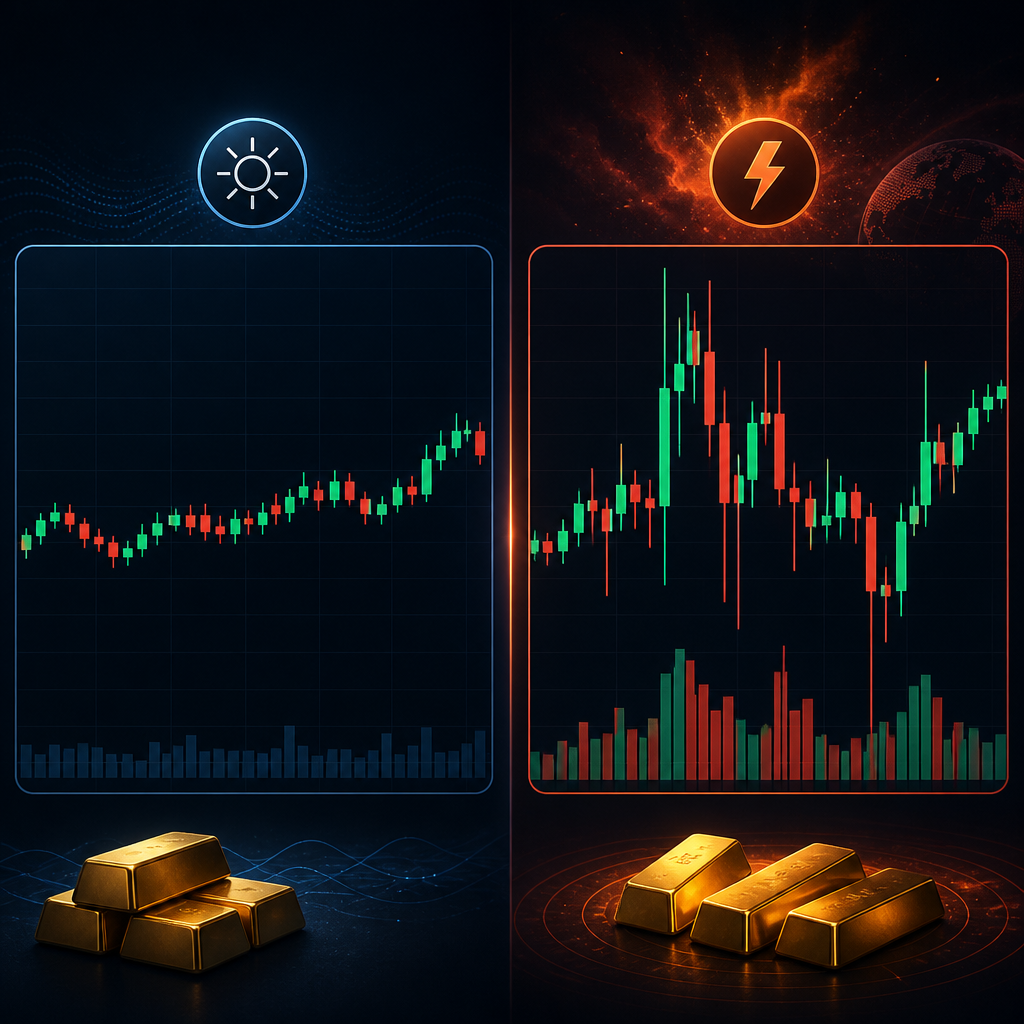
News-day success starts before the news. If you’re reacting at the release with no map, you’re trading the algorithm’s game.
Your pre-news map has three layers:
1) The higher-timeframe bias (H4/D1)
Mark the nearest swing high/low and the current range. Around $2650, you might see a recent swing low near $2618 and a swing high near $2688.
Those levels become “liquidity shelves.” On CPI, price often raids one shelf first, then reverses into the real move.
2) The intraday structure (M15/M5)
Identify the pre-news consolidation box. For example, gold may compress between $2642 and $2658 for 90 minutes before CPI.
That box matters because the first reaction often breaks one side, then snaps back through the other.
3) The USD context (DXY + majors)
Gold’s reaction is tightly linked to USD. With DXY 106.80, EUR/USD 1.0520, GBP/USD 1.2680, and USD/JPY 149.50, you can quickly judge whether the move is “USD broad” or “gold-specific.”
- If DXY spikes up and EUR/USD dumps, gold often drops with it (not always, but often).
- If yields jump and USD/JPY rips higher, gold can get hit even if equities are steady.
Pre-news checklist (5 minutes):
- Mark the range: high/low of the last 4 hours.
- Mark obvious liquidity: equal highs/lows, prior day high/low.
- Note the “line in the sand” level: where bias flips.
- Decide your plan: trade the breakout after confirmation or trade the sweep-and-reversal.
This map is what lets you follow XAUUSD signals with context instead of blind execution.
Step 2: Entry Delays That Save You From the First Whipsaw
The first move after CPI/FOMC is frequently a liquidity event, not a trend. That’s why entry delays are not “hesitation.” They’re a filter.
Here are three delay models that work well with gold signals.
Model A: Time-based delay (simple and effective)
Rule: No new entries in the first 2–5 minutes after CPI, and 5–15 minutes after FOMC (because FOMC has multiple waves: statement, dots, Powell).
Example: A buy signal triggers at $2654 right at CPI. You wait 3 minutes. Price wicks down to $2641 and back to $2656. You enter only after the market proves it can hold above $2654.
Model B: Candle-close confirmation (professional-style)
Rule: Enter only if the M1 or M5 candle closes beyond the level, not just spikes through it.
Example: Sell idea below $2640. Price spikes to $2637 but closes M1 back at $2643. That’s a trap. You skip the sell and wait.
Model C: Break-and-retest (highest quality, fewer trades)
Rule: Wait for the breakout, then the retest, then enter on rejection.
Example: Gold breaks above $2660 after CPI and prints $2668. You don’t chase. You wait for a pullback to $2660–$2662, then enter long if price rejects with a bullish M1/M5 close.
When entry delays are mandatory:
- Spread is wider than your usual threshold.
- The first candle is a “monster wick” (long wick, small body).
- Price is inside a tight box and the release is likely to sweep both sides.
Entry delays reduce trades, but they increase trade quality. On news days, that’s the only trade-off that matters.
Step 3: ATR-Based Wider Stops (Without Increasing Your Risk)
On a normal NY session, a $10 stop on gold can be reasonable. On CPI, that same $10 is often just “noise.”
The fix is not “hope.” The fix is volatility-based sizing using ATR (Average True Range).
How to use ATR for XAUUSD stop sizing
Pick a timeframe that matches your signal style. If you’re executing intraday signals, M5 ATR(14) is a practical tool.
Let’s say:
- Normal day M5 ATR(14) ≈ $2.5
- News day M5 ATR(14) spikes to ≈ $5.0
A simple rule: Stop = 3x to 5x M5 ATR depending on the setup.
- Normal day: 4 × $2.5 = $10 stop
- News day: 4 × $5.0 = $20 stop
Concrete examples around $2650 (with realistic stops/TP)
Example 1 (Long): Entry $2652, SL $2634 (risk $18). For 1:2 R:R, TP ≈ $2688. For 1:3, TP ≈ $2706 (often ambitious on the same day, but possible on FOMC).
Example 2 (Short): Entry $2646, SL $2666 (risk $20). For 1:2, TP ≈ $2606 (outside today’s guideline range, so you may instead scale partial at $2620 and trail the rest).
The key: wider stops require smaller position size
Most traders widen stops but keep the same lot size. That’s how accounts blow up on news.
Instead, keep your dollar risk fixed. If you normally risk $100 with a $10 stop, and today you need a $20 stop, your size should be cut in half.
News-day risk rule we use: keep risk per trade at 0.25%–1% depending on experience, and reduce size when ATR expands.
When wider stops are still not enough
If your broker’s spread and slippage are extreme, even a $25 stop can be meaningless. That’s not a strategy problem. That’s an execution environment problem.
In that case, the best “trade” is to wait for the post-release structure to form, then execute with normal spreads.
Step 4: News Filters That Keep You Out of the Worst Trades
Filters are what separate “news gambling” from a repeatable gold news trading strategy. You don’t need many. You need the right ones.
Filter 1: Spread spike filter (non-negotiable)
Rule: If spread is more than 2–3x your normal, do not enter market orders.
On XAUUSD, some brokers widen dramatically at the CPI second. If you normally see $0.20–$0.40 spread and it jumps to $1.50–$3.00, your entry is already compromised.
Action: either wait, or use limit orders only if your strategy supports it (many news environments will not fill limits cleanly).
Filter 2: “First candle” wick filter
Rule: If the first M1 candle after the release has a wick larger than 2x its body, treat it as a liquidity sweep and wait for confirmation.
This single filter prevents countless “entered the spike” losses.
Filter 3: Compression box filter
If price has been stuck in a tight pre-news box (example: $2646–$2654), assume the release will sweep both sides.
Rule: Don’t trade the first break. Trade the reclaim or the break-and-retest.
Filter 4: Correlation sanity check (DXY and EUR/USD)
Gold can decouple, but on CPI/FOMC it often moves with USD repricing.
- If gold is trying to break up while DXY is also ripping up, you’re likely seeing conflicting flows.
- Wait for alignment: DXY down + gold up, or DXY up + gold down.
Filter 5: “Two prints” rule for fake breakouts
Rule: Require two consecutive closes beyond the breakout level on M1 (or one close on M5) before entry.
News algos love one-tick breaks. Two prints reduce false triggers.
These filters won’t make you trade more. They’ll make you trade cleaner. And on FOMC/CPI, clean is profitable.
Step 5: Executing United Kings-Style XAUUSD Signals on News Days
If you follow premium signals, your edge comes from two places: the analysis behind the levels and your execution discipline.
At United Kings, we focus heavily on London and New York session timing, and our signals are designed with clear Entry, SL, and TP levels. But on news days, you still need a framework to execute those levels intelligently.
Here’s a step-by-step approach you can apply to any gold signal on CPI/FOMC/NFP.
Step-by-step: The “Delay + Confirm + Execute” workflow
- Step 1: Identify the event time and define your no-trade window (example: CPI 8:30 NY time, no new entries 8:29–8:33).
- Step 2: Mark the signal level(s) and your pre-news range (example: $2642–$2658).
- Step 3: Decide the entry model: time delay, candle close, or break-and-retest.
- Step 4: Apply ATR stop sizing. If ATR expands, widen SL and reduce lot size.
- Step 5: Check filters: spread, wick, compression, correlation.
- Step 6: Execute only when the market confirms (close/retest), not when it spikes.
Example: CPI day buy signal near $2648
Scenario: Gold is at $2650 pre-CPI. A buy idea is $2648 with SL $2636 (risk $12) on normal days.
On CPI day, you adapt:
- ATR has expanded. You set SL at $2630 (risk $18).
- You reduce size so your dollar risk stays the same.
- You wait 3 minutes post-release.
- You enter only after price reclaims $2648 and closes above it on M1/M5.
Targets: TP1 at $2684 (1:2), TP2 at $2702 (1:3) if momentum is strong. If $2702 is too far for the day’s range, you trail after TP1 and let the market decide.
Example: FOMC day sell signal below $2640
FOMC often creates a “statement move” and a “Powell move.” You might see gold break $2640, reverse to $2665, then trend down later.
Execution rule: you don’t sell the first break. You wait for:
- a close below $2640,
- a retest to $2640–$2643,
- and rejection (bearish close) before entering.
If you want to see how we structure our broader signal process, start with our main premium trading signals overview and our dedicated gold (XAUUSD) signals page.
Step 6: Managing Trades During Volatility (Scaling, Trailing, and Time Stops)
News-day trade management is where most profits are either protected or donated back to the market.
The mistake: treating TP like a static number when volatility is dynamic.
Use a two-stage take profit plan
On CPI/FOMC, price can move $25–$60 in minutes. That’s opportunity, but also risk.
A practical approach:
- TP1: Take partial at 1:1.5 or 1:2 (bank something).
- TP2: Let the rest run with a trailing stop once the market calms.
Example long: Entry $2652, SL $2634 (risk $18).
- TP1 at $2688 (1:2). Close 50–70%.
- Move SL to breakeven or to a structure level (example: $2658).
- Trail the remainder below M5 higher lows if trend continues.
Add a “time stop” to avoid post-news chop
After the initial impulse, gold often enters a messy 20–60 minute consolidation.
Rule: If price hasn’t progressed at least 0.5R–1R in your favor within a set time (example: 20 minutes for M1/M5 setups), consider exiting or reducing.
This protects you from the classic pattern: impulse → chop → stop-out at breakeven → move resumes without you. You won’t avoid it every time, but you’ll avoid death by a thousand cuts.
Don’t trail too early
Trailing a stop too tightly during CPI is like standing in front of a door and being surprised it hits you.
Wait for volatility to compress. A simple proxy is ATR dropping back toward pre-news levels, or the range of candles narrowing.
Be realistic about fills
On news spikes, your TP can be skipped and filled worse (positive or negative). That’s why partial profits and structure-based exits often outperform “all-out at TP2.”
If you’re building disciplined execution habits, our educational posts in the United Kings blog pair well with this playbook, especially around risk control and signal execution.
Step 7: The “Second Move” Strategy—Where the Cleanest Entries Often Appear
If you only remember one idea from this guide, make it this: the first move is often the trap; the second move is often the trade.
Why does the second move work?
- The market has already cleared liquidity (stops above/below obvious levels).
- Spreads typically normalize after the initial shock.
- Direction becomes clearer as USD and yields settle.
How to identify the second move in real time
Look for a three-part sequence:
- Impulse: a sharp candle run (example: $2650 → $2668).
- Pullback: a retrace into a key level (example: back to $2660).
- Continuation trigger: a higher low + bullish close (or lower high + bearish close).
This is where break-and-retest shines. You’re not predicting the news. You’re trading the market’s reaction after it reveals intent.
Second-move example around today’s levels
Assume CPI prints hotter than expected. DXY spikes from 106.80 to 107.20, EUR/USD drops from 1.0520 to 1.0475.
Gold dumps from $2650 to $2632, then rebounds to $2646.
A low-quality trade is selling the first break at $2648 and getting wicked out at $2656.
A higher-quality trade is waiting for price to fail at $2646–$2648, then entering short at $2644 with SL $2662 (risk $18) and TP1 at $2608 (again, may be too far intraday), so you scale at $2620 and trail.
When the second move fails
Sometimes the first move is the real move. That’s okay. You don’t need every move. You need the moves you can execute with controlled risk.
Professionals survive by avoiding the worst trades, not by catching every candle.
Step 8: FOMC-Specific Rules (Statement, Dots, Powell) for XAUUSD Signals
FOMC is not one event. It’s a sequence.
- 2:00 pm ET: statement release (and sometimes dot plot + SEP).
- 2:30 pm ET: Powell press conference.
Gold can reverse completely between 2:00 and 2:30. That’s why FOMC is where traders either level up or get humbled.
Rule 1: Treat 2:00–2:05 as “do not chase” time
Even if you get a signal, your fill and spread can be terrible in the first minutes.
Use a delay model: 5 minutes minimum, or candle-close confirmation on M5.
Rule 2: Expect a narrative shift at 2:30
The statement can be interpreted one way; Powell’s tone can change everything.
Practical action:
- If you’re in profit by 1R–2R before 2:30, consider taking partial or tightening risk.
- If you’re barely positive, consider reducing exposure. The press conference can whip $20–$40 quickly.
Rule 3: Use wider stops or smaller size—preferably both
FOMC volatility can exceed CPI because it reprices the entire rate path.
Stops of $20–$25 around $2650 are common for intraday FOMC trades, with reduced size to keep risk stable.
Rule 4: Watch USD/JPY and DXY for confirmation
USD/JPY at 149.50 is a key barometer for rate expectations. If USD/JPY spikes higher on hawkish tone, gold often struggles.
Alignment helps you avoid fighting the macro tape.
Rule 5: Don’t hold “hope trades” into the event
If you’re in a drawdown pre-FOMC, don’t rationalize it as “it will reverse on the news.” That’s gambling.
Either the setup is valid with a planned stop, or you’re out.
If you want a broader framework for evaluating signal quality before high-impact events, pair this article with our beginner-friendly checklist: forex signals provider checklist.
Step 9: CPI & NFP Specific Rules (Data Details, Revisions, and Fakeouts)
CPI and NFP are “data shocks.” They often create a clean directional move—but only after the market processes the details.
CPI: headline vs core vs components
Traders love the headline number. Markets often care more about core, services, and anything that changes the Fed narrative.
Practical execution rule: If the first move is violent but then instantly retraces, assume the market is re-reading the release. Wait for the second move structure.
NFP: the revision trap
NFP can whipsaw because of revisions, participation rate, and wage growth.
Rule: Treat NFP like CPI in the first 2–5 minutes: delay entries, require confirmation, and avoid chasing the first spike.
Typical fakeout pattern to recognize
- Gold breaks above a pre-news high (example: $2662).
- Stops get triggered, price prints $2674.
- Then it dumps below the box to $2640.
This is why the compression box filter matters. If you see a tight pre-news box, assume both sides are targets.
Execution example: CPI breakout with confirmation
Pre-news range: $2642–$2658. CPI hits, gold spikes to $2672, then pulls back.
You wait for:
- M5 close above $2658,
- retest of $2658–$2660,
- then enter long at $2661 with SL $2644 (risk $17) and TP1 at $2695 (near the upper guideline band; if $2690 is a key resistance, you take profit slightly before).
This is not “late.” This is “confirmed.” On news days, confirmation is paid for by fewer but cleaner trades.
For more on how gold signals behave when the unexpected hits (geopolitical headlines, surprise comments, shock prints), read: how gold signals react to unexpected news events.
Step 10: Broker, Platform, and Order Type Tactics (Slippage-Proofing)
On FOMC/CPI, your strategy can be perfect and still lose if execution is poor. This is the part most traders ignore until it’s too late.
Market orders vs limit orders on news
- Market orders: higher fill certainty, higher slippage risk.
- Limit orders: controlled price, higher chance of no fill (or partial fill) during fast moves.
For most retail traders, the safer approach on news is: wait for confirmation, then use a market order when spreads normalize. That’s often better than trying to “snipe” the exact level during the spike.
Stop orders can be dangerous on CPI/FOMC
Buy stops and sell stops can trigger at the worst moment and fill far from expected.
If you use them, size down and assume slippage. Better yet, use them only with a strict spread filter and only when your broker is proven stable during news.
Platform stability checklist
- Check if your platform freezes during high volatility.
- Know how to close trades quickly (one-click trading, hotkeys).
- Have your SL/TP set immediately—don’t “add it later.”
Execution reality: your stop may not be exact
On extreme spikes, stops can be filled worse than your level. That’s why you should reduce size and avoid trading in the first seconds where liquidity is thin.
If you’re deciding between platforms and want a practical execution checklist, our guide on MT4 vs MT5 is a good companion read (especially for gold): MT4 vs MT5 for gold signals.
Putting It All Together: A Complete News-Day Routine You Can Repeat
Consistency comes from routine. Here’s a repeatable process you can run on every CPI/FOMC/NFP day, whether you trade manually or follow signals.
60–90 minutes before the event
- Mark key levels: prior day high/low, session high/low, equal highs/lows.
- Identify the pre-news box (compression range).
- Check DXY (106.80) and majors (EUR/USD 1.0520, GBP/USD 1.2680, USD/JPY 149.50) for positioning clues.
15 minutes before the event
- Decide your no-trade window (example: 1 minute before to 3 minutes after CPI).
- Set your ATR-based stop plan (normal vs news stop).
- Reduce lot size to keep risk constant.
0–5 minutes after the event (CPI/NFP) / 0–15 minutes (FOMC)
- Do not chase spikes.
- Apply wick and spread filters.
- Wait for close + retest or two-print confirmation.
5–30 minutes after the event
- Look for the second move setup: impulse → pullback → continuation.
- Execute with defined SL/TP and partial profit plan.
- Manage risk into the next wave (especially FOMC 2:30).
After the trade
- Log: entry model used, spread at entry, slippage, ATR, outcome.
- Review whether you followed the routine, not just P/L.
This routine is exactly how serious signal followers avoid emotional decisions. If you’re newer, consider reading our beginner-friendly guide to following Telegram signals with structure: forex signals Telegram for beginners.
FAQ: Trading XAUUSD Signals on FOMC, CPI, and NFP
1) Should I avoid trading gold during CPI entirely?
No. But you should avoid trading it the same way you trade a normal day. Use entry delays, ATR-based stops, and strict spread filters.
2) What’s a good stop loss for XAUUSD on FOMC day?
It depends on volatility, but around $2650 it’s common to need $15–$25 stops for intraday setups. The key is to reduce position size so your dollar risk stays constant.
3) Why do I get stopped out and then price goes my way?
Because news spikes often sweep liquidity before trending. Tight stops placed at obvious levels are easy targets. Confirmation entries and wider, ATR-based stops reduce this.
4) Is break-and-retest better than instant breakout entries on news?
Most of the time, yes. It produces fewer trades but higher quality fills and fewer fakeouts—especially when spreads are unstable.
5) Can I follow XAUUSD signals on Telegram during news safely?
You can, if you have a rules-based execution plan. Use a demo first if you’re new, and treat news days as a different volatility regime with different sizing.
Risk Disclaimer (Read Before You Trade)
Forex and gold trading involves significant risk and may not be suitable for all investors. High-impact news events (FOMC, CPI, NFP) can cause rapid price moves, widened spreads, and slippage that may exceed your planned risk. Past performance does not guarantee future results. No signal or strategy can guarantee profits. If you are a beginner, practice on a demo account first and use strict risk management.
Join United Kings: Premium XAUUSD Signals Built for Real Market Conditions
If you want gold signals that come with clear structure—Entry, SL, TP—and a community that trades London and NY sessions with discipline, United Kings is built for you.
We provide premium Telegram signals for forex and gold, backed by a large community of 300K+ active traders, and a performance-focused process designed to reduce emotional trading. We don’t promise guaranteed profits, but we do focus on consistency, clarity, and execution.
- Explore our full signal suite: United Kings premium signals
- For dedicated XAUUSD setups: gold trading signals
- For major FX pairs alongside gold: forex signals
Pricing (3 plans): Starter 3 Months ($299), Best Value 1 Year ($599 with 50% savings + FREE ebook), and Unlimited Lifetime ($999). See details on our pricing page. Every plan includes a 48-hour money-back guarantee.
Want the signals in real time? Join our Telegram now: United Kings signals channel on Telegram.
Your next CPI or FOMC doesn’t have to be a coin flip. Use this playbook, trade the second move, and let disciplined execution do the heavy lifting.


