
Ever had a perfect XAUUSD signal… and still watched your trade start in the red?
You enter exactly on time, your stop loss is “reasonable,” and the setup is clean. Then gold spikes, your fill comes back worse than expected, and your risk-to-reward quietly collapses.
That’s not your strategy failing. That’s XAUUSD spread and gold slippage doing what they do best—showing up when volatility is highest and execution is weakest.
In today’s market, gold is trading around $2650 (+0.35% on the day). DXY is near 106.80, USD/JPY is around 149.50, and majors like EUR/USD (1.0520) and GBP/USD (1.2680) are steady—but gold can still jump $10–$25 in minutes around session transitions and liquidity gaps.
This guide is your execution playbook. We won’t change the signal strategy. We’ll protect it—so the entry, SL, and TP you receive behave closer to how they were designed.
TL;DR: The XAUUSD Spread & Slippage Survival Rules
- Don’t “market buy” into thin liquidity. Use limit orders or stop-limit logic when spreads are unstable.
- Measure the real spread first. If XAUUSD spread is 40–80 points (or more) during rollover/news, your stop and position size must account for it.
- Protect your R:R with execution rules. A $2–$5 worse fill can turn a 1:3 into a 1:2 without you noticing.
- Place stops beyond “spread spikes,” not beyond hope. For gold, many traders need SL buffers of $10–$25 from entry—plus execution tolerance.
- Avoid the worst minutes. The most dangerous windows are rollover, session handoffs, and high-impact data seconds.
- Use a checklist. The fastest way to reduce hidden costs is to standardize how you execute every gold signal.
1) Why XAUUSD Spread Widens (And Why Gold Slippage Gets Brutal)
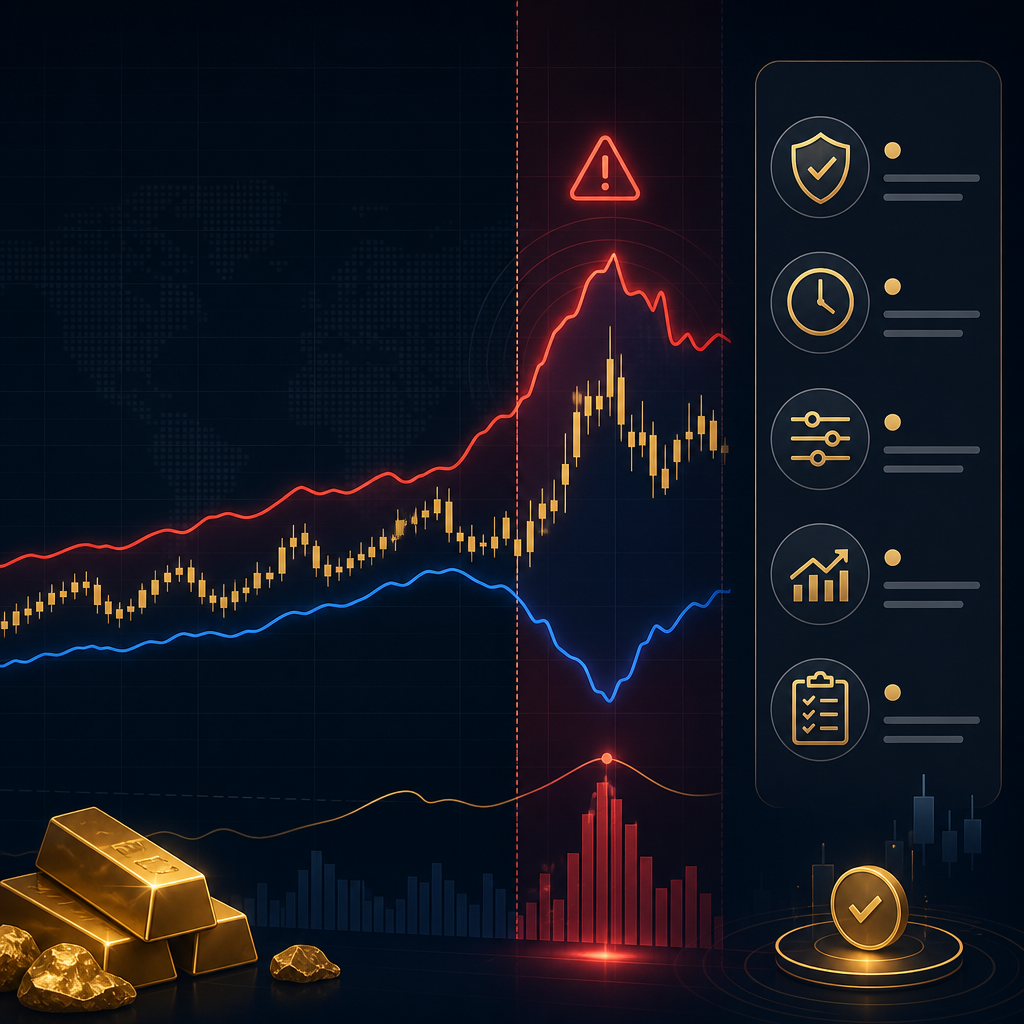
Gold is liquid, but it’s not liquid the same way EUR/USD is. XAUUSD is a CFD/spot product for most retail traders, and your pricing comes through a broker’s liquidity stack.
When volatility rises, quotes update faster, liquidity thins at each price level, and the distance between bid and ask widens. That’s the XAUUSD spread problem.
Then comes the second punch: gold slippage. You click buy at $2650.10, but the next available ask is $2651.00. Your order fills there instead. That’s slippage.
Spread vs slippage: what’s the difference in real money?
Spread is the cost you pay immediately for crossing the bid/ask. Slippage is the extra cost when your fill is worse than the price you expected.
Here’s a realistic scenario around current levels:
- You receive a buy idea around $2650.00.
- Normal conditions: spread might be ~$0.20–$0.60 (broker-dependent).
- Volatile conditions: spread can widen to ~$1.00–$3.00 (or more) briefly.
- Slippage can add another ~$0.50–$3.00 on top during fast moves.
If your signal targets a 1:3 R:R with a $12 stop and $36 target, losing $2–$4 on execution is not “small.” It’s a meaningful percentage of your intended edge.
Why it happens more in XAUUSD than majors
Gold reacts to both currency flows and risk flows. When DXY is firm near 106.80, yields shift, and headlines hit, gold can move quickly as traders reprice inflation expectations and safe-haven demand.
That repricing creates micro-gaps—moments where there simply isn’t enough liquidity at the price you clicked. Your broker fills you at the next available price.
The hidden killer: “strategy drift” caused by execution
Most traders think they’re following a signal exactly. In reality, their entry is 1–3 dollars worse, their stop is tighter than it should be, and their take profit is unchanged.
That creates a silent change: your system becomes lower R:R and higher stop-out probability, even if the signal provider is consistent.
If you use premium alerts like the ones we share at United Kings—clear Entry, SL, and TP—your job is to execute them with minimal distortion. That’s how you keep the math intact.
2) The Real Cost of “Bad Fills” on a Gold Signal (With $2650 Examples)
Let’s turn execution into numbers, because numbers remove denial.
Assume gold is around $2650 and you receive a simple setup:
- Buy $2650.00
- SL $2638.00 (risk: $12)
- TP $2686.00 (reward: $36)
- Planned R:R = 1:3
Now add realistic execution friction during a fast minute.
Case A: Spread widens, but you still get filled “okay”
You click market buy and get filled at $2651.20 (a $1.20 worse entry). Your stop remains $2638.00 because you “followed the signal.”
- Actual risk = $2651.20 - $2638.00 = $13.20
- Actual reward = $2686.00 - $2651.20 = $34.80
- Actual R:R ≈ 1:2.64
Not catastrophic, but you just gave away edge.
Case B: Spread + slippage hits you at the worst time
You get filled at $2653.00 (a $3 worse entry). Same stop, same take profit.
- Actual risk = $15.00
- Actual reward = $33.00
- Actual R:R = 1:2.2
If your system expects a certain win rate at 1:3, you just changed the expectancy. You didn’t “take the same trade.” You took a different trade.
Case C: You panic-adjust the stop closer to “keep risk the same”
This is common. Traders move SL from $2638 to $2641 to keep the dollar risk similar after a worse fill.
Now you’re tighter by $3. That’s often the difference between surviving a normal pullback and getting wicked out before the real move.
In gold, wicks are not a rare event. Around London/NY transitions, a $6–$12 wick can happen fast—especially if USD/JPY is volatile near 149.50 and DXY is pushing.
The “spread tax” on scalps vs swings
Execution friction hurts scalps more than swings. If your TP is $8 and you pay $2 in spread/slippage, you just donated 25% of the move.
If your TP is $36, paying $2 is still painful but survivable. That’s why many signal traders do best when they stop forcing tiny targets during high-volatility hours.
Bottom line: the goal isn’t “no slippage.” The goal is controlled slippage that doesn’t destroy your R:R.
3) High-Volatility Hours: When XAUUSD Spread Spikes the Most

If you want to execute gold signals safely, you need to know when not to fight the tape.
United Kings focuses heavily on London and New York sessions because that’s where liquidity and follow-through are usually best. But even inside those sessions, there are danger windows.
The top spread/slippage danger windows
- Daily rollover (broker-dependent, often around 5pm New York time): liquidity thins, pricing widens, and many brokers increase spreads.
- Session transitions: the handoff between Asia → London and London → New York can create short-lived gaps in depth.
- Major data releases: CPI, NFP, FOMC minutes/rate decisions. Even if direction is “right,” fills can be ugly.
- Unscheduled headlines: geopolitical shocks, sudden central bank commentary, unexpected risk-off events.
Gold can move $15–$30 in minutes when liquidity is stressed. In the $2610–$2690 range, that’s enough to hit stops, trigger pending orders, and then reverse.
Why spreads widen most when you feel “urgent”
There’s a psychological trap: the faster the candle moves, the more you feel you must enter immediately.
That urgency pushes you toward market orders at the exact moment spreads and slippage are worst. Execution becomes emotional, not systematic.
Use DXY and USD/JPY as volatility tells (quick filter)
You don’t need a complex model. Just watch whether the dollar is jumping.
- If DXY (106.80) is accelerating upward, gold often whips as it reprices.
- If USD/JPY (149.50) is moving fast, it often signals broader USD momentum and risk sentiment shifts.
This doesn’t replace a signal. It tells you whether you should expect spread spikes and slippage risk right now.
Practical timing rule (simple and effective)
If you’re trading a gold signal during a known volatile window, wait for one of these before executing:
- Spread stabilizes for 30–60 seconds (your platform shows consistent bid/ask distance).
- A candle closes (M1 or M5) and price stops “teleporting.”
- Retest entry zone after the first impulse (often gives better fill and lower slippage).
You’re not trying to be late. You’re trying to be filled correctly.
4) Market vs Limit vs Stop Orders for Gold Signals (Execution Comparison)
The order type you use is one of the biggest levers you control. And it’s the lever most signal followers ignore.
When traders say, “I took the signal,” what they often mean is, “I hit market and hoped for the best.” That’s not a plan.
Quick comparison table: which order type survives volatility best?
| Order Type | Best For | Risk in High Volatility | When to Use on XAUUSD |
|---|---|---|---|
| Market | Immediate entry | High slippage, worst fills during spikes | Only when spread is stable and you accept possible slippage |
| Limit | Price control | May miss the trade if price runs | Ideal for retests, pullbacks, and volatile conditions |
| Stop | Breakout confirmation | Can slip badly if breakout is violent | Use when you want momentum confirmation and accept slippage risk |
| Stop-Limit (if supported) | Breakout + price control | May not fill if price gaps through limit | Best “professional” tool for news-like volatility |
How to choose the right order type without changing the signal strategy
Signals often provide an entry zone or a specific entry price. Your job is to translate that into an order that protects execution.
- If the signal is a pullback buy near $2648–$2650, a limit buy is usually superior.
- If the signal is a breakout buy above $2660, a buy stop or stop-limit makes sense.
- If the signal is “enter now” but spreads are wide, consider waiting for a micro-retest and using a limit.
Real example: limit order protecting a gold signal
Gold is $2650.00, spread is fluctuating. You want to buy, but you notice the ask is jumping to $2651.40.
Instead of market buying, you place a buy limit at $2650.20. If price retests, you get filled closer to plan. If it runs without you, that’s information too: the trade may be too hot to chase.
The “missed trade” fear (and how pros handle it)
Missing a trade feels bad. Taking a trade with broken R:R feels worse—because it quietly damages your account over time.
Professional execution accepts that not every signal must be taken. Your filter is not “do I like it?” Your filter is “can I execute it cleanly?”
5) Step-by-Step: Set Max Deviation & Slippage Controls (MT4/MT5 Logic)
Slippage controls vary by broker and platform. But the logic is universal: you decide how much “worse” you’re willing to be filled.
Some platforms show this as deviation. Some brokers apply their own rules. Some order types (like limit) inherently control price.
Even if your platform doesn’t show a “max deviation” box, you can still apply the concept using order structure.
Step 1: Define your maximum acceptable execution damage
Before you place any order, decide a number. For XAUUSD, many disciplined traders use something like:
- Normal conditions: max $0.30–$0.80 worse fill
- High volatility: max $1.00–$2.00 worse fill (or skip)
Your exact number depends on your stop size. If your stop is $10, accepting $2 slippage is accepting 20% extra risk. That’s usually too much.
Step 2: Use limit orders to “hard cap” slippage
A limit order is the cleanest slippage control. You either get your price (or better) or you don’t get filled.
For example, if a signal suggests buying $2650.00, you can set:
- Buy limit: $2650.00 to $2650.30 (depending on your plan)
- SL: $2638.00
- TP: $2686.00
If price never comes back, you miss it. But you also avoid the “late fill” that ruins the math.
Step 3: For breakouts, use stop-limit (if possible)
Breakouts are where slippage is most common. A buy stop triggers when price trades above a level, but the fill can be far worse if it jumps.
Stop-limit adds a second condition: it triggers at the stop price, but only fills up to your limit price.
Example:
- Buy stop: $2660.00 (trigger)
- Buy limit: $2661.20 (max acceptable fill)
If gold jumps from $2659.80 to $2663.00, you won’t be filled at $2663.00. That protects your R:R. The trade might be missed, but it won’t be distorted.
Step 4: Don’t ignore partial fills and requotes
Some brokers may requote or partially fill in fast markets. If you see repeated requotes, treat it as a warning: liquidity is poor.
In that moment, your “edge” is not your analysis. It’s your ability to not donate money to bad execution.
Step 5: Build a personal execution rulebook
Write down your execution rules in one place. Example:
- No market orders during rollover window.
- If spread is above my threshold, I only use limit or stop-limit.
- If my fill is worse by more than $1.50, I skip the trade.
This is how you trade like a pro even when you’re following signals.
6) Stop Loss Placement: Put SL Beyond Spread Spikes (Not Just Beyond the Setup)
Most stop losses fail for one of two reasons: the idea was wrong, or the stop was placed where liquidity hunts.
During high-volatility hours, the second reason becomes far more common—especially on XAUUSD.
What is a “spread spike” stop-out?
A spread spike stop-out happens when the bid/ask briefly widens and prints a price that hits your stop, even though the broader move continues in your direction.
It’s most painful when you did everything “right” and still got clipped.
Practical rule: account for execution + spread when placing SL
If your signal stop is $12 away, and you frequently experience $1–$2 of combined spread/slippage during the worst minutes, your effective buffer might only be $10.
That’s why traders often need to place stops with a buffer, or choose not to trade during the worst conditions.
Example: safer SL logic around $2650
Say you buy $2650.00 with SL $2638.00 (risk $12). During a volatile minute, you might get filled at $2651.50.
If you keep SL at $2638.00, your risk becomes $13.50. That’s okay if position sizing adjusts. It’s not okay if you keep the same lot size.
The safer approach is to decide in advance:
- Either you accept wider effective risk and reduce lot size.
- Or you skip the trade if execution exceeds your tolerance.
What you should avoid is tightening SL to “compensate,” because that increases stop-out probability.
Where stops get hunted on gold (common zones)
- Just below obvious round numbers (e.g., $2650, $2640, $2630).
- Just below the last swing low on M5/M15.
- At the edge of an Asian range right before London breaks it.
When liquidity is thin, price can wick into these zones and reverse quickly. Your stop needs to respect that reality.
Use ATR as a sanity check (not a strategy change)
You’re not changing the signal. You’re checking whether your stop makes sense in current volatility.
If M15 ATR is elevated and gold is printing $6–$10 candles, a $10 stop may be structurally fragile. If your signal uses $10–$25 stops (common for gold), make sure your execution doesn’t shrink that buffer unintentionally.
7) Entry Timing Playbook: Rollover, Session Transitions, and “The First Spike”
Execution is often less about being smart and more about being patient for 90 seconds.
Gold loves to do a “first spike” that traps both sides. Then it shows the real direction.
The rollover rule: treat it like a storm
Around rollover, many brokers widen spreads aggressively. Even if XAUUSD is “not moving,” your cost to enter can jump.
If you must trade, consider these rules:
- Prefer limit orders only.
- Reduce size.
- Require spread to stabilize for 2–3 minutes.
Most traders are better off simply not opening new positions in that window.
Session transitions: London open and NY open
Liquidity increases at London and New York opens, but the first few minutes can be chaotic.
Gold can sweep an Asian range and reverse. Or it can break and run. Your execution needs a plan.
Step-by-step: the “first spike then retest” entry
- Identify the signal entry zone (example: buy $2648–$2650).
- Wait for the spike (price runs to $2654 quickly).
- Do not chase with market orders.
- Place a limit at the original zone or the midpoint (e.g., $2649.80).
- Accept that you may miss it. Your edge is clean execution.
This is one of the simplest ways to reduce slippage without changing the signal’s logic.
When you should use “enter on close” logic
If the signal is based on a breakout confirmation, waiting for a candle close (M1/M5) can reduce false triggers and reduce slippage from instant spikes.
You may enter $0.50–$1 later, but you often avoid entering at the very top of a liquidity sweep.
Use a “spread threshold” before executing
Create a personal rule like:
- If spread is above $1.20, I only use limit orders.
- If spread is above $2.50, I don’t enter new trades.
Your thresholds depend on your broker. The point is to stop pretending spread is constant.
8) Protecting Risk-to-Reward: Keep the Signal’s Math Intact
Most traders obsess over win rate. Professionals obsess over expectancy.
Expectancy is what you make per trade over time, factoring wins, losses, and the size of each.
Execution costs attack expectancy directly. The scary part is they do it quietly.
How spread and slippage distort R:R
Let’s use a clean 1:2 example to keep it simple:
- Buy $2650.00
- SL $2640.00 (risk $10)
- TP $2670.00 (reward $20)
If you slip $2 worse and get filled at $2652.00:
- Risk becomes $12
- Reward becomes $18
- R:R becomes 1:1.5
That’s a different system.
Three ways to protect R:R without changing strategy
- Use limit/stop-limit orders to control entry price.
- Skip trades when execution damage exceeds your threshold.
- Adjust position size if your fill is worse but you still take the trade.
Notice what’s not on the list: moving TP further “to make it back.” That’s how traders turn structured signals into random hope.
The “execution-adjusted position sizing” method
If you planned risk based on a $12 stop, but you get filled $1.50 worse, your effective stop distance is $13.50.
To keep the same dollar risk, reduce position size by:
- New size = Old size × (Planned stop / Actual stop)
- Example: New size = Old size × (12 / 13.5) ≈ 0.89
That’s a simple adjustment that keeps your risk management consistent.
Why this matters for signal followers specifically
Signals are standardized. Your execution environment is not. Different brokers, different spreads, different liquidity, different slippage.
So the professional signal follower isn’t the one who “copies fastest.” It’s the one who copies most accurately.
If you want a deeper framework for risk, pair this guide with our dedicated breakdown on risk management strategies when using forex signals—the principles apply perfectly to XAUUSD.
9) Practical Checklists: Before, During, and After You Execute Gold Signals
Checklists feel boring. Checklists also prevent expensive mistakes.
When you’re trading gold around $2650 during high-volatility hours, you want fewer decisions in the moment—not more.
Pre-trade checklist (60 seconds)
- What is the current XAUUSD spread right now?
- Is this near rollover or a session transition?
- Is there major news in the next 10–30 minutes?
- Is DXY (106.80) moving sharply? Is USD/JPY (149.50) spiking?
- Which order type will I use: limit, stop, stop-limit, or market?
- What’s my max acceptable slippage/deviation?
Execution checklist (the moment you place the order)
- Entry price is within my acceptable range (no chasing).
- SL is placed immediately (no “I’ll add it later”).
- TP is placed or clearly planned (no improvising mid-trade).
- If my fill is worse than expected, I either reduce size or skip.
Post-entry checklist (first 2 minutes)
- Did I get slipped? By how much?
- Did spread widen after entry (temporary) or stay wide (warning)?
- Is my effective risk larger than planned?
- Am I still trading the original plan, or am I reacting emotionally?
Post-trade checklist (learning loop)
- Record entry vs intended entry (difference in $).
- Record spread at entry and at stop-out/TP.
- Note time of day and session.
- Did order type help or hurt?
This is how you improve execution without changing the signal strategy at all.
If you’re still choosing a provider, our forex trading signals provider checklist helps you evaluate the quality of entries, stops, and communication—critical for volatile instruments like gold.
10) Broker & Platform Factors: Real Spreads, Execution Speed, and What to Test
Not all XAUUSD feeds are equal. Two traders can receive the same signal and get very different outcomes because their broker environment is different.
This section isn’t about “which broker is best.” It’s about what to measure so you stop guessing.
Real spreads vs “advertised” spreads
Many brokers advertise tight spreads, but the real spread during volatile minutes is what matters.
You want to observe XAUUSD spread during:
- London open
- New York open
- High-impact news minutes
- Rollover
Track it for a week. You’ll quickly see patterns.
Execution model: why it matters for slippage
Some environments are more prone to requotes, some to slippage, some to both. What you care about is consistency.
If you frequently see:
- Large negative slippage on entries
- Stops triggered by brief spikes
- Wide spreads that persist for minutes
…then you must tighten your execution rules, trade less during danger windows, or consider improving your trading infrastructure.
Use demo testing the right way (especially for beginners)
Demo accounts often have “perfect” execution. That can be misleading.
Still, demo is valuable for practicing the checklist and order types. Then you validate on a small live account to see real spreads and slippage.
If you’re new to Telegram alerts, our guide on how forex signals work on Telegram for beginners helps you build the right habits before you scale.
Platform settings that reduce mistakes
- One-click trading: useful, but dangerous if you use market orders impulsively.
- Default lot size: set it small to avoid accidental oversizing.
- Trade confirmation: consider enabling it during volatile sessions.
- Order templates: save common SL/TP structures to reduce delays.
In fast gold markets, a 10-second delay can be the difference between a clean fill and a distorted trade.
11) High-Volatility Execution Scenarios (News, Breakouts, and Fakeouts)
Let’s make this practical with three common scenarios you will face if you trade XAUUSD around $2610–$2690.
These examples assume you’re following a structured signal with defined Entry/SL/TP, like the ones we share in our premium gold signals.
Scenario A: News spike, then retrace (classic CPI/NFP behavior)
Gold is at $2650. A headline hits. Price spikes to $2662, then snaps back to $2652.
Common mistake: market buy at $2661 because you fear missing the move. Spread is wide, slippage is heavy, and you’re buying the spike.
Execution play:
- Wait 30–90 seconds for spread to normalize.
- Use a limit order at the signal’s intended zone (or skip).
- If the signal is breakout-based, use stop-limit with a tight max fill range.
If you want a deeper survival framework for surprise volatility, read how gold signals react to unexpected news events.
Scenario B: London open sweep (stop hunt) then trend
Gold trades in a tight Asian range near $2642–$2648. London opens and sweeps below $2640 to $2637, then reverses and runs to $2660.
Common mistake: you place stops right under $2640 because it’s “the low.” You get stopped on the sweep.
Execution play:
- Expect a sweep around obvious levels.
- Place SL beyond the sweep zone if the signal’s structure allows.
- Prefer limit entries on pullbacks after the first impulse.
Scenario C: Breakout with slippage risk (NY momentum)
Gold consolidates near $2658–$2660. A buy stop triggers above $2660 and price jumps to $2664 instantly.
Common mistake: you use a buy stop and accept any fill. You get filled at $2664, but your SL/TP are still based on $2660.
Execution play:
- Use stop-limit: trigger $2660, max fill $2661.20.
- If not filled, don’t chase. Wait for retest near $2660–$2661.
- Only take the trade if you can keep the R:R close to plan.
The mindset shift: “I execute setups, not adrenaline”
High volatility is where traders donate money to the market because they confuse movement with opportunity.
Your edge comes from structured entries and controlled risk. Execution is how you keep that edge.
12) The United Kings Execution Standard (And How to Apply It in Telegram)
Signals are only as good as the trader’s ability to execute them. That’s why we emphasize not just entries, but process.
At United Kings, we’re built for active traders who want clarity:
- Premium Telegram signals for forex and gold
- 85%+ win rate target with clear Entry, SL, and TP levels (no guarantees—execution and risk matter)
- 300K+ active traders in the community
- Strong focus on London and NY session trading where follow-through is typically best
- Educational content alongside signals so you improve, not just copy
- 48-hour money-back guarantee for new members
How to follow a gold signal in Telegram like a pro (step-by-step)
- Read the full signal: entry, SL, TP, and any notes about timing.
- Check current spread and whether you’re near a danger window.
- Choose the right order type: limit for pullbacks, stop/stop-limit for breakouts.
- Set your max acceptable deviation (or replicate it with limit/stop-limit).
- Place SL and TP immediately.
- Log the fill quality so you can refine your execution rules.
Where to start inside United Kings
- If you want gold-focused alerts, start with our XAUUSD gold signals.
- If you want diversified FX alerts as well, explore our forex signals and the full signals hub.
- To understand our membership options, see United Kings pricing (Starter 3 Months $299, Best Value 1 Year $599 with 50% savings + FREE ebook, Lifetime $999 pay once).
Want the fastest access?
Join our official Telegram channel here: United Kings Telegram signals community.
FAQ: XAUUSD Spread, Gold Slippage, and Executing Gold Signals
1) What is a “good” XAUUSD spread?
It depends on your broker and account type. What matters is consistency and how spreads behave during volatile windows. Track spread at London/NY opens and rollover to set your personal thresholds.
2) Should I use market orders for gold signals?
Only when spreads are stable and you accept potential slippage. In high-volatility minutes, limit or stop-limit orders usually protect your entry price and preserve R:R better.
3) How do I avoid slippage during news?
You can’t eliminate it, but you can control it. Use limit/stop-limit orders, set a maximum acceptable fill range, avoid the first 30–90 seconds after the release, and skip trades when spreads are abnormal.
4) Should I move my stop loss because of spread widening?
Don’t move stops impulsively. Instead, plan for execution costs in advance: either reduce position size if the fill is worse, or avoid trading when spreads are unstable. Tightening SL after slippage often increases stop-outs.
5) Is slippage always negative?
No. You can get positive slippage (better fills), but in fast gold markets it’s more common to experience negative slippage. Build rules assuming slippage can be unfavorable.
Risk Disclaimer (Read This Before You Trade)
Forex and gold trading involves significant risk and may not be suitable for all investors. Spreads can widen and slippage can occur, especially during high-volatility periods and low-liquidity windows. Past performance does not guarantee future results. Signals and educational content are not financial advice. If you’re a beginner, practice on a demo account first and use strict risk management before trading live.
Final CTA: Trade Gold Signals With a Real Execution Edge
If you’ve been losing money on “good trades,” it’s often not the setup—it’s the spread, slippage, and execution decisions made in a 10-second window.
When you combine a clean execution playbook with premium alerts, your results become more consistent and your risk-to-reward stays intact.
Join United Kings today for premium forex and gold signals with clear Entry, SL, and TP levels, London/NY session focus, and a massive community of 300K+ traders.
- Explore all services: United Kings Signals
- Get XAUUSD alerts: Premium Gold Signals
- See membership options: Starter ($299), Best Value Yearly ($599), Lifetime ($999)
- Join Telegram now: United Kings official Telegram
If you have questions before joining, visit our About United Kings page or reach out via contact. You can also browse more education in our trading blog.


