
Ever watched gold (XAUUSD) sit dead quiet… then explode right as London opens?
You’re not imagining it. The London session is where liquidity, volatility, and intent often show up at the same time—especially when XAUUSD is trading near key levels like $2650 (today’s context) and the dollar is firm (DXY around 106.80).
The problem is that “London Open breakout” is also one of the most faked moves in gold. If you trade it without a checklist, you’ll get chopped by stop-hunts, spread spikes, and false candles that look perfect—until they reverse 12 minutes later.
This guide gives you a repeatable, signal-style framework: time windows, pre-session range marking, volatility filters, and a step-by-step confirmation checklist you can run in under 60 seconds before you ever place a trade.
TL;DR — London Open Breakout for XAUUSD (Quick Rules)
- Trade window: focus on 07:00–10:00 London time, with the highest-quality breakouts often forming in the first 30–90 minutes.
- Mark the pre-London range: use a consistent box (example: 00:00–06:59 London time) and trade the first clean break + confirmation.
- Use a volatility filter: skip breakouts when gold is already expanded (e.g., big impulse from $2618 to $2650 before London) or when spreads widen.
- Confirmation checklist: breakout candle close, retest behavior, structure alignment, and DXY/yields context must agree.
- Risk rules: typical XAUUSD stop is $10–$25; target 1:2 or 1:3 RR (e.g., $12 risk → $24–$36 reward).
- Most common trap: the “first poke” above range high (liquidity grab) that instantly snaps back—wait for a close + retest.
Why the London Open Matters for XAUUSD (and Why It Traps Traders)

The London session is not magic. It’s mechanics.
Gold is a global market, but the concentration of institutional order flow tends to increase as London comes online. That means tighter participation, more volume, and more willingness for price to move away from an overnight equilibrium.
In today’s context, gold is hovering around $2650 with a mild 24h gain (+0.35%). The dollar index is elevated near 106.80, and USD/JPY is around 149.50. When the dollar is strong, gold can still rally—but breakouts become more selective. You’ll often see sharp two-way moves as the market tests liquidity above and below the range before choosing direction.
Here’s why London Open breakouts work when they work:
- Range compression: Asia often creates a tight box as liquidity thins and price mean-reverts.
- Liquidity pools: stops accumulate above the Asian high and below the Asian low.
- Session handoff: London participants reprice gold based on updated risk sentiment, yields, and FX flows.
And here’s why they fail:
- Stop-hunts first, direction second: the market frequently sweeps one side of the range to trigger stops and fill larger orders.
- Spread/volatility spikes: your entry may be fine, but execution can be poor if your broker widens spreads around the open.
- News proximity: even “mid-tier” UK/EU data can produce whipsaw if the range is tight.
So the goal isn’t to trade every breakout. The goal is to trade the clean breakout with confirmation—the one that looks boring and obvious after it’s already moving.
This is exactly how we approach London and NY session setups inside our premium gold signals: rules first, then execution, then risk control.
London Open Time Windows for Gold (Exact Session Timing You Can Use)
If you don’t define a time window, you’ll “London Open breakout” yourself into random trades all day.
For XAUUSD, we treat the London session as a sequence, not a single moment. Your strategy changes depending on where you are in that sequence.
Core London windows (practical trading view)
- Pre-London build-up: 06:00–07:00 London time
- London Open impulse zone: 07:00–08:30 London time
- London continuation / false-breakout resolution: 08:30–10:00 London time
- Midday fade risk: 10:00–12:00 London time (often choppy unless trend day)
Why these windows matter: gold often makes its first meaningful expansion during 07:00–10:00 London time. If you show up at 11:30 and call it a London breakout, you’re typically trading the leftovers—late entries, weaker RR, and higher chance of reversal.
UTC vs broker time (avoid the #1 scheduling mistake)
Many traders lose consistency because their “London Open” is based on their broker’s server time or their phone clock.
Your solution: pick one reference (London time or UTC) and stick to it. If you use TradingView, set the chart time zone to Europe/London and keep your session boxes consistent.
Also account for DST. London time shifts relative to UTC depending on the season, and that changes when liquidity hits your chart.
How this ties into signal execution
Signals work best when they’re aligned with the expected liquidity window. That’s why United Kings focuses heavily on London and New York session trading—it’s when gold is most likely to deliver clean movement and hit structured targets.
If you want a steady stream of session-based setups (with Entry, SL, TP clearly defined), you can explore our full signals page and see how we structure trades for real execution—not hindsight charts.
Pre-Session Range Marking: The “Box” That Makes Breakouts Tradable
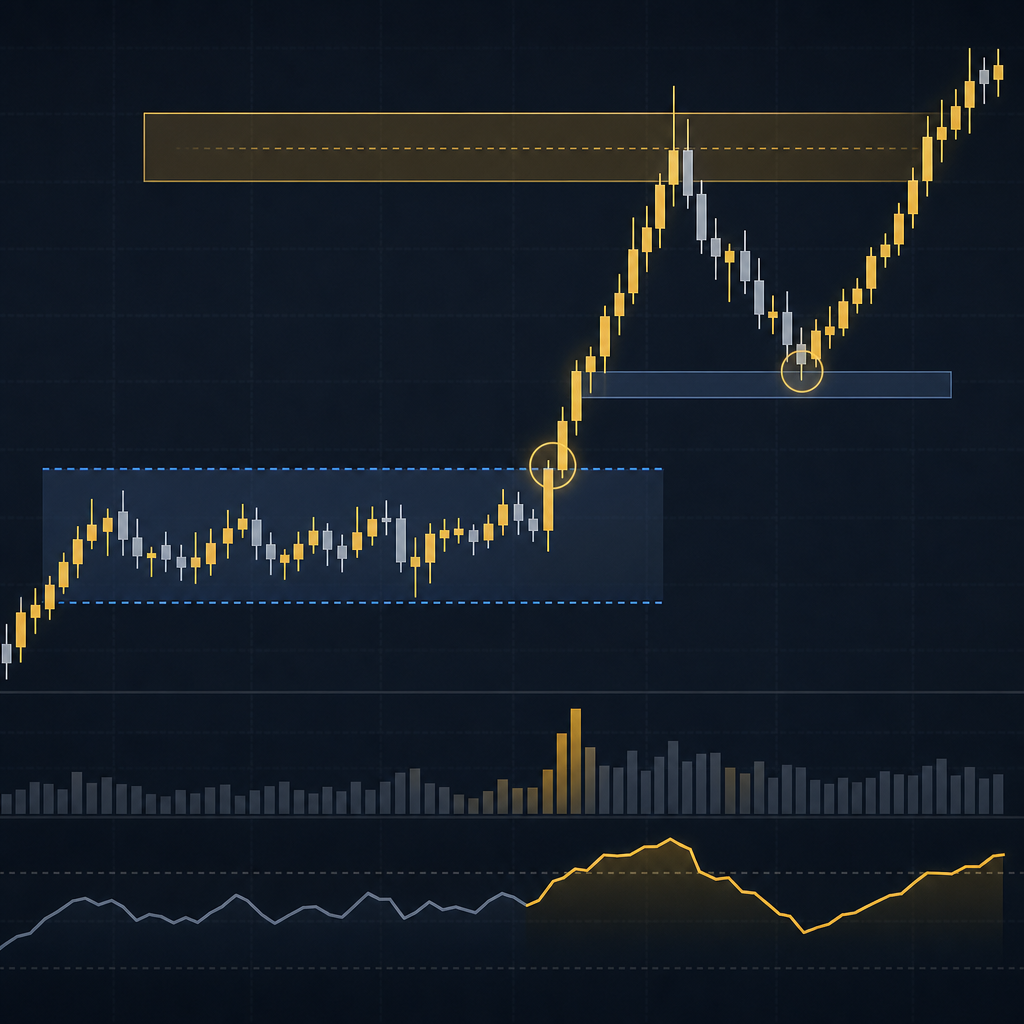
A London breakout strategy without a defined pre-session range is just momentum chasing.
Your job before London opens is to mark a range that’s likely to contain liquidity. For gold, the cleanest approach is to box the overnight consolidation and treat the edges as decision points.
Step-by-step: how to mark the pre-London range
- Choose your range window: a consistent choice is 00:00–06:59 London time.
- Mark the high and low: draw horizontal lines at the highest high and lowest low within that window.
- Measure range size: note the dollar width. For example, if Asia ranged from $2636 to $2648, the box is $12.
- Identify the midpoint: this often acts like a magnet. If price keeps snapping to midpoint, you’re in balance.
- Mark nearby HTF levels: add any obvious H1/H4 swing levels within ~$10–$20 of the range edges (e.g., $2658 resistance, $2628 support).
Now you have a structure that defines what “breakout” actually means: a move beyond a known liquidity boundary.
What a “good” pre-London range looks like on XAUUSD
- Tight but not microscopic: roughly $8–$18 is workable in normal conditions.
- Multiple touches: at least 2–3 reactions at the high/low shows the market respects the boundary.
- No huge trend already: if gold already ran from $2612 to $2650 in Asia, your “breakout” is likely late.
In today’s volatility environment (gold around $2650 and DXY elevated), you may see sharper spikes. That makes the box more important, not less—because it tells you whether a move is expansion from balance or just random noise.
Range marking mistake that kills RR
Many traders redraw the box to “fit” price as London approaches. That’s curve-fitting.
Pick the window and stick to it. If the range is messy or too wide (say $25+), that’s information: you may need to shift from breakout trading to pullback/continuation trading later in the session.
For a complementary concept (how liquidity runs often happen around session edges), you may also like our educational posts inside the United Kings blog—we keep the focus on actionable execution, not theory.
Volatility & Spread Filters: When NOT to Trade the London Breakout
Most traders focus on entries. Professionals focus on filters.
Your London Open breakout edge comes from trading a specific condition: compressed price + fresh liquidity + clean expansion. If volatility is already expanded, or spreads are unstable, your “breakout” becomes a coin flip.
Filter #1: Range size vs expected move
A simple rule: if the pre-London range is too large, your stop must be large, and your RR suffers.
- If the box is $8–$18, you can often place a $10–$18 stop and target $20–$45.
- If the box is $25–$35, you’ll either use a huge stop or get wicked out.
Example: If gold ranged from $2620 to $2650 overnight (a $30 box), a breakout above $2650 with a $12 stop is unrealistic—you’re likely inside chop, not a clean expansion.
Filter #2: Pre-London impulse (already moved?)
If gold has already printed a strong directional move before 07:00 London time, London may deliver a reversal sweep instead of continuation.
Example scenario:
- Asia drifted up from $2632 to $2649.
- Pre-London (06:30–07:00) spikes to $2656.
- At 07:10, price breaks $2656 again… then collapses to $2640.
That’s a classic “too many longs too early” trap. Your filter is simple: if the move already happened, don’t chase the second breakout without retest confirmation.
Filter #3: Spread and execution conditions
Even the best setup fails if execution is poor.
- Track your broker’s typical XAUUSD spread during 07:00–07:15.
- If spreads widen abnormally, reduce size or skip.
- Avoid market orders during spikes; use stop-limit or wait for retest entries when possible.
Filter #4: News proximity
London often overlaps with European data releases. If a high-impact release is within 15–30 minutes, a breakout can turn into a whip.
If you want a framework for handling surprise volatility and protecting your entries, pair this article with our risk-focused guide: risk management strategies when using forex signals. The principles apply directly to gold.
The XAUUSD London Open Breakout Confirmation Checklist (Signal-Style)
This is the heart of the strategy: a checklist you run before you commit risk.
Think of it like how a professional signal desk confirms a trade. We’re not trying to predict the future. We’re trying to confirm that the market is actually breaking out—not just poking.
Checklist Part A: Structure & context (30 seconds)
- Box marked: pre-London high/low are clear and respected.
- HTF bias known: H1/H4 trend is up, down, or range. No guessing.
- Nearby liquidity mapped: where are the obvious stops? Above range high, below range low, and near round numbers (e.g., $2660, $2675).
- Macro context: DXY at 106.80 suggests USD strength; be cautious with upside gold breakouts unless price action is clean.
Checklist Part B: Breakout candle quality (15 seconds)
- Close outside the range: not just a wick. You want a candle body close beyond the level.
- Size makes sense: breakout candle shouldn’t be so huge that your stop becomes $30+.
- Minimal upper/lower wick against direction: heavy rejection is a warning.
Checklist Part C: Retest behavior (the difference-maker)
For XAUUSD, the retest is where most false breakouts get exposed.
- Ideal: break above $2648, pull back to $2648–$2646, hold, then push.
- Red flag: break above $2648, instantly dumps to $2639 (back inside range) and stalls.
If you only adopt one improvement from this article, make it this: don’t enter on the first touch. Enter on the confirmed hold (or on the retest rejection).
Checklist Part D: Momentum confirmation (optional, but useful)
- ATR/volatility rising: London should expand range, not compress further.
- RSI/MACD not required: but if RSI diverges hard on the breakout, be cautious.
- Volume (if available): breakout with higher relative volume is stronger.
Checklist Part E: Execution & risk (non-negotiable)
- Stop location is logical: beyond structure, not arbitrary.
- RR is acceptable: minimum 1:2 planned before entry.
- Position size is correct: risk fixed % (many traders use 0.5%–1% per trade).
This is the same philosophy we apply in our XAUUSD gold signals: a trade is not “good” because it moved once. It’s good because it meets structure + confirmation + risk.
Entry Models: Aggressive vs Conservative (With Real Price Examples)
There isn’t one “correct” entry for a London breakout. There are entry models, each with trade-offs.
To keep this practical, we’ll use a realistic example around current levels: gold is trading near $2650, and your pre-London range is $2638–$2648 (a $10 box).
Model 1: Aggressive breakout close entry
You enter as soon as a candle closes above the range high.
- Trigger: M5 candle closes above $2648 at $2651.
- Entry: Buy $2651.
- Stop loss: below range midpoint/low, e.g., $2639 (risk $12).
- Take profit 1 (1:2): $2675 (reward $24).
- Take profit 2 (1:3): $2687 (reward $36).
Best for: strong trend days when London doesn’t retest deeply.
Risk: you’re most exposed to the classic “break and snap back” fakeout.
Model 2: Conservative retest entry (preferred for consistency)
You wait for the breakout, then buy the retest hold of the range high.
- Breakout: price closes above $2648 and trades to $2654.
- Retest: price pulls back to $2649–$2647.
- Entry: Buy $2649 after a rejection candle (pin/engulf) off the level.
- Stop loss: below retest low, e.g., $2639 (risk $10).
- Take profit (1:2): $2669.
- Take profit (1:3): $2679.
Best for: avoiding false breakouts and improving win rate.
Trade-off: sometimes price won’t retest and you’ll miss the move. That’s fine.
Model 3: Sweep-and-reclaim (advanced, high precision)
This is when price briefly breaks one side to grab liquidity, then reclaims and breaks the other side.
Example:
- Range is $2638–$2648.
- At 07:05, price sweeps below $2638 to $2632, then snaps back inside.
- At 07:20, price breaks above $2648 and holds.
A disciplined entry is after the reclaim + hold above $2648, targeting the expansion to $2668–$2680.
Which entry model should you use?
If you’re building a repeatable routine, start with the conservative retest model. It aligns best with a checklist approach and reduces emotional chasing.
If you prefer to follow structured calls instead of manually deciding entries, you can also compare how we deliver them in our Forex signals Telegram guide—the same clarity applies to gold: entry, SL, TP, and timing.
Stop Loss & Take Profit Rules for London Breakouts (Gold-Specific)
Gold is not EUR/USD. It spikes harder, it wicks deeper, and it punishes tight stops placed in obvious locations.
So your SL/TP rules must be gold-specific and session-aware.
Stop loss placement rules that actually survive XAUUSD
- Rule 1: Place SL beyond structure, not just “$10 below entry.” Structure means below the range low, below the retest swing low, or below a clear demand zone.
- Rule 2: Avoid “equal lows/highs” stops. If everyone sees the same low, it’s a liquidity magnet.
- Rule 3: Typical London breakout SL is $10–$25 depending on box size and volatility.
Example (buy breakout):
- Entry: $2649 (retest hold)
- Retest swing low: $2641
- Range low: $2638
- Logical SL: $2637 (below range low) → risk $12
That SL is not random. If price breaks below $2638 and holds, your breakout thesis is invalid.
Take profit rules: target where the next liquidity sits
For London breakouts, targets should be based on:
- Measured move: range size projected from breakout point (a $10 box often expands $20–$30 on a clean day).
- HTF levels: prior swing highs/lows on H1/H4.
- Round numbers: $2660, $2675, $2685 can act like magnets or reaction points.
Example TP planning (1:2 and 1:3):
- Entry: $2651
- SL: $2639 (risk $12)
- TP1 (1:2): $2675
- TP2 (1:3): $2687
Trade management: the simplest approach that works
- At 1R (profit equals your risk), consider moving SL to breakeven only if structure supports it.
- Scale partials at TP1 and leave a runner to TP2/TP3 on trend days.
- If price returns inside the box and closes there, treat it as a warning to reduce exposure.
If you’re combining signals with your own execution, this is where discipline matters most. A great reference for building that discipline is our checklist-style guide: forex trading signals provider checklist—use the same “verify before you trust” mindset for any London breakout call.
False Breakout Traps at London Open (and How to Avoid Them)
Gold loves to fake you out at the exact moment you feel most confident.
Below are the most common London Open breakout traps we see traders fall into—plus the specific “if/then” rules to avoid them.
Trap #1: The wick break (liquidity poke) mistaken for a breakout
Price wicks above the Asian high by $2–$5, triggers buy stops, then closes back inside the range.
Fix: require a candle close outside the range, not just a wick. If you use M5, then use M5 closes consistently.
Trap #2: Breakout into immediate resistance
Even if the range breaks, if the next HTF resistance is only $6 away, your RR is crushed.
Example:
- Range high: $2648
- Breakout entry: $2650
- H1 resistance: $2656
You’re risking $12 to make $6. That’s not a strategy—it’s hope.
Fix: confirm there is at least 2R space to the next major level.
Trap #3: The “first 5 minutes” adrenaline entry
The first minutes after 07:00 London time can be chaotic. Spreads can widen and candles can print extreme wicks.
Fix: let the first 1–2 candles close. If the breakout is real, it will still be tradable on the retest.
Trap #4: The reversal day (trend exhaustion)
If gold has been trending hard for days and is now stalling near a major level (say $2685–$2690), London can be the turning point.
Fix: check H4 structure. If you’re buying breakouts directly into a multi-day resistance zone, reduce size or wait for a deeper confirmation.
Trap #5: Dollar-driven whipsaws (DXY and USD/JPY context)
With DXY around 106.80 and USD/JPY near 149.50, USD flows can be aggressive. Gold may spike up and down as the market reprices rate expectations.
Fix: if the dollar is ripping higher on the same minute your gold breakout triggers, be extra strict: only take the trade if retest holds and momentum confirms.
For more on how news shocks and unexpected headlines change signal behavior, keep this bookmarked: how gold signals react to unexpected news events.
London Open Breakout vs Other Gold Session Strategies (Comparison Table)
Not every day is a London breakout day. Some days are range days, some are NY continuation days, and some are “don’t touch it” days.
Use this comparison to decide what you’re actually trading—and what you should ignore.
| Strategy Type | Best Time Window (London time) | Best Market Condition | Typical SL (XAUUSD) | Typical Target | Main Risk |
|---|---|---|---|---|---|
| London Open Breakout | 07:00–10:00 | Asia compression + fresh liquidity | $10–$25 | 1:2 to 1:3 (e.g., $24–$36) | False break / stop-hunt |
| Asian Range Mean Reversion | 00:00–06:00 | Low volatility, balanced flow | $8–$18 | Back to midpoint/opposite side | London sweep breaks range |
| London Pullback Continuation | 09:00–12:00 | Clear trend established early | $12–$30 | Retest to new highs/lows | Midday chop / fades |
| New York Expansion (US Open) | 13:30–16:00 | US data / risk sentiment shift | $15–$35 | Large impulses, 1:2+ | News spikes / slippage |
The takeaway: London Open breakout is powerful, but it’s not universal. The checklist helps you identify when the condition is present—and when you should stand down.
If you prefer a done-with-you approach where trades are prepared around the highest-liquidity windows, you can review our gold signals and forex signals offerings. Many traders use both to diversify session opportunities.
A Full Step-by-Step Routine You Can Repeat Every Trading Day
Consistency comes from routine, not motivation.
Below is a complete London Open breakout routine you can follow daily. It’s designed to be realistic for traders who have jobs, who can’t stare at charts for 6 hours, and who want a process that matches how professional signal teams operate.
Step 1 (06:30 London): Prepare the chart
- Set chart time zone to Europe/London.
- Mark the pre-London range: 00:00–06:59.
- Draw high, low, midpoint.
- Mark nearest H1/H4 levels within $10–$30.
Step 2 (06:45–07:00): Run the filters
- Is the box size reasonable ($8–$18)?
- Did gold already expand heavily pre-London?
- Are spreads normal for your broker?
- Any high-impact news in the next 30 minutes?
Step 3 (07:00–08:30): Wait for the first clean signal
Your trigger is not “price touched the line.” Your trigger is break + close + confirmation.
- Wait for a candle close outside the range.
- Prefer a retest entry if possible.
- Skip if breakout candle is abnormally large (late move).
Step 4: Place the trade with pre-defined SL/TP
Example template (buy breakout):
- Entry: $2649–$2652
- SL: $2637–$2640 (based on structure)
- TP1: $2669–$2675
- TP2: $2679–$2687
Step 5: Manage like a professional (not like a gambler)
- Don’t move SL wider.
- Don’t add to losers.
- If price re-enters the box and closes there, reduce risk or exit depending on your rules.
Step 6: Journal the outcome in 2 minutes
- Screenshot entry and exit.
- Note: did it meet the checklist?
- Record: range size, time of breakout, RR achieved.
This is how you turn a “strategy” into a system. And it’s also how you evaluate any provider you follow—if you want a benchmark for that, our guide on choosing providers is useful: signals provider checklist for beginners.
Realistic Trade Scenarios Around $2650 (Winning, Losing, and No-Trade)
Let’s make this concrete with three scenarios using today’s market context: XAUUSD near $2650, EUR/USD around 1.0520, GBP/USD around 1.2680, and a firm DXY near 106.80.
These are not “perfect hindsight” examples. They’re realistic outcomes you will experience if you trade this strategy long enough.
Scenario A: Clean breakout + retest (high-quality long)
- Pre-London range: $2639–$2648
- 07:12: M5 closes above $2648 at $2651
- 07:25: retest to $2648, rejection candle forms
- Entry: $2649
- SL: $2639 (risk $10)
- TP1: $2669 (1:2)
- TP2: $2679 (1:3)
Price pushes to $2672, takes TP1, then consolidates and tags $2680 later. That’s a textbook London expansion day.
Scenario B: False breakout (the classic loss you must accept)
- Pre-London range: $2642–$2650
- 07:05: wick to $2656, closes back at $2649
- Trader buys $2654 on the wick break
- Price drops to $2640, then $2636
The mistake wasn’t losing money. The mistake was entering without confirmation. If you require a close + retest, you likely avoid this trade entirely.
Scenario C: No-trade day (the most profitable decision)
- Pre-London range is wide: $2620–$2650 ($30)
- London opens with two violent candles up and down
- Spreads widen and price is erratic
Your checklist fails the volatility filter. You stand down. Later, NY provides a cleaner move or you skip the day.
Many traders underestimate how powerful “no trade” is. Protecting capital is a skill.
How United Kings Confirms London Breakouts (What to Look for in a Signal)
If you’re using signals—whether ours or anyone else’s—you still need a way to validate quality.
At United Kings, our community (300K+ active traders) is built around clarity and repeatability. Our signals are designed to be executable in real time: clear Entry, SL, and TP levels, with a focus on high-liquidity windows like London and NY.
Here’s what a high-quality London breakout signal should include:
- Time context: is this a London Open setup (07:00–10:00) or a late chase?
- Entry logic: breakout close entry or retest entry—specified clearly.
- Stop placement: beyond structure, typically $10–$25 for gold depending on conditions.
- Targets: at least two take-profits, usually aligned to 1:2 and 1:3.
- Invalidation condition: “If price closes back inside the range, idea is weaker.”
We also publish educational content alongside signals so you’re not blindly copying trades. If you’re exploring how Telegram delivery compares and what to expect from a professional channel, see: our expert picks for gold signals on Telegram.
And if you want to join the real-time feed, you can connect directly via our official Telegram: United Kings Telegram channel.
FAQ: XAUUSD London Open Breakout Strategy
1) What is the best timeframe for a London Open breakout on XAUUSD?
Most traders execute on M5 or M15 for confirmation (candle close + retest). Use H1/H4 to define the broader trend and major levels.
2) How big should my stop loss be for gold during London?
A common range is $10–$25, depending on the size of the pre-London box and current volatility. The SL should sit beyond structure (range low/high or retest swing), not at a random distance.
3) What time is the London Open for gold trading?
Practically, focus on 07:00–10:00 London time as the main window where breakout behavior is most consistent. Always account for daylight savings changes.
4) Why do London breakouts often reverse?
Because the market frequently performs a liquidity sweep first—grabbing stops above the range high or below the range low—before committing to the real direction. Waiting for a close + retest greatly reduces this problem.
5) Can I trade London breakouts if I’m following signals?
Yes, but you should still validate the setup with a checklist: time window, range structure, confirmation, and RR. If you’re new, consider demo trading first and keep risk small until execution is consistent.
Risk Disclaimer (Read Before You Trade)
Forex and gold (XAUUSD) trading involves significant risk and may not be suitable for all investors. Past performance does not guarantee future results. No signal, strategy, or checklist can guarantee profits. Spreads, slippage, and volatility—especially around session opens and news—can materially affect outcomes. If you are a beginner, we strongly recommend practicing on a demo account before risking real capital and using strict risk management at all times.
Join United Kings: Trade London & NY With Clear XAUUSD Signals
If you want London Open breakout setups delivered with clear Entry, SL, and TP—and the education to understand why the trade is taken—United Kings is built for exactly that.
We provide premium Telegram signals for gold (XAUUSD) and major forex pairs, with a community of 300K+ active traders and a performance-driven approach that targets high-quality session windows.
Choose the plan that fits your goals on our pricing page:
- Starter (3 Months): $299 (~$100/mo)
- Best Value (1 Year): $599 ($50/mo) with 50% savings + FREE ebook
- Unlimited (Lifetime): $999 pay once, access forever
All plans include a 48-hour money-back guarantee (terms apply). When you’re ready, join the official channel here: United Kings on Telegram.
Want help picking the right plan or confirming if this strategy matches your schedule? Reach out via our contact page and we’ll point you in the right direction.