
If gold (XAUUSD) moves $20 in minutes, do you know exactly what to do—or do you freeze?
Gold trading looks simple from the outside: price goes up, you buy; price goes down, you sell.
But anyone who has traded XAUUSD around $2650 knows the truth.
Gold can trend smoothly for hours, then whip $8–$12 in a single candle and tag your stop before continuing in your direction.
This xauusd trading guide is designed to take you from “I’m guessing” to “I have a repeatable plan.”
We’ll cover how gold really moves, what drives volatility, which sessions matter most, and the exact risk rules that keep profitable traders alive.
TL;DR: The XAUUSD Trading Guide in 6 Takeaways
- XAUUSD is a volatility instrument. At ~$2650, a normal intraday swing is often $15–$35, so your stop and position size must match reality.
- London and New York sessions matter most. Many clean moves form in London and expand during NY, especially during the overlap.
- Gold is highly sensitive to DXY and yields. With DXY near 106.80, gold reactions often depend on whether the dollar is trending or stalling.
- Stops are not optional. Typical gold stops are $10–$25 depending on structure, not on “what feels safe.”
- Use 1:2 or 1:3 R:R as a baseline. Example: Buy 2650, SL 2638 (risk $12), TP 2674 (reward $24) for 1:2.
- Signals work best with rules. If you follow premium signals, you still need execution discipline, risk limits, and session filters.
Why XAUUSD (Gold) Trades Differently Than Forex Pairs

Gold is quoted as XAUUSD: the price of one ounce of gold in US dollars.
That sounds similar to EUR/USD or GBP/USD, but gold behaves differently in ways that matter for your strategy.
First, gold is event-sensitive.
Inflation data, central bank comments, geopolitical headlines, and risk sentiment can move it fast, even when EUR/USD looks sleepy at 1.0520.
Second, gold is liquidity-layered.
It trades nearly 24/5, but the “quality” of liquidity changes by session.
You’ll see smooth price action during the London morning, then sharp expansions during New York—especially when US data hits.
Third, gold is psychological.
Round levels like 2600, 2650, and 2700 attract orders.
At $2650.00 (up about +0.35% in the last 24 hours), it’s common to see price probe above 2650, dip to 2644, then rip to 2662.
New traders call it manipulation.
Experienced traders call it order-flow behavior around liquidity pools.
Fourth, gold’s “pip” concept differs across brokers.
Many platforms quote gold with two decimals (e.g., 2650.10), where a $1 move equals 100 “points.”
So a move from 2650.00 to 2660.00 is $10, which may display as 1000 points.
That matters for position sizing and expectations.
Finally, gold often trends beautifully—until it doesn’t.
It can be the cleanest trending instrument in your watchlist, then deliver a two-candle stop-out that feels personal.
Your edge comes from accepting this personality and building rules around it.
Gold vs Major Forex Pairs: Practical Differences
When EUR/USD is at 1.0520, a 30-pip move is meaningful intraday.
When XAUUSD is at 2650, a $3 move is often noise.
This is why copying a forex scalping mindset onto gold usually fails.
Gold wants room to breathe.
It also rewards traders who understand sessions, correlations, and structure-based stops.
Gold Market Fundamentals: What Actually Moves XAUUSD
Gold doesn’t move because of one “magic indicator.”
It moves because large market participants react to real-world drivers.
If you want to trade XAUUSD profitably, you need a simple framework for fundamentals.
Start with the big three: USD strength, real yields, and risk sentiment.
When the dollar strengthens (DXY rising), gold often faces headwinds.
Right now, DXY around 106.80 suggests the dollar is relatively firm.
That doesn’t mean gold can’t rally—gold is at ~$2650—but it changes how you interpret breakouts.
Next, yields.
When US yields rise, holding non-yielding gold becomes less attractive, which can pressure XAUUSD.
When yields fall, gold often benefits.
Third, risk sentiment.
In risk-off environments (equities down, fear up), gold can act as a safe haven.
But it’s not guaranteed.
Sometimes in a panic, traders sell everything for cash, and gold drops first before recovering.
Key Economic Events That Hit Gold Hard
Gold reacts strongly to certain calendar events because they shift expectations for rates and inflation.
- US CPI: Inflation surprise can move gold $15–$40 quickly.
- NFP: Jobs data often triggers whipsaws before direction becomes clear.
- FOMC: Rate decisions and Powell’s tone can change the trend for weeks.
- Retail Sales / PCE: Secondary, but still impactful in rate-sensitive regimes.
If you’re new, don’t “learn” gold by trading it during red-folder news.
Use a demo first, or trade smaller size with wider structure-based stops.
For how signals and gold react during surprise headlines, see our survival-focused breakdown: how gold signals react to unexpected news events.
Central Banks and Physical Demand
Longer-term, central bank buying, jewelry demand, and ETF flows matter.
But intraday, your chart will mostly reflect the market’s rate expectations and USD positioning.
As a trader, you don’t need to forecast central bank purchases.
You need to know when the market is pricing “higher for longer” versus “rate cuts coming.”
That’s the narrative layer behind many XAUUSD trends.
Sessions & Timing: When to Trade XAUUSD for Cleaner Moves
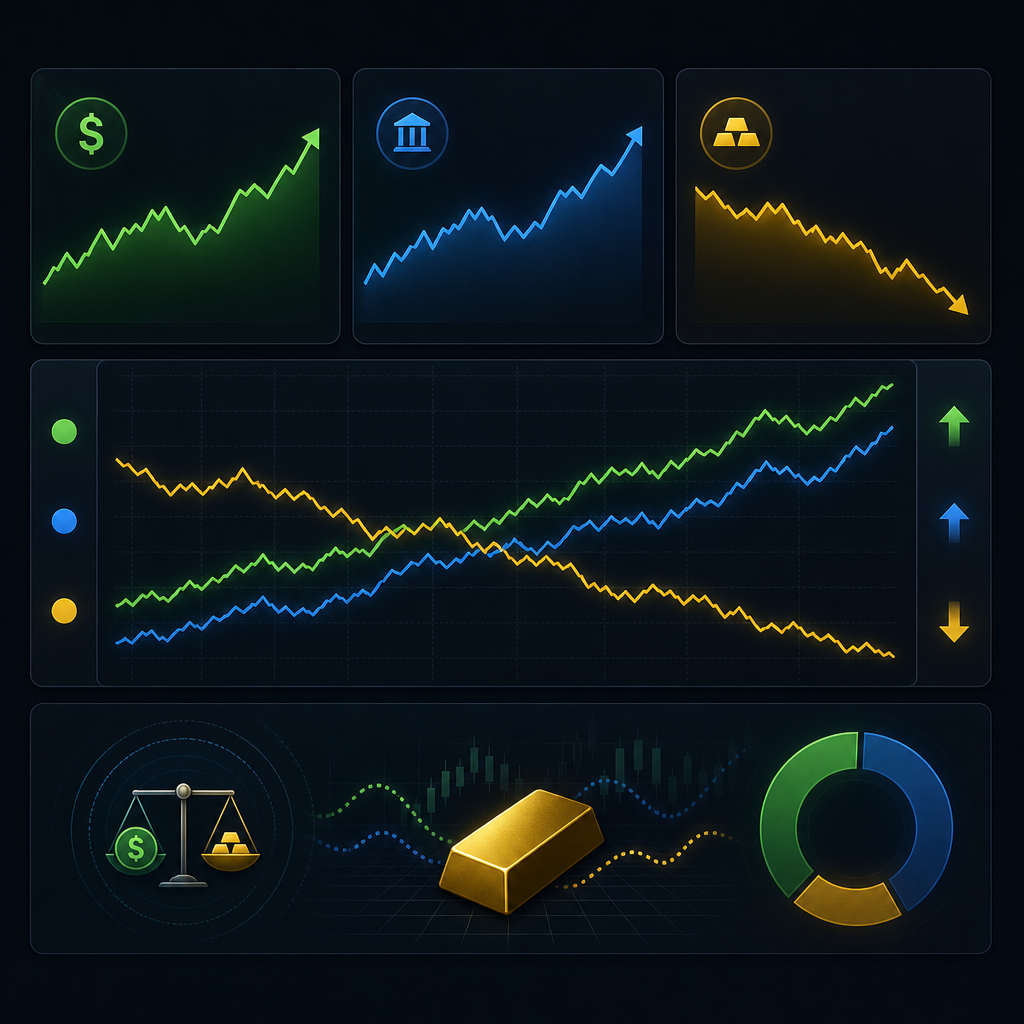
Timing is a strategy.
Many traders lose on gold not because their analysis is wrong, but because they trade at the worst possible hours.
XAUUSD is tradable all day, but it’s not equally tradable all day.
The best consistency typically comes from the London session, the New York session, and especially the London–NY overlap.
What Each Session “Feels” Like on Gold
Asia session often ranges.
You’ll see slower candles, smaller expansions, and more mean-reversion behavior.
This is where traders get chopped trying to force breakouts.
London session is where structure forms.
Breaks of Asian range highs/lows are common, and trend days often start to reveal themselves.
New York session is where the market commits.
US data, US equities open, and liquidity influx can expand a $10 move into a $25 move.
Practical Session Plan (Beginner-Friendly)
Here’s a simple routine you can follow without overcomplicating it.
- Mark the Asian range (high and low) before London.
- Wait for London to show intent: sweep and reclaim, or a clean breakout and retest.
- Trade only after confirmation: don’t enter mid-spike.
- Manage risk before NY data: reduce exposure or move stop to structure if appropriate.
Example near current pricing:
Suppose Asia ranges between 2642 and 2652.
London sweeps below 2642 to 2639, then closes back above 2642.
A conservative long could be Entry 2645, SL 2635 ($10 risk), TP1 2665 ($20 reward), TP2 2675 ($30 reward).
This is a clean 1:2 to 1:3 framework, built around session behavior.
Why London + NY Is the “Signal Sweet Spot”
Many premium signal providers focus on these hours because execution quality improves.
Spreads are typically tighter, momentum is more reliable, and follow-through is more common.
At United Kings, our approach emphasizes London and NY session trading with clear Entry, SL, and TP levels.
If you want to see how our broader signal ecosystem works, start here: United Kings trading signals.
XAUUSD Correlations: DXY, USD/JPY, EUR/USD, and Risk Sentiment
Gold rarely moves in isolation.
If you trade XAUUSD without checking the dollar and yields, you’re trading with one eye closed.
Correlations are not perfect, but they are powerful filters.
They help you decide when to press trades and when to be cautious.
Gold vs DXY (Dollar Index)
Most of the time, gold and DXY have an inverse relationship.
If DXY is pushing higher from 106.50 to 107.10, gold rallies often struggle.
Right now with DXY near 106.80, a key question is: is DXY trending or ranging?
If DXY is stalling under resistance, gold can still trend up.
If DXY is breaking out, gold longs need stronger technical confirmation.
Gold vs USD/JPY (Risk + Yield Proxy)
USD/JPY around 149.50 often reflects yield dynamics and risk appetite.
When USD/JPY is ripping higher, it can signal rising yields, which may pressure gold.
But watch for divergence.
If USD/JPY is rising while gold holds firm above 2648–2650, that resilience can be bullish for gold once yields pause.
Gold vs EUR/USD and GBP/USD
EUR/USD at 1.0520 and GBP/USD at 1.2680 can provide a “USD tone.”
If both are falling, USD strength is broad-based, and gold longs face friction.
If EUR/USD stabilizes and starts reclaiming levels while gold is building higher lows, that’s often a supportive environment for XAUUSD upside.
A Simple Correlation Checklist (Fast)
- Gold long bias: DXY flat/down, EUR/USD stable/up, yields not surging, risk-off or mixed.
- Gold short bias: DXY trending up, EUR/USD breaking down, yields rising, risk-on with strong USD.
- Neutral/no-trade: DXY and gold both choppy, multiple fake breaks, news in 30 minutes.
Correlation is a filter, not an entry trigger.
Your entries should still come from price action and structure.
Core Technical Foundations: Structure, Liquidity, and Price Action
If you strip away indicators, profitable gold trading often comes down to three things: structure, liquidity, and timing.
Gold respects key highs/lows, but it also loves to run them before reversing.
That’s why beginners get trapped.
They sell the breakdown after the stop-hunt already happened.
Or they buy the breakout right into a liquidity sweep.
Market Structure on XAUUSD
Structure means identifying higher highs/higher lows (uptrend) or lower highs/lower lows (downtrend).
At ~$2650, imagine gold has been printing higher lows: 2622 → 2636 → 2646.
That’s bullish structure.
Now imagine price spikes to 2664, then pulls back to 2652.
The question becomes: does 2652 hold as a higher low, or does it break and flip the structure?
Liquidity Sweeps (Why Gold “Wicks” So Much)
Gold frequently sweeps obvious highs/lows because that’s where stops cluster.
A classic example:
- Price ranges under 2658 for hours.
- Retail traders place buy stops above 2658.
- Price spikes to 2661, triggers those orders, then dumps to 2649.
Was that random?
Not really.
It’s a common liquidity event where the market grabs orders and then moves to the next area of interest.
If you want a deeper tactic around this behavior, you can later explore our London-open focused concepts on the blog hub: United Kings blog.
Support/Resistance That Actually Works on Gold
Static lines alone are not enough.
On XAUUSD, better “levels” are zones of $3–$8, not single prices.
For example, instead of “support at 2640.00,” think “support zone 2638–2644.”
This aligns with how gold breathes.
It also helps you place stops where they belong: beyond structure, not inside noise.
Indicators That Help (Without Overcomplicating Your Chart)
Indicators won’t make you profitable by themselves.
But the right indicators can improve timing, confirm momentum, and keep you out of bad trades.
The key is using one trend tool, one momentum tool, and one volatility tool.
Anything beyond that often becomes analysis paralysis.
Moving Averages (Trend Context)
A simple 50 EMA and 200 EMA can help you define regime.
If price is above the 200 EMA and the 50 EMA is rising, you prioritize longs.
If price is below and both are sloping down, you prioritize shorts.
Example: gold at 2650 with the 200 EMA near 2632 and rising suggests dips may be buyable—until structure breaks.
RSI (Momentum and Divergence)
RSI can help you avoid buying late.
If price makes a new high at 2668 but RSI makes a lower high, that bearish divergence can warn you to tighten risk or wait for confirmation.
Don’t short just because RSI is overbought.
Gold can stay “overbought” for hours on a trend day.
ATR (Stop and Target Reality Check)
Average True Range (ATR) helps you understand typical movement.
If your timeframe ATR is $6 and you place a $4 stop, you’re likely to get tagged often.
At current volatility, many intraday gold moves are $15–$35.
That’s why structure-based stops of $10–$25 are common.
One Clean Setup Template
- Trend: 50/200 EMA for bias.
- Momentum: RSI for divergence and confirmation.
- Volatility: ATR to sanity-check SL/TP distance.
Then you execute using price action: breaks, retests, and sweeps.
Comparison Table: Best XAUUSD Trading Styles (Scalp vs Day vs Swing)
Not every gold strategy fits every personality.
Some traders love fast scalps.
Others want calm swing trades with wider stops and fewer decisions.
Use this table to choose a style that matches your schedule and psychology.
| Style | Typical Hold Time | Common SL Range (Gold) | Typical Target | Best Session | Who It Fits |
|---|---|---|---|---|---|
| Scalping | 2–20 minutes | $6–$12 | $10–$20 (often 1:1.5 to 1:2) | London/NY overlap | Fast decision-makers with strict rules |
| Day Trading | 30 minutes–6 hours | $10–$20 | $20–$45 (1:2 to 1:3) | London + NY | Traders who can monitor charts during sessions |
| Swing Trading | 1–10 days | $20–$60 | $60–$180 (1:3+ possible) | All sessions (entries often London/NY) | Busy traders who prefer fewer trades |
If you’re following signals, day trading is often the sweet spot.
You get meaningful targets without the stress of hyper-fast execution.
For traders who want dedicated gold setups, explore our dedicated page: premium gold signals.
Step-by-Step: How to Trade Gold (XAUUSD) as a Beginner
Beginners don’t fail because they lack intelligence.
They fail because they skip steps.
Gold punishes “random entries” faster than many forex pairs.
Here’s a step-by-step process you can follow today.
Step 1: Define Your Session Window
Pick a 90–180 minute window during London or New York.
Consistency beats “watching charts all day.”
If you can only trade evenings, focus on early NY or the overlap when possible.
Step 2: Mark the Day’s Key Levels
- Previous day high/low
- Asian session high/low
- Major round numbers (e.g., 2650, 2660, 2670)
These are the zones where liquidity sits.
Gold tends to accelerate after these levels break with confirmation.
Step 3: Choose One Setup Only
One setup is enough to become profitable.
Two setups is okay.
Five setups is usually a sign you’re not sure what you’re doing yet.
A beginner-friendly setup is the break and retest.
Step 4: Plan the Trade With Real Numbers
Let’s build a realistic example around current market context.
Gold is trading near 2650.
Price breaks above a consolidation at 2654 and retests 2654–2652.
You enter long at 2655.
- Stop loss: 2643 (risk $12)
- Take profit 1: 2679 (reward $24, 1:2)
- Take profit 2: 2691 (reward $36, 1:3)
Notice how the stop is based on structure, not a random $5.
Notice how the targets are not “hope.”
They’re calculated from risk.
Step 5: Execute With a Simple Rule
- If price hits TP1, take partial profit or move stop to breakeven (only if structure supports it).
- If price chops and invalidates structure, exit early.
- If major news is 10 minutes away, reduce risk or stay flat.
This is how you survive long enough to build skill.
If you want a structured way to evaluate signal quality before risking money, use our checklist-style guide: signals provider checklist for beginners.
Advanced XAUUSD Strategies: Trend, Reversal, and Breakout Models
Once you can execute the basics, you can add advanced models.
Advanced does not mean complicated.
It means your rules are tighter, your filters are smarter, and your risk is more consistent.
1) Trend Continuation (Pullback to Structure)
This is the “boring money” strategy.
You identify an uptrend, wait for a pullback into a demand zone, then buy the continuation.
Example:
- Trend: higher highs and higher lows above 200 EMA
- Pullback: from 2668 down to 2652
- Entry: 2656 after bullish confirmation
- SL: 2644 ($12 risk)
- TP: 2680 ($24 reward) or 2692 ($36 reward)
The edge is not predicting.
The edge is waiting for the market to come to your level.
2) Liquidity Sweep Reversal (Stop-Hunt + Reclaim)
This is common on gold because of how it hunts stops around obvious highs/lows.
Rules:
- Identify a clear high/low that many traders see.
- Wait for price to sweep it (wick through).
- Enter only after price reclaims the level and closes back inside.
Example near 2650:
Price sweeps above 2660 to 2663, then closes back under 2660.
A short entry could be 2658, SL 2670 ($12 risk), TP 2634 ($24 reward).
This is a clean 1:2 with a logical narrative.
3) Range Breakout (With a Filter)
Breakouts work on gold, but only when you filter fakeouts.
Filters you can use:
- Breakout candle closes beyond the range by at least $2–$4.
- Retest holds (no immediate snapback).
- DXY/yields are not contradicting the move.
Gold might range between 2646 and 2658.
A real breakout might close at 2662, retest 2658–2660, then push to 2678.
A fake breakout often spikes to 2661 and instantly dumps to 2649.
Your job is to wait for the retest confirmation.
Risk Management for XAUUSD: Position Sizing, Stops, and Daily Limits
Gold rewards skill, but it destroys sloppy risk.
If you want to become consistently profitable, risk management is not a chapter.
It’s the foundation.
The #1 Rule: Risk a Fixed Percentage, Not a Fixed Lot
Many traders trade the same lot size on every gold trade.
That’s how you blow accounts.
Instead, decide a fixed risk per trade, like 0.5% to 1% of your account.
Then calculate lot size based on stop distance.
If your stop is $12 and you want to risk $50, your position size must match that $12 risk—not your emotions.
Stop Loss Placement: Structure First, Then Volatility
On gold, a tight stop in the wrong place is worse than a wider stop in the right place.
Common beginner mistake:
Buy 2650, put SL at 2647 because “$3 seems enough.”
Gold tags 2647 in normal noise, then rallies to 2668 without you.
Better approach:
- Find the invalidation level (the point where your setup is wrong).
- Place SL beyond that level, usually $10–$25 away intraday.
Daily Loss Limits (The Professional Habit)
Gold can tempt revenge trading because it moves fast.
Set a daily max loss, such as 2R or 2% of account.
If you hit it, stop trading for the day.
This single rule prevents the “one bad day” that becomes a blown account.
Scaling Out vs Full TP
Gold often runs to TP1, pulls back, then continues.
Scaling out can stabilize your equity curve.
- Close 50% at 1:2.
- Move SL to entry only after structure confirms.
- Let the rest aim for 1:3 or a key level like 2690.
If you want a deeper framework specifically for traders using signals, read: risk management strategies when using signals.
Execution & Trade Management: Entries, Partial Profits, and Avoiding Slippage
A strategy can be profitable on paper and still lose in real trading.
The difference is execution.
Gold is fast, and fast markets punish hesitation.
This section will make your trading more “mechanical,” which is a good thing.
Market vs Limit Orders on XAUUSD
Market orders give you certainty of entry, but not price.
Limit orders give you price, but not certainty of fill.
In high volatility, market entries can suffer slippage.
In slow markets, limits can improve your average entry.
A practical rule:
- Use limit orders on retests and pullbacks.
- Use market orders only when confirmation is strong and the move is already leaving.
Where Beginners Lose Money: Moving Stops Too Early
Gold loves to retest.
Moving SL to breakeven too quickly often turns winners into scratches.
Instead of “move to BE at +$5,” use structure:
- Move to BE only after a new higher low forms on your timeframe.
- Or after TP1 is hit and price consolidates above your entry.
Trade Management Example (Realistic Numbers)
You buy 2652, SL 2640 (risk $12).
Price hits 2676 (TP1, +$24).
You close 50% and trail the rest under a higher low at 2666.
Price spikes to 2688, pulls back to 2670, then runs to 2690.
This is how you capture trend days without needing perfect exits.
Spreads, Slippage, and “Bad Fills”
Gold spreads can widen during rollovers, news, and low-liquidity moments.
If you’re trading during the overlap, conditions are usually better.
But you still need rules:
- Avoid entering seconds before major news.
- Prefer liquid session hours.
- Use stop distances that can survive normal spread changes.
Building a Profitable XAUUSD Trading Plan (Templates You Can Copy)
Profitable traders don’t “wing it.”
They follow a plan that reduces decisions in the moment.
Your plan should fit on one page.
If it can’t, it’s too complex.
Your One-Page XAUUSD Plan
- Market: XAUUSD only (focus beats variety).
- Sessions: London + NY (avoid random hours).
- Bias tools: 200 EMA + structure.
- Setup: break & retest OR sweep & reclaim (choose one).
- Risk per trade: 0.5%–1%.
- Daily max loss: 2R or 2%.
- Targets: TP1 at 1:2, TP2 at 1:3.
Weekly Review (The Missing Edge)
Most traders never review trades.
They just take more trades.
Do a 20-minute weekly review:
- Screenshot entries and exits.
- Write why you entered (setup rules).
- Track whether you followed your plan.
Over 8–12 weeks, you’ll see patterns.
Maybe you lose in Asia session.
Maybe you win on pullbacks but lose on breakouts.
That’s how you evolve from random results to consistent performance.
Where Signals Fit Into a Real Plan
Signals can accelerate your progress if you treat them as structured trade ideas, not lottery tickets.
A good signal should include:
- Clear entry
- Stop loss
- Take profit levels
- Context (session, key levels, bias)
This is exactly why many traders use a premium provider for gold and forex.
If you trade more than gold, you can also explore our broader setups: premium forex signals.
Using United Kings Gold Signals the Smart Way (Without Overtrading)
Signals are powerful when you combine them with discipline.
They are dangerous when you use them to avoid learning.
At United Kings, we focus on premium Telegram signals for forex and gold, with a community of 300K+ active traders.
Our signal format is designed to be executable: Entry, SL, TP, plus guidance aligned with London and NY session behavior.
We aim for a high-quality approach with an 85%+ win rate track record, while always acknowledging that no result is guaranteed.
How to Follow Signals Like a Pro (Step-by-Step)
- Check the session. If it’s a thin liquidity hour, be cautious with market orders.
- Confirm spread conditions. If spread is abnormally wide, reduce size or wait.
- Match risk to stop size. A $20 SL means smaller lot size than a $10 SL.
- Don’t stack trades. One good gold trade beats five emotional ones.
- Journal outcomes. Track whether you followed the signal exactly.
Where to Get United Kings Signals
You can learn more about our full offering here: United Kings signals overview.
If you want gold-specific trade ideas, start here: United Kings gold signals.
For beginners who prefer Telegram delivery, join our official channel here: United Kings Telegram signals channel.
Pricing Plans (3 Options)
We keep pricing simple with three plans designed for different commitment levels:
- Starter (3 Months): $299 (~$100/month)
- Best Value (1 Year): $599 (~$50/month) with 50% savings + FREE ebook
- Unlimited (Lifetime): $999 pay once, access forever
You can review the plans on our pricing section here: United Kings pricing plans.
And if you want to know who we are and how we operate, visit: about United Kings.
Common XAUUSD Mistakes (And How to Fix Them Fast)
Most gold traders don’t need a new strategy.
They need to stop doing a few expensive things.
Here are the mistakes we see constantly—and the fixes that actually work.
Mistake 1: Using Forex Stops on Gold
A 10-pip stop might work on EUR/USD in calm conditions.
A $3 stop on gold is often just noise.
Fix: Use structure-based stops, typically $10–$25 intraday, and reduce lot size accordingly.
Mistake 2: Trading Every Candle
Gold prints lots of “interesting” candles.
Most are irrelevant.
Fix: Trade only at your pre-marked levels, during your chosen session window.
Mistake 3: Chasing Breakouts Without Retests
Gold loves to fake out breakout traders.
Fix: Require a close beyond the level and a retest hold, or trade sweep-and-reclaim instead.
Mistake 4: Ignoring the Dollar Context
If DXY is trending hard, gold often reacts.
Fix: Use a 30-second correlation check: DXY direction, EUR/USD tone, USD/JPY behavior.
Mistake 5: Overleveraging Because Gold “Moves Well”
Gold moving well is exactly why leverage is dangerous.
Fix: Cap risk per trade at 0.5%–1% and set a daily max loss.
FAQ: The Complete XAUUSD Trading Guide
Is XAUUSD good for beginners?
XAUUSD can be beginner-friendly if you trade small size, use structure-based stops, and avoid major news at first.
It becomes difficult when beginners overleverage or scalp during volatile moments.
What is the best time to trade gold (XAUUSD)?
Many traders find the best consistency during the London session, the New York session, and especially the London–NY overlap.
These hours often provide cleaner liquidity and follow-through.
How many dollars should my stop loss be on XAUUSD?
There’s no universal number, but intraday stops commonly fall in the $10–$25 range depending on volatility and structure.
Use ATR and key levels to avoid placing stops inside normal noise.
How do I calculate risk-reward on gold?
Measure the distance from entry to stop (your risk), then set targets at 2x or 3x that distance.
Example: Entry 2650, SL 2638 (risk $12). A 1:2 target is 2674 (+$24), and a 1:3 target is 2686 (+$36).
Do gold signals work?
Signals can work when they come with clear Entry/SL/TP and you execute them with disciplined risk management.
They don’t work if you overtrade, ignore stops, or treat them as guaranteed profits.
Risk Disclaimer: Trading forex and gold (XAUUSD) involves significant risk and may not be suitable for all investors. You can lose more than your initial deposit if using leverage. Past performance does not guarantee future results. Nothing in this article is financial advice. If you are new, practice on a demo account first and use strict risk management.
Ready to Trade XAUUSD With a Clear Edge? Join United Kings
If you want to stop guessing and start trading gold with structure, timing, and professional risk rules, we’re here to help.
Join our premium Telegram community of 300K+ traders and get gold and forex signals with clear Entry, SL, and TP levels—built for London and NY session conditions.
- Explore our full offering: United Kings premium signals
- Start with gold-specific setups: United Kings gold signals
- Choose your plan (Starter, Best Value, Unlimited): view pricing and plans
- Join the official Telegram now: United Kings on Telegram
Bonus: We offer a 48-hour money-back guarantee so you can test the service with confidence and see if it fits your trading style.
When you’re ready, join United Kings and let’s trade XAUUSD with a plan—not hope.


