
You’re trying to place a trade on USDJPY or GBPJPY in MT4/MT5, but your lot size keeps feeling “off.” You risk $50, set what you think is a 20-pip stop, and the platform shows a very different money risk than expected. This happens a lot on JPY pairs because the quote decimals and the pip definition are different from most major pairs.
This guide explains pip value JPY pairs in plain terms, why JPY pairs use 2/3 decimals, and a reliable step-by-step method to convert “risk in dollars” into the correct lot size. We’ll also show how to sanity-check your math inside MT4/MT5 before you click Buy/Sell.
Important: All numbers below are hypothetical examples for learning. They are not price forecasts.
Key takeaways
- JPY pairs have a different pip: 1 pip is usually 0.01 (not 0.0001). Many brokers also show a pipette of 0.001.
- Pip value changes with price when your account currency is USD and the quote currency is JPY (USDJPY, GBPJPY). It’s not a fixed $10 per pip like EURUSD.
- You can calculate lot size from first principles using: Risk $ ÷ (stop pips × pip value per 1 lot).
- In MT4/MT5, confirm the math using Symbol Specification (tick size/value) and the order window before placing the trade.
- Most sizing mistakes on JPY pairs come from mixing up pips vs pipettes and using the wrong conversion into USD.
Why JPY pairs quote with 2 or 3 decimals (and what a pip is)
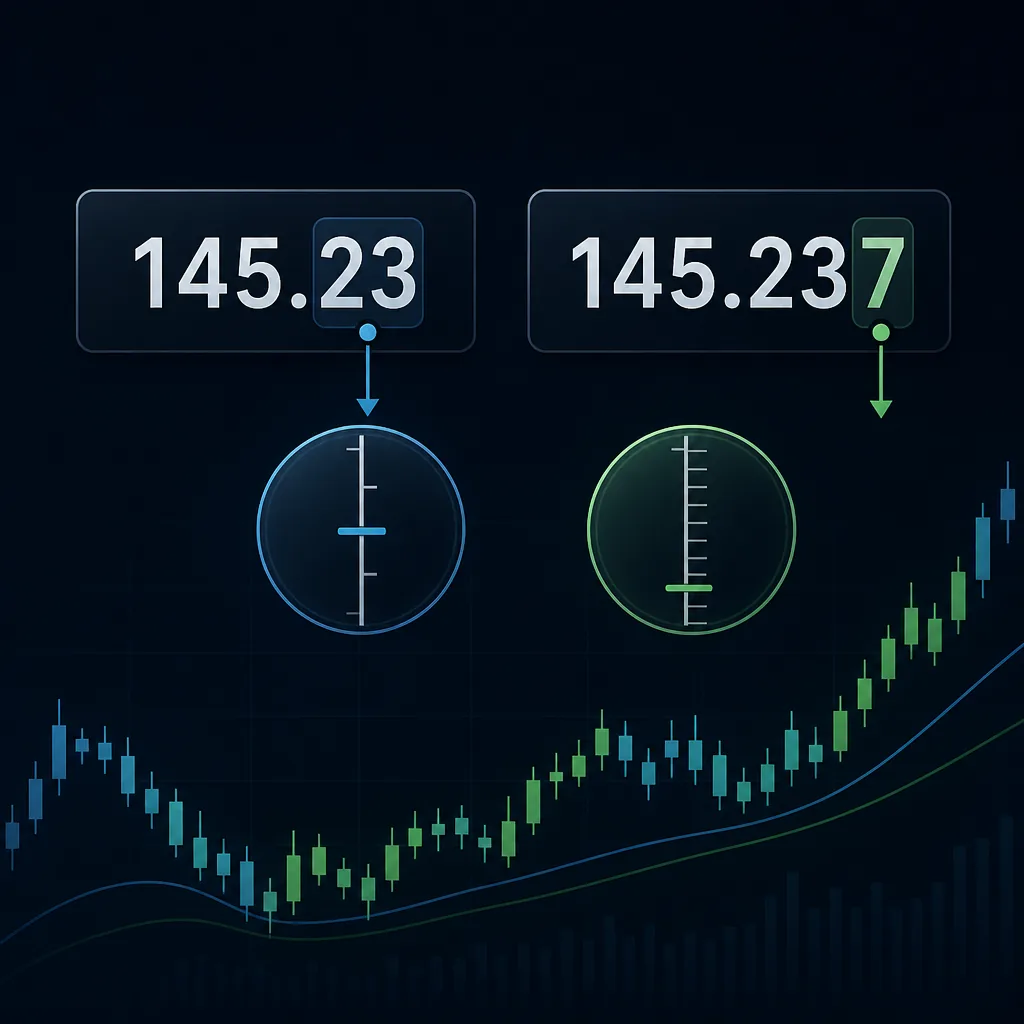
Most major pairs like EURUSD quote to 4 or 5 decimals:
- EURUSD: 1.0852 (4 decimals) or 1.08523 (5 decimals)
JPY pairs typically quote to 2 or 3 decimals:
- USDJPY: 145.23 (2 decimals) or 145.237 (3 decimals)
- GBPJPY: 186.40 (2 decimals) or 186.406 (3 decimals)
The reason is simple: the Japanese yen is a much smaller unit relative to 1 USD or 1 GBP, so quoting to 4 decimals would often be unnecessary. Brokers therefore quote JPY pairs with fewer decimals while still giving enough precision for trading.
Pip vs pipette on JPY pairs
For most retail FX platforms:
- 1 pip on JPY pairs = 0.01 (example: 145.23 → 145.24 is 1 pip)
- 1 pipette (fractional pip) = 0.001 (example: 145.237 → 145.238 is 1 pipette)
This matters because many stops are visually measured in “points” on the platform. If you accidentally treat pipettes as pips (or vice versa), your position size can be 10× too big or too small.
Quick conversion: pips, pipettes, points
Terminology differs by broker and platform, but the practical rule is:
- If your USDJPY has 3 decimals, then 0.001 = 1 point/pipette and 0.01 = 10 points = 1 pip.
- If your USDJPY has 2 decimals, then 0.01 = 1 pip (no pipettes shown).
Hypothetical example: USDJPY is quoted as 145.237 and your stop is at 145.087. The difference is 0.150. Since 1 pip = 0.01, that stop is 15.0 pips (or 150 pipettes/points).
Pip value JPY pairs: the concept in one paragraph
Pip value is how much money you gain/lose when price moves 1 pip, for your specific lot size. On JPY pairs, 1 pip is 0.01 JPY per 1 unit of the base currency. For standard FX contract sizing, 1 standard lot = 100,000 units of the base currency (most brokers; always verify your symbol specs).
So for 1 standard lot:
- USDJPY: 1 pip = 0.01 JPY per USD. With 100,000 USD, that’s 1,000 JPY per pip.
- GBPJPY: 1 pip = 0.01 JPY per GBP. With 100,000 GBP, that’s 1,000 JPY per pip.
But if your account is in USD, you must convert that JPY pip value into USD. That conversion depends on the current exchange rate (which is why pip value isn’t constant for JPY pairs in a USD account).
USDJPY pip value vs GBPJPY pip value (what changes)
The “JPY per pip per lot” part is straightforward: it’s usually 1,000 JPY per pip for 1 standard lot (because 0.01 × 100,000 = 1,000). The tricky part is converting JPY to your account currency.
Case A: Your account currency is USD
This is the most common scenario. Here’s the practical difference:
- USDJPY: pip value in JPY converts to USD using USDJPY itself.
- GBPJPY: pip value in JPY still converts to USD using USDJPY (because you’re converting JPY → USD). Your platform does this automatically, but your manual math needs that step.
So even when you trade GBPJPY, you often still need USDJPY (or a JPYUSD conversion) to express pip value in USD.
Case B: Your account currency is JPY
If your account is in JPY, pip value on JPY pairs is simpler: for 1 standard lot it’s about 1,000 JPY per pip (again, verify contract size). No currency conversion needed.
Case C: Your account currency is something else (EUR, GBP, etc.)
Then pip value becomes a two-step conversion: JPY → USD (or another liquid cross) → your account currency. MT4/MT5 handles this internally, but manual calculation requires the relevant conversion rates.
The formulas you actually need (with worked examples)
We’ll keep this practical and focused on the most common setup: USD account, trading USDJPY or GBPJPY, using standard FX lots.
Step 1: Define pip size for JPY pairs
Pip size = 0.01 for JPY pairs.
Step 2: Calculate pip value in JPY for 1 standard lot
Pip value (JPY) = Contract size × Pip size
- Contract size (standard lot) is typically 100,000 units of base currency.
Hypothetical example: 1 lot USDJPY (100,000 USD):
- Pip value (JPY) = 100,000 × 0.01 = 1,000 JPY per pip
Same for 1 lot GBPJPY (100,000 GBP):
- Pip value (JPY) = 100,000 × 0.01 = 1,000 JPY per pip
Step 3: Convert that pip value into USD
To convert JPY to USD, divide by the USDJPY rate (because USDJPY = JPY per 1 USD).
Pip value (USD) ≈ 1,000 ÷ USDJPY (for 1 standard lot)
Hypothetical example: if USDJPY is trading at 145.00:
- Pip value (USD) ≈ 1,000 ÷ 145.00 = $6.90 per pip (rounded)
Notice what this means: if USDJPY is 100.00, pip value is about $10/pip. If USDJPY is 150.00, pip value is about $6.67/pip. That’s why using a fixed “$10 per pip” assumption breaks on JPY pairs.
Step 4: Convert your stop distance into pips (not pipettes)
For JPY pairs:
- Stop distance in pips = (Price difference) ÷ 0.01
- If your broker shows 3 decimals, you can also do: stop distance in pips = (points/pipettes) ÷ 10
Hypothetical example: USDJPY entry 145.200, stop 145.050.
- Difference = 0.150
- Pips = 0.150 ÷ 0.01 = 15 pips
Step 5: Calculate lot size from risk in USD
Lot size = Risk ($) ÷ (Stop pips × Pip value per 1 lot ($/pip))
Hypothetical example (USDJPY):
- Account risk = $50
- Stop = 15 pips
- USDJPY = 145.00 (for pip value conversion)
- Pip value per 1 lot ≈ $6.90/pip
So:
- Risk per 1 lot at 15 pips ≈ 15 × 6.90 = $103.50
- Lot size ≈ 50 ÷ 103.50 = 0.48 lots (rounded down slightly for safety)
Hypothetical example (GBPJPY):
- Account risk = $50
- Stop = 30 pips
- USDJPY = 145.00 (still used for JPY→USD conversion)
- Pip value per 1 lot ≈ $6.90/pip
So:
- Risk per 1 lot at 30 pips ≈ 30 × 6.90 = $207.00
- Lot size ≈ 50 ÷ 207.00 = 0.24 lots
Key point: For a USD account, the pip value (in USD) is approximately the same for USDJPY and GBPJPY at the same USDJPY rate, because both are “JPY as quote currency” and you convert JPY → USD the same way. What changes your position size most is your stop distance in pips.
JPY pair lot size cheat sheet (standard lots)
This table summarizes the moving parts. Use it to avoid the most common mix-ups.
| Item | USDJPY | GBPJPY | Notes (USD account) |
|---|---|---|---|
| Pip size | 0.01 | 0.01 | If broker shows 3 decimals, 0.001 is a pipette. |
| Contract size (1.00 lot) | 100,000 USD | 100,000 GBP | Typical spot FX. Confirm in Symbol Specification. |
| Pip value in JPY (1 lot) | 1,000 JPY/pip | 1,000 JPY/pip | Because 100,000 × 0.01 = 1,000. |
| Pip value in USD (1 lot) | ≈ 1,000 ÷ USDJPY | ≈ 1,000 ÷ USDJPY | Conversion uses USDJPY (JPY per USD). |
| Common sizing mistake | Treating 0.001 as 1 pip | That makes your stop 10× smaller and your lot 10× larger than intended. |
Step-by-step process: from “$ risk” to correct lot size (JPY pairs)
Use this workflow every time you trade USDJPY or GBPJPY. It’s fast once you’ve done it a few times.
Step 1) Decide your fixed money risk per trade
Pick a number you can repeat without emotion. Many traders risk a small percentage of their account, but the key is consistency.
If you want a structured approach, see our guide on forex risk management.
Step 2) Measure your stop in pips (not “points”)
Do not guess. Measure it:
- Stop pips = (Entry − Stop) ÷ 0.01 for JPY pairs
- Or if your platform shows “points” (pipettes): pips = points ÷ 10
Hypothetical example: Your analysis gives a 22-pip stop on GBPJPY. Write down “Stop = 22 pips.”
Step 3) Estimate pip value per 1.00 lot in your account currency
For a USD account and a JPY-quoted pair:
- Pip value (USD) per 1 lot ≈ 1,000 ÷ USDJPY
Hypothetical example: if USDJPY is 150.00, pip value per 1 lot ≈ 1,000 ÷ 150 = $6.67/pip.
Step 4) Compute your lot size
Lot size = Risk ($) ÷ (Stop pips × Pip value per 1 lot)
Hypothetical example:
- Risk = $25
- Stop = 22 pips
- Pip value per 1 lot ≈ $6.67/pip
Then:
- Risk per 1 lot ≈ 22 × 6.67 = $146.74
- Lot size ≈ 25 ÷ 146.74 = 0.17 lots (round down to your broker’s volume step)
Step 5) Round for your broker’s volume step (and round down)
Some brokers allow 0.01 steps, others 0.10 on certain accounts, and some symbols have different minimums. If your math gives 0.17 and your broker only allows 0.10 steps, you may need to use 0.10 (reducing risk) or adjust your stop/risk plan.
Step 6) Sanity-check inside MT4/MT5 before placing the trade
This is where most traders avoid expensive mistakes.
- Open the order window (New Order / One-Click trading panel).
- Enter your Volume (lot size).
- Set your Stop Loss at the correct price level.
- Confirm the platform’s estimated loss (if shown) matches your intended $ risk approximately.
If your platform doesn’t show money risk directly, use the symbol’s tick value (next section) or a calculator. You can also use our pip calculator and lot size calculator to cross-check.
How to verify pip/tick value in MT4 and MT5 (the sanity-check)
Even if you prefer manual math, always verify the symbol’s trading properties. Brokers can vary on:
- Contract size (especially on mini/cent accounts)
- Digits (2 vs 3 decimals)
- Tick size and tick value reporting
MT5: check Symbol Specification (recommended)
In MT5, you can usually do:
- Market Watch → right-click the symbol (USDJPY/GBPJPY) → Specification
Look for:
- Contract size (often 100,000)
- Digits (2 or 3 for JPY pairs)
- Tick size (often 0.001 on 3-digit quotes)
- Tick value (value of one tick move for 1 lot, in your deposit currency)
How to interpret it: if tick size is 0.001, that is one pipette. Since 1 pip = 0.01, then:
- 1 pip = 10 ticks
- Pip value ≈ tick value × 10 (for 1 lot)
Hypothetical example: MT5 Specification shows tick value = $0.67 for USDJPY at 1.00 lot with tick size 0.001. Then pip value ≈ 0.67 × 10 = $6.70/pip. That should be close to your manual estimate.
MT4: use Symbol Properties / Market Info
MT4 is more limited, but you can still verify key numbers:
- Market Watch → right-click symbol → Specification (some brokers)
- Or use the platform’s “Market Info” fields (varies by broker)
If your MT4 doesn’t show tick value clearly, your backup options are:
- Use the pip calculator for pip value
- Place a demo pending order and observe the platform’s risk/required margin behavior before going live
Common mistakes when calculating JPY pair lot size (and how to catch them)
Mistake 1: Confusing pips with pipettes (10× error)
If your broker quotes USDJPY with 3 decimals, a move from 145.230 to 145.240 is 10 pipettes = 1 pip. Traders often measure “10 points” and call it 10 pips. That inflates lot size dramatically.
Catch it: Always convert price difference using 0.01 for JPY pips. If your stop is 0.150 away, it’s 15 pips, not 150 pips.
Mistake 2: Assuming $10 per pip like EURUSD
On EURUSD, 1 lot is often close to $10/pip. On USDJPY/GBPJPY in a USD account, it can be closer to $6–$10 depending on the rate.
Catch it: Do the quick estimate: pip value ≈ 1,000 ÷ USDJPY. If USDJPY is well above 100, pip value must be below $10.
Mistake 3: Using the wrong contract size
Some accounts use different contract sizes, or you might be trading a symbol that’s not the standard spot FX contract. If contract size isn’t 100,000, your pip value changes linearly.
Catch it: Check Symbol Specification first. If contract size is 10,000, your pip value is 10× smaller than standard.
Mistake 4: Rounding lot size up
Rounding 0.24 up to 0.25 doesn’t sound like much, but if you’re trying to control risk tightly (especially with wider JPY stops), it can meaningfully increase your loss at the stop.
Catch it: Round down, not up—unless you intentionally accept slightly higher risk.
Mistake 5: Forgetting spread and slippage in real execution
Your stop distance in pips is based on your planned level. In fast markets, the actual fill can be worse, and spread can widen—especially around news.
Catch it: Consider using slightly smaller size than the formula suggests, and practice on demo first if you’re new to JPY volatility.
A practical “sanity-check” checklist before you click Buy/Sell
- Digits check: Is the quote 2 decimals or 3 decimals?
- Pip definition: Are you treating 0.01 as 1 pip?
- Stop in pips: Did you compute stop pips from price difference ÷ 0.01?
- Pip value estimate: Did you estimate pip value ≈ 1,000 ÷ USDJPY (for 1 lot, USD account)?
- Lot size: Risk ÷ (stop pips × pip value) = volume. Rounded down?
- Platform confirmation: Does MT4/MT5 tick value/specification align with your estimate?
What if you’re following a signal on USDJPY/GBPJPY?
If you follow trade alerts, the cleanest workflow is:
- Copy the entry and stop loss exactly as provided.
- Measure the stop distance in pips (JPY pip = 0.01).
- Use the process above to compute your lot size for your chosen $ risk.
If you ever notice your executed trade risk doesn’t match your plan, it’s usually one of: wrong entry type (market vs limit), wrong digits, or wrong lot rounding. We also have a separate troubleshooting post for mismatches like this on our blog.
FAQ
How many dollars is 1 pip on USDJPY for 1 lot?
In a USD account, it’s not fixed. For 1 standard lot, pip value is approximately 1,000 ÷ USDJPY dollars per pip. Hypothetical example: if USDJPY is 145.00, that’s about $6.90 per pip.
Is a pip on GBPJPY also 0.01?
Yes. For most brokers, all JPY-quoted pairs use 0.01 as 1 pip. If your broker shows 3 decimals, 0.001 is a pipette (1/10 of a pip).
Why does MT5 show tick size 0.001 on USDJPY—does that mean the pip is 0.001?
No. Tick size is the smallest price increment (often a pipette). If tick size is 0.001, then 1 pip (0.01) = 10 ticks. To estimate pip value from tick value, multiply tick value by 10.
My calculated risk doesn’t match MT4/MT5 exactly—what’s normal?
Small differences are normal due to live spread, rounding, and how the platform estimates conversion rates. Large differences (like 2× or 10×) usually mean you mixed up pips vs pipettes, used the wrong contract size, or measured the stop distance incorrectly.
Should I use a calculator instead of manual math?
Using a calculator is fine, especially for speed. The key is understanding the inputs so you can spot errors. You can cross-check quickly with our pip calculator and lot size calculator.
Risk warning
Trading forex and gold involves a significant risk of loss, and you can lose more than you deposit in some circumstances. Pip values, spreads, and execution can change quickly, especially during volatile news. Past performance does not guarantee future results. This article is for education only and is not personal financial advice. If you’re new, practise position sizing on a demo account before trading live.
Where United Kings fits in
If you want trade ideas delivered clearly, United Kings sends forex and gold (XAUUSD) signals on Telegram with an entry, stop loss, and take-profit levels. You can view a selection in the free public channel on telegram. If you’re comparing services, see our notes on best forex signals, and for transparency you can review how results are presented on results and explained on methodology. VIP access details are on our pricing page.


