
Ever had gold (XAUUSD) spike 10–20 dollars, tag your stop, and then reverse perfectly in your original direction?
That frustrating moment is often not “random volatility.”
It’s frequently a liquidity sweep—a deliberate stop-run into a known pool of orders—followed by a reversal once the market has “filled” what it needed.
In today’s context, with XAUUSD around $2650 (+0.35% in the last 24h), DXY near 106.80, and USD pairs like USD/JPY around 149.50, gold is moving with enough intraday volatility to make sweep-and-reversal setups both common and tradable.
This guide gives you a practical, step-by-step playbook for spotting and trading Asian range high/low sweeps on XAUUSD—then confirming the reversal with market structure shift and displacement.
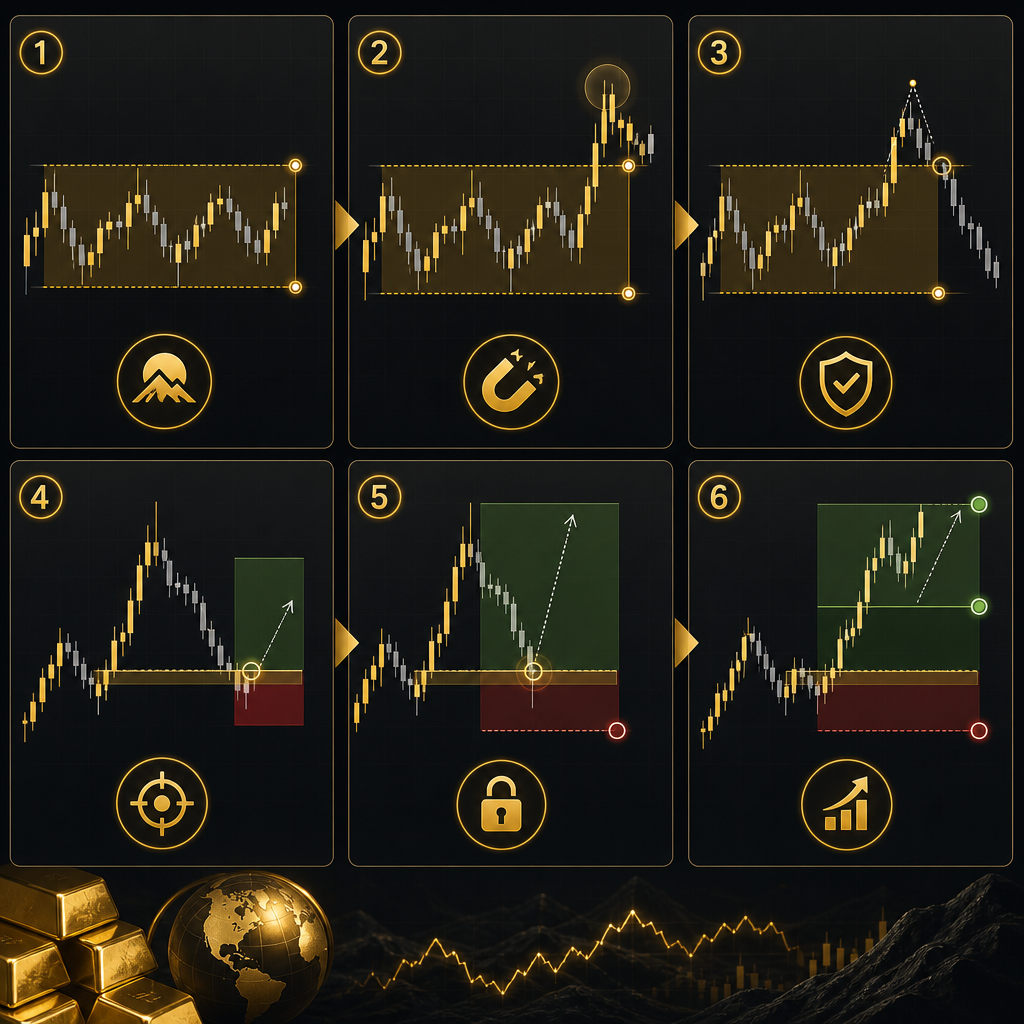
TL;DR — The XAUUSD Asian Range Liquidity Sweep Strategy
- Mark the Asian session range (high/low) and treat those edges as “liquidity magnets” for London/NY.
- Wait for a sweep: price wicks above the Asian high (or below the low), grabs stops, then fails to continue.
- Confirm reversal with displacement (impulsive move) + market structure shift (MSS/BOS) on a lower timeframe.
- Enter on the retest of the displacement leg / FVG / key level, with SL $10–$25 beyond the sweep wick.
- Scale out: take partials at 1R, target 2R–3R into the opposite side of the range or a higher-timeframe level.
- Avoid false sweeps on high-impact news (CPI/NFP/FOMC) unless you use strict timing rules and wider volatility buffers.
Why Liquidity Sweeps Matter in XAUUSD (And Why Asia Range Works)
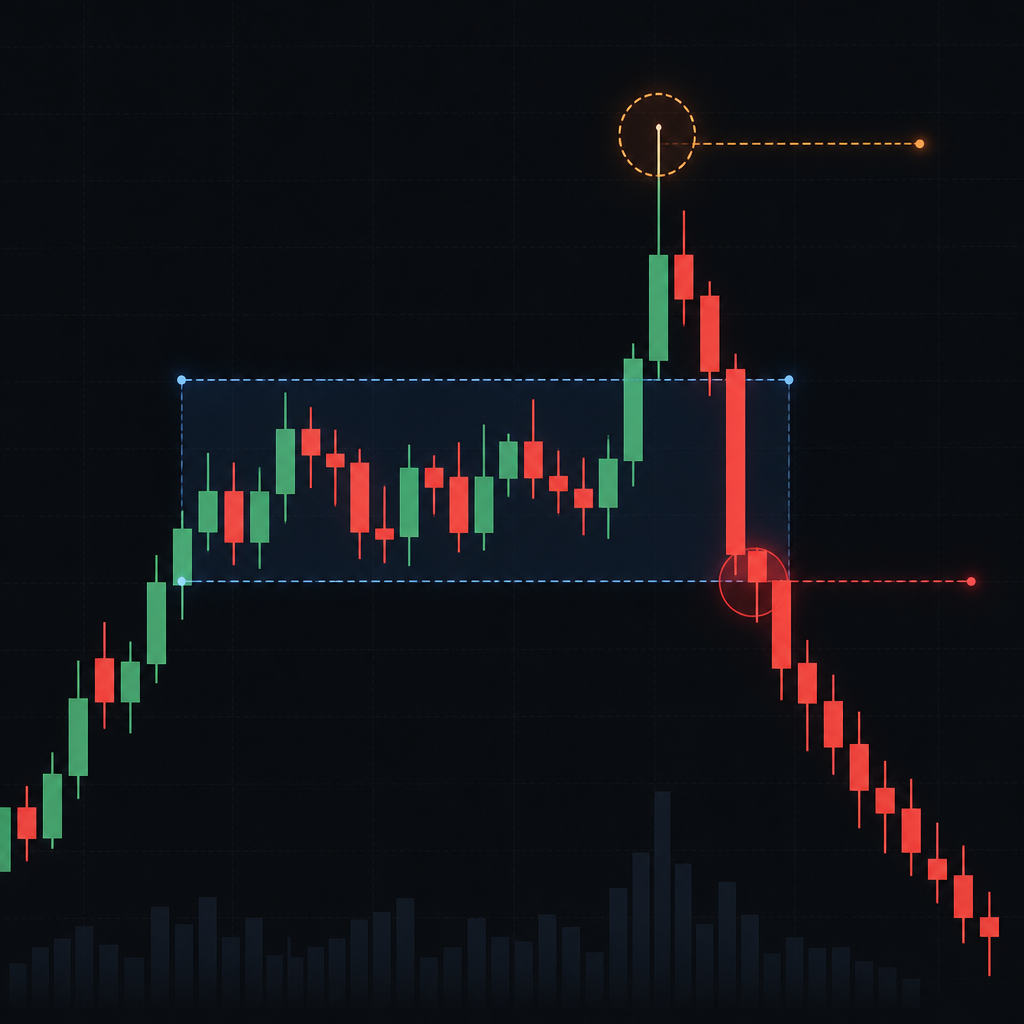
Gold is one of the cleanest markets for liquidity concepts because it’s liquid, widely traded, and highly reactive to USD flows.
When DXY is firm around 106.80 and USD pairs are stable (like EUR/USD 1.0520 and GBP/USD 1.2680), gold often oscillates intraday between clear liquidity pools.
Here’s the core idea: most retail stops cluster around obvious levels.
Asian session highs/lows are obvious because Asia often ranges, then London/NY expands.
What is a liquidity sweep in simple terms?
A liquidity sweep is when price pushes above a known high (or below a known low) to trigger stop orders and breakout orders.
That burst of orders provides liquidity for larger participants to enter or exit positions efficiently.
Why the Asian range is a “stop map” for London
During Asia, XAUUSD often trades in a tighter band.
By the time London opens, that band becomes a reference point for both breakout traders and stop placement.
- Breakout buyers place buy stops above the Asian high.
- Range sellers place stops above the Asian high.
- Breakout sellers place sell stops below the Asian low.
- Range buyers place stops below the Asian low.
That means the Asian high/low contains dense liquidity.
And dense liquidity is where sweeps happen.
Why this is especially relevant around $2650
In the $2610–$2690 band, gold can easily swing $15–$30 intraday.
That’s enough to run stops beyond an Asian boundary and still reverse cleanly without breaking the day’s broader structure.
When you combine a known liquidity pool (Asian high/low) with a reversal confirmation (MSS + displacement), you get a repeatable setup with defined risk.
That’s exactly what we aim to systematize in this playbook.
Asian Session Range High/Low: How to Mark It Correctly (Step-by-Step)
If you mark the Asian range wrong, everything downstream gets messy.
Your “sweep” becomes subjective, and your stop placement becomes guesswork.
Step 1: Define your Asian session times (and stick to them)
Pick a consistent definition based on your broker time and chart timezone.
A common, practical window for XAUUSD is 00:00–06:00 UTC (or roughly Tokyo open through pre-London).
- Asian Range High: the highest wick/candle during your window.
- Asian Range Low: the lowest wick/candle during your window.
Consistency matters more than the “perfect” time window.
We want repeatability, not constant tweaking.
Step 2: Use wicks, not bodies
Stops trigger on traded prices, not candle closes.
So your range boundaries should include wicks.
Step 3: Draw the range on M15 or M30, execute on M5 or M1
Marking on M15/M30 reduces noise.
Execution on M5/M1 helps you see the sweep and structure shift clearly.
Step 4: Note the range size (it’s a filter)
Range size influences the odds of a clean sweep.
If Asia is extremely tight (e.g., $4–$6), London can blow through both sides.
If Asia is huge (e.g., $20+), the “sweep” may require too much extension to be practical.
A workable sweet spot for many days is roughly $8–$15 Asian range size.
Example with realistic levels (around $2650)
Let’s say Asia prints:
- Asian High: $2646.20
- Asian Low: $2634.10
That’s a $12.10 range—very tradable.
Now you have two liquidity pools: above $2646.20 and below $2634.10.
Step 5: Add “context lines” above and below
Add nearby higher-timeframe levels like:
- Prior day high/low
- London high/low (once formed)
- Round numbers (e.g., $2650, $2660)
When a sweep happens into a round number or prior day level, reversals tend to be cleaner.
It’s not magic—it’s just more orders stacked in the same area.
What a “Real” Asian Range Sweep Looks Like on Gold (Not Just a Breakout)
Many traders confuse a breakout with a sweep.
In a breakout, price runs through the level and keeps going.
In a sweep, price runs the level, grabs liquidity, then fails and reverses.
The anatomy of a sweep (bullish and bearish)
Bearish sweep setup (sweep above Asian high):
- Price trades above the Asian high.
- A wick forms (or multiple wicks) showing rejection.
- Price returns back below the Asian high.
- Then we look for MSS + displacement to confirm shorts.
Bullish sweep setup (sweep below Asian low):
- Price trades below the Asian low.
- A wick forms showing rejection.
- Price returns back above the Asian low.
- Then we look for MSS + displacement to confirm longs.
Key rule: the sweep must be “meaningful”
On XAUUSD, a meaningful sweep is often $1.50–$5.00 beyond the level, depending on volatility.
If price only ticks $0.20 above the Asian high and reverses, that could be spread/noise.
Example: bearish sweep into $2650
Assume:
- Asian High: $2646.20
- London open push: price wicks to $2652.40
- Then drops back below $2646.20
That wick to $2652.40 is a classic “stop run.”
It likely triggered breakout buys above $2646.20 and stops for shorts.
Now, do we instantly short? Not yet.
We confirm with structure and displacement so we don’t fade a real trend day.
How to tell a sweep from a trend continuation (practical cues)
- Sweep: sharp wick, quick return inside range, then impulsive move opposite.
- Breakout: multiple closes above the high, shallow pullbacks, higher highs continue.
Also watch correlated context.
If DXY is ripping higher and real yields are pushing up, gold may trend down and sweeps above highs might fail less often.
That’s why we use confirmation, not prediction.
Confirmation Rules: Market Structure Shift (MSS) + Displacement (Your “Green Light”)
The sweep is the invitation.
MSS + displacement is your entry permission slip.
What is displacement in this strategy?
Displacement is an impulsive move that shows real order flow, not chop.
On M5, it often looks like one or two strong candles that:
- Move $5–$12 quickly (depending on volatility).
- Close decisively (not tiny-bodied).
- Break a recent swing point (structure).
What is MSS/BOS here?
After a sweep above the Asian high, we want to see price break a prior M5 swing low.
That break suggests the “up move” was a liquidity grab, not genuine demand.
After a sweep below the Asian low, we want to see price break a prior M5 swing high.
That break suggests sellers are done and buyers are taking control.
Step-by-step confirmation checklist (bearish sweep example)
- Asian high is marked (e.g., $2646.20).
- Price sweeps above it (e.g., wick to $2652.40).
- Price returns below $2646.20.
- On M5, identify the most recent swing low formed during the push up (e.g., $2644.80).
- Wait for a clean break and close below $2644.80 with displacement.
That’s your MSS/BOS.
Without it, you’re guessing.
Where does an FVG / imbalance fit in?
Displacement often leaves an inefficiency (fair value gap) on M1/M5.
We can use that as the “retest zone” for entry.
- After bearish displacement, mark the FVG and sell on retest.
- After bullish displacement, mark the FVG and buy on retest.
This improves entries because you’re not chasing.
You’re letting price come back to you.
Practical displacement threshold for gold
At XAUUSD $2650, a helpful rule is:
- M5 displacement candle body of $3+ is notable.
- Two consecutive M5 candles totaling $6–$10 is strong.
Adjust on high-volatility days.
But keep the idea: we want a move that looks “obvious” even without indicators.
The Exact Entry Model: Sweep → MSS → Retest (With Real Price Examples)
Now we turn the concept into an executable model.
We’ll use two blueprints: one for shorts (sweep above Asian high) and one for longs (sweep below Asian low).
Model A: Bearish reversal after sweeping Asian high
Scenario: XAUUSD trades around $2650 during London.
Asia range is $2634.10–$2646.20.
Step 1 — Sweep: London pushes to $2652.40 (above Asian high $2646.20).
Step 2 — Return: price falls back under $2646.20.
Step 3 — MSS: M5 breaks and closes below a swing low at $2644.80.
Step 4 — Entry: sell the retest of the displacement leg / FVG.
- Example entry zone: $2646.00–$2647.20
- Example entry: Sell $2646.60
Step 5 — Stop loss: place SL beyond the sweep wick.
- Sweep high: $2652.40
- SL: $2656.40 (about $9.80 risk from $2646.60)
Step 6 — Take profits: target the opposite liquidity pool and scale out.
- 1R: $2646.60 − $9.80 = $2636.80
- 2R: $2627.00
Notice $2636.80 is near the Asian low area ($2634.10).
That’s realistic: the first objective is often a return to the range low.
Model B: Bullish reversal after sweeping Asian low
Scenario: Asia range is $2641.50–$2653.00.
London dips below the Asian low and wicks to $2633.80.
- Example entry: Buy $2642.20 on retest after MSS
- SL: $2625.80 (about $16.40 risk, beyond sweep low)
- 1R target: $2658.60
- 2R target: $2675.00 (into higher-timeframe liquidity)
Gold can absolutely cover $20–$30 on a good session.
But your job is not to “hope.”
Your job is to define risk and let the market pay you when it’s aligned.
Execution tip: use limit orders only after confirmation
We don’t place limits at the Asian high/low blindly.
We place limits only after the sweep and MSS appear.
This one rule alone filters out many losses.
It forces you to trade the reversal after the market proves it.
Stop Loss Placement on XAUUSD: Beyond the Sweep (Not “Somewhere”)
Stops are where most traders sabotage a good setup.
On gold, a stop that’s too tight gets clipped.
A stop that’s too wide destroys your R:R and psychology.
The core SL rule: your stop belongs beyond the liquidity event
If you’re shorting after a sweep above the Asian high, your stop must be above the sweep high.
If you’re buying after a sweep below the Asian low, your stop must be below the sweep low.
Why?
Because if price re-sweeps and holds beyond that extreme, your reversal thesis is likely wrong.
Practical SL buffers for gold (around $2650)
In normal volatility, a buffer of $3–$6 beyond the sweep wick is often reasonable.
In higher volatility (news days, big trend days), you may need $6–$12.
That’s why your guideline of $10–$25 from entry is realistic.
It gives the trade room to breathe without turning it into a lottery ticket.
Stop placement examples (bearish sweep)
- Sweep high: $2652.40
- Entry: $2646.60
- Conservative SL: $2657.40 (risk $10.80)
- Moderate SL: $2656.40 (risk $9.80)
- Aggressive SL: $2654.90 (risk $8.30, more stop-out risk)
Where traders go wrong (and how to fix it)
- Mistake: SL inside the Asian range because “it shouldn’t come back.”
- Fix: If it’s a sweep trade, accept the sweep extreme as the invalidation point.
- Mistake: SL exactly at the wick high/low.
- Fix: Add a buffer. Gold loves to re-tap extremes by $1–$3.
- Mistake: Moving SL to breakeven too early.
- Fix: Use a rule-based BE move (e.g., after 1R is hit or after a new structure forms).
Position sizing note (quick, practical)
On XAUUSD, $1 move = 100 points (on many brokers) and roughly $100 per lot.
So a $10 stop can be meaningful.
If you risk 1% per trade, size accordingly so a full SL is survivable.
For deeper risk planning, we also recommend reviewing our guide on risk management strategies when using forex signals.
Take Profit & Scaling Rules: How to Lock Wins Without Cutting the Runner
Liquidity sweep reversals can move fast.
They can also stall and re-accumulate before the next leg.
That’s why scaling is not optional—it’s how you stay consistent.
Rule 1: Your first target is the opposite liquidity pool
If you short after sweeping the Asian high, the first “magnet” is often the Asian low.
If you buy after sweeping the Asian low, the first “magnet” is often the Asian high.
This keeps your targets realistic.
You’re trading a range-to-range move with confirmation.
Rule 2: Use a simple partial plan (example)
- TP1: 1R (take 30–50% off)
- TP2: 2R (take another 30–40% off)
- Runner: leave 10–30% for 3R or a higher-timeframe level
This method reduces the emotional pressure to “call the top/bottom.”
You get paid for being right, then you give the market a chance to overdeliver.
Example with numbers (short setup)
Sell $2646.60, SL $2656.40 (risk $9.80).
- TP1 (1R): $2636.80
- TP2 (2R): $2627.00
- TP3 (3R): $2617.20 (if trend day / heavy selloff)
Notice how TP1 lines up near the Asian low region.
That’s not coincidence—it’s structure and liquidity.
Rule 3: Trailing stop only after the market “proves” continuation
A clean approach is to trail behind new M5 swing highs (for shorts) or swing lows (for longs).
But only after TP1 is secured.
If you trail too early, gold will whip you out and then run.
That’s one of the most common reasons traders say, “My analysis was right but I still lost.”
Rule 4: Respect “mid-range” reactions
The midpoint of the Asian range often acts like a reaction level.
If price stalls there, it’s a clue to tighten execution—not to panic.
- If you already took TP1, you can tolerate chop.
- If you didn’t, you’ll be tempted to close early.
Scaling solves this.
Filters to Avoid False Sweeps: News Days, Trend Days, and Volatility Traps
The Asian range sweep strategy works best when the market is “liquidity-seeking” and rotational.
It performs worse when the market is in a one-directional expansion driven by macro catalysts.
Filter 1: High-impact news timing (CPI, NFP, FOMC)
On major releases, XAUUSD can spike $20–$40 in minutes.
That can create “double sweeps” that look like your setup but behave differently.
Practical rule:
- Avoid entering 15 minutes before and 15 minutes after high-impact USD news.
- If you trade it, reduce size and use wider SL buffers.
If you want a dedicated plan for those days, read our volatility playbook: trade XAUUSD during CPI/NFP with spike rules.
Filter 2: Trend day identification (don’t fade a freight train)
Some days, gold trends hard.
On those days, the “sweep” is often just the market pausing before continuing.
Signs you may be in a trend day:
- London breaks the Asian range and holds outside it with multiple closes.
- Pullbacks are shallow (e.g., $3–$6) and quickly bought/sold.
- DXY and yields align strongly with the move (risk-off/risk-on narrative).
In trend days, require a stronger MSS and be more selective.
No MSS, no trade.
Filter 3: Range size extremes
If the Asian range is too tight (say $4–$6), sweeps can occur on both sides.
If it’s too large ($20+), your stop and target distances may become impractical.
Practical sweet spot remains around $8–$15.
Outside that, trade smaller or wait for a cleaner day.
Filter 4: Spread and execution quality
Gold spreads can widen during session opens and news.
A “sweep” of $1.00 can be meaningless if spreads are unstable.
If you’re unsure how spreads affect stops and fills, our guide helps: XAUUSD spread explained for gold traders.
Filter 5: Confirmation timeframe discipline
Many false sweeps happen because traders “see” MSS where there isn’t one.
Pick a rule:
- M5 must close beyond the swing point.
- Or M1 can trigger, but M5 must confirm within the next 1–2 candles.
This keeps you from overtrading noise.
Asian Range Sweep vs Other Gold Setups (When to Use What)
You don’t need 20 strategies.
You need a small set of tools that match different market conditions.
Below is a practical comparison so you know when the Asian range sweep reversal is the best choice—and when another approach might be more appropriate.
| Setup Type | Best Market Condition | Typical Trigger | Stop Logic | Common Mistake |
|---|---|---|---|---|
| Asian Range Sweep & Reversal | Rotational days, London/NY expansions | Sweep + MSS + displacement | Beyond sweep wick ($10–$25 typical) | Entering before MSS confirmation |
| Asian Range Breakout | Trend days, strong macro catalyst | Hold above/below range with retest | Back inside range or below retest low | Fading a real breakout too early |
| Support/Resistance Bounce | Clear HTF levels, low news risk | Rejection candle at level | Beyond level structure | Ignoring liquidity sweep into the level |
| News Spike Fade | Post-release mean reversion | Extreme wick + stabilization | Wider stops, smaller size | Trading during the first 1–3 minutes |
How we use this at United Kings
We focus on London and NY session opportunities because that’s where liquidity and follow-through live.
The Asian range sweep reversal is one of the cleanest “session models” for that.
But we don’t force it daily.
When conditions favor trend continuation, we adapt.
If you want signals that reflect this flexibility, explore our premium gold signals or the full United Kings signals hub.
A Complete Trade Walkthrough: From Markup to Entry to Partial Profits
Let’s walk through a full, realistic example using today’s price neighborhood.
Assume XAUUSD is trading around $2650 during London.
Step 1: Mark Asia
From 00:00–06:00 UTC, price ranges between:
- Asian High: $2647.90
- Asian Low: $2636.30
Range size: $11.60.
That’s workable.
Step 2: Wait for the sweep
At 08:10 UTC, London pushes up.
Price spikes above $2647.90 and wicks to $2654.60.
Within minutes, it drops back below $2647.90.
This is your “liquidity grab” candidate.
Step 3: Identify the swing low for MSS
On M5, during the push up, a swing low formed at $2645.20.
You now want a break and close below $2645.20.
Step 4: Confirm displacement + MSS
A strong bearish M5 candle closes at $2643.80.
That’s a clear close below $2645.20.
Now you have:
- Sweep above Asian high
- Return inside range
- MSS confirmed with displacement
Step 5: Mark the retest zone
The displacement leg left an imbalance/FVG around $2646.40–$2647.30.
You plan to sell in that zone.
Step 6: Execute
- Entry: Sell $2646.80
- Stop: $2658.00 (beyond sweep high $2654.60 + buffer)
- Risk: $11.20
Step 7: Plan partials and targets
- TP1 (1R): $2646.80 − $11.20 = $2635.60
- TP2 (2R): $2624.40
Notice TP1 is basically the Asian low ($2636.30).
That’s a logical first take-profit.
Step 8: Management rules (simple, repeatable)
- When TP1 hits: take 40–50% off.
- Move SL to entry or reduce risk (optional, rule-based).
- Let the rest target TP2 or trail behind M5 swings.
This is how you turn a “nice idea” into a trading system.
And it’s exactly the kind of clarity we provide in our forex signals and gold calls: entry, SL, and TP—no vague commentary.
Common Mistakes Traders Make With Gold Liquidity Sweeps (And Fixes)
Even a strong strategy fails if execution is sloppy.
Here are the mistakes we see most often with Asian range sweeps on XAUUSD.
Mistake 1: Trading the sweep without confirmation
Traders short the first wick above the Asian high.
Then price continues trending up and they get stopped.
Fix: Wait for MSS + displacement on M5.
No close beyond structure = no trade.
Mistake 2: Using an SL that’s “technically logical” but practically wrong
A stop inside the range may look good on paper.
But it ignores how gold hunts liquidity.
Fix: SL beyond the sweep wick with a volatility buffer.
Then size your position so the $10–$25 stop doesn’t over-risk your account.
Mistake 3: Taking profits randomly
Gold moves fast.
Without a plan, you’ll either exit too early or hold too long.
Fix: Use 1R partials and target the opposite side liquidity pool.
Then let a runner work when the day expands.
Mistake 4: Ignoring the macro calendar
High-impact USD events can invalidate intraday technicals temporarily.
Spreads widen, slippage increases, and sweeps become chaotic.
Fix: Stand down around CPI/NFP/FOMC or trade smaller with strict rules.
For unexpected headlines, keep a survival plan: how gold signals react to unexpected news events.
Mistake 5: Overtrading both sides
Some traders try to trade every touch of the Asian high/low.
They end up taking 4–6 trades in chop.
Fix: Limit yourself to the best sweep of the day.
Quality beats quantity, especially on XAUUSD.
How We Turn This Into Actionable Gold Reversal Trading Signals (United Kings Method)
A strategy is only as good as your ability to execute it consistently.
Most traders don’t struggle with “knowledge.”
They struggle with speed, discipline, and decision fatigue.
What you get in United Kings signals (practical, not vague)
Our community receives premium Telegram signals with:
- Clear entry (exact price or entry zone)
- Defined stop loss (placed beyond invalidation)
- Multiple take profits (scaling rules included)
- Session focus (London and NY, where this strategy performs best)
We also add educational context so you learn the “why,” not just the “what.”
That’s how you become independent over time.
How this strategy fits our workflow
- Pre-London: mark Asian high/low and key HTF levels.
- London open: wait for sweep behavior and volatility confirmation.
- Trigger: MSS + displacement; entries often on retests.
- Management: partials at 1R/2R, runner if conditions support.
We aim for high-quality setups, not constant noise.
That’s part of how we’ve built a 300K+ trader community around structured execution.
If you’re evaluating providers, our checklist helps you avoid hype: forex signals provider checklist for beginners.
Where to follow and how to start
- Start with our Gold Signals page for XAUUSD-specific coverage.
- Or browse the full Signals offerings (forex, gold, and more).
- Join the Telegram channel: United Kings Telegram signals community.
FAQ: XAUUSD Asian Range Sweep & Reversal Strategy
1) What timeframe is best for the Asian range sweep gold strategy?
Mark the Asian range on M15 or M30 for cleaner boundaries.
Use M5 for MSS confirmation and M1/M5 for precise retest entries.
2) How far beyond the Asian high/low should a sweep go to be valid?
On gold around $2650, a sweep of roughly $1.50–$5.00 beyond the level is often meaningful.
But always pair it with MSS + displacement—distance alone isn’t enough.
3) Where should I place my stop loss on XAUUSD reversal trades?
Place the SL beyond the sweep wick, typically with a $3–$12 buffer depending on volatility.
In many cases that results in a $10–$25 stop distance from entry, which is normal for gold.
4) What are the best take-profit targets for Asian range sweep trades?
TP1 is commonly the opposite side of the Asian range (the other liquidity pool).
Then aim for 2R–3R into prior day levels, round numbers like $2650/$2660, or NY session liquidity.
5) Should I trade this strategy on CPI, NFP, or FOMC days?
It’s safer to avoid entries 15 minutes before and after major USD releases.
If you do trade, reduce size, expect slippage, and require stricter confirmation.
Risk Disclaimer (Read Before You Trade)
Forex and gold trading involves significant risk and may not be suitable for all investors.
Past performance does not guarantee future results.
No strategy—including an XAUUSD liquidity sweep strategy—can guarantee profits, and losses can exceed expectations during high volatility.
If you’re new, practice on a demo account first and use disciplined position sizing.
Join United Kings: Get Premium XAUUSD Liquidity Sweep Signals (Entry, SL, TP)
If you want to trade this strategy without second-guessing every candle, we’ve built a system around it.
United Kings delivers premium Telegram signals for forex and gold with a structured approach, clear levels, and education alongside execution.
Explore our services:
- Premium Gold Signals for XAUUSD
- Forex Signals for major pairs
- All United Kings Signals (Forex, Gold, and more)
Choose a plan on our pricing page:
- Starter (3 Months): $299 (~$100/mo)
- Best Value (1 Year): $599 ($50/mo) + FREE ebook (50% savings)
- Unlimited (Lifetime): $999 (pay once, access forever)
We also offer a 48-hour money-back guarantee for peace of mind.
Join the community on Telegram now: United Kings signals on Telegram.


